
2014 Fiat 500L Windows and Mirrors Still Dead After Wiring Repair: Follow the Shared Output

Quick answer: A visible wire break can be a real fault without being the whole fault. When both windows and mirrors remain inoperative, compare the repaired wiring with the shared controller output and its electrical requirements.
The useful capability here is separating a circuit’s source from its delivery path. The MRCARTOOL B550 can support passive voltage checks at permitted points; it does not establish that a BCM needs replacement or perform its configuration. Do not power a controller output externally.
In this guide
Was the first repair wrong, or was it incomplete?
Finding broken wires gives a workshop something concrete to repair. It does not promise that the original complaint will disappear, particularly when several functions share more than one part of the system. A remaining fault deserves a new comparison rather than an argument over whether the visible damage was real.
Ask what was confirmed after the wiring work: continuity where appropriate, connection condition and operation of the affected controls. A description such as repaired door wiring identifies work performed, but it is not a complete account of the result. If neither the windows nor the mirrors now works, that shared outcome should guide the next checks. Keep any improvement visible too; partial restoration can be useful evidence.
Use the two dead functions to find the common path
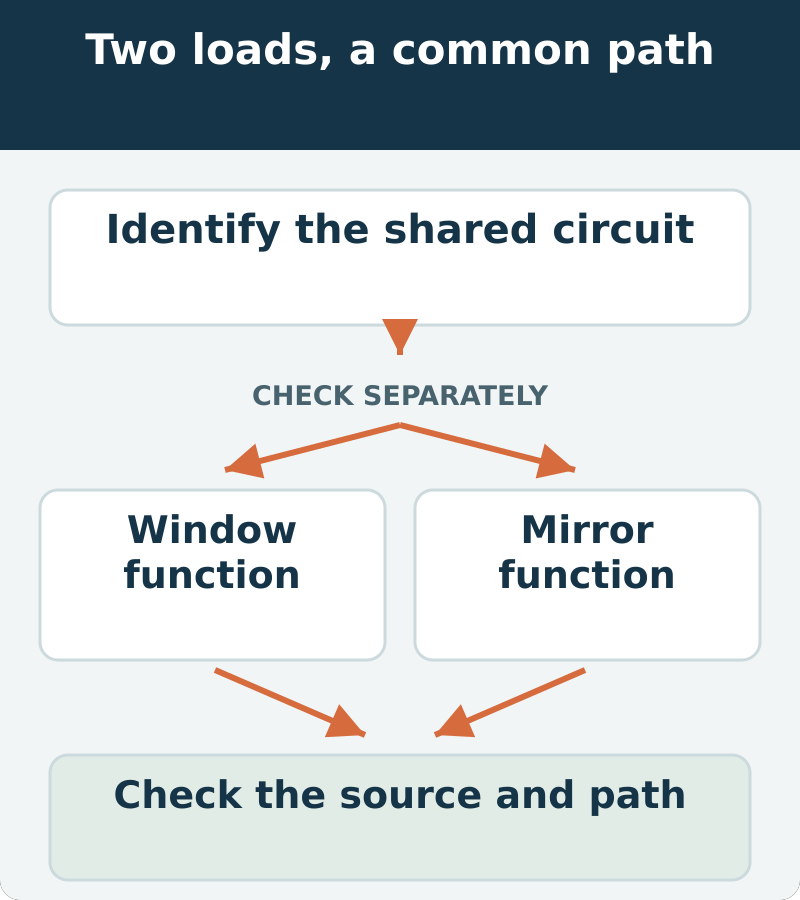
Two failed functions create a reason to inspect what they share. They do not prove that the shared controller is bad. The exact wiring diagram identifies which supply, ground, connection or output is genuinely common on this version of the vehicle.
For an owner, the practical question is simple: which part of the circuit can explain both failures, and how has it been tested? That is more useful than authorizing unrelated window and mirror parts separately. Also describe which controls were tried and whether every affected door behaves the same way. Do not rely on a single switch attempt to describe the whole system. Keep fingers and objects clear of any window whose movement may return unexpectedly.
In the ALLDATA published case, broken wiring at the driver-door pass-through was repaired on this Fiat, but the windows and mirrors remained inoperative. A shared BCM output was low. After checking controller supplies, grounds and connections, the shop replaced and configured the BCM. Both functions then operated normally in the report.
Measure the source and the path separately
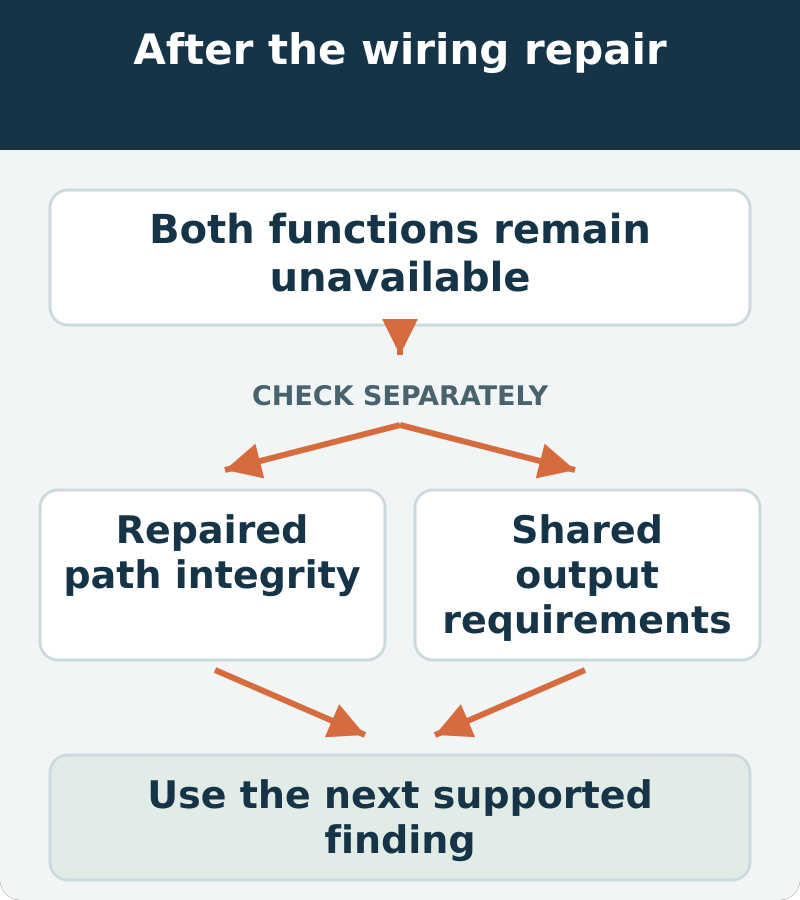
A low reading at an inoperative device leaves several questions open. Is the source producing the expected output? Is something being lost along the path? Are the conditions for that output satisfied? The technician needs to compare appropriate points under the conditions specified for the circuit.
This is why the repaired harness still belongs in the assessment without being presumed guilty. Workmanship, terminal contact and the remaining path should be considered alongside the source. A measurement is more informative when its location, reference and operating state are explained. Ask for that explanation in ordinary language: was the problem present at the source, or did it appear between the source and the load?
A low output is the beginning of the module decision
A controller cannot be judged fairly without checking the electrical conditions it depends on. Its supplies, grounds, connections and relevant command conditions belong in the decision. One low output reading by itself is not a universal BCM replacement test.
Before approving a module, ask which checks ruled out an external cause and whether the proposed unit is correct for the vehicle. The earlier harness damage should not automatically be presented as the cause of an internal module defect; the published account does not establish that causal link.
Avoid a jumper-wire demonstration. Feeding voltage into a protected controller circuit can create a new problem and does not reproduce normal control. The objective is to explain the original failure, not merely make a window move by another route.
Both hardware and configuration belong in the result
A replacement module is not just a box with matching sockets. The estimate needs to account for the configuration or setup required by the exact vehicle and the equipment to complete it. Ask who is responsible for that part of the job before purchasing a unit independently.
Separate component identity from installation readiness. A seller’s part description does not by itself confirm that a replacement can be fitted and used without further work. If the shop is proposing a used or otherwise alternative unit, ask what compatibility and setup checks govern that choice.
The completed invoice should distinguish wiring work, controller replacement and configuration. This makes it clear what actually restored operation without suggesting that every similar Fiat complaint needs all three.
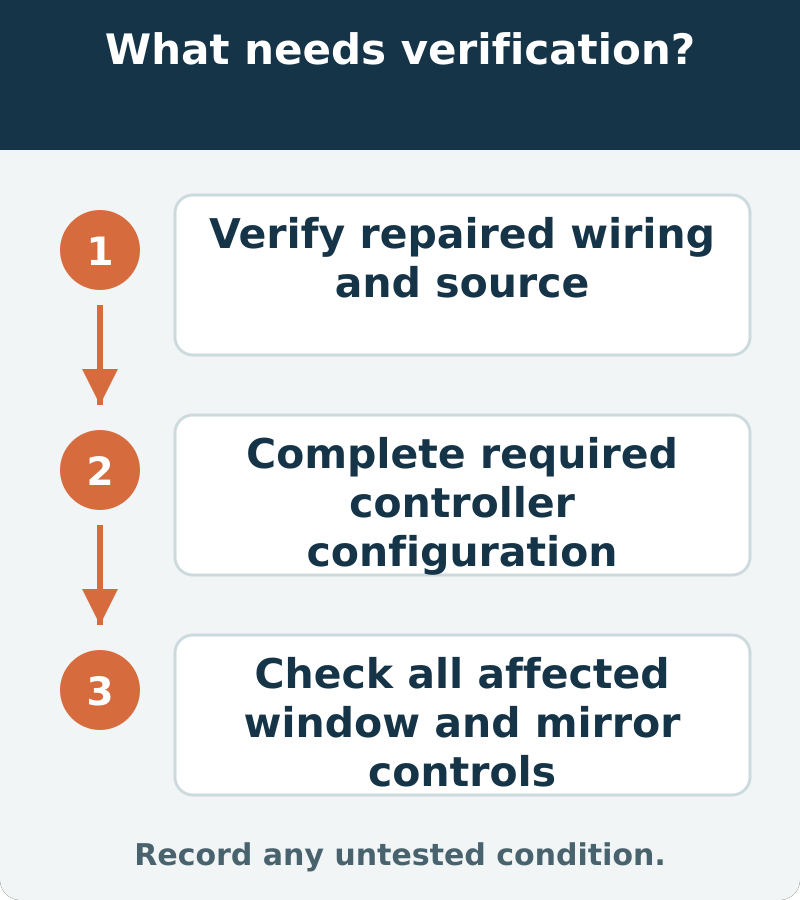
Try every affected control before closing the job
At handover, try the affected functions through their normal controls with the workshop present. Check the windows and mirrors, not merely the one feature that first caught your attention. Where several controls should command the same function, ask whether each was included in the assessment.
Have the repairer explain any required window initialization or protection checks under the correct procedure. Do not test obstruction protection using a hand or body part. A restored motor response is not a reason to improvise a safety test.
If something remains inoperative, leave it explicitly listed rather than accepting a general electrical repair label. The useful end point is supported operation of the original affected functions, with the remaining uncertainties stated, not simply a list of newly fitted parts.










Comments 0
Questions, fixes, and real-world diagnostic notes from readers.
Be the first to share a diagnostic result or ask a follow-up question.