
2000 Chevy K3500 Fuel Tank Collapses: Replace the Damage and Find the Vacuum Cause

Quick answer: A deformed or leaking fuel tank is an immediate safety problem. A replacement tank also needs protection from the abnormal pressure condition that damaged the original.
Do not wait for a warning lamp when a fuel tank is visibly deformed or leaking. Stop using the vehicle, avoid ignition sources and arrange professional recovery. Once the immediate hazard is controlled, the repair needs to answer two questions: what damage must be replaced, and what pressure condition could damage the replacement again?
In this guide
Treat the leak as urgent even without a warning lamp
A warning system is not a substitute for responding to visible fuel damage. The absence of a stored code cannot make separating seams or a fuel leak safe. Do not start the engine to see whether the symptom produces a warning this time.
Tell the recovery provider exactly what you observed so transport can be planned appropriately. Keep away from ignition sources and do not attempt an improvised tank repair, cap modification or pressure test. The first decision is safe containment and handling by qualified personnel. Diagnosing the cause is essential, but it follows control of the immediate hazard rather than competing with it.
A tank has to manage pressure as fuel changes
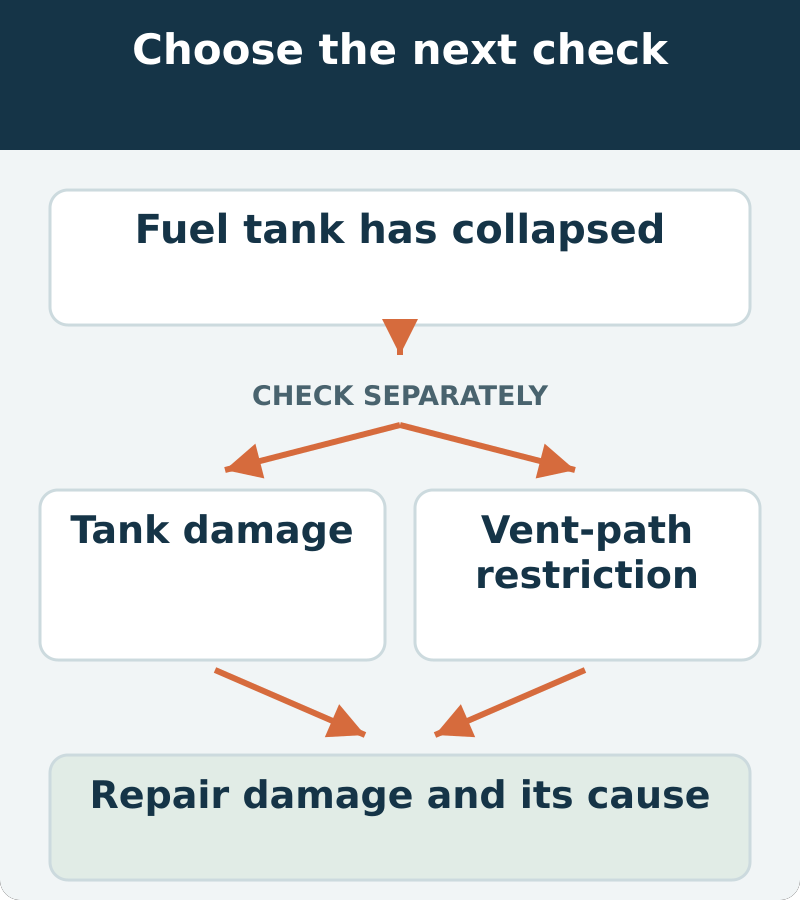
A vehicle’s fuel and vapor system must manage pressure through its designed paths and controls. A tank is not simply a container that can be replaced without considering what happens around it. An abnormal pressure condition can be relevant to physical damage.
The inward arrows in the illustration explain the concept of pressure difference; they do not represent measured values or the K3500’s exact plumbing. The workshop needs the applicable information and a safe method to assess the actual system. No cap-opening workaround is recommended. Changing the way a tank vents is not the same as restoring the designed pressure-management arrangement.
Why an early pass did not settle the restriction question
A reassuring early test answers only the question that test was capable of asking under its conditions. If later observations contradict it, the investigation should revisit the assumptions rather than discard the new evidence.
Ask the repairer what the initial check established and how the later pressure concern was assessed. A broad note saying the vapor system passed may conceal a much narrower result. This is not a reason to distrust testing; it is a reason to describe testing accurately. The method must suit the suspected restriction and the safe state of the system, particularly when the tank itself is already damaged.
In the published ALLDATA case, the K3500 had a collapsed tank with separating seams but no stored codes. Later pressure data showed excessive vacuum, and inspection found an obstructed canister despite initially reassuring checks. Tank and canister replacement restored the reported pressure behavior. Exact restriction-test methods are not provided.
Replacing only the tank leaves a question open
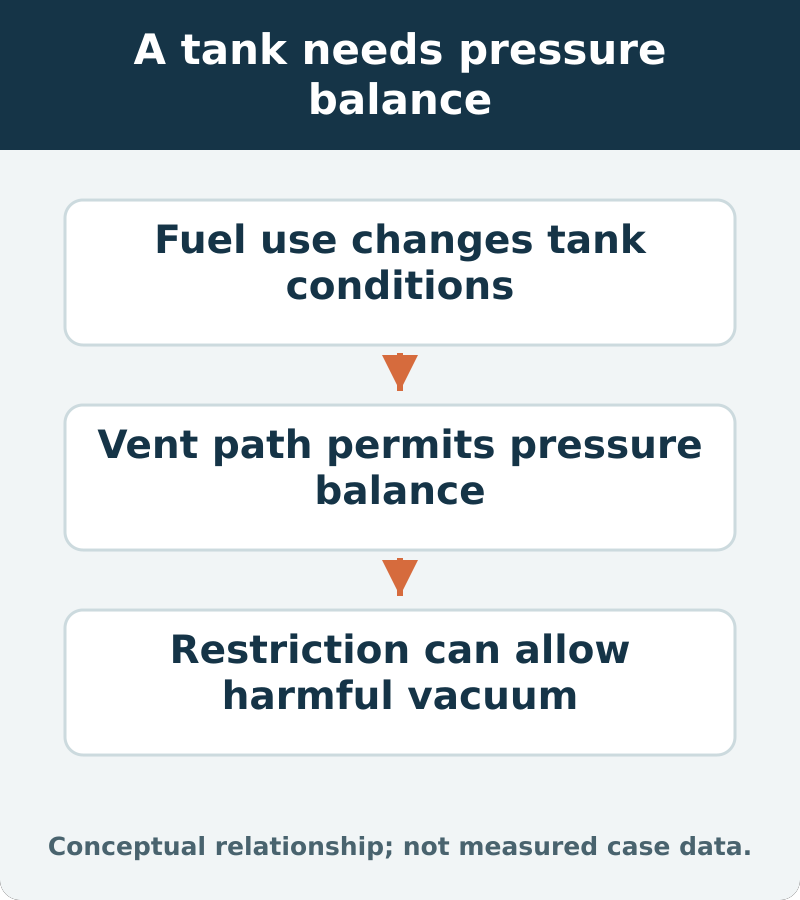
Replacing the damaged container addresses a consequence. It does not automatically remove the condition that caused or contributed to that damage. A durable repair therefore needs a documented decision about the pressure-management path as well as the tank.
Conversely, correcting a restriction would not make a structurally damaged tank fit for service. These are complementary objectives, not alternatives. Ask the estimate to identify both explicitly. The diagram separates them so the discussion does not end with a new tank part number. It is a repair-scope map, not a procedure for testing a damaged fuel system with smoke or compressed air.
What to ask about the complete repair scope
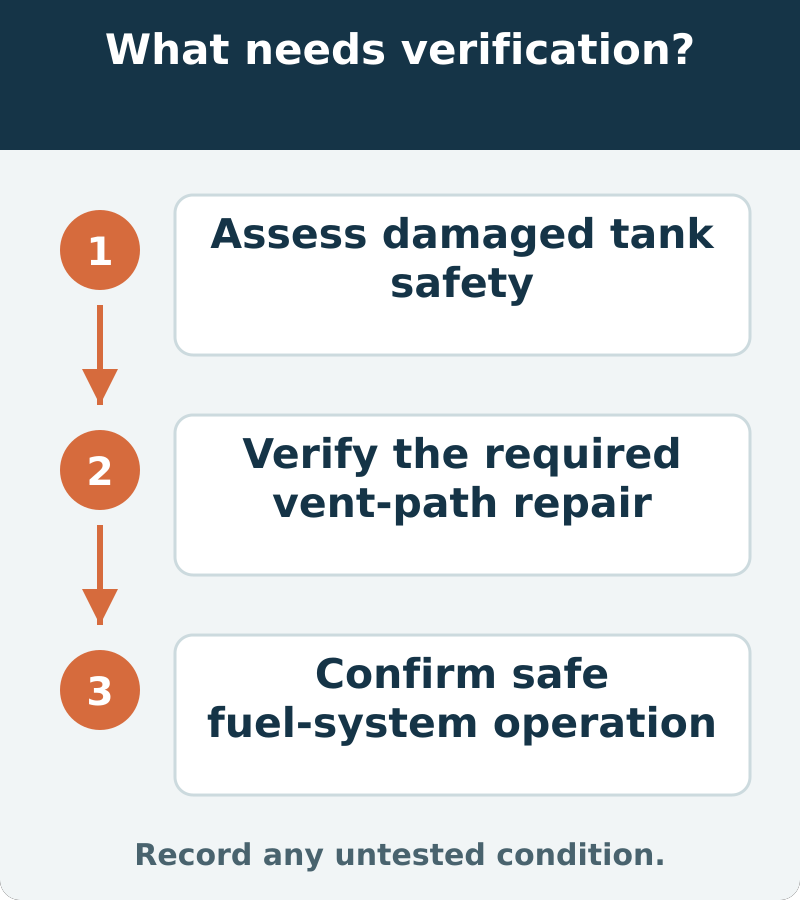
A complete scope should identify damaged containment components, the confirmed pressure-control concern and the required assessment of connected hardware. The technician determines which lines, seals or associated parts need service based on condition and the applicable procedure.
Ask how fuel will be handled safely and which verification is included after reassembly. If estimates differ, compare those work items rather than only the tank price. Do not request larger vent openings, bypassed components or improvised pressure relief to reduce the bill. The aim is correct containment and control, with the original protective design preserved.
Confirm safe containment and normal pressure behavior
Before release, the workshop should confirm the appropriate containment checks and assess pressure behavior using the correct method. Ask for an explanation of both results. A tank that no longer looks distorted is not a complete functional assessment of the system around it.
Keep the damage findings and cause-related repair together in the records. If another concern appears, those details help the next repairer understand what was established. This case is not a claim that every deformed tank has the same restriction. It is a clear two-part rule for the repair conversation: make the damaged fuel system safe, then prevent the confirmed abnormal condition from reaching the replacement.









Comments 0
Questions, fixes, and real-world diagnostic notes from readers.
Be the first to share a diagnostic result or ask a follow-up question.