
2022 Nissan Frontier Says Press the Brake and Will Not Crank: Check the Missing Brake Signal

Quick answer: Accessory power does not establish starting permission. A brake-pedal message accompanied by missing brake lamps makes the pedal-input circuit a useful early check.
If the display asks you to press a pedal you are already pressing, tell the repairer whether the brake lamps also respond. The switch circuit can be checked with an appropriate passive electrical tester; the MRCARTOOL B550 supports voltage measurement in the correct mode. That does not authorize energizing the circuit or bypassing the starting interlock.
In this guide
Why does the button still turn on accessories?
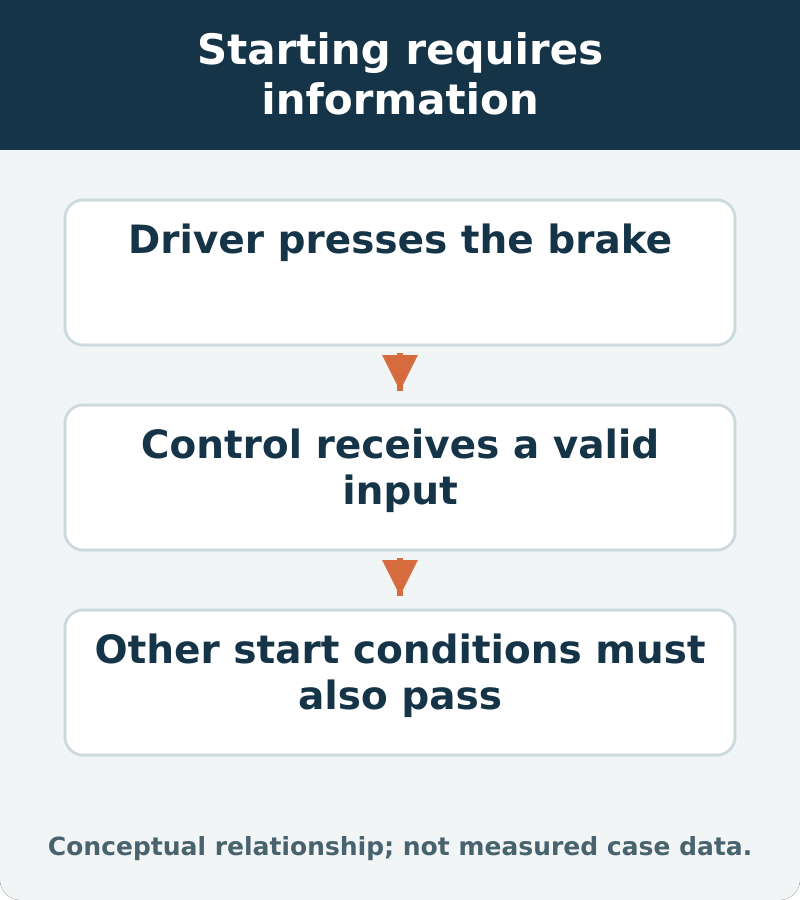
Accessory operation shows that the vehicle can enter that state. Starting the engine requires its own conditions to be satisfied. A working radio or instrument display therefore cannot establish that the starter has received a valid command, nor does it identify a failed starter.
For a useful service report, distinguish no crank from an engine that turns but will not fire. Include the exact pedal message and whether the behavior is consistent. Those observations help the workshop decide which permission or electrical path to examine. Do not repeatedly cycle the button or defeat an interlock to see whether the engine can be made to start.
Why do the brake lamps matter?
The lamps provide another observable function associated with pedal use. If both the lamp behavior and the starting request are abnormal, that combination can focus an early investigation. It is more informative than a no-start description alone.
However, lamp operation does not prove every pedal-input channel is correct on every system. The exact circuit design still matters. If the lamps are not working, road safety is affected even if the truck later starts. Arrange safe repair rather than treating starting as the only objective. Owners can report what is visible without accessing switch wiring or making assumptions about connector pins.
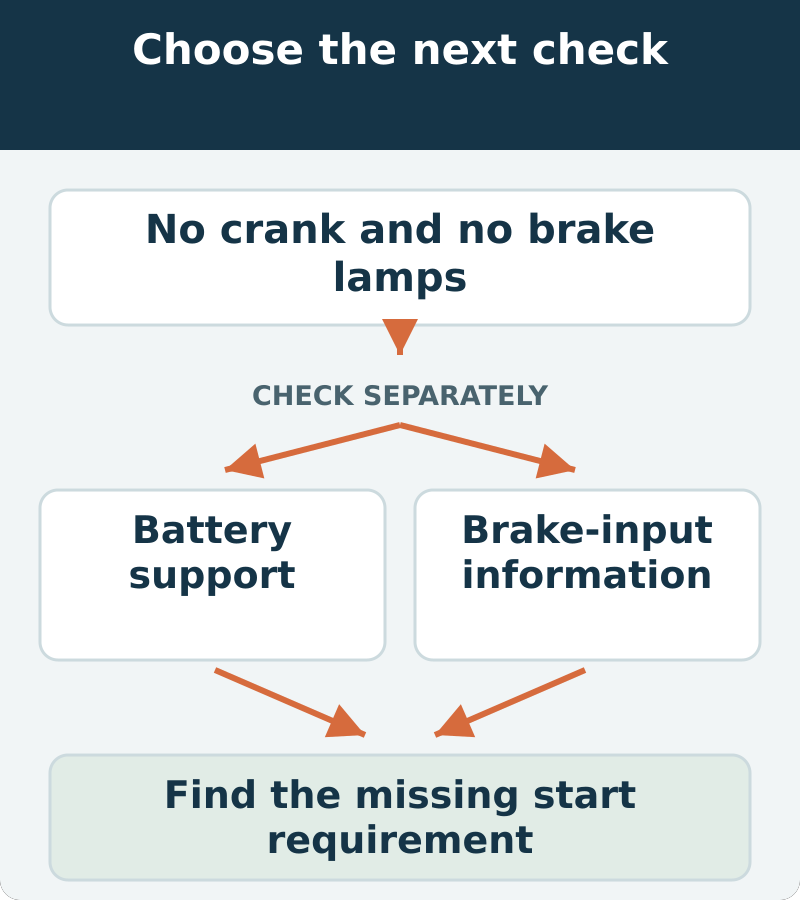
In the published ALLDATA case, this Frontier would enter accessory mode but not crank. The brake lamps were also out. Testing found supply to the brake switch but no corresponding output with the pedal pressed. Replacing the switch restored starting. The short report does not explicitly document final brake-lamp or interlock checks.
Could it still be the starter?
It could be a different starting-system fault on another truck. The purpose of the pedal clue is to establish a sensible test order, not exclude every other possibility from a distance. Ask whether starting permission was present before a starter replacement was proposed.
The repairer should be able to explain what was supplied, what signal was expected and what was observed. If the permission path is correct, investigation may move elsewhere. If it is not, replacing downstream hardware may leave the original problem unchanged. That is the value of the two-symptom question: it creates a testable branch before an expensive assumption becomes an invoice.
What makes a switch replacement justified?
A switch decision needs evidence about its inputs and outputs under the specified conditions, together with the relevant installation or adjustment requirements. A dashboard request alone is not enough. Neither is a continuity check performed in an unsuitable state.
A technician must use the correct circuit information, test mode and permitted access points. No pin numbers, wire colors or jumper method are supplied here. A power-probe feature should not be used to force the vehicle to recognize the pedal. The useful tool capability is passive measurement; the useful diagnostic result is an explained disagreement between what reaches the switch and what leaves it.
What else must work before collection?
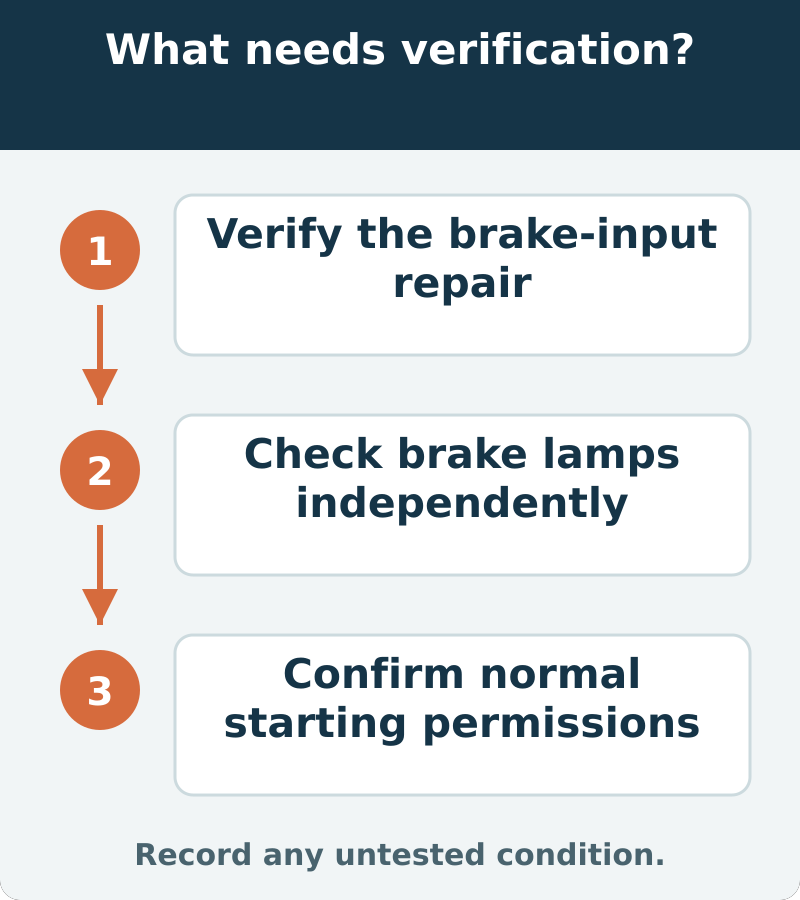
Starting, brake-lamp operation and the applicable interlock checks should be considered separately at handover. A truck that now cranks may still have an unresolved lighting concern. Ask for confirmation of both the original starting complaint and the related safety function.
The short published account explicitly reports restored starting but does not document every final lamp or interlock check. That is a limit of the account, not a reason to omit those checks on your vehicle. A careful reader should distinguish what a case says happened from what a complete collection checklist ought to include.
What should I record if it happens again?
If the problem returns, record the exact message, whether the engine cranks and the safely observed lamp behavior. Preserve the repair details so the workshop knows which part and installation work were completed. Avoid resetting or bypassing anything before the new condition is assessed.
This is not a recommendation to buy a switch in advance. It is a way to make an otherwise vague no-start complaint specific. The best next question is often small: does the vehicle see the pedal action it is requesting? Answering that properly can separate a missing permission signal from a failed starting component without unnecessary parts replacement.



Comments 0
Questions, fixes, and real-world diagnostic notes from readers.
Be the first to share a diagnostic result or ask a follow-up question.