
2016 Audi A3 P0116 and a Hot Gauge: Which Temperature Sensor Was Replaced?

Quick answer: Do not dismiss a hot warning, but identify the sensor behind it. This A3 still reported excessive temperature after a different sensor had been replaced.
A hot warning deserves immediate attention even if cooling parts were recently replaced. Stop safely and follow the vehicle’s overheating instructions. Do not open the hot system or decide it is safe because one hose feels cool.
After identifying the relevant sensor circuit, a multimeter such as the AUTOOL DM301 can support disconnected, de-energized resistance checks against the correct temperature-dependent specification. A bare resistance number without its test conditions is not a sensor verdict.
The first paperwork question is often simpler than the electrical one: did the previous repair replace the component that supplies the information now in doubt?
In this guide
Treat the hot warning seriously first
Do not start by assuming the warning is false. The investigation must distinguish genuine excessive temperature from incorrect reporting, and both paths require evidence.
Record what happened before stopping: elapsed operating time, other warnings and recent cooling-system work. Do not continue running the engine merely to obtain a more convincing symptom, touch hot components or unplug a sensor as a driving workaround.
An owner can help by bringing the invoice and the exact warning description. The workshop should handle the safe assessment of temperature and system condition before any decision to resume operation.
The invoice may name the wrong measuring point
ALLDATA’s 2016 A3 Quattro 2.0L account reports P0116, a hot gauge and high coolant-temperature data after thermostat, water-pump and radiator-outlet sensor work. The relevant G62 engine-side sensor was providing incorrect information. Replacing it, checking for trapped air and road testing restored normal temperature reporting.
“Temperature sensor replaced” can be an accurate invoice entry while remaining too broad to settle the next diagnosis. Ask for the installed part identification and its location or circuit designation.
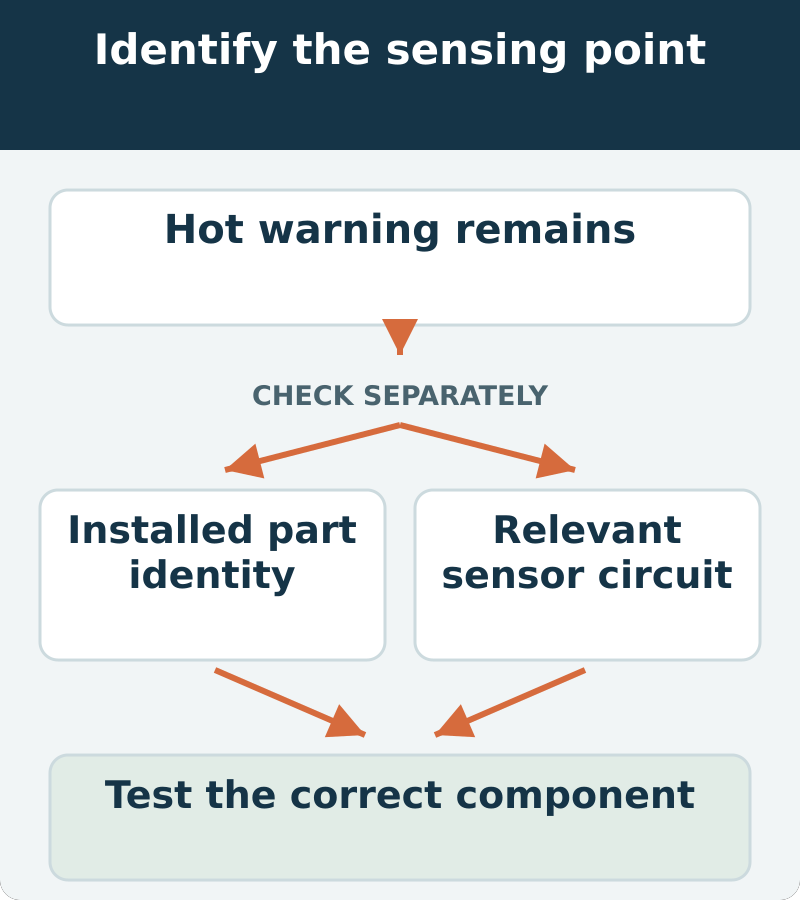
This is not an invitation to order the other sensor by elimination. It is a reason to establish which component the data refer to before evaluating whether previous work addressed that path.
Why the gauge and scan tool can agree and still mislead
Two displays do not necessarily provide two independent measurements. A dashboard indication and a scan-tool value may both derive from the same input. If so, agreement between them confirms consistency of reporting, not necessarily accuracy of the physical temperature.
The technician should identify the source of each value using the actual system information. Which reading is directly sensed? Which is passed along or processed? What independent observation can help assess the disputed condition?
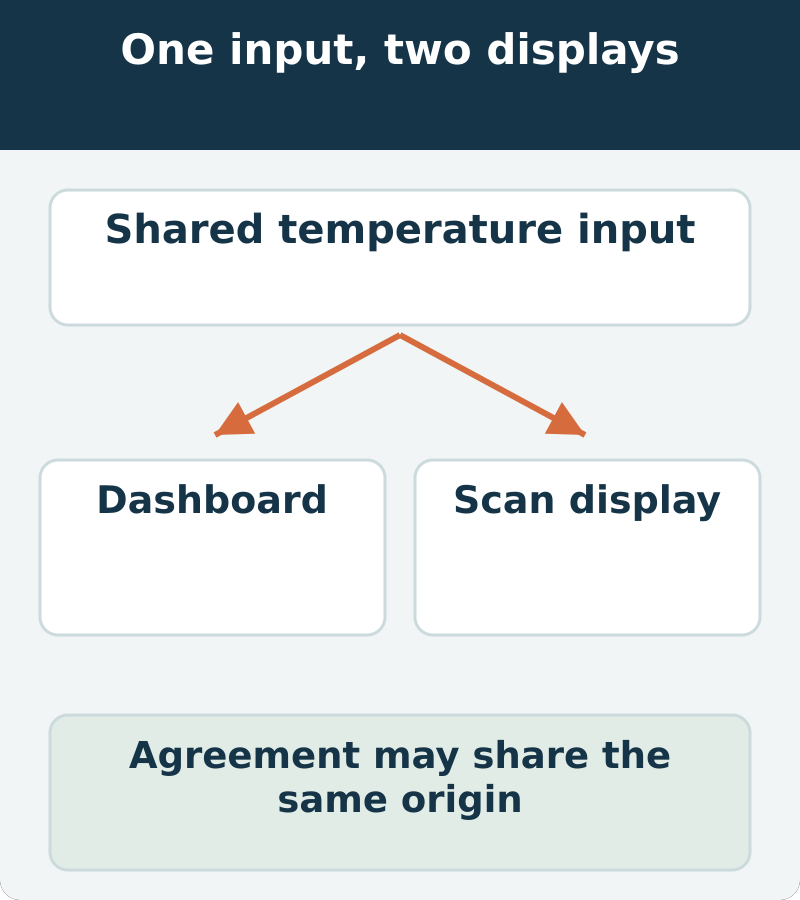
Independent checks need interpretation as well. An infrared reading is a surface measurement, not a direct measurement of coolant inside the engine. It should not be expected to match a PID exactly simply because both are shown in temperature units.
Test the identified circuit under known conditions
Once the relevant component is established, the applicable service information determines the electrical checks. Temperature-sensitive resistance must be compared with the correct curve or specification under known conditions, not with an isolated number copied from another repair.
A sensor assessment also needs to account for its circuit. The workshop should distinguish the component’s behavior from a problem in the connection or supporting wiring. Ask what result localizes the fault and what alternative was considered.
There is no universal connector-pin instruction here. The correct vehicle identification and wiring arrangement are prerequisites, especially when similar component names appear at different locations.
For the owner, the useful record is short: component identified, test conditions recorded, failed requirement explained. That is more actionable than a list of resistance values without temperatures or measuring points.
Do not lose the cooling-system checks in the process
An electrical explanation does not cancel the need to assess the physical system after cooling work. Installation, leaks, fluid condition and the applicable filling or air-removal requirements still need attention.
Keep those checks distinct from the disputed temperature signal. One can pass while another remains incomplete. A sensor that now reports plausibly does not, on its own, certify the quality of every earlier mechanical repair.
Ask the workshop to document what it verified rather than assume previous replacement means the entire cooling system has already been cleared. Equally, do not repeat a valid mechanical repair simply because the warning persisted for a different reason.
If uncertainty remains about actual overheating, the vehicle should not be released on the strength of a new sensor alone. The safe operating decision needs the appropriate system evidence.
Match the final result to the original complaint
The proposed acceptance check should confirm the identified circuit’s behavior, the required physical cooling-system checks and the relevant warm-up or operating condition. Review warning and fault status without relying only on information immediately after clearing.
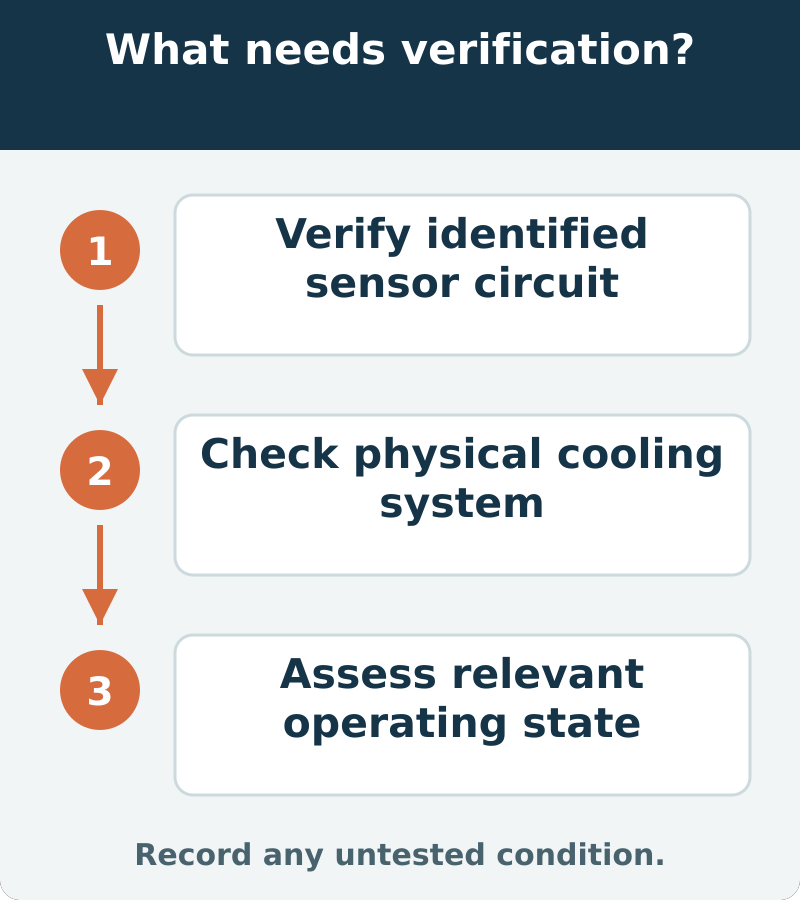
If the warning returns, preserve the new event and the previous test conditions. Begin with which observation changed. The lasting lesson is not “replace G62 for P0116”; it is to connect the complaint to the correct measuring point before asking a new part to solve it.










Comments 0
Questions, fixes, and real-world diagnostic notes from readers.
Be the first to share a diagnostic result or ask a follow-up question.