
1998 Toyota 4Runner Misfires When Hot: Test the Injector Electrically Before Cleaning It

Quick answer: Injector cleaning is not a repair for an electrically failing coil. This 4Runner’s hot-idle investigation eventually found excessive resistance in the removed cylinder-six injector.
Cleaning addresses deposits. It cannot repair an injector coil that loses electrical integrity. Before booking a cleaning service for a hot misfire, ask which evidence points to restricted flow and which points to an electrical failure.
Once the affected cylinder is identified, a multimeter such as the AUTOOL DM301 can help check a disconnected injector’s resistance against the correct service specification. That is a coil check, not a measurement of how much fuel actually enters the cylinder.
Stop driving if the malfunction lamp flashes or the misfire becomes severe. Useful evidence does not require deliberately continuing to run an engine that may be damaging its catalyst.
In this guide
Catch the fault before deciding what to clean
Gary Goms’s 1998 4Runner case began with intermittent hot-weather rough idle. Earlier visits had no code, but P0306 was present during his diagnosis. Ignition checks and a running-compression comparison did not explain it. Warm-fault data and improvement under commanded enrichment shifted attention toward cylinder-six fueling. He recommended injector replacement; the removed injector later showed excessive, unstable resistance. The article does not document a quantified post-replacement road test.
Notice the change in the evidence. “It never sets a code” may describe an earlier visit accurately and the current visit inaccurately. Preserve the latest fault status and operating conditions instead of making the initial description a permanent rule.
For an owner, useful notes include whether the fault appears after a long drive, after sitting hot, only at idle, or with particular loads. Do not guess a component from the weather. Give the shop enough context to choose a meaningful capture window.
One cylinder, several possible failures
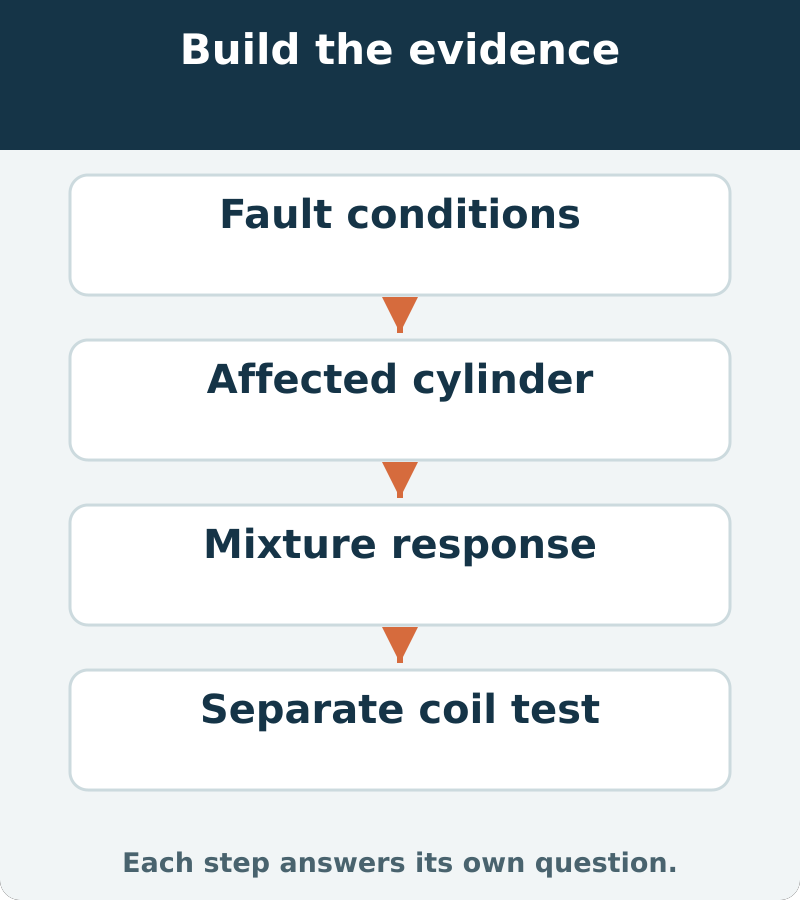
A cylinder-specific misfire directs attention; it does not distinguish ignition, fuel delivery and mechanical sealing by itself. Tests become useful when their conditions and limits are recorded alongside their results.
For example, a comparison made while the engine runs normally may not resolve a fault that appears only after heat soak. A component exchange can also be inconclusive if the complaint has not been reproduced afterward. Ask whether the test actually challenged the suspected failure, not merely whether the procedure was performed.
Access difficulty matters, too. If reaching an injector requires substantial work, the technician should collect the available supporting evidence before dismantling. That is an argument for a deliberate test sequence, not for guessing from the least accessible part.
What enrichment tells you—and what it does not
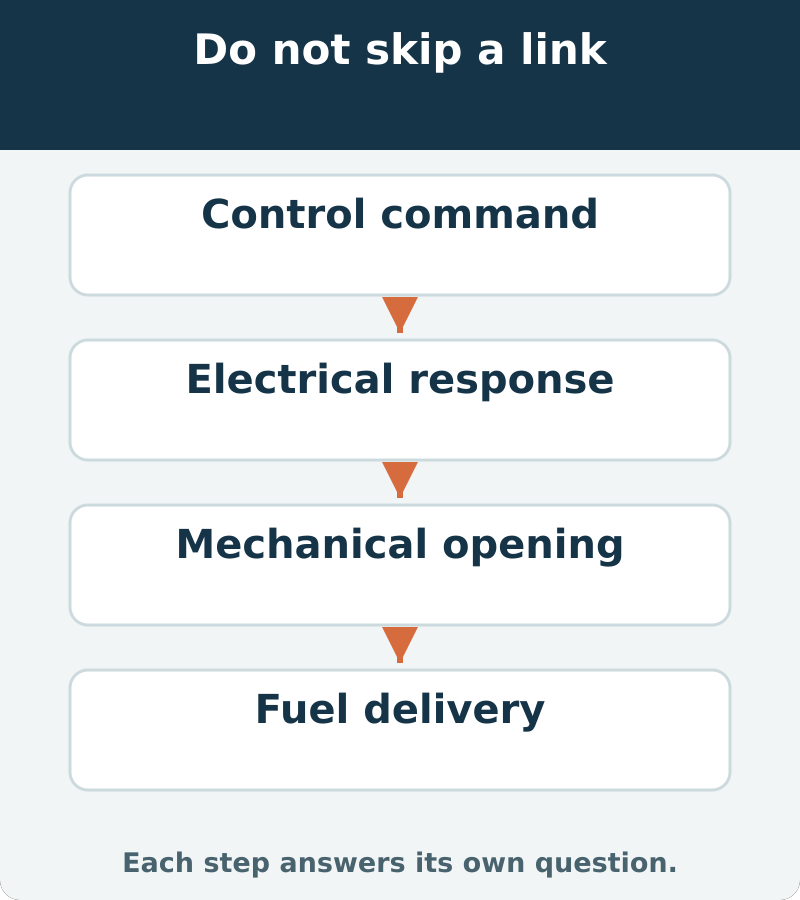
If an approved diagnostic command makes the engine run better by changing fuel delivery, it gives the technician a useful response to interpret. It does not explain why the original mixture was wrong, and it does not distinguish deposits from every other cause of inadequate fueling.
The question should become narrower: what evidence can separate an electrical problem, a delivery problem and a misleading interpretation of the data? A test that changes one condition can support a direction without completing that entire distinction.
Owners should not try to reproduce commanded enrichment with sprays or improvised fuel additions. This is a controlled diagnostic function for suitable equipment and the correct application. The helpful takeaway is about evidence, not a shortcut to running a rough engine on added fuel.
Check the coil without claiming a flow test
Resistance testing requires the ignition off and the injector electrically disconnected, following the applicable procedure. Compare the result with the specification for that injector and the stated test conditions. Fluke’s injector resistance guidance describes this basic distinction; a generic resistance range is not a substitute for the vehicle’s service data.
Record the component’s temperature condition, the contact quality and whether the reading is stable. If a result changes unexpectedly, verify the measurement setup before treating the number as a component defect. Do not heat a fuel-containing part with a household appliance or open flame to imitate a historical bench test.
An out-of-spec coil result can justify an electrical-failure conclusion when the checks support it. A normal coil result leaves other questions open. It does not establish correct control under load, mechanical opening, sealing, spray pattern or delivered quantity.
When cleaning is the wrong next purchase
Ask the person proposing cleaning to name the problem the service is intended to correct. “The cylinder is lean” is a description of a diagnostic direction, not evidence that a cleaning process will repair it.
If the established fault is electrical, cleaning does not restore the failed circuit inside the component. If electrical checks pass and separate testing supports deposits or a delivery imbalance, cleaning may be considered under the applicable equipment and component procedure. Those are different authorizations with different acceptance tests.
This distinction can save more than the price of an unnecessary service. It avoids losing the original evidence through repeated treatments while an intermittent failure continues. Keep the removed part and the recorded finding where practical if the shop needs to explain its conclusion.
The verification the repair still needs
The proposed handover should revisit the conditions that exposed the fault. Ask for operation after the relevant warm-up or heat-soak period, appropriate cylinder-specific data, and the required checks for safe installation and fuel leaks. A brief cold idle is not an equivalent challenge to a hot complaint.
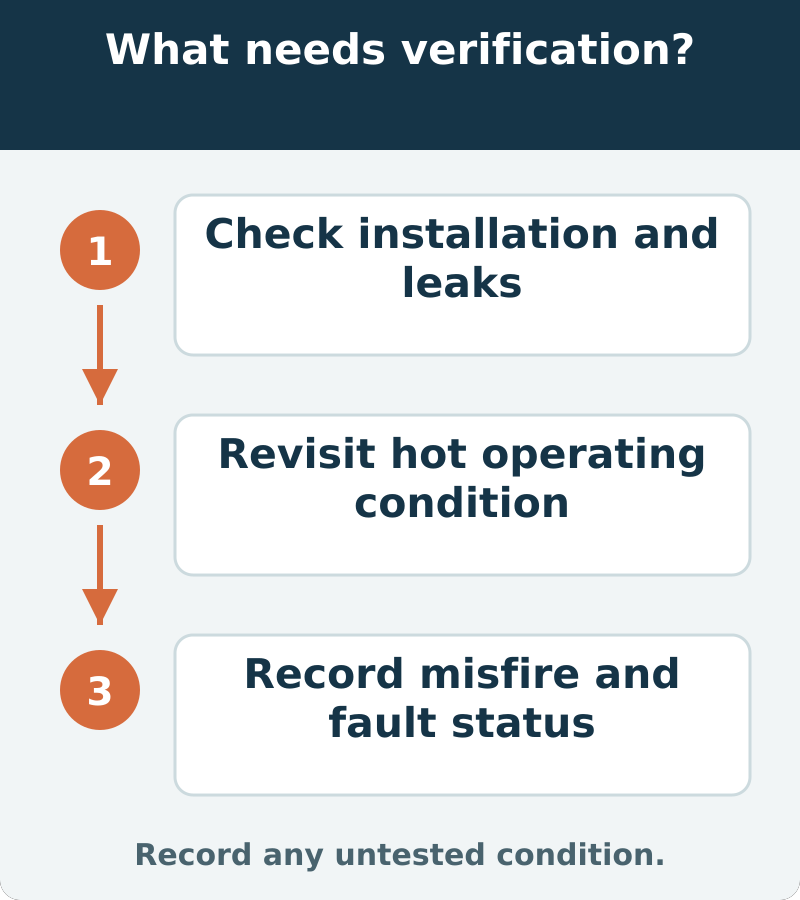
These are checks to request, not an invented continuation of the published repair. If the complaint cannot be reproduced or the operating condition has not yet been tested, say so on the handover record. A convincing component finding and a verified vehicle repair are related achievements, but they are not the same achievement.







Comments 0
Questions, fixes, and real-world diagnostic notes from readers.
Be the first to share a diagnostic result or ask a follow-up question.