
2012 Honda Civic Hybrid Would Turn Only Counterclockwise: The A/C Compressor Had Locked the Belt

Engine Turns One Way Only? Isolate The Belt
<strong>Quick answer:</strong> The engine was not internally locked. Removing the accessory belt separated the crankshaft from a seized A/C compressor; the specified compressor-system repair and recharge restored operation. This article follows one documented vehicle. It explains the evidence chain, not a universal failure rate or a direction to replace the same part on every similar car. Stop whenever the test would involve overheated brakes, high current, moving parts, refrigerant handling or an uncontrolled road condition.
After the failed compressor circuit has been repaired and flushed by qualified A/C personnel, a compatible refrigerant service station such as AUTOOL LM708 A/C Service Station can support controlled recovery, evacuation, leak checking and recharge by specified mass. It cannot diagnose the seized pulley, establish hybrid high-voltage safety, choose the repair scope, or substitute for refrigerant identification and Honda oil/refrigerant procedures.
The Civic Hybrid appeared mechanically locked, but only in one direction. Once the accessory belt was isolated, the crankshaft turned both ways and the seized A/C compressor—not the engine—was left holding the load.
Quick answer: The engine was not internally locked. Removing the accessory belt separated the crankshaft from a seized A/C compressor; the specified compressor-system repair and recharge restored operation.
In this guide
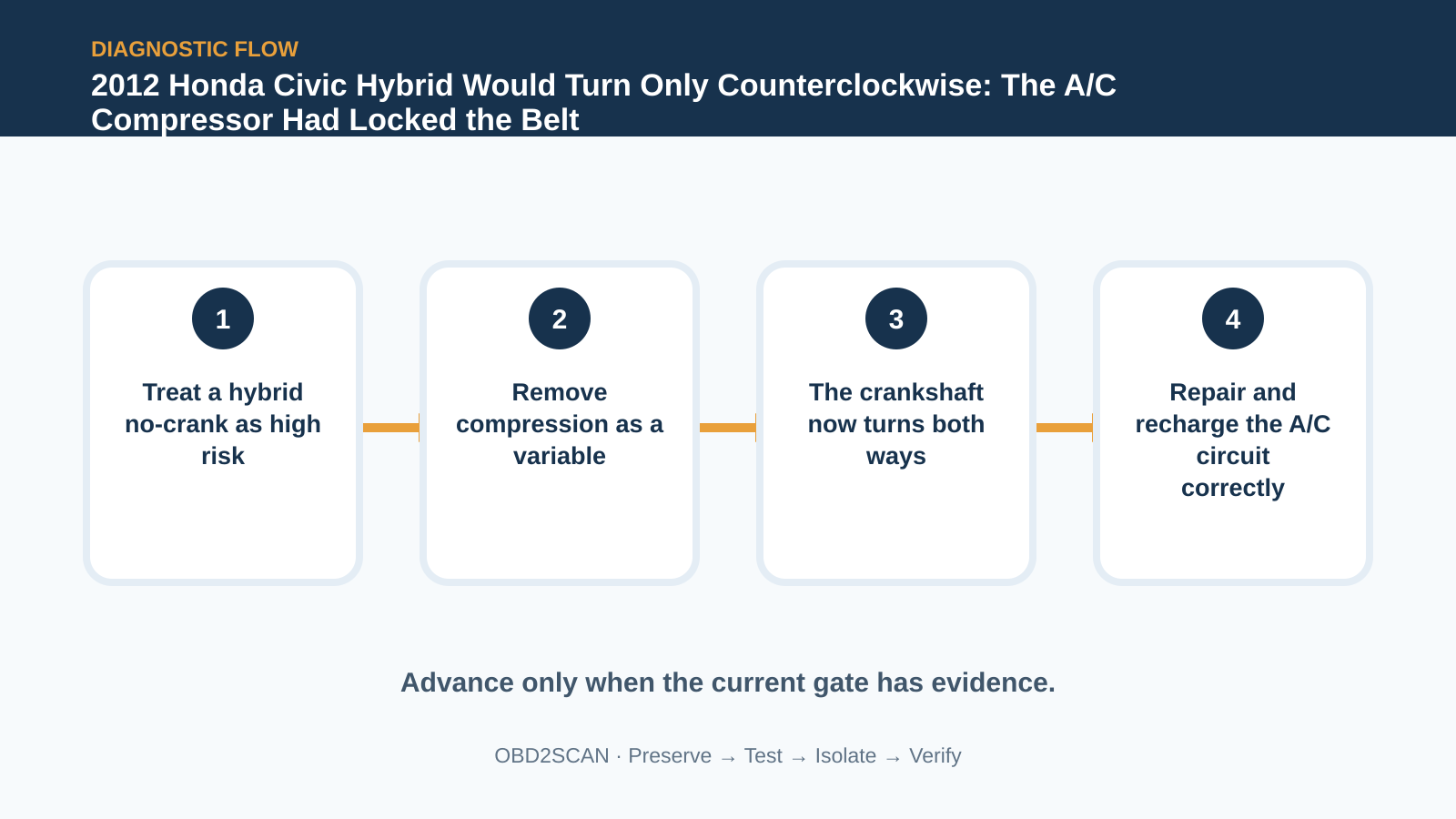
- Treat a hybrid no-crank as high risk
- Prove the engine’s direction-dependent bind
- Remove compression as a variable
- Isolate the accessory belt safely
- The crankshaft now turns both ways
- Confirm the seized compressor and contamination scope
- Repair and recharge the A/C circuit correctly
- Verify crank, cooling and belt tracking
Treat a hybrid no-crank as high risk
A Civic Hybrid no-crank requires hybrid-specific safety boundaries. Secure the vehicle, keep clear of high-voltage components and follow Honda disable/isolation instructions before mechanical work. The absence of DTCs does not make the orange-cable system safe to touch. Preserve the original condition before changing it. The first observation is the control sample against which every later test must be compared.
Prove the engine’s direction-dependent bind
With the correct socket and procedure, the crankshaft would rotate counterclockwise but not clockwise. Do not apply escalating force; direction-dependent movement can involve belt load, valve timing or internal contact. Mark the observation and stop before turning a diagnostic clue into damage. Use service information for the exact engine, build date and options. A correct method on the wrong terminal can create a precise but useless result.
Remove compression as a variable
Removing the spark plugs reduces compression resistance and helps separate a hydraulic/compression effect from a hard mechanical bind. Disable fuel and ignition as specified, protect the plug wells and compare feel—not just whether brute force can move the crank. Treat prior work as evidence, not blame. A repair that made no change can narrow the case when its installation and test conditions are verified.
Isolate the accessory belt safely
The accessory belt connects several possible loads to the crankshaft. Remove or release it only with the proper tensioner method and inspect routing first. Once isolated, turn each accessible accessory by the approved method while keeping fingers clear of pinch points. At this stage, separate what was observed from what is inferred. The observation should remain true even if the current theory is later rejected.
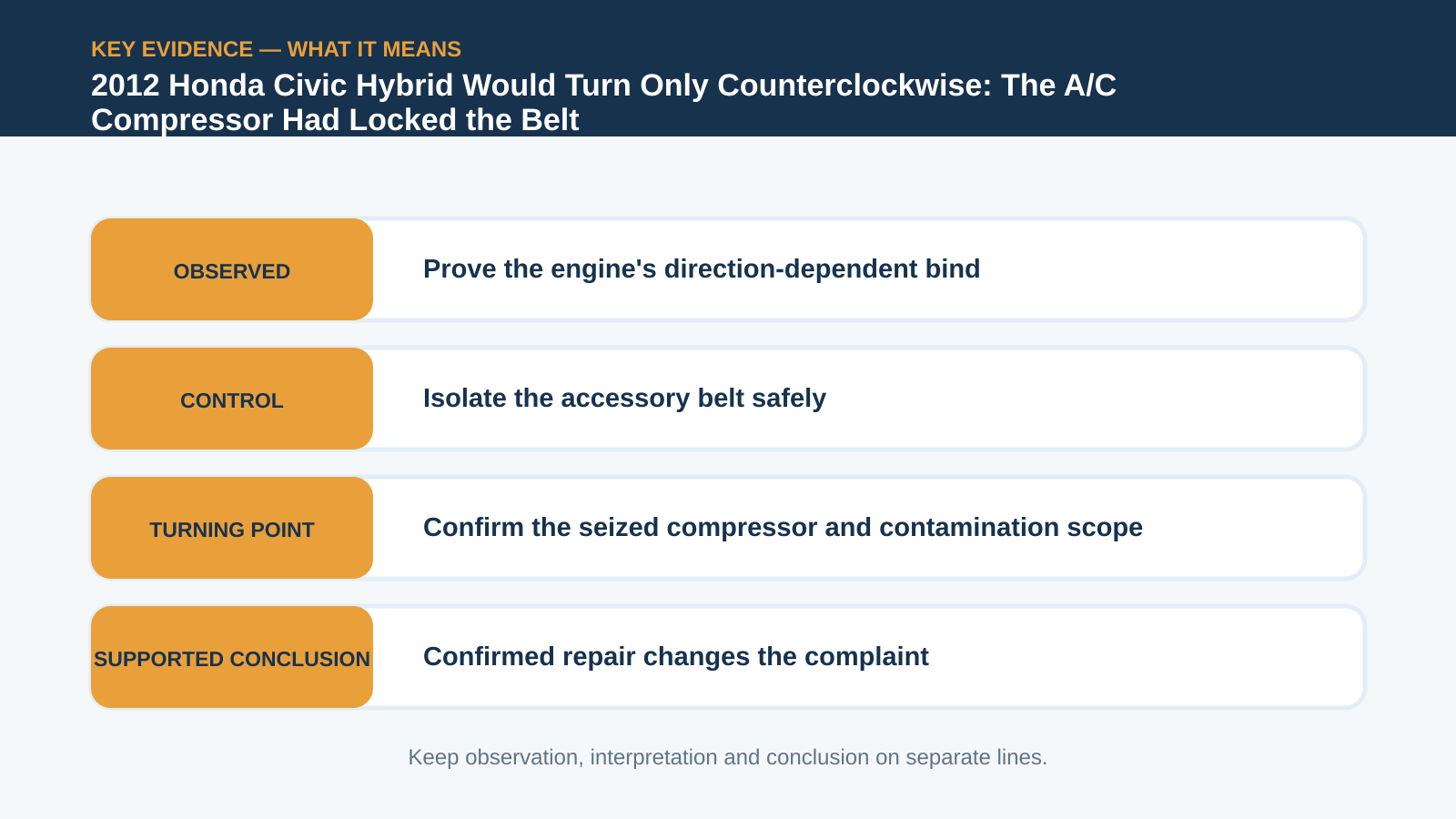
| Observation | What it supports | What it does not prove |
|---|---|---|
| Crank turns only counterclockwise | Load path changes with direction | Engine is internally seized |
| Spark plugs removed; bind remains | Compression is not the cause | Valve timing is safe |
| Belt removed; crank turns both ways | Accessory drive contains the bind | Compressor is the only possible accessory |
| Seized compressor repaired | Accessory seizure caused this case | A/C service scope is universal |
The crankshaft now turns both ways
With the belt removed, the engine turned in both directions. That one controlled change moved internal engine seizure down the list and accessory lockup up. It did not by itself identify which pulley or whether contamination had spread through the A/C system. This is the decision point in the documented case. Its value comes from changing one bounded condition while leaving the rest of the system intact.
Confirm the seized compressor and contamination scope
Inspection found the compressor and clutch seized. The counterclockwise motion had been possible because tensioner movement allowed the belt to slip around the locked pulley. Assess compressor debris and oil contamination to determine whether the expansion device, drier and heat exchangers require the broader service performed in the case. A confirmed component still needs a repair that restores sealing, support, torque, routing or terminal fit—the physical conditions that keep the fault from returning.
Repair and recharge the A/C circuit correctly
Refrigerant recovery, flushing decisions, evacuation, oil balancing and recharge belong to qualified personnel using identified refrigerant and Honda specifications. In the documented repair the compressor assembly, expansion valve and receiver-drier were replaced and the lines, condenser and evaporator were flushed before recharge. Reassemble protective covers and retainers before declaring success. A diagnostic shortcut must not become the next failure mechanism.
Verify crank, cooling and belt tracking
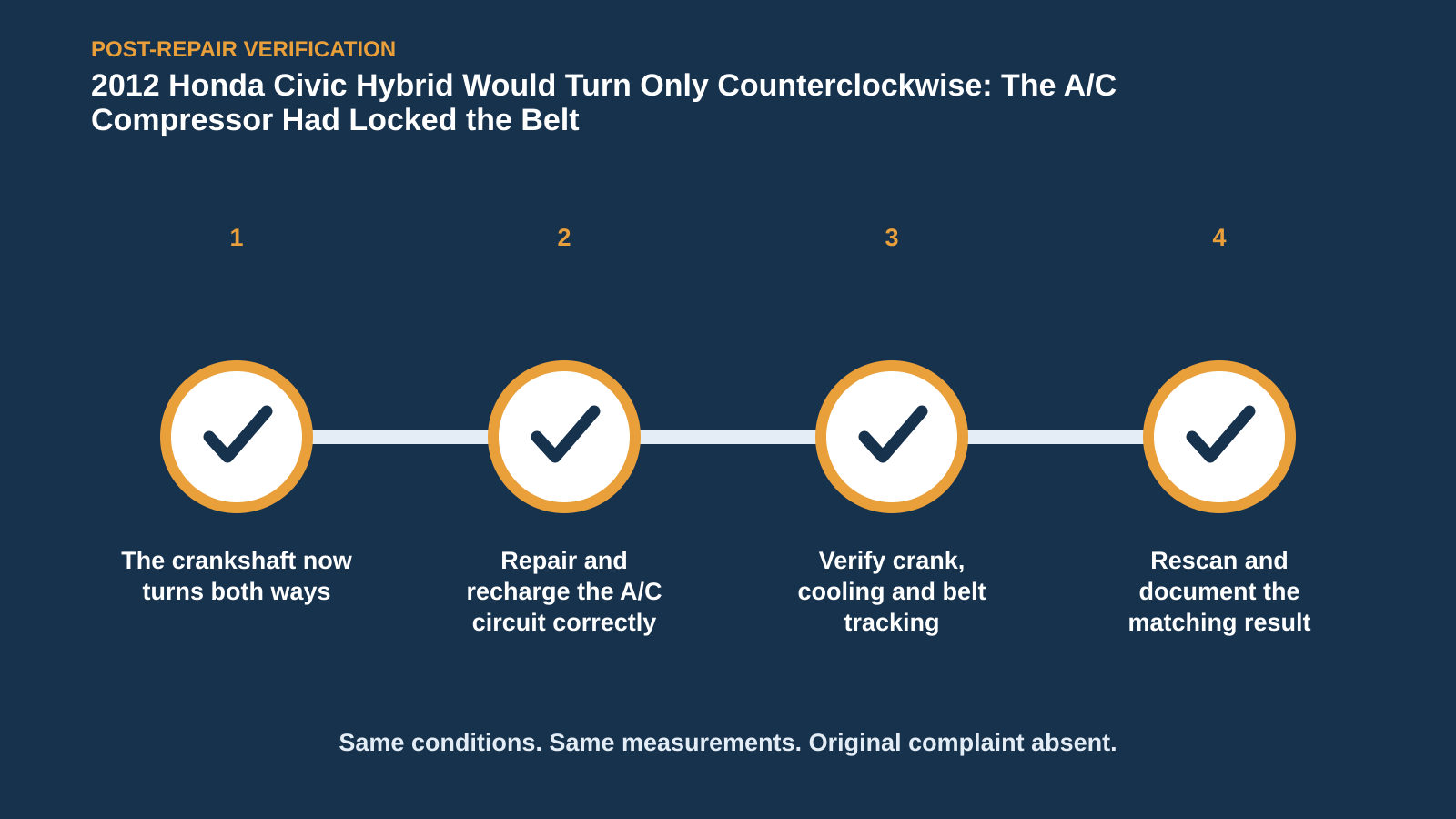
After repair, verify normal cranking and start, stable A/C pressures and vent temperature, quiet clutch/pulley operation and correct belt tracking. Recheck for leaks and scan all systems. The original one-direction bind must be gone; cold air alone would not prove the no-crank mechanism was resolved. Use the customer’s original complaint as the final specification. A cleared code, quiet bay or one good key cycle is not equivalent to reproducing and passing that condition.
If you are bringing a similar symptom to a shop, arrive with the useful conditions rather than a requested part: whether the vehicle was cold or hot, the exact speed or switch position, which warning lamps appeared, what changed after a restart, and a chronological list of earlier repairs. A short video can preserve an intermittent sound or lamp pattern, but record it only while parked or with a passenger handling the camera. Ask the technician to retain the pre-repair scan and measurements, explain the test that separated the failed path from the alternatives, and show how the original complaint was repeated afterward.
For the owner or service adviser, a useful repair explanation has three parts: what was observed, why the decisive test narrowed the fault, and which original condition passed after the repair. It should also say what the test did not prove. That boundary prevents a memorable case from becoming an automatic parts recommendation.
The engine was not internally locked. Removing the accessory belt separated the crankshaft from a seized A/C compressor; the specified compressor-system repair and recharge restored operation. The reusable lesson is narrower and more valuable: Let direction be the diagnostic variable: the belt tensioner changed load in one direction, making an accessory seizure imitate an engine lock.










Comments 0
Questions, fixes, and real-world diagnostic notes from readers.
Be the first to share a diagnostic result or ask a follow-up question.