
2006 Honda Civic Read 10 MPH in Park After Transmission Replacement: Two Connectors Had Traded Places

10 Mph In Park After A Transmission Swap?
<strong>Quick answer:</strong> The transmission itself was not the first place to go back inside. Correcting the swapped ISS and VSS connectors and adjusting the range selector switch returned the speedometer to zero in Park and restored the Park-to-Reverse shift path. This article follows one documented vehicle. It explains the evidence chain, not a universal failure rate or a direction to replace the same part on every similar car. Stop whenever the test would involve overheated brakes, high current, moving parts, refrigerant handling or an uncontrolled road condition.
When identical plugs make visual identification unreliable, non-destructive terminal access lets a technician compare the circuits against the correct connector view; AUTOOL 92-Piece Circuit Test Lead Kit can support that careful access with a compatible meter. A lead kit cannot assign connector identity, set the range switch, or replace Honda connector views and pin tests; never force an adapter into a terminal.
A speedometer showing 10 mph in Park is not a subtle symptom. Because it began immediately after a transmission replacement, the impossible number became a map back through the connectors and adjustments disturbed during the job.
Quick answer: The transmission itself was not the first place to go back inside. Correcting the swapped ISS and VSS connectors and adjusting the range selector switch returned the speedometer to zero in Park and restored the Park-to-Reverse shift path.
In this guide
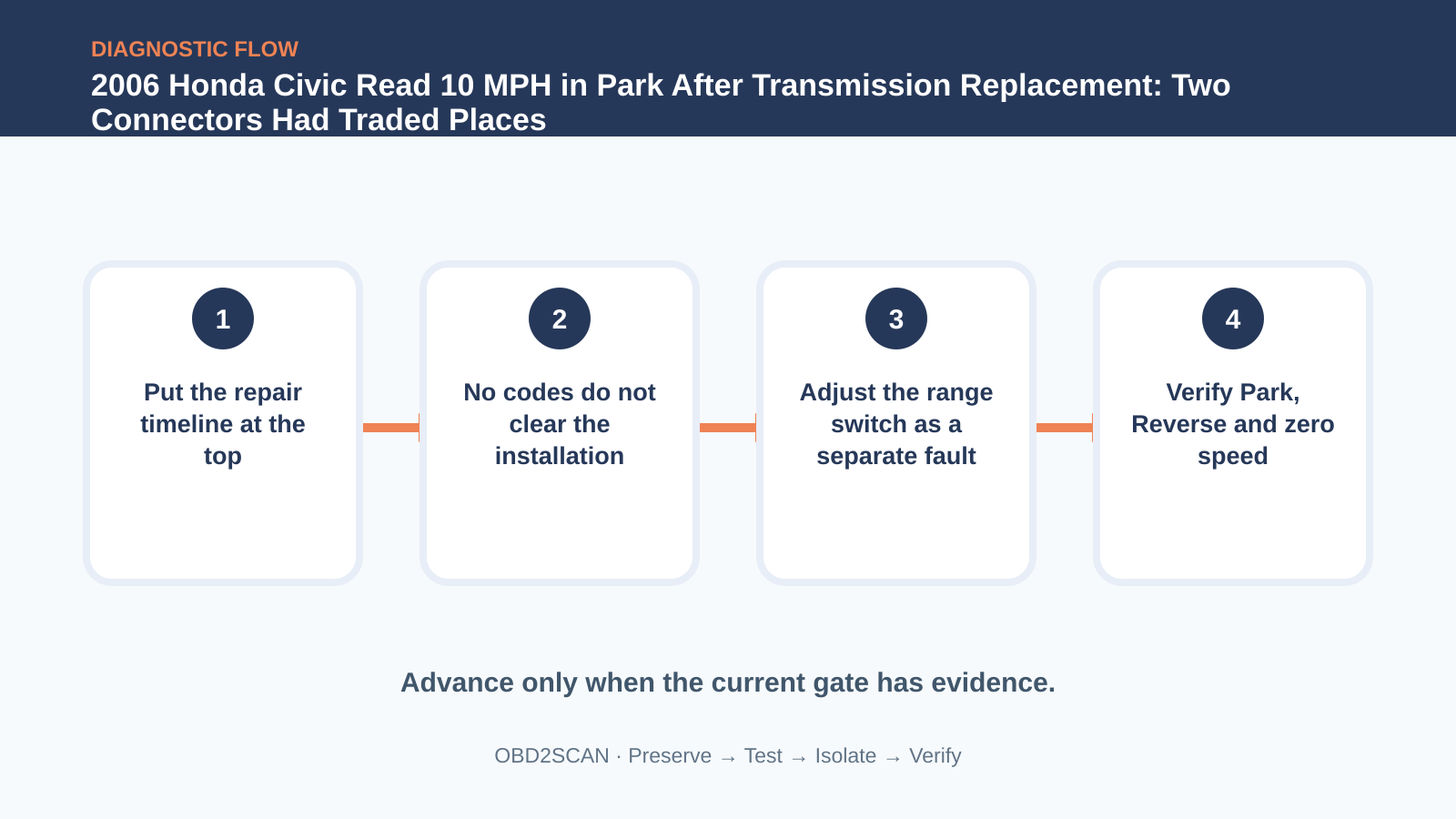
- Put the repair timeline at the top
- Treat 10 MPH in Park as a hard contradiction
- No codes do not clear the installation
- Match identical plugs by circuit, not shape
- Adjust the range switch as a separate fault
- Restore the transmission-side configuration
- Verify Park, Reverse and zero speed
- How to prevent this kind of comeback
Put the repair timeline at the top
The strongest clue was chronological: the false speed reading and selector problem began immediately after transmission replacement. That does not prove installer error, but it makes disturbed connectors, grounds, linkage and adjustments more productive than opening a replacement unit that has not yet been electrically audited. Preserve the original condition before changing it. The first observation is the control sample against which every later test must be compared.
Treat 10 MPH in Park as a hard contradiction
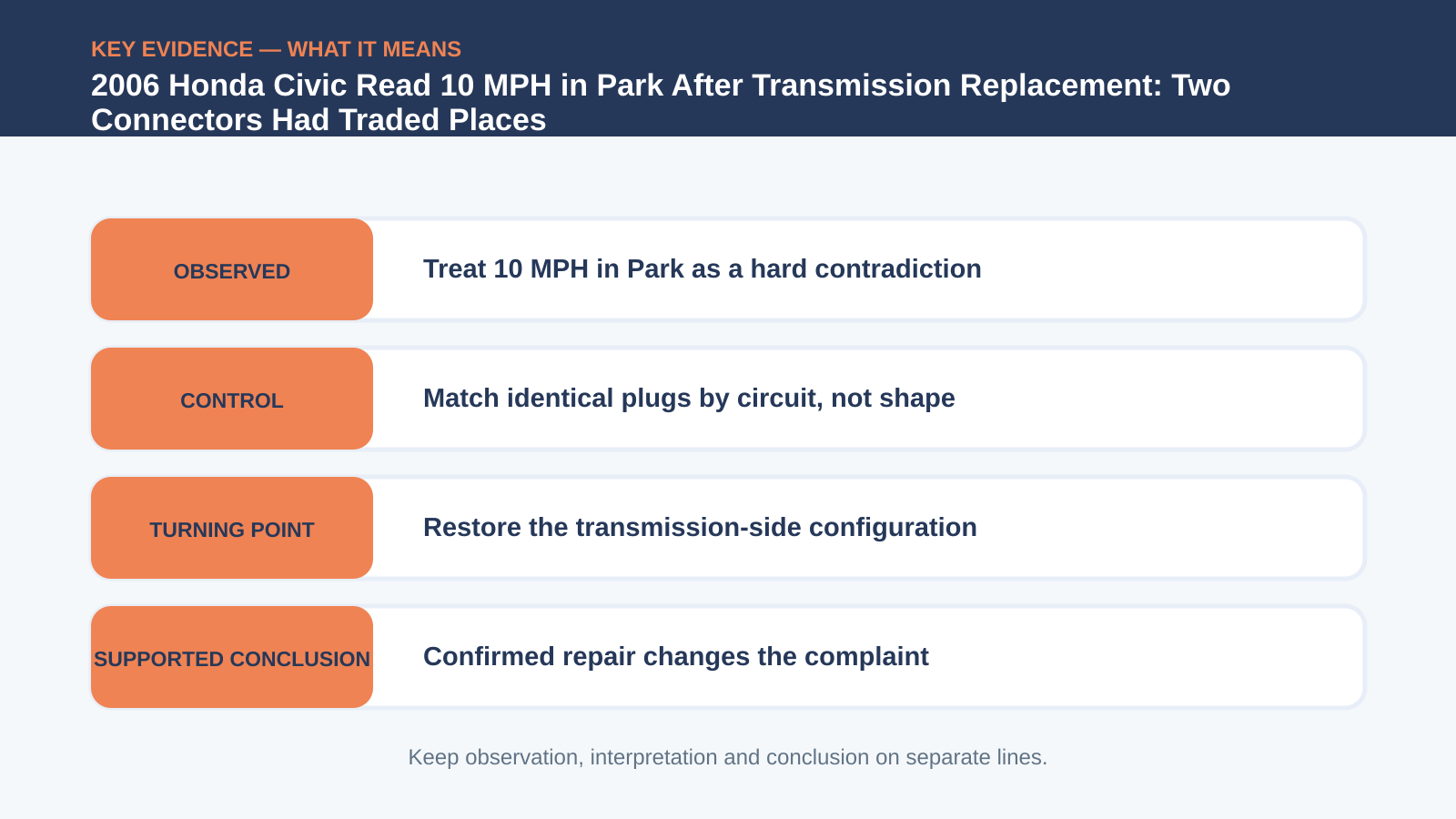
A vehicle cannot be moving at 10 mph while stationary in Park. Treat that impossible value as a sensor-path contradiction. Record scan-tool vehicle speed and input speed with the wheels safely stationary; do not road-test a car whose selector behavior is not predictable merely to collect more symptoms. Use service information for the exact engine, build date and options. A correct method on the wrong terminal can create a precise but useless result.
No codes do not clear the installation
No DTCs were present. Plausible electrical signals on the wrong circuits can stay inside expected voltage ranges and therefore avoid a circuit code. The absence of codes made a careful comparison of connector identity and data more important, not less. Treat prior work as evidence, not blame. A repair that made no change can narrow the case when its installation and test conditions are verified.
Match identical plugs by circuit, not shape
The ISS and VSS used identical nearby three-wire connectors. Color, harness routing, locking features and pin function must all agree with the connector view. Do not swap plugs as an experiment with the key on; power down as specified, inspect terminals, then restore the documented routing deliberately. At this stage, separate what was observed from what is inferred. The observation should remain true even if the current theory is later rejected.
| Observation | What it supports | What it does not prove |
|---|---|---|
| 10 MPH displayed in Park | Speed input is contradictory | Transmission hard parts are damaged |
| No DTCs | Signals may remain plausible electrically | Installation is correct |
| ISS and VSS plugs are crossed | Two inputs were assigned incorrectly | Range switch is adjusted |
| Connectors and switch corrected | Configuration caused both symptoms here | All post-swap issues share this cause |
Adjust the range switch as a separate fault
The range selector switch was slightly out of adjustment as a second installation-related issue. Adjust it by the exact Honda procedure and verify mechanical alignment separately from the sensor connectors. Correcting only the crossed plugs could leave the Park-to-Reverse complaint unresolved. This is the decision point in the documented case. Its value comes from changing one bounded condition while leaving the rest of the system intact.
Restore the transmission-side configuration
After the connectors were placed correctly and the selector adjusted, the configuration once again matched the control module’s assumptions. Secure the harness away from moving parts and exhaust heat, seat every lock, and reinstall brackets that prevent two identical plugs from migrating back together. A confirmed component still needs a repair that restores sealing, support, torque, routing or terminal fit—the physical conditions that keep the fault from returning.
Verify Park, Reverse and zero speed
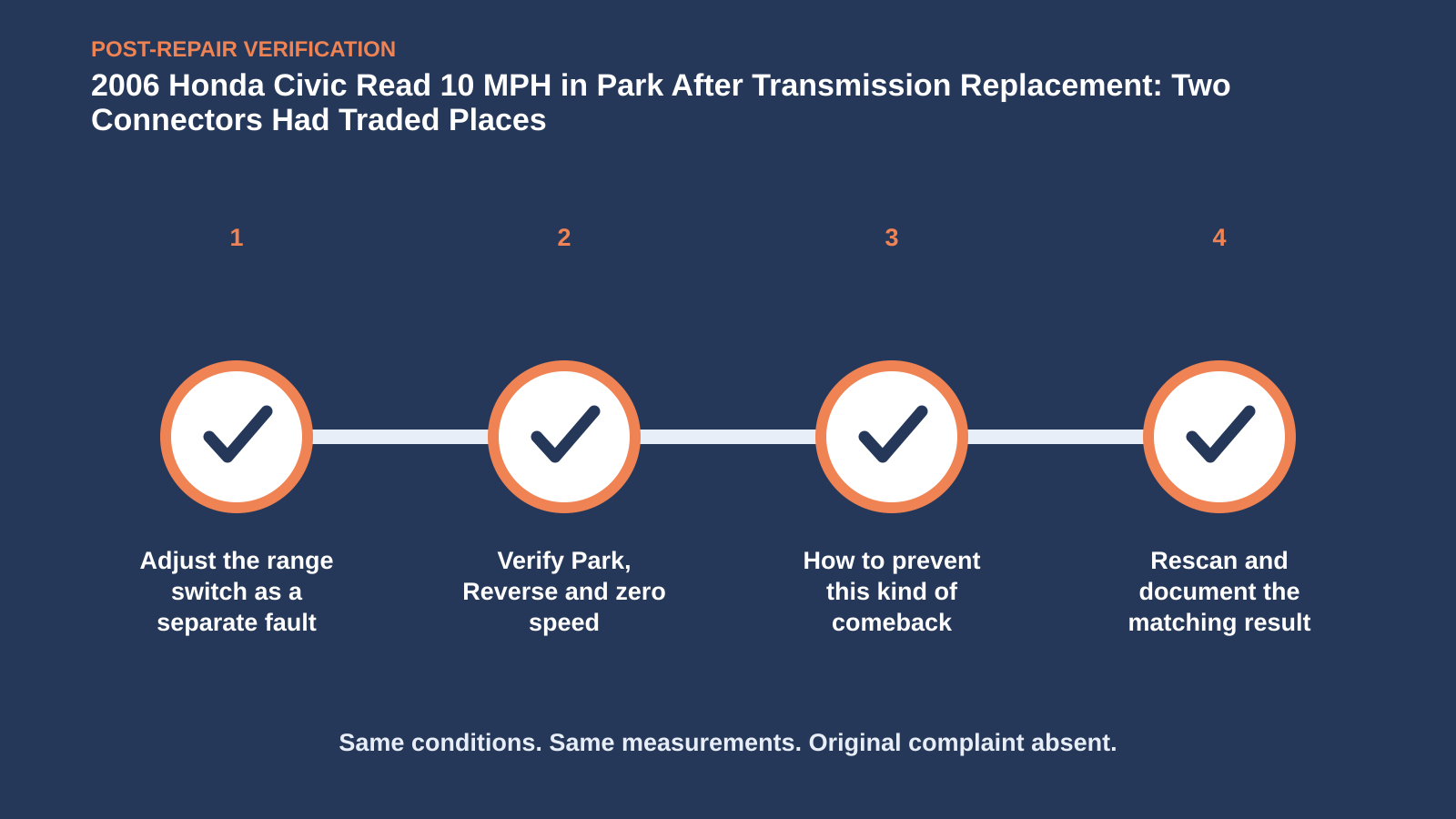
With the vehicle secured, confirm zero vehicle speed in Park, the expected selector PID in every position, normal backup-lamp behavior and a clean Park-to-Reverse engagement. Only then proceed to a controlled road test that compares displayed speed with actual movement. Reassemble protective covers and retainers before declaring success. A diagnostic shortcut must not become the next failure mechanism.
How to prevent this kind of comeback
Prevention is practical: photograph connector routing before removal, label identical connectors with heat- and fluid-resistant markers, and include range-switch adjustment in the replacement checklist. A comeback is cheapest when the final inspection is designed around every interface the repair disturbed. Use the customer’s original complaint as the final specification. A cleared code, quiet bay or one good key cycle is not equivalent to reproducing and passing that condition.
If you are bringing a similar symptom to a shop, arrive with the useful conditions rather than a requested part: whether the vehicle was cold or hot, the exact speed or switch position, which warning lamps appeared, what changed after a restart, and a chronological list of earlier repairs. A short video can preserve an intermittent sound or lamp pattern, but record it only while parked or with a passenger handling the camera. Ask the technician to retain the pre-repair scan and measurements, explain the test that separated the failed path from the alternatives, and show how the original complaint was repeated afterward.
For the owner or service adviser, a useful repair explanation has three parts: what was observed, why the decisive test narrowed the fault, and which original condition passed after the repair. It should also say what the test did not prove. That boundary prevents a memorable case from becoming an automatic parts recommendation.
The transmission itself was not the first place to go back inside. Correcting the swapped ISS and VSS connectors and adjusting the range selector switch returned the speedometer to zero in Park and restored the Park-to-Reverse shift path. The reusable lesson is narrower and more valuable: Organize the article as a post-repair audit: what changed last is not automatically guilty, but it defines the smallest useful search area.










Comments 0
Questions, fixes, and real-world diagnostic notes from readers.
Be the first to share a diagnostic result or ask a follow-up question.