
2004 Dodge Neon Stuck in Second With P0750: The Solenoid Pack Was Losing Its Relay Feed

P0750, But The Solenoids Test Good?
<strong>Quick answer:</strong> P0750 named the low/reverse solenoid circuit, but the solenoid pack tested within specification. The fault was an intermittent transmission-control-relay feed; a new relay restored normal shifting and kept the MIL off on the confirming drive. This article follows one documented vehicle. It explains the evidence chain, not a universal failure rate or a direction to replace the same part on every similar car. Stop whenever the test would involve overheated brakes, high current, moving parts, refrigerant handling or an uncontrolled road condition.
Once the correct relay circuit is identified from the wiring diagram, a tool that can observe voltage under load and check a relay outside the control module can keep the diagnosis focused; AUTOOL DM303 Circuit Tester is one such supporting option. Its relay and waveform functions do not prove PCM command, identify a poor terminal by themselves, or justify injecting power into a module-controlled circuit.
P0750 seemed to point straight at a solenoid, and the Neon was already protecting itself in second gear. The useful clue arrived when the named load passed its resistance check but its power feed would not stay present.
Quick answer: P0750 named the low/reverse solenoid circuit, but the solenoid pack tested within specification. The fault was an intermittent transmission-control-relay feed; a new relay restored normal shifting and kept the MIL off on the confirming drive.
In this guide
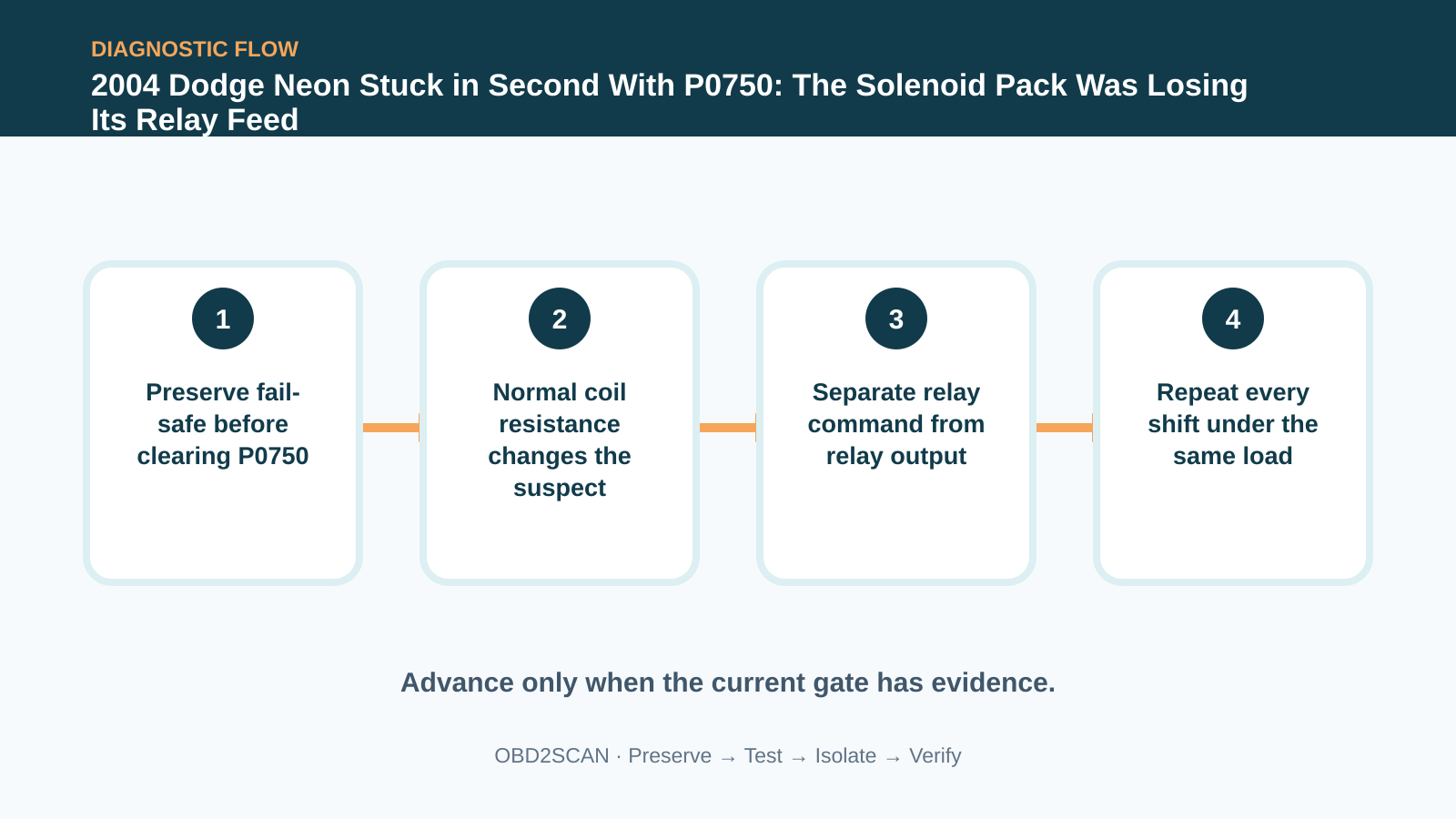
- Preserve fail-safe before clearing P0750
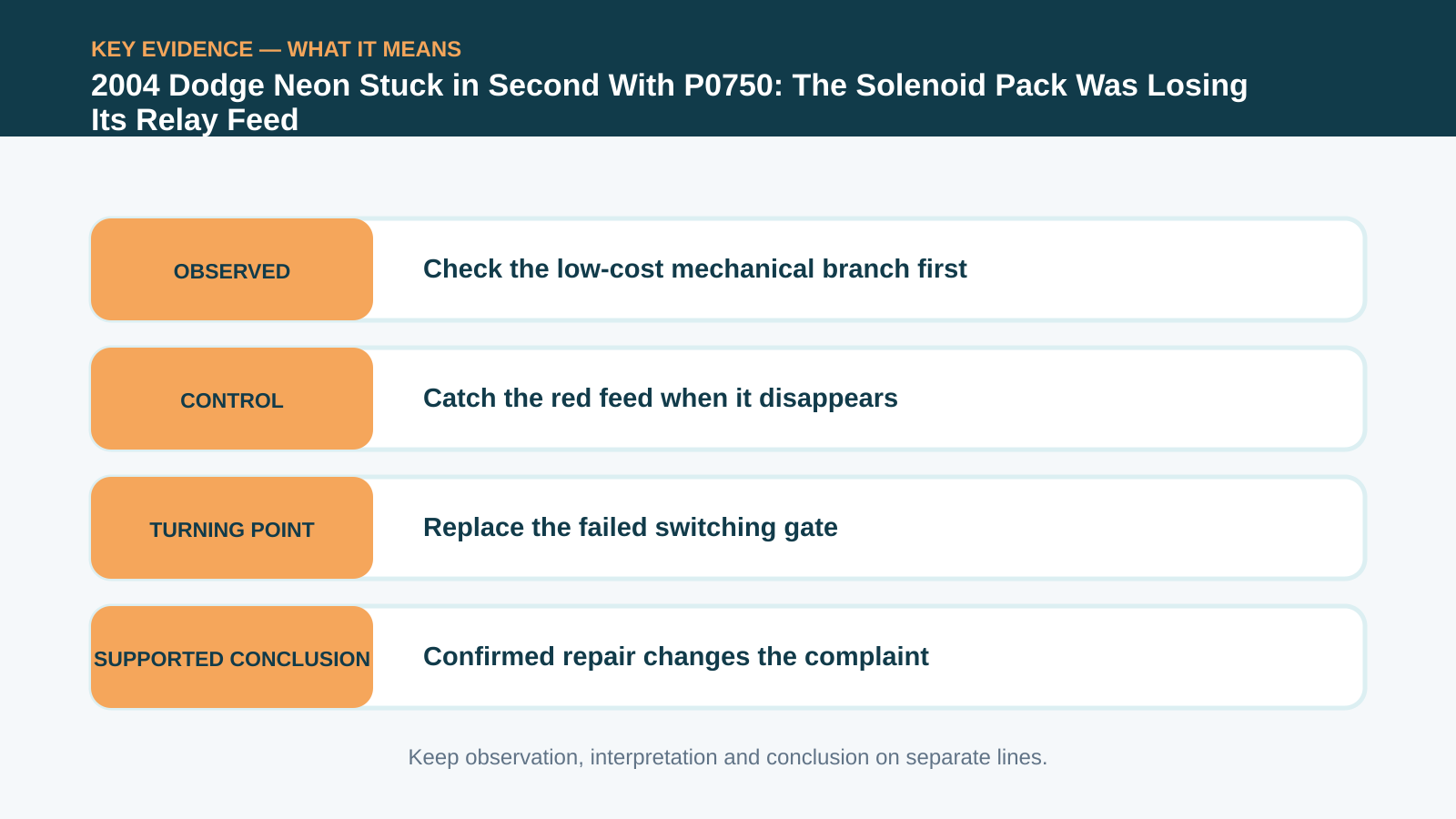
- Check the low-cost mechanical branch first
- Normal coil resistance changes the suspect
- Catch the red feed when it disappears
- Separate relay command from relay output
- Replace the failed switching gate
- Repeat every shift under the same load
- The transferable lesson from one Neon
Preserve fail-safe before clearing P0750
Second gear was the transmission’s protective state, not a component diagnosis. Save P0750, freeze-frame data and the exact start/shift behavior before clearing anything. If the car enters fail-safe immediately, note whether cycling the key changes it; that timing helps distinguish a hard open from an intermittent supply. Preserve the original condition before changing it. The first observation is the control sample against which every later test must be compared.
Check the low-cost mechanical branch first
Fluid level and condition belong near the beginning because a basic hydraulic problem can change shift behavior without an electrical repair. In this case the fluid appeared normal, so attention moved to the named low/reverse-solenoid circuit instead of treating a normal preliminary check as proof that the transmission was healthy. Use service information for the exact engine, build date and options. A correct method on the wrong terminal can create a precise but useless result.
Normal coil resistance changes the suspect
The solenoid-pack windings measured within specification. Resistance alone does not prove a coil under heat or a connector under load, but it made blind pack replacement a weak next move. The useful shift was from ‘is the solenoid bad?’ to ‘does the pack consistently receive the power that lets any command work?’ Treat prior work as evidence, not blame. A repair that made no change can narrow the case when its installation and test conditions are verified.
Catch the red feed when it disappears
The red feed wire was intermittent. Measure it in the failed state, use the correct ground reference, and load the path only as the circuit allows. A good reading captured after a relay recovers is not equivalent to watching the feed disappear when the car actually enters second-gear protection. At this stage, separate what was observed from what is inferred. The observation should remain true even if the current theory is later rejected.
| Observation | What it supports | What it does not prove |
|---|---|---|
| P0750 with second-gear fail-safe | Low/reverse circuit needs testing | The solenoid pack is failed |
| Pack resistance is in specification | Static coil branch passes | Feed remains stable under load |
| Red feed becomes intermittent | Common supply path is causal | PCM command is absent |
| Relay replacement restores shifts | Relay was causal in this case | Every P0750 needs a relay |
Separate relay command from relay output
A relay has a command side and a switched-power side. The wiring diagram showed which terminals should receive control, ground and source voltage. Those supporting circuits passed in the documented case, while the output to the pack did not remain stable, narrowing the decision to the relay rather than the PCM or pack. This is the decision point in the documented case. Its value comes from changing one bounded condition while leaving the rest of the system intact.
Replace the failed switching gate
Replace the relay with the correct part and inspect cavity tension, heat damage and moisture before closing the box. A loose terminal can imitate a relay and damage the replacement. Avoid random fused jumpers: an accidental feed into a control terminal can create a more expensive fault than P0750. A confirmed component still needs a repair that restores sealing, support, torque, routing or terminal fit—the physical conditions that keep the fault from returning.
Repeat every shift under the same load
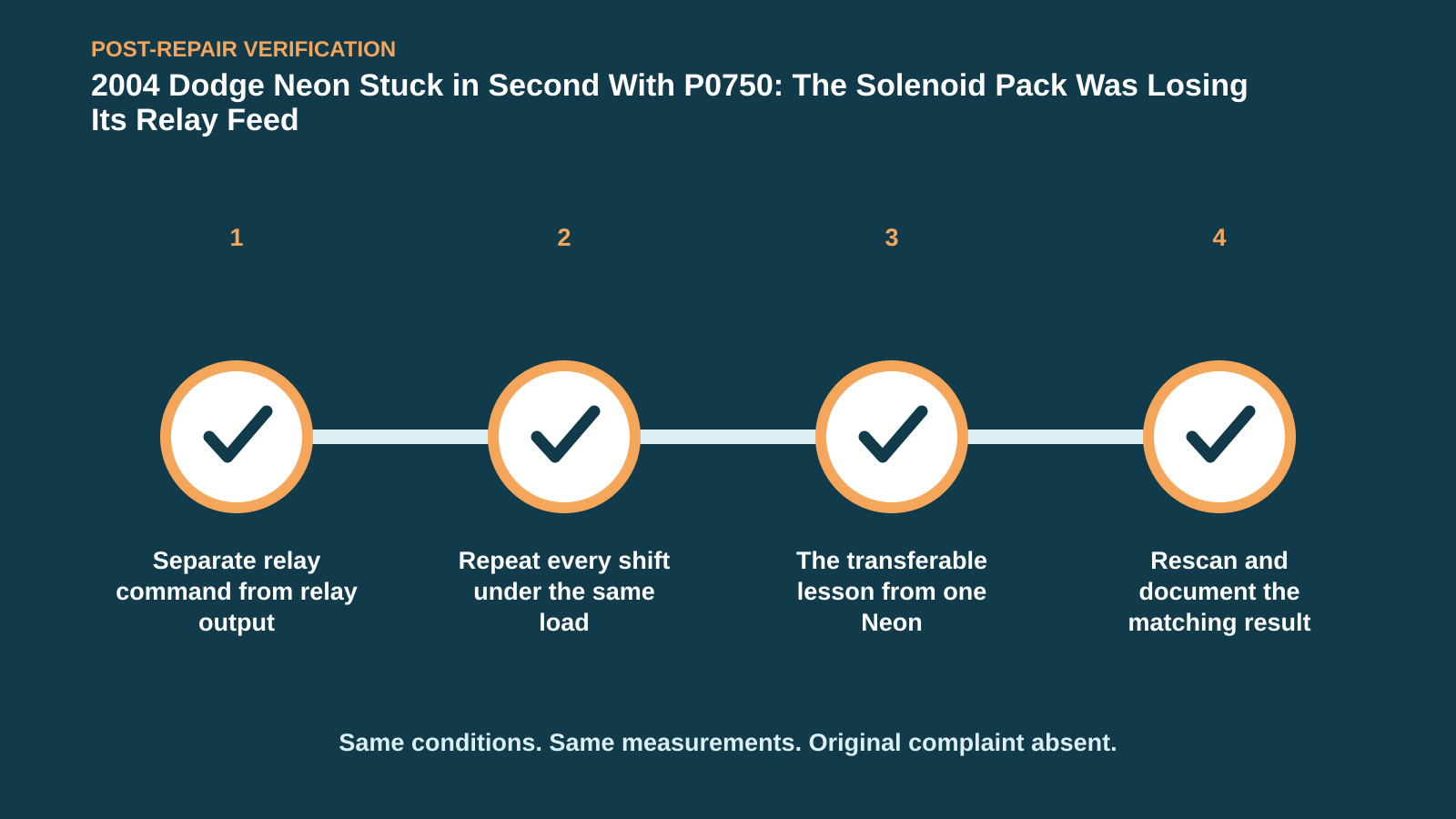
Clear the code only after preserving the evidence. The confirming road test should include the shift conditions that previously triggered fail-safe, then a rescan for pending as well as stored faults. Normal shifting once in the bay is not enough if vibration or heat was needed to interrupt the feed. Reassemble protective covers and retainers before declaring success. A diagnostic shortcut must not become the next failure mechanism.
The transferable lesson from one Neon
The case does not mean every P0750 is a relay. It demonstrates a reusable order: verify fluid, test the named load, prove its supply and control, then replace the first switching point that fails under the complaint condition. Each result should remove one branch rather than add one guessed part. Use the customer’s original complaint as the final specification. A cleared code, quiet bay or one good key cycle is not equivalent to reproducing and passing that condition.
If you are bringing a similar symptom to a shop, arrive with the useful conditions rather than a requested part: whether the vehicle was cold or hot, the exact speed or switch position, which warning lamps appeared, what changed after a restart, and a chronological list of earlier repairs. A short video can preserve an intermittent sound or lamp pattern, but record it only while parked or with a passenger handling the camera. Ask the technician to retain the pre-repair scan and measurements, explain the test that separated the failed path from the alternatives, and show how the original complaint was repeated afterward.
For the owner or service adviser, a useful repair explanation has three parts: what was observed, why the decisive test narrowed the fault, and which original condition passed after the repair. It should also say what the test did not prove. That boundary prevents a memorable case from becoming an automatic parts recommendation.
P0750 named the low/reverse solenoid circuit, but the solenoid pack tested within specification. The fault was an intermittent transmission-control-relay feed; a new relay restored normal shifting and kept the MIL off on the confirming drive. The reusable lesson is narrower and more valuable: Let the code open a circuit, then let each measurement decide which side of that circuit survives.










Comments 0
Questions, fixes, and real-world diagnostic notes from readers.
Be the first to share a diagnostic result or ask a follow-up question.