
2014 Nissan Rogue Wobbled Only Under Acceleration: The Replacement Axles Were the Clue

Wobbles Only On Acceleration?
This Rogue’s shake was defined by the driver’s right foot: it appeared from 20 to 60 mph under acceleration and faded on coast. That distinction survived several plausible but unsuccessful repairs.
When this diagnostic path reaches a measurement question, the useful machine type is one that answers only that question. For that supporting role, the AUTOOL TWB203/TWB205 Wheel Balancer is one practical option. A wheel balancer can verify compatible wheel/tire imbalance as one branch of a vibration diagnosis. It cannot reproduce acceleration torque, measure CV plunge geometry, or certify that a replacement axle matches the VIN.
<strong>Quick answer:</strong> The wobble depended on drivetrain load, not simply wheel speed. Incorrect replacement-axle geometry remained after other branches were controlled; correct OEM axles fixed it. This article follows one documented vehicle. It explains the evidence chain, not a universal failure rate or a direction to replace the same part on every similar car. Stop whenever the test would involve overheated brakes, high current, moving parts, refrigerant handling or an uncontrolled road condition.
Quick answer: The wobble depended on drivetrain load, not simply wheel speed. Incorrect replacement-axle geometry remained after other branches were controlled; correct OEM axles fixed it.

In this guide
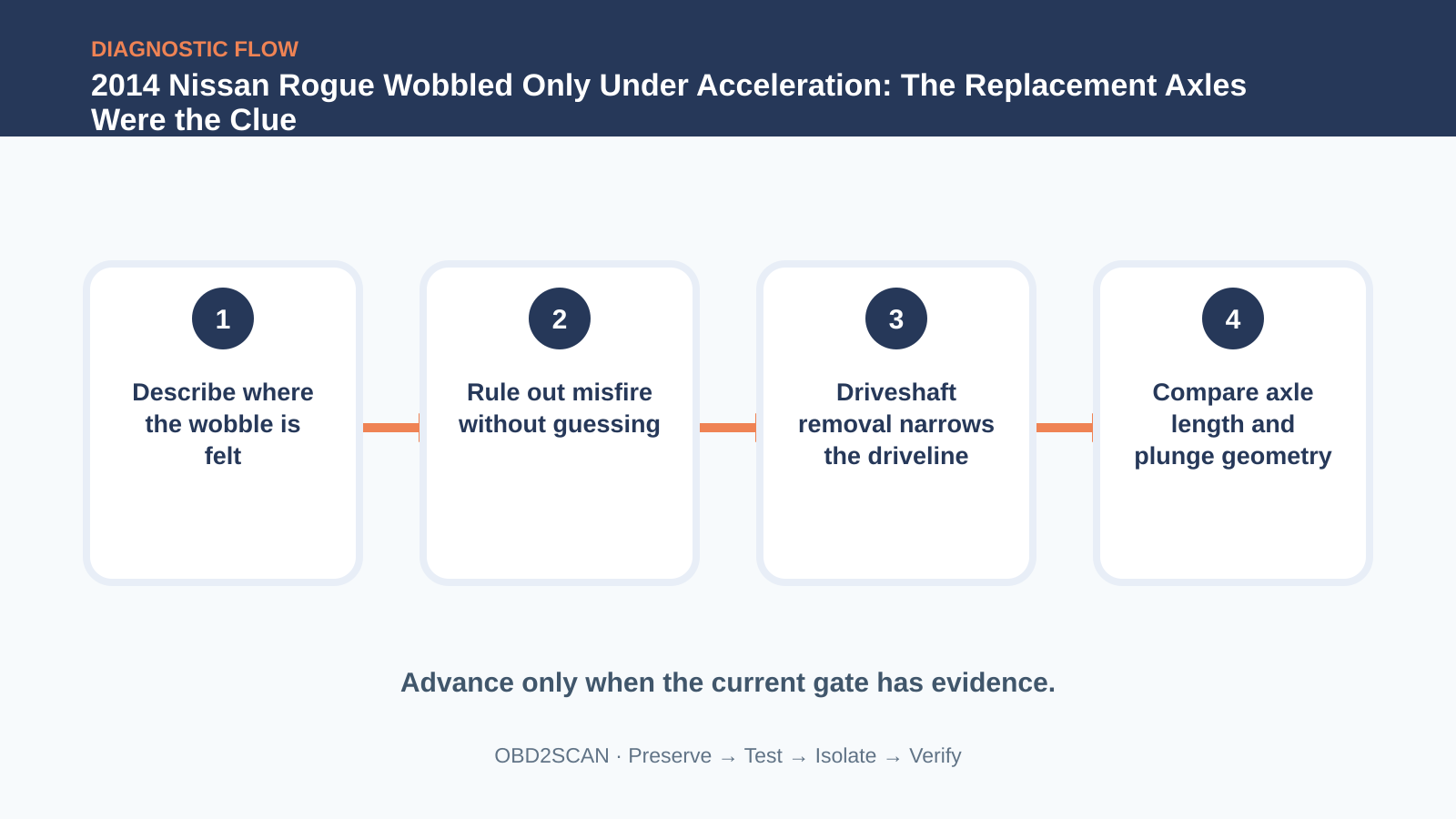
- Describe where the wobble is felt
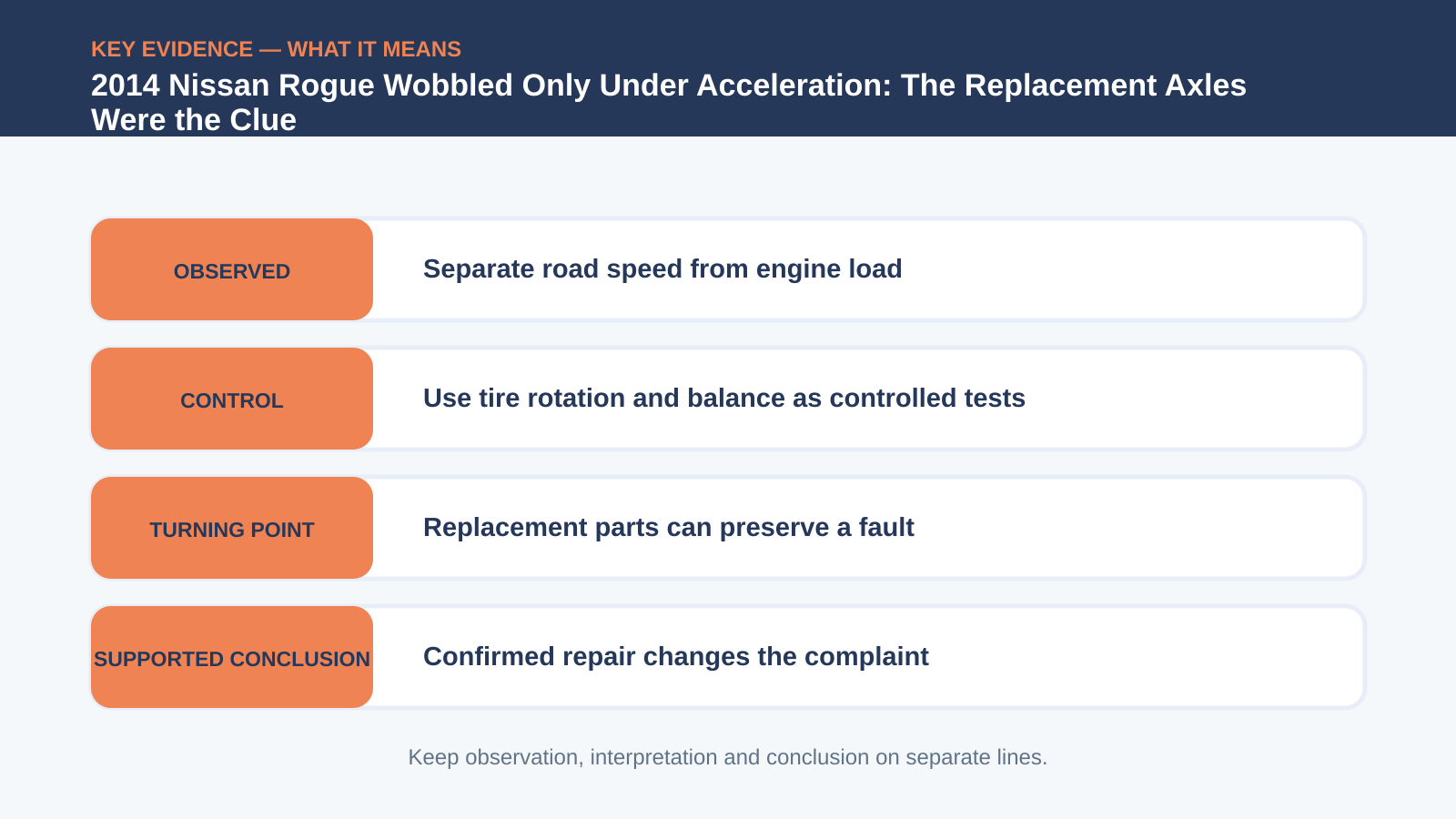
- Separate road speed from engine load
- Rule out misfire without guessing
- Use tire rotation and balance as controlled tests
- Driveshaft removal narrows the driveline
- Replacement parts can preserve a fault
- Compare axle length and plunge geometry
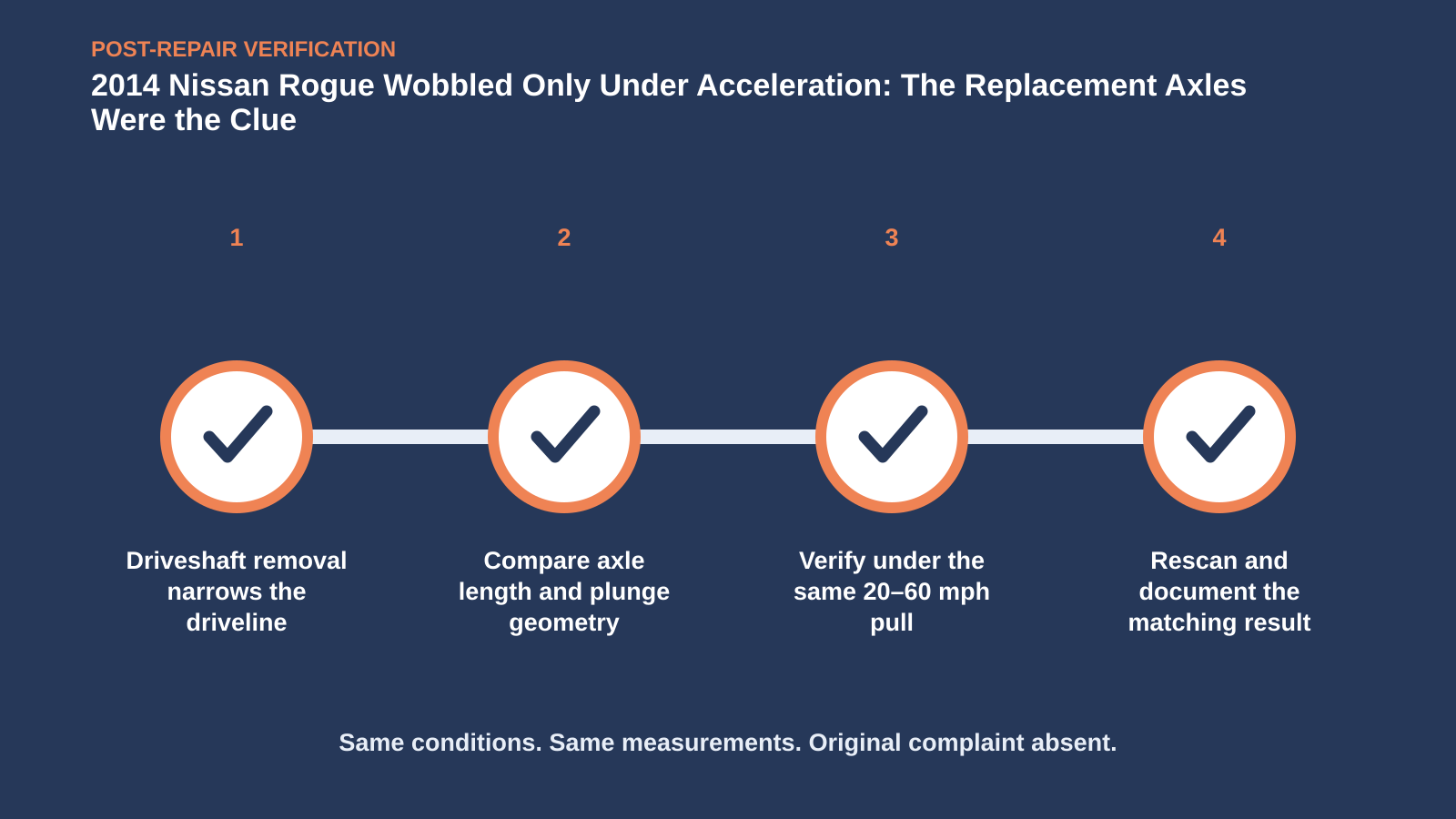
- Verify under the same 20–60 mph pull
Describe where the wobble is felt
Describe a vibration by condition and location before naming a part. This Rogue wobbled through the floor from about 20 to 60 mph under acceleration, not chiefly through the steering wheel. Note whether it changes on coast, steady throttle, gear ratio or engine speed. Preserve the original condition before changing it. The first observation is the control sample against which every later test must be compared.
Separate road speed from engine load
A load-only shake differs from a wheel-speed vibration that persists while coasting. Compare equal-speed acceleration, cruise and lift-off on a safe route. Check for misfire counters and engine response, but do not replace ignition parts simply because the engine is supplying the load. Use service information for the exact engine, build date and options. A correct method on the wrong terminal can create a precise but useless result.
Rule out misfire without guessing
Engine mounts, control arms and repeated axle replacements had not fixed the car. Build a matrix of what changed and what stayed constant. Prior parts are not automatically good, particularly when the same dimensional error exists across aftermarket assemblies. Treat prior work as evidence, not blame. A repair that made no change can narrow the case when its installation and test conditions are verified.
Use tire rotation and balance as controlled tests
Tire inspection, rotation and balancing are still valuable because they can confirm or move down a common branch. Record road force or imbalance where available. A successful balance does not certify CV-joint plunge or explain why the wobble stops the moment torque is removed. At this stage, separate what was observed from what is inferred. The observation should remain true even if the current theory is later rejected.
| Observation | What it supports | What it does not prove |
|---|---|---|
| Wobble only under load | Torque-dependent branch rises | Wheels are balanced |
| Balance/rotation no change | Simple imbalance is less likely | Every tire is good |
| Aftermarket axles are shorter | Geometry differs | Length alone proves cause |
| OEM axles end wobble | Installed geometry was causal | All aftermarket axles are wrong |
Driveshaft removal narrows the driveline
Removing the propeller shaft did not eliminate the symptom, reducing the rear-driveline theory. Such a test must follow Nissan procedure and must not create an unsafe operating condition. Use every change to divide the system rather than to generate another expensive guess. This is the decision point in the documented case. Its value comes from changing one bounded condition while leaving the rest of the system intact.
Replacement parts can preserve a fault
Comparison showed the OEM front axles were slightly longer than the installed aftermarket parts. Effective length affects joint angle and plunge under torque. Catalog compatibility is not the same as measured geometry for a specific VIN, ride height and transmission. A confirmed component still needs a repair that restores sealing, support, torque, routing or terminal fit—the physical conditions that keep the fault from returning.
Compare axle length and plunge geometry
Install verified correct axles, protect seals and splines, torque axle nuts and suspension fasteners at the required condition, and inspect fluid level if a seal was disturbed. Do not force a shaft inward to compensate for a length mismatch. Reassemble protective covers and retainers before declaring success. A diagnostic shortcut must not become the next failure mechanism.
Verify under the same 20–60 mph pull
Return to the same 20–60 mph acceleration band, then compare cruise and coast. Recheck for leaks and fastener security after the drive. The floor wobble disappeared with correct OEM axles, while a balanced wheel remained only one controlled elimination step. Use the customer’s original complaint as the final specification. A cleared code, quiet bay or one good key cycle is not equivalent to reproducing and passing that condition.
If you are bringing a similar symptom to a shop, arrive with the useful conditions rather than a requested part: whether the vehicle was cold or hot, the exact speed or switch position, which warning lamps appeared, what changed after a restart, and a chronological list of earlier repairs. A short video can preserve an intermittent sound or lamp pattern, but record it only while parked or with a passenger handling the camera. Ask the technician to retain the pre-repair scan and measurements, explain the test that separated the failed path from the alternatives, and show how the original complaint was repeated afterward.
For the owner or service adviser, a useful repair explanation has three parts: what was observed, why the decisive test narrowed the fault, and which original condition passed after the repair. It should also say what the test did not prove. That boundary prevents a memorable case from becoming an automatic parts recommendation.
The wobble depended on drivetrain load, not simply wheel speed. Incorrect replacement-axle geometry remained after other branches were controlled; correct OEM axles fixed it. The reusable lesson is narrower and more valuable: Use an evidence matrix to explain why balanced tires can coexist with a load-only axle vibration.










Comments 0
Questions, fixes, and real-world diagnostic notes from readers.
Be the first to share a diagnostic result or ask a follow-up question.