
2005 Ford Focus Stuck in Third Gear: Six Tiny Brake Bulbs Explained the Transmission Codes

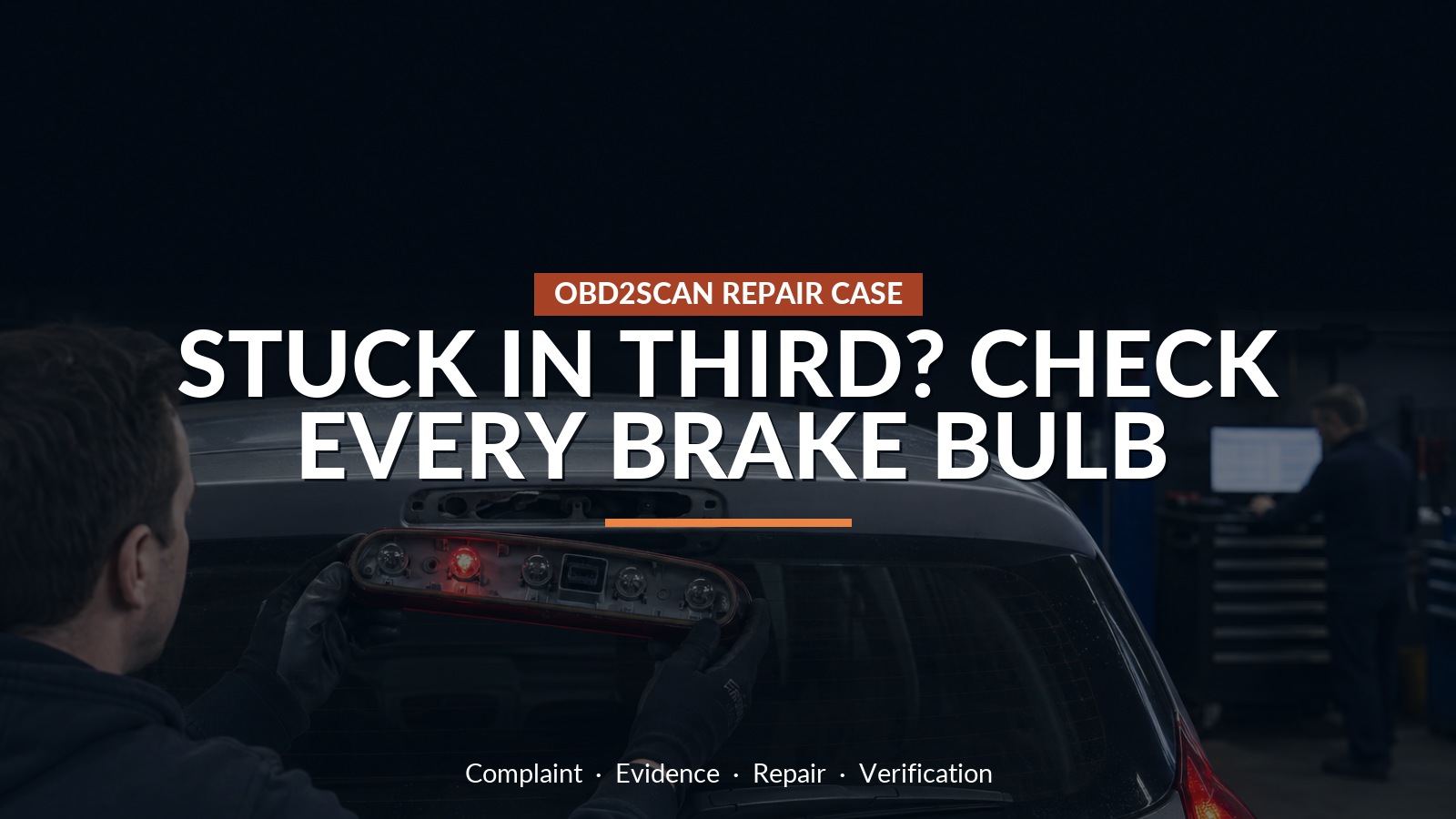
Stuck In Third? Check Every Brake Bulb
A rebuilt transmission, a default gear and two range-related codes make a convincing transmission story. One factory wiring caution and five dark brake bulbs changed that story completely.
When this diagnostic path reaches a measurement question, the useful machine type is one that answers only that question. For that supporting role, the MRCARTOOL B550 Circuit Analyzer is one practical option. A circuit analyzer can support loaded voltage, ground and bulb-feed checks on identified low-voltage lighting circuits. It must not inject power into module or data lines, and it cannot substitute for the Ford circuit map.
<strong>Quick answer:</strong> The transmission was reacting to an electrical reference problem associated with failed brake-lamp bulbs, not to another internal mechanical defect. This article follows one documented vehicle. It explains the evidence chain, not a universal failure rate or a direction to replace the same part on every similar car. Stop whenever the test would involve overheated brakes, high current, moving parts, refrigerant handling or an uncontrolled road condition.
Quick answer: The transmission was reacting to an electrical reference problem associated with failed brake-lamp bulbs, not to another internal mechanical defect.
In this guide
Default third is a protective response
Default third gear is the transmission controller protecting the car after it sees implausible information. Save P0705 and P1702, freeze-frame data and the selector complaint before clearing anything. A protective gear does not prove clutches or a rebuilt valve body have failed again. Preserve the original condition before changing it. The first observation is the control sample against which every later test must be compared.
Save the codes and compare range data
Compare commanded or selected range with the transmission-range PID through every lever position while stationary and secured. The mismatch justified testing the range circuit, but the data alone could not distinguish sensor, reference, ground, wiring or controller interpretation. Use service information for the exact engine, build date and options. A correct method on the wrong terminal can create a precise but useless result.
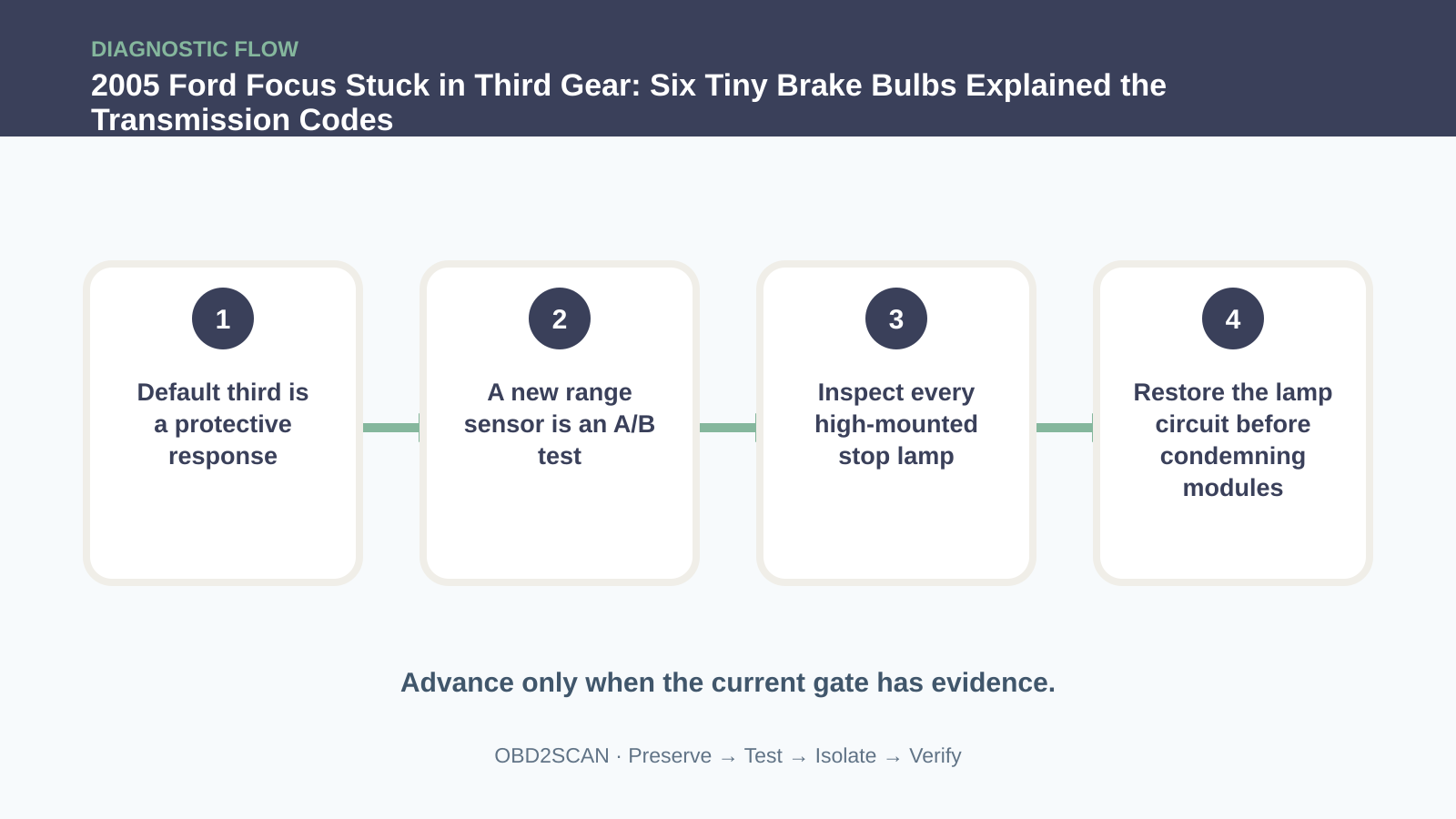
A new range sensor is an A/B test
A replacement range sensor did not change the symptom. That result has value if the correct part was installed and adjusted properly: it reduces the sensor theory. Put the known configuration back if necessary and avoid treating each remaining code word as another shopping list. Treat prior work as evidence, not blame. A repair that made no change can narrow the case when its installation and test conditions are verified.
Read the factory caution literally
Ford’s pinpoint information warned that a tail-lamp ground problem could disturb the relevant signal. This is why service-information notes matter: shared references often cross the neat boundaries implied by dashboard symptoms. Inspect the lighting operation before opening a rebuilt transmission. At this stage, separate what was observed from what is inferred. The observation should remain true even if the current theory is later rejected.
| Observation | What it supports | What it does not prove |
|---|---|---|
| P0705/P1702 return | Range/reference path remains suspect | Transmission rebuild failed |
| New range sensor no change | Sensor theory weakens | Its circuit is perfect |
| Five stop bulbs failed | Lamp load/ground is abnormal | Bulbs caused every shift issue |
| Lamp repair clears symptom | Circuit was causal here | Every Focus needs bulbs |
Inspect every high-mounted stop lamp
Only one of six bulbs in the high-mounted stop lamp worked. Check every socket, filament, contact and specified bulb rather than accepting one illuminated section as proof. A lamp assembly can partly light while its electrical load and ground behavior remain far from intended. This is the decision point in the documented case. Its value comes from changing one bounded condition while leaving the rest of the system intact.
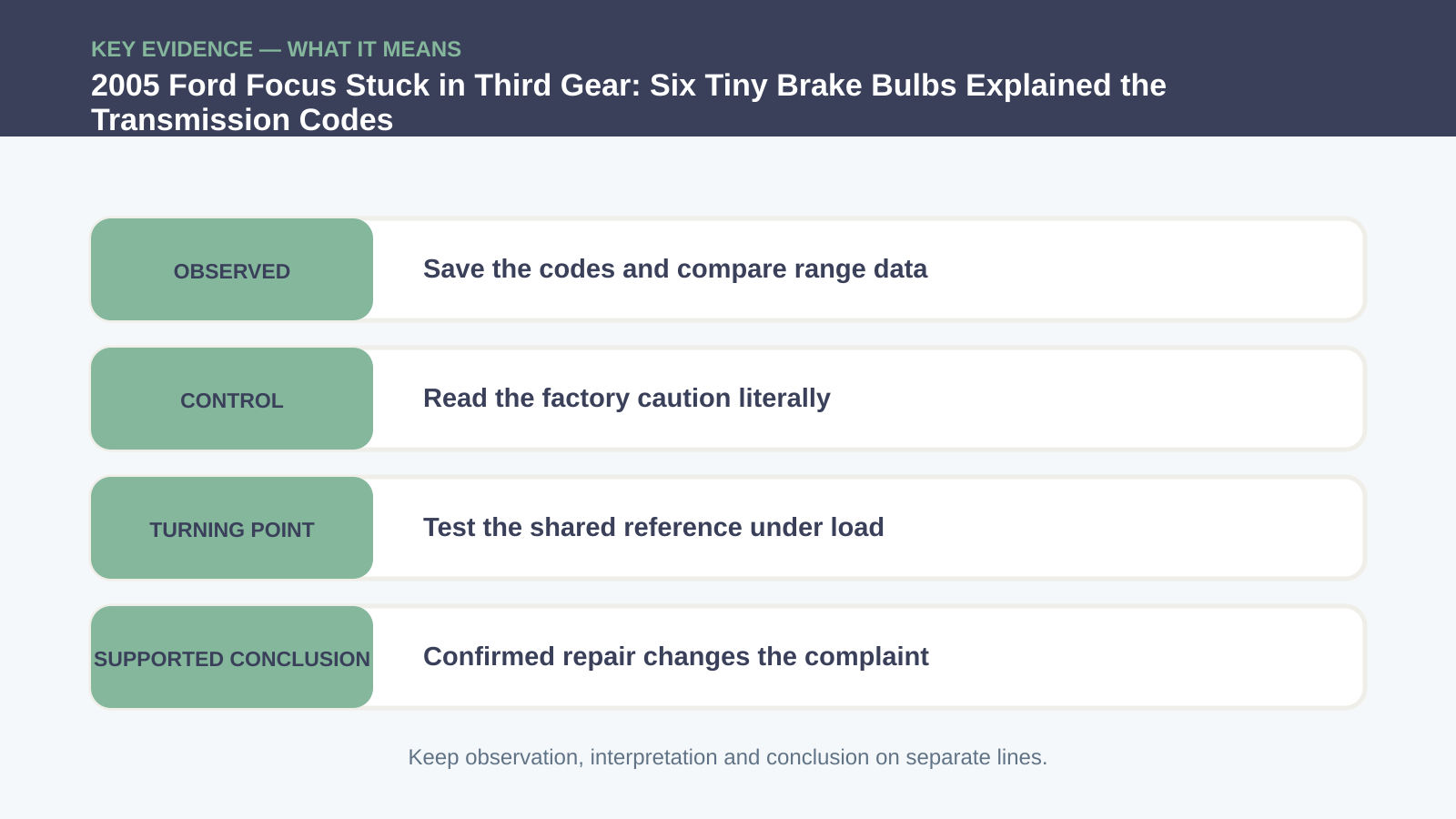
Test the shared reference under load
Measure voltage drop on the identified feed and ground with the brake lamps commanded on. A powered probe can help on a verified lighting circuit, but never inject voltage into a sensor reference, network or transmission-module pin. Restore the designed bulb load before interpreting range data again. A confirmed component still needs a repair that restores sealing, support, torque, routing or terminal fit—the physical conditions that keep the fault from returning.
Restore the lamp circuit before condemning modules
Install correct bulbs, repair terminals if heat or corrosion is present, and confirm all stop lamps illuminate evenly. The repair in this Focus was the lamp-circuit restoration, not another transmission component. Clear the codes only after saving the pre-repair record. Reassemble protective covers and retainers before declaring success. A diagnostic shortcut must not become the next failure mechanism.
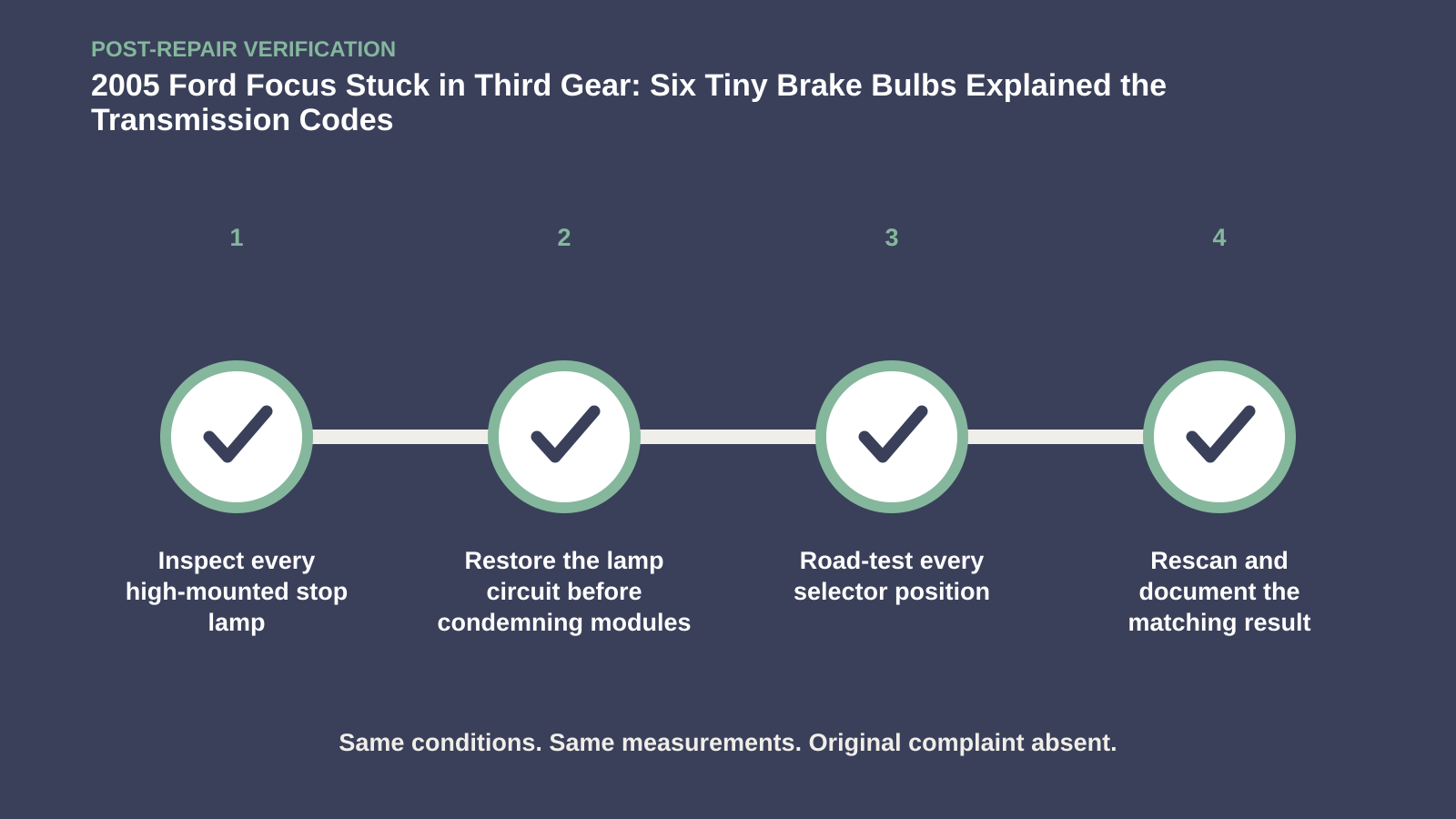
Road-test every selector position
Operate the selector through all positions, verify the displayed range, apply the brake lamps repeatedly and road-test every commanded shift. Rescan for P0705 and P1702. Normal shifting plus complete lighting and no returning codes closed both halves of this seemingly unrelated case. Use the customer’s original complaint as the final specification. A cleared code, quiet bay or one good key cycle is not equivalent to reproducing and passing that condition.
If you are bringing a similar symptom to a shop, arrive with the useful conditions rather than a requested part: whether the vehicle was cold or hot, the exact speed or switch position, which warning lamps appeared, what changed after a restart, and a chronological list of earlier repairs. A short video can preserve an intermittent sound or lamp pattern, but record it only while parked or with a passenger handling the camera. Ask the technician to retain the pre-repair scan and measurements, explain the test that separated the failed path from the alternatives, and show how the original complaint was repeated afterward.
For the owner or service adviser, a useful repair explanation has three parts: what was observed, why the decisive test narrowed the fault, and which original condition passed after the repair. It should also say what the test did not prove. That boundary prevents a memorable case from becoming an automatic parts recommendation.
The transmission was reacting to an electrical reference problem associated with failed brake-lamp bulbs, not to another internal mechanical defect. The reusable lesson is narrower and more valuable: Let an overlooked factory caution connect two systems that initially look unrelated.








Comments 0
Questions, fixes, and real-world diagnostic notes from readers.
Be the first to share a diagnostic result or ask a follow-up question.