
BMW 330e Valvetronic Codes Without a Final Repair: What the Evidence Actually Proved

Valvetronic Codes: Know What Is Still Unproved
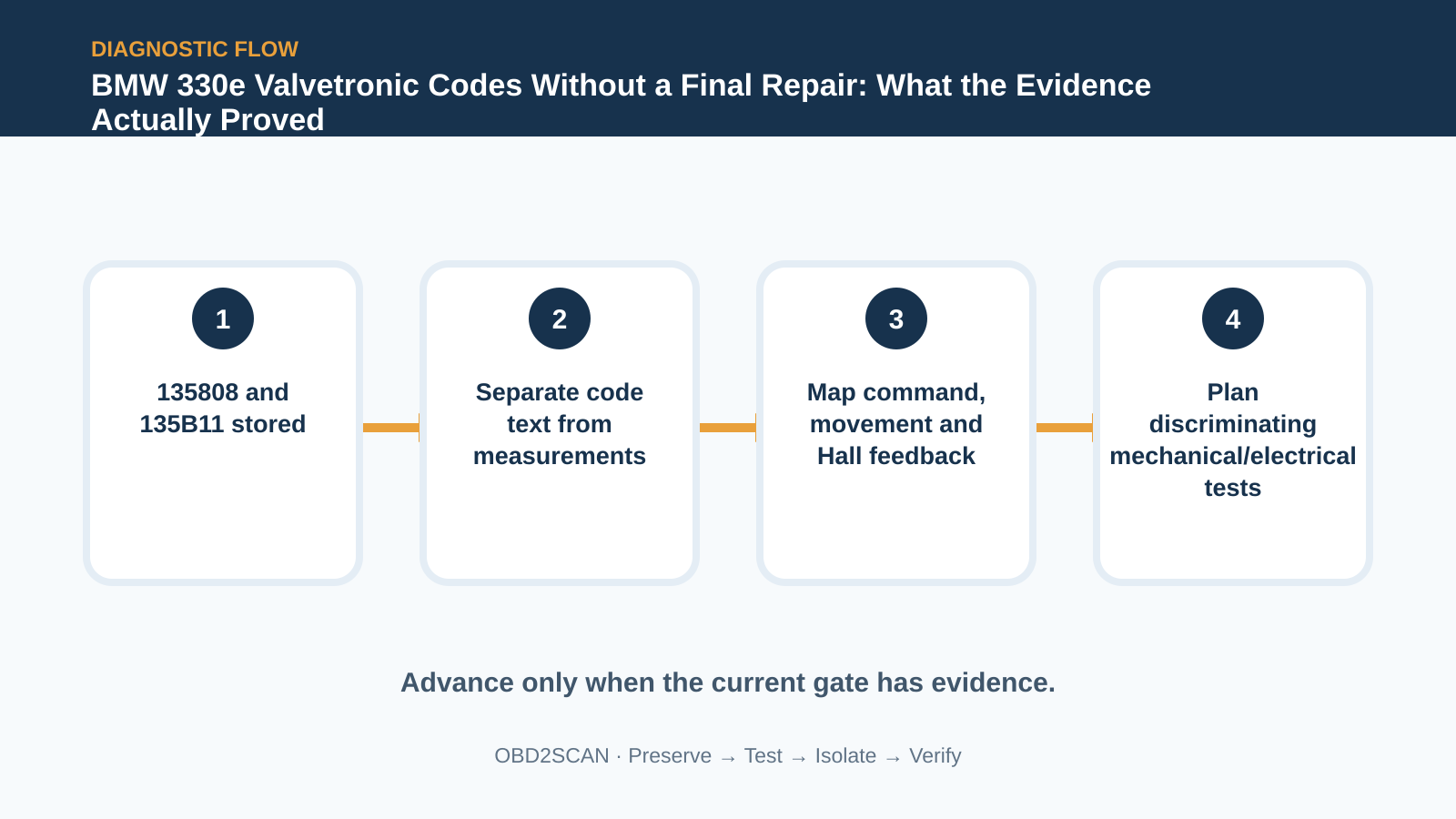
This BMW 330e case does not end with a replacement part. That is precisely why it is worth studying. Codes 135808 and 135B11, winding imbalance, fixed Valvetronic position values and an unexpected voltage created several plausible branches—but the vehicle left before one became a confirmed failure.
The early questions include bounded low-voltage resistance, voltage and signal checks at identified points. A diagnostic meter such as the AUTOOL DM303 can support those individual questions after BMW information defines the circuit. DM303 can support bounded low-voltage resistance, voltage and one-channel signal checks at identified points. It cannot reproduce the eight-channel phase-current and five-Hall-sensor capture used for full Valvetronic analysis, measure energized milliohms by guess or replace BMW test plans.
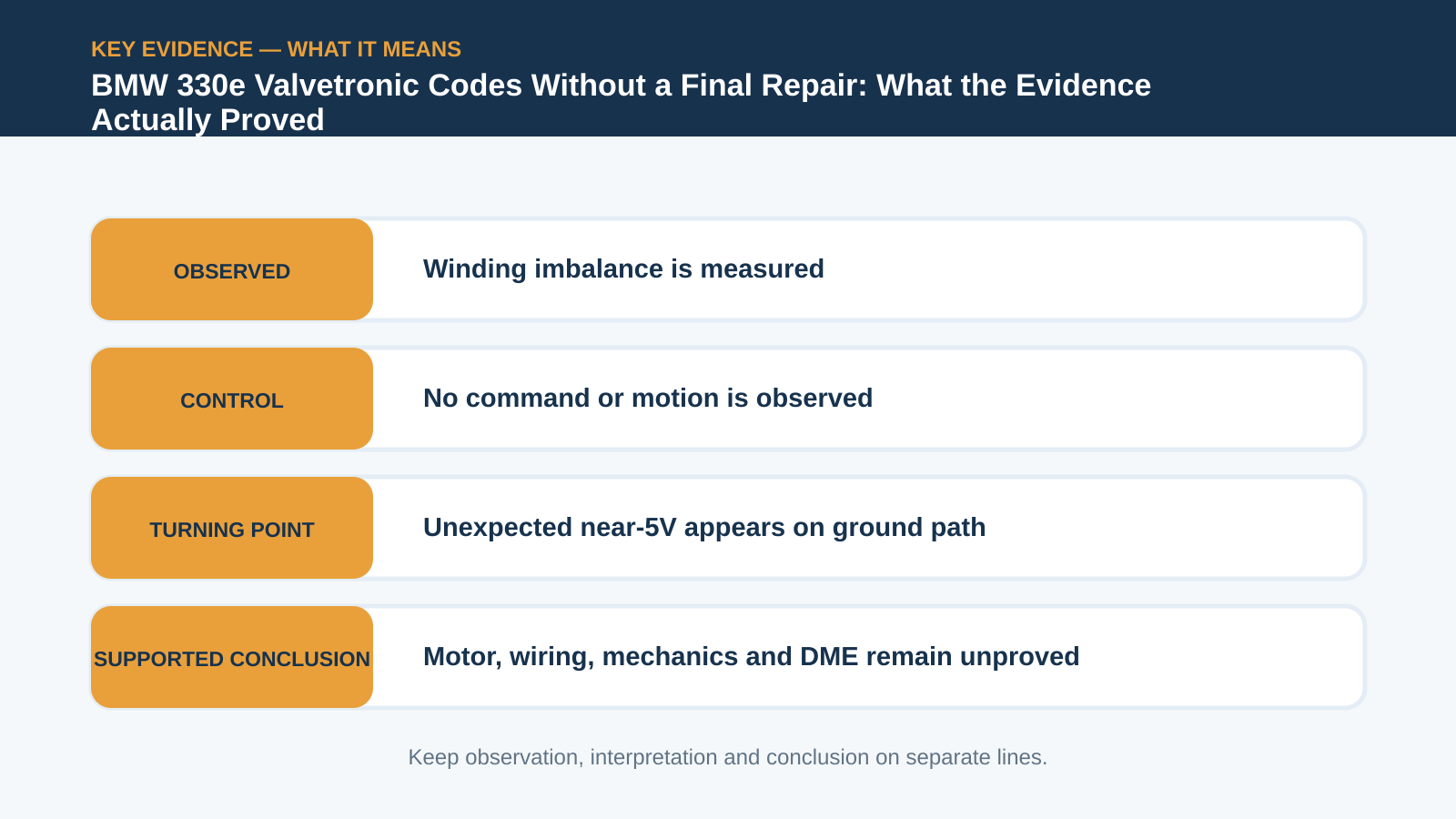
The published evidence proved that code wording and measurements did not align neatly. It did not prove a seized motor, failed eccentric mechanism, open phase, harness fault or DME. The useful outcome is an evidence ledger and a next-test plan that can discriminate among permission, three-phase drive, Hall feedback and mechanics.
Quick answer: The investigation proved winding imbalance, no observed command or motion and an unexpected voltage—but not a failed motor, mechanism or DME.
In this guide
- An unfinished diagnosis can still be useful
- Translate 135808 and 135B11 cautiously
- Winding imbalance is not the same as an open phase
- No command and no motion leave several branches
- Treat the unexpected five volts as a question
- Build the next test around mechanics, permission and wiring
- Use known-good Valvetronic behavior as the control
- Do not call the case repaired until movement is verified
An unfinished diagnosis can still be useful
An illuminated engine warning led to 135808 for faulty Valvetronic position operation and 135B11 describing an open phase in the actuator circuit. Save BMW and generic descriptions because wording can differ, along with live data and operating conditions. Do not activate the mechanism with covers removed or hands near the valvetrain. The Valvetronic servomotor is a three-phase device with integrated position sensing and reduction gearing; familiar two-wire motor shortcuts do not apply. The first job is to translate each code into a testable condition, not a part name.
Translate 135808 and 135B11 cautiously
A motor tester found winding imbalance, but not the literal open circuit suggested by the code text. That contradiction is information. Compare all phase-to-phase values at controlled temperature using equipment suitable for low resistance, zero the leads as required and inspect connectors before interpretation. An imbalance can support internal winding or connection differences; it does not by itself prove the motor cannot move under control. Conversely, a code description can reflect what the controller inferred during one event rather than the static state found later.
Winding imbalance is not the same as an open phase
Live data showed commanded and actual Valvetronic positions fixed near 254 degrees, with no observed command or movement. Several branches remain: the DME may be withholding command because of fail-safe conditions, the drive stage may not switch, the motor may be seized, the eccentric shaft may be mechanically stuck, or feedback may be invalid. “No movement” does not separate them. Check battery support, all prerequisite faults and the exact activation conditions before asking the hardware to respond.
No command and no motion leave several branches
The actuator contains five Hall-effect signals: three relate to rotor commutation and two form position feedback for the eccentric shaft. Full analysis can require simultaneous phase-current and sensor captures through start, idle, shutdown and reset. In the original investigation, an unexpected near-5-volt reading appeared on a black wire expected to terminate at DME ground. Treat that as a question about reference, ground strategy, connector state and measurement point. Do not ground it manually. A mislabeled or controller-biased circuit could be damaged by that assumption.
| Published evidence | Supported statement | Still open |
|---|---|---|
| 135808 and 135B11 stored | DME detected Valvetronic operation/circuit concerns | Which physical part failed |
| Phase resistance is imbalanced | Windings or connections are unequal | Literal open phase or inability to move |
| Command and actual stay near 254° | No actuation was observed in that test | Whether command was inhibited or drive failed |
| Near 5 V appears on expected return | Circuit behavior needs explanation | DME, wiring, connector state or measurement context |
Treat the unexpected five volts as a question
Build the next session around discriminating tests. First, use ISTA to identify every prerequisite and run the official test plan with stable support voltage. Second, check connector pins and low-voltage supplies/returns under the specified state. Third, capture the three phase currents and Hall signals together during a commanded reset. If current appears but the rotor and eccentric signals do not move, mechanics or motor become stronger. If there is no phase drive despite valid permission and supplies, the controller path moves upward. Each result should eliminate at least one branch.
Build the next test around mechanics, permission and wiring
A known-good Valvetronic 3 vehicle can provide pattern knowledge, but its engine, software and actuator must be comparable before numerical overlays are treated as limits. Known-good research shows how the three rotor Hall sensors correspond with phase commutation while two signals encode eccentric position through gearing. Use that architecture to ask whether sequence and direction are credible. Do not transplant an exact pulse count or voltage threshold without BMW information for the 330e. A reference teaches relationships; it does not replace specifications.
Use known-good Valvetronic behavior as the control
Mechanical checks must be planned before removing the actuator. Follow BMW procedures to relieve load, establish eccentric-shaft position and avoid uncontrolled movement. Determine whether the mechanism turns freely only by the approved method; forcing it can damage gearing or valves. Inspect oil condition and mechanical binding if the electrical command is present. If the motor is removed, preserve position and adaptation requirements. The winding imbalance makes the actuator suspicious, but suspicion should survive a controlled mechanics-versus-drive test before it becomes a repair estimate.
Do not call the case repaired until movement is verified
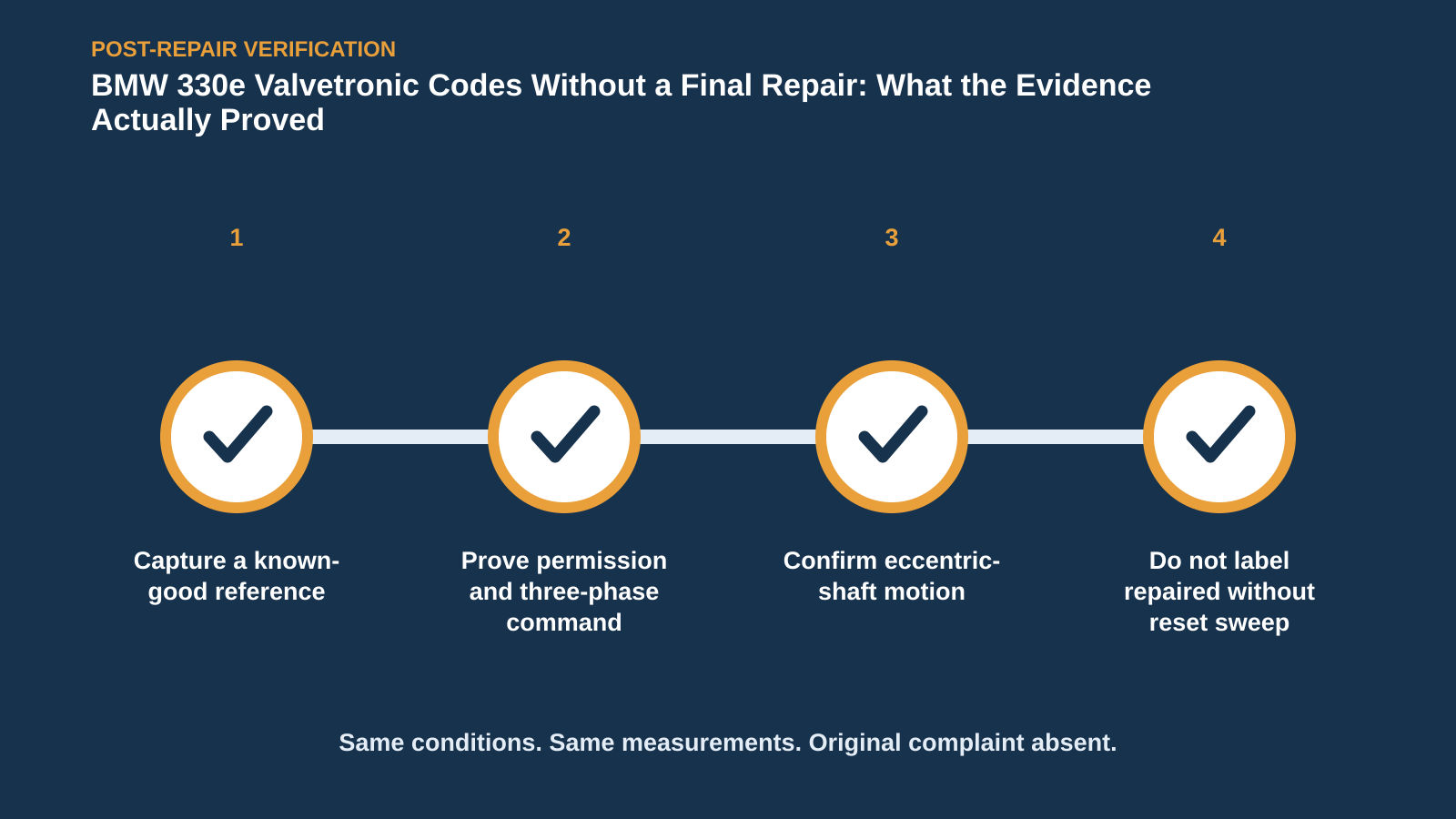
Closure would require a confirmed failed path, the corresponding repair, successful Valvetronic relearn or reset sweep, agreement between commanded and actual position, normal start/idle operation and no returning 135808 or 135B11. The source ran out of time before those events. Therefore this article does not claim that a servomotor or DME was replaced. Its value is a sharper next appointment: eight synchronized channels or an equivalent controlled strategy, known prerequisites, safe mechanical assessment and a decision table that prevents one ambiguous code from ordering an expensive part.
A responsible open case is not unfinished writing. It is a precise boundary around what the measurements proved—and a plan designed to make the next result decisive.









Comments 0
Questions, fixes, and real-world diagnostic notes from readers.
Be the first to share a diagnostic result or ask a follow-up question.