
2010 Toyota Corolla Dash Lit Up and the Tach Died: A Steering-Angle Sensor Shorted the Bus

Many Dash Lights? Find The Shared Data Path
The Corolla looked as though several systems had failed at once: warning lamps filled the cluster, the tachometer dropped out and the cooling fan ran. That crowd is often useful. Three unrelated parts rarely fail on the same key cycle, but three systems can lose the same information when a shared network is pulled down.
The first measurement need is access to the correct DLC network, power and ground pins while a compatible meter or scope observes the bus. The AUTOOL OBD2 Breakout Box Upgraded provides that physical breakout point. The upgraded OBD2 breakout box can expose specified DLC network pins, power and grounds for measurement. It cannot show the Corolla’s branch layout, calibrate a replacement steering-angle sensor or make random module disconnection safe.
A full scan confirmed a communication problem rather than separate fan and cluster failures. Module isolation restored the bus when the steering-angle sensor was disconnected. Wiring inspection supported the component, and replacement returned communication, tachometer, warning and fan behavior to normal.
Quick answer: Disconnecting the steering-angle sensor restored the bus; replacement returned the tachometer, cooling fan and warning systems to normal.
In this guide
- Treat the fan, tach and lamps as one event
- Confirm which modules have disappeared
- Check DLC power, grounds and bus state
- Use the Toyota topology to choose branches
- The steering-angle sensor restored communication when unplugged
- Inspect wiring before replacing the sensor
- Install and calibrate as required
- Verify fan, tach, warnings and full scan together
Treat the fan, tach and lamps as one event
Write the symptoms on one timeline before scanning. Did the fan start as soon as the ignition was switched on? Did the tach fall at the same instant the warnings appeared? Which gauges remained believable? Controllers may command a cooling fan failsafe when engine-temperature messages disappear, while the cluster loses rpm for the same reason. That does not mean the fan relay and tachometer failed together. Check battery voltage and main grounds because widespread undervoltage can create a similar storm, then preserve the exact warning pattern with a photo or video.
Confirm which modules have disappeared
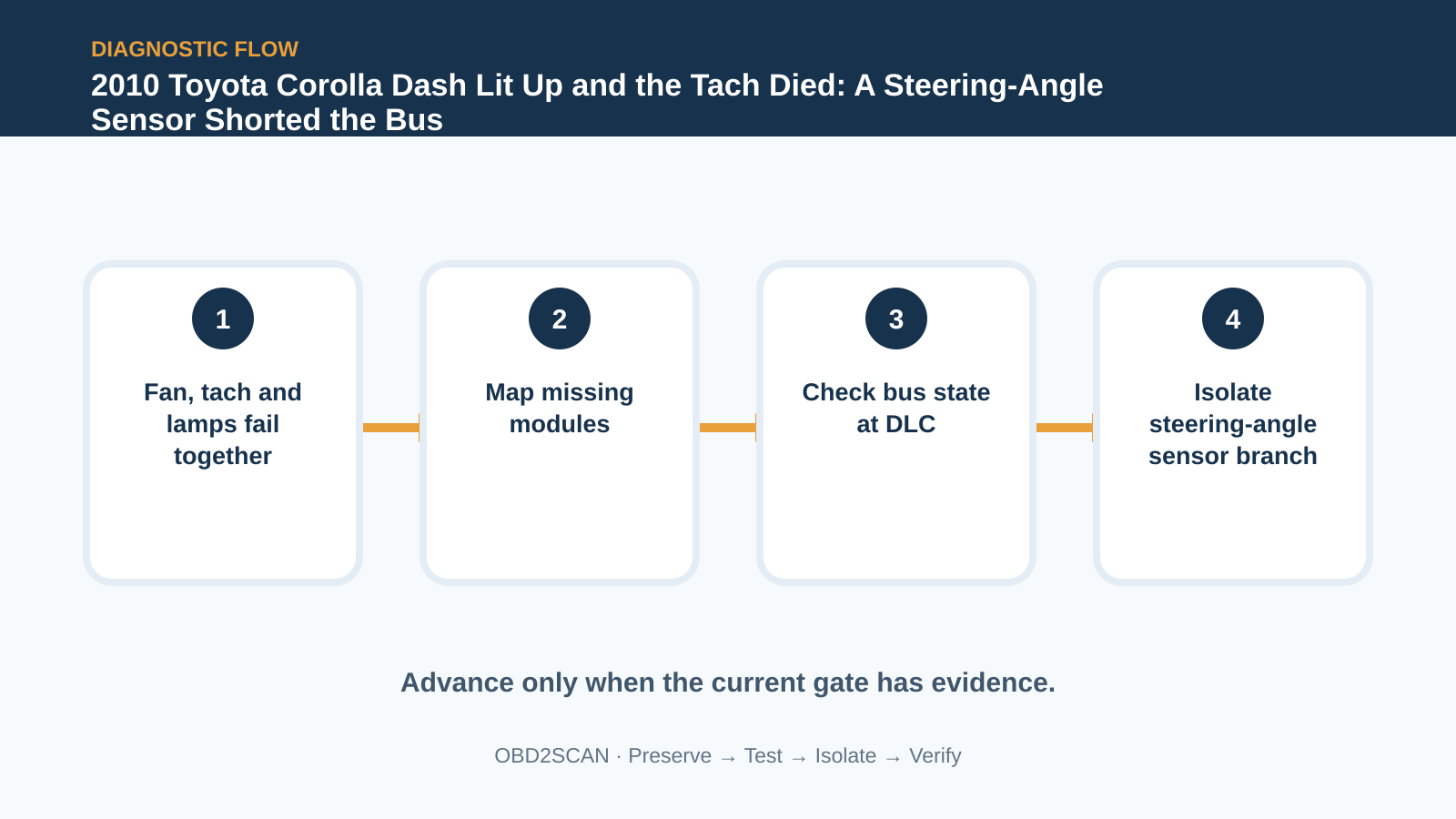
Run a complete module scan and group results by communication rather than by code count. Identify modules that answer normally, modules that are absent and controllers storing U-codes about the same missing peers. A network map from Toyota information shows which nodes share a bus and where junctions sit. If the scan tool cannot communicate with anything, also check DLC power and ground. In this case the pattern supported one collapsed network. The steering-angle sensor was not guessed from its name; it emerged from the topology.
Check DLC power, grounds and bus state
Observe the specified CAN lines at the DLC without loading them. Check that DLC powers and grounds are sound, then use a scope for waveform shape or manufacturer-approved voltage and resistance checks in the correct key state. A digital meter can average bus activity into numbers that look plausible, so a scope is preferable when distortion matters. Never resistance-test an energized bus or inject power. The breakout point makes access cleaner, but it cannot tell whether the defect is wiring, a shorted controller or a missing termination.
Use the Toyota topology to choose branches
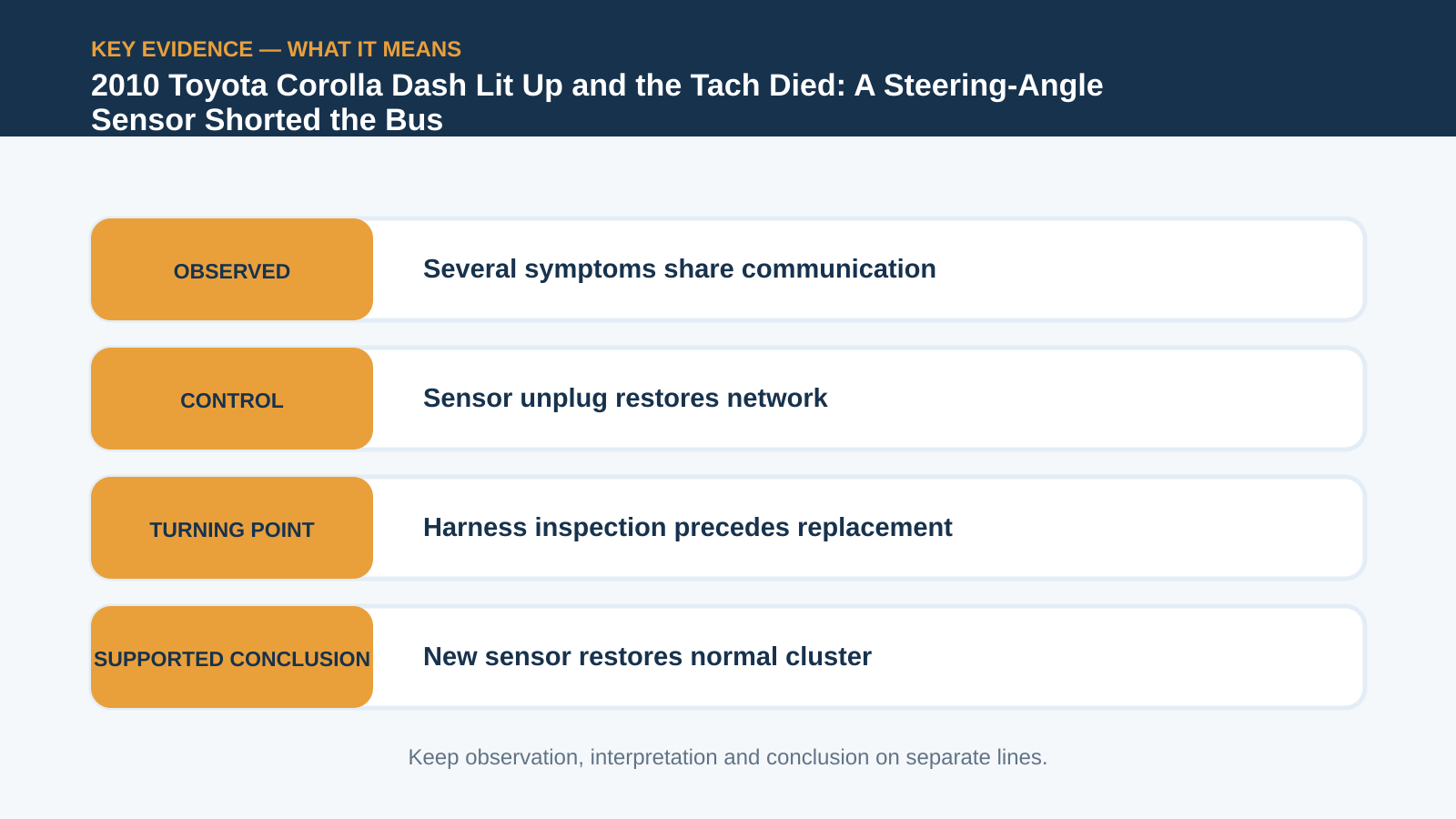
Choose isolation points from the diagram and disconnect one branch or module at a time with power managed as specified. Note the bus measurement and scan result after every change. When the steering-angle sensor was unplugged, communication returned and the broader symptom cluster changed. That is strong isolation evidence: something on that leg was pulling the network down. It is not yet proof that the sensor electronics are bad, because connector water, crushed wiring and a short between the sensor and junction can behave the same way.
| Shared symptom | Network explanation | Individual-parts trap |
|---|---|---|
| Cooling fan runs | Failsafe after temperature data disappears | Replacing the fan relay first |
| Tachometer falls to zero | Cluster loses engine-speed message | Condemning the cluster |
| Many warning lamps appear | Dependent controllers lose peers | Diagnosing each lamp separately |
| Bus returns with SAS unplugged | Fault is on that branch | Ordering the sensor before wire inspection |
The steering-angle sensor restored communication when unplugged
Inspect the steering-column area for prior repairs, strained clockspring wiring, pin damage, contamination and harness contact. Check the isolated leg for shorts and continuity only in the state Toyota specifies. Manipulate the connector while monitoring the circuit, not randomly. If wiring remains stable and reconnecting the sensor reliably pulls the network down, the sensor itself becomes supported. Record the before-and-after bus response so the part decision is reviewable. This distinction matters because column disassembly can disturb safety systems and alignment.
Inspect wiring before replacing the sensor
Replace the sensor using steering and supplemental-restraint precautions. Keep the wheels and steering position controlled, wait the specified capacitor-discharge time where applicable and do not rotate a clockspring outside its centered range. A replacement steering-angle sensor may require zero-point calibration or initialization with Toyota-capable diagnostics. Restored communication before calibration is only part of the job; stability and braking controllers need a trustworthy centered-angle value before the vehicle is driven normally.
Install and calibrate as required
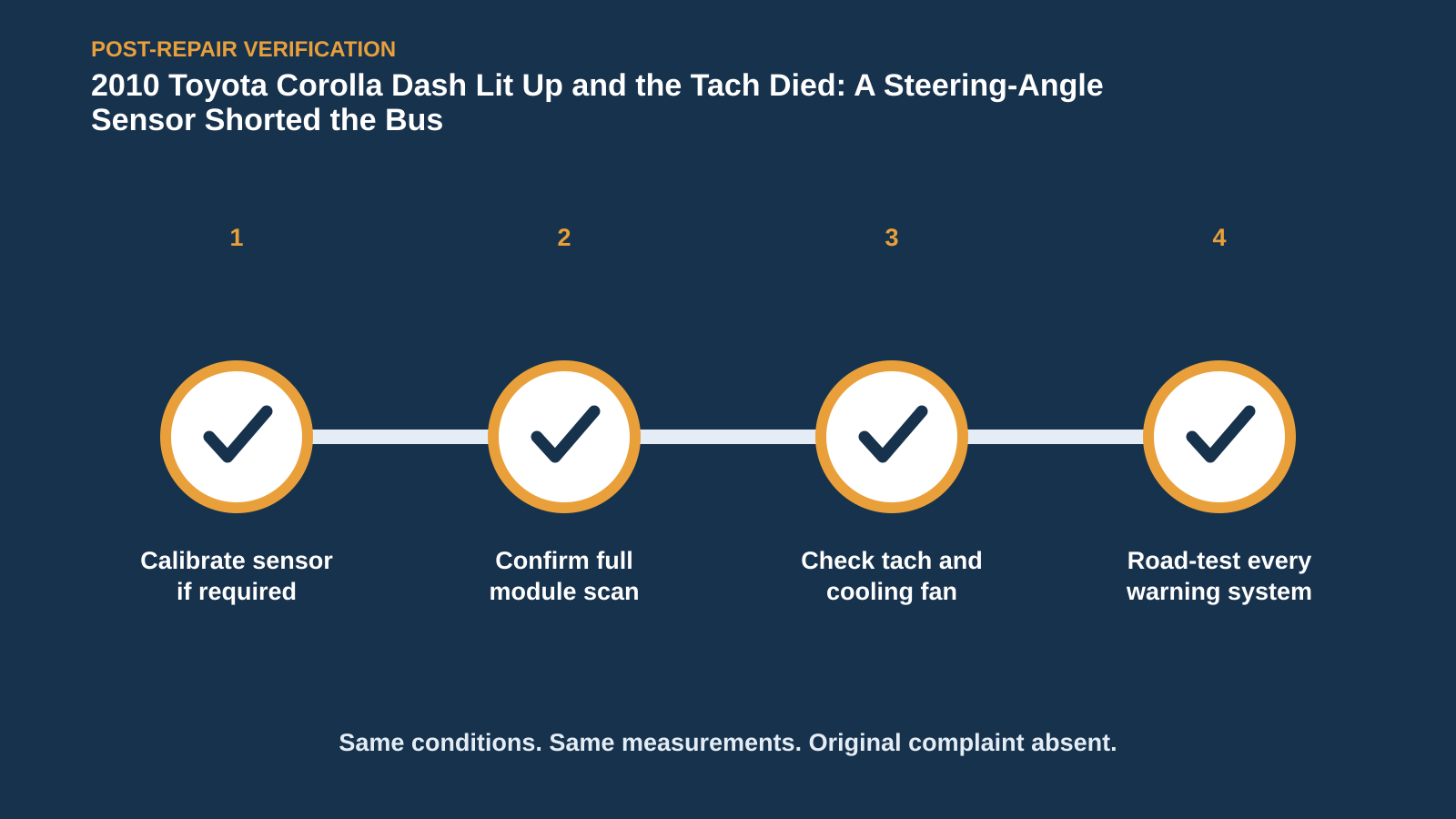
With the network restored, run a full scan and confirm every previously missing module responds. Observe steering angle through a slow lock-to-lock movement while stationary if the procedure allows, then return to center. Check that the tachometer follows engine speed, the cooling fan behaves according to temperature and the warning lamps complete normal self-check. Clear codes only after recording them, cycle the ignition several times and rescan. A cleared dashboard without full communication would be cosmetic, not closure.
Verify fan, tach, warnings and full scan together
Perform the specified calibration and a controlled road test. Verify steering angle near straight ahead, stable ABS and stability-control operation, normal gauges and no failsafe fan command. Avoid provoking stability control on public roads. After the drive, scan every network again and inspect the column trim and connectors. The reusable lesson is to value symptom simultaneity: when fan, tach and warning systems fail together, search for the information they share before buying the parts the driver can see.
The crowded dashboard was not noise. It was a dependency diagram: one shorted steering-angle sensor removed the messages several other systems needed to behave normally.







Comments 0
Questions, fixes, and real-world diagnostic notes from readers.
Be the first to share a diagnostic result or ask a follow-up question.