
2012 Nissan Sentra Lost All Four Power Locks: Load Testing Cleared the Shared Circuit

Four Dead Locks: Common Circuit Or Four Actuators?
One Sentra door lock failed, then another, then another, until none of the four responded. Four failed actuators sounds less elegant than one common wiring fault, so the shared circuit had to be challenged first. The progressive timeline and a repeated loaded test eventually made the less tidy answer credible.
A circuit analyzer can help load an identified low-voltage power or ground path instead of trusting an open-circuit voltage. The MRCARTOOL B550 is one option for that supporting test. B550 can support loaded power and ground checks on identified 9–30-volt door-lock circuits. Its power-output modes must not be used on module outputs or unknown wires, and it cannot judge latch binding or BCM strategy by itself.
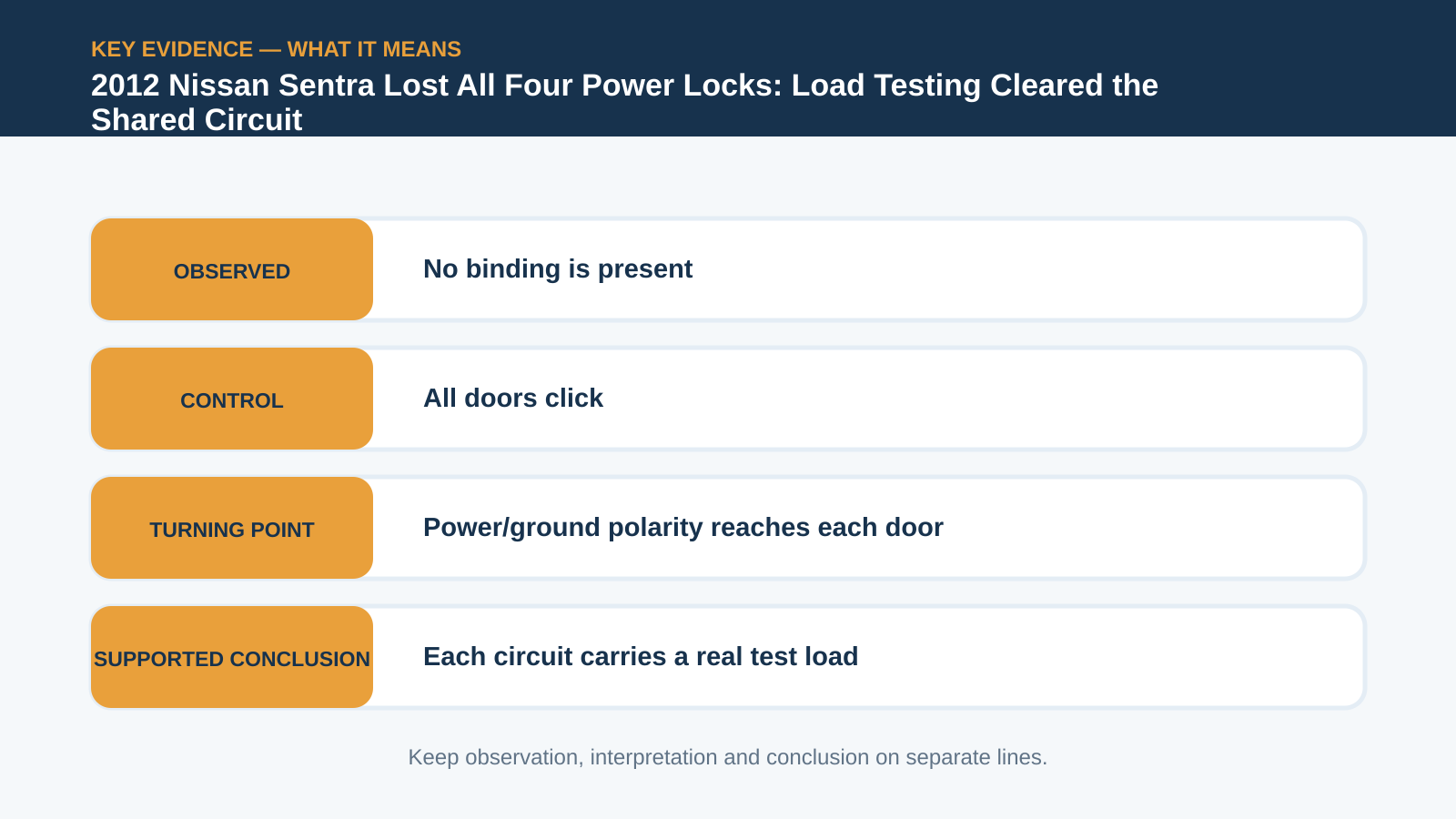
All latches moved freely by hand, no relevant DTCs were stored, and each door clicked when commanded. At every actuator connector, an incandescent test load confirmed usable power and ground in both command directions. With the shared paths proven, replacement of all four actuators restored normal operation.
Quick answer: Each door received usable power and ground under load, while every free-moving latch only clicked; all four actuators had failed progressively.

In this guide
- The order of failure was useful evidence
- Confirm manual latch movement first
- Clicks prove effort, not actuator strength
- Test command polarity at every door
- Use a load that exposes resistance
- Why four failed parts became believable
- Replace actuators without creating adjustment faults
- Verify switches, remote and every door
The order of failure was useful evidence
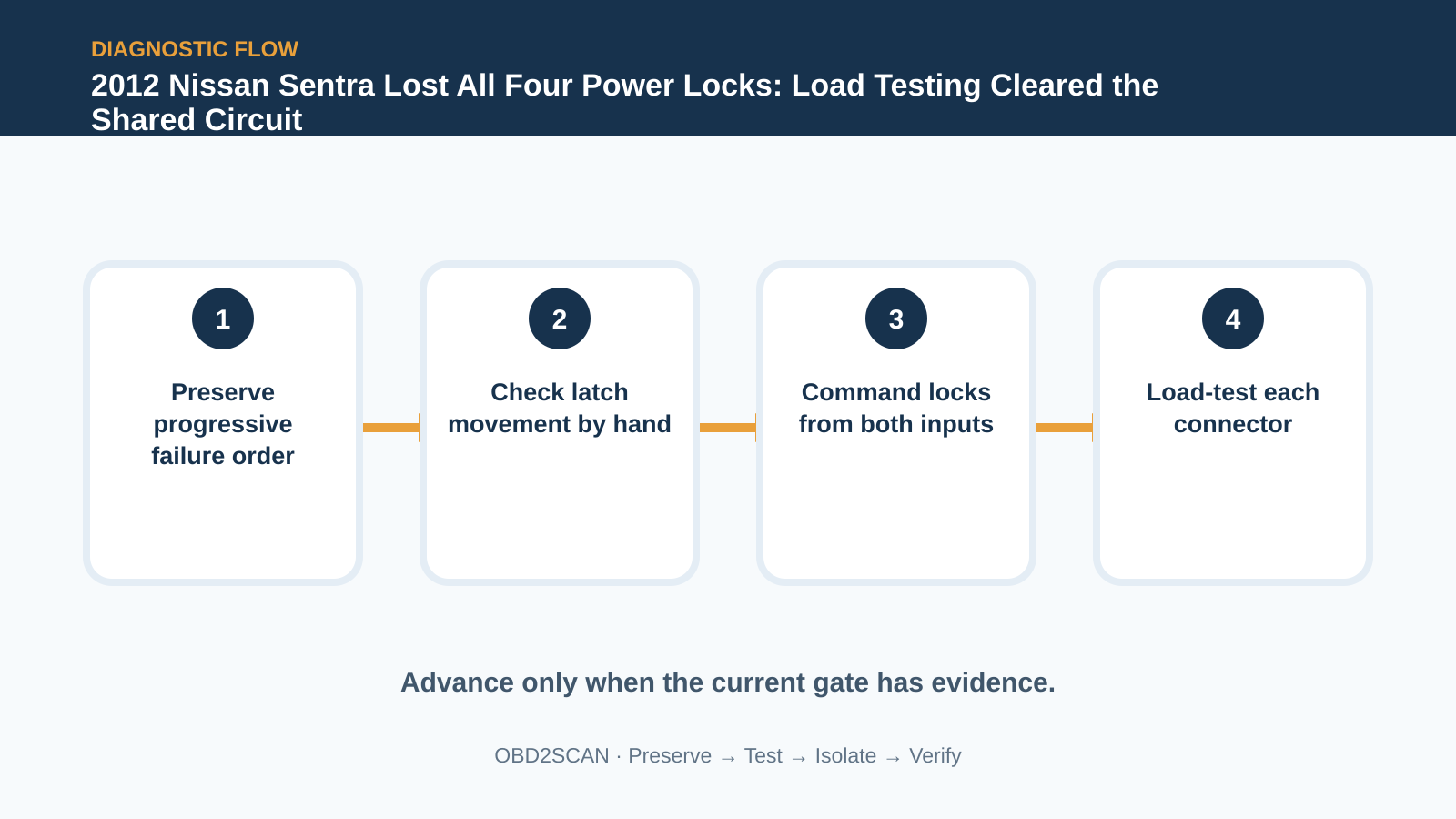
The failure order matters. A BCM or shared fuse problem often affects several doors at once, while progressive loss over time is compatible with similar actuators wearing at similar ages. Compatible does not mean proven. Ask which door failed first, whether operation became slow or noisy, and whether the remote and interior switches behave identically. Check battery voltage because weak system power can make every actuator sluggish. Preserve that chronology before trim panels are removed and connectors are disturbed.
Confirm manual latch movement first
Operate each latch manually with the door open and the vehicle secured. Mechanical binding, a misadjusted rod or frozen latch can overload an otherwise healthy actuator. All four Sentra latches moved without abnormal resistance. Inspect for water entry and prior door repairs. Keep fingers clear of powered linkages and do not close a door with the mechanism placed in a false latched position. A free manual latch removes one load problem; it does not prove the internal motor can generate force.
Clicks prove effort, not actuator strength
Clicking from each door showed that something responded to the command. It did not show that the motor completed travel or that full voltage reached it under load. Listen for a strong snap versus a faint click, compare doors, and observe the lock knob movement. A control module can reverse polarity correctly yet lose voltage through a resistive connector. Likewise, a worn motor may click as its brushes touch without producing torque. Sound is a routing clue, not a pass certificate.
Test command polarity at every door
Door-lock motors commonly receive reversed polarity for lock and unlock. Use the diagram to identify both conductors, then test both directions from the remote and master switch. A high-impedance meter may show battery voltage through corrosion that collapses when the motor is asked to work. Backprobe without damaging seals, or use correct breakout leads. Do not power unknown module outputs. The goal is to learn whether each connector can deliver and return current under demand, not to force a latch mechanically.
| Possibility | Evidence for it | Evidence against it |
|---|---|---|
| Shared fuse or BCM supply | All four doors are now dead | Each connector carries a commanded load |
| Binding latch/linkage | Actuator cannot move lock | Every latch moves freely by hand |
| Open individual door harnesses | Door motor receives no usable feed | Load passes at all four connectors |
| Four worn actuators | Failures occurred progressively; all click weakly | Unusual, so common circuits had to be cleared first |
Use a load that exposes resistance
The technician used an incandescent bulb at each actuator connector. Unlike a meter alone, the bulb demanded useful current; it illuminated as power and ground reversed with the commands. Select a load appropriate to the circuit and module—an oversized bulb can damage electronics. Compare voltage drop while the load is active and confirm terminal tension. Repeating the same test at all four doors established that the common command path and individual harness branches could do real work.
Why four failed parts became believable
Once mechanical binding and loaded feeds were cleared, four failed actuators became the simplest explanation that fit the timeline. Coincidence is not forbidden; it just carries a higher evidence burden. Similar motors share design, age, duty and environment, and one-by-one degradation is plausible. This case does not establish a fleet-wide Sentra failure rate. It shows that replacing a BCM to avoid accepting multiple worn components would have contradicted the measurements at the doors.
Replace actuators without creating adjustment faults
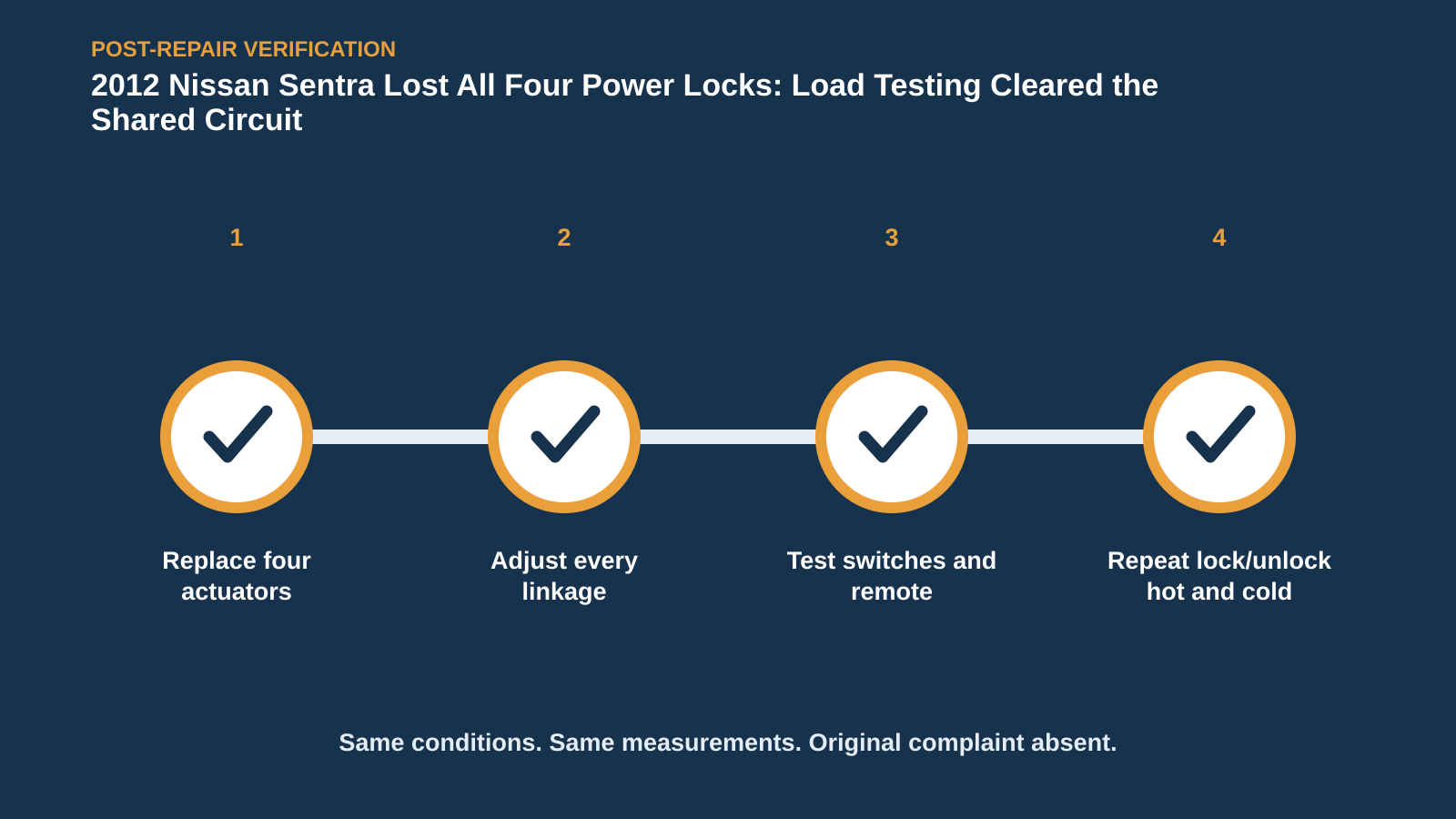
Replace the actuators according to Nissan trim, vapor-barrier and linkage procedures. Photograph rod routing before removal, protect clips, and restore water shields so the repair does not create wind noise or moisture entry. Compare old actuator current or bench behavior only with a protected setup; a free-spinning motor may behave differently from a loaded latch. Verify door alignment and child-lock function where applicable before refitting every panel.
Verify switches, remote and every door
Test lock and unlock from the key fob, driver switch and each relevant local switch. Confirm every knob completes travel with doors open and closed, the alarm recognizes state changes, and no actuator labors after repeated cycles. Check battery voltage during the sequence and rescan the BCM even though the original case stored no code. The documented repair restored all four locks, closing the question the loaded tests had already framed: the circuit could work, but the motors could not.
A common fault would have been satisfying, but the evidence did not owe the workshop a tidy answer. By load-testing every door the same way, four progressive actuator failures became a measured conclusion rather than a parts gamble.










Comments 0
Questions, fixes, and real-world diagnostic notes from readers.
Be the first to share a diagnostic result or ask a follow-up question.