
Renault C460 Misfire With No Codes: Cylinder 3 Was Losing Compression Through an Exhaust Valve

No Misfire Code? Name The Weak Cylinder
The Renault C460 shook and lacked power like a truck with a dead cylinder, yet the dashboard was quiet and the scan returned no useful misfire code. That did not leave the workshop without evidence. Every compression stroke still changed starter current, and every exhaust event still moved gas. The job was to turn one repeating weak event into a cylinder number before opening the engine.
An automotive meter/scope can support an identified cam signal or cranking-voltage reference during the first checks. The AUTOOL DM303 is one example for that bounded layer. DM303 can support an identified cam signal and cranking-voltage reference. Its single scope channel cannot reproduce the synchronized current, cam and exhaust-pulse capture used to identify the cylinder, and it cannot set valve clearance.
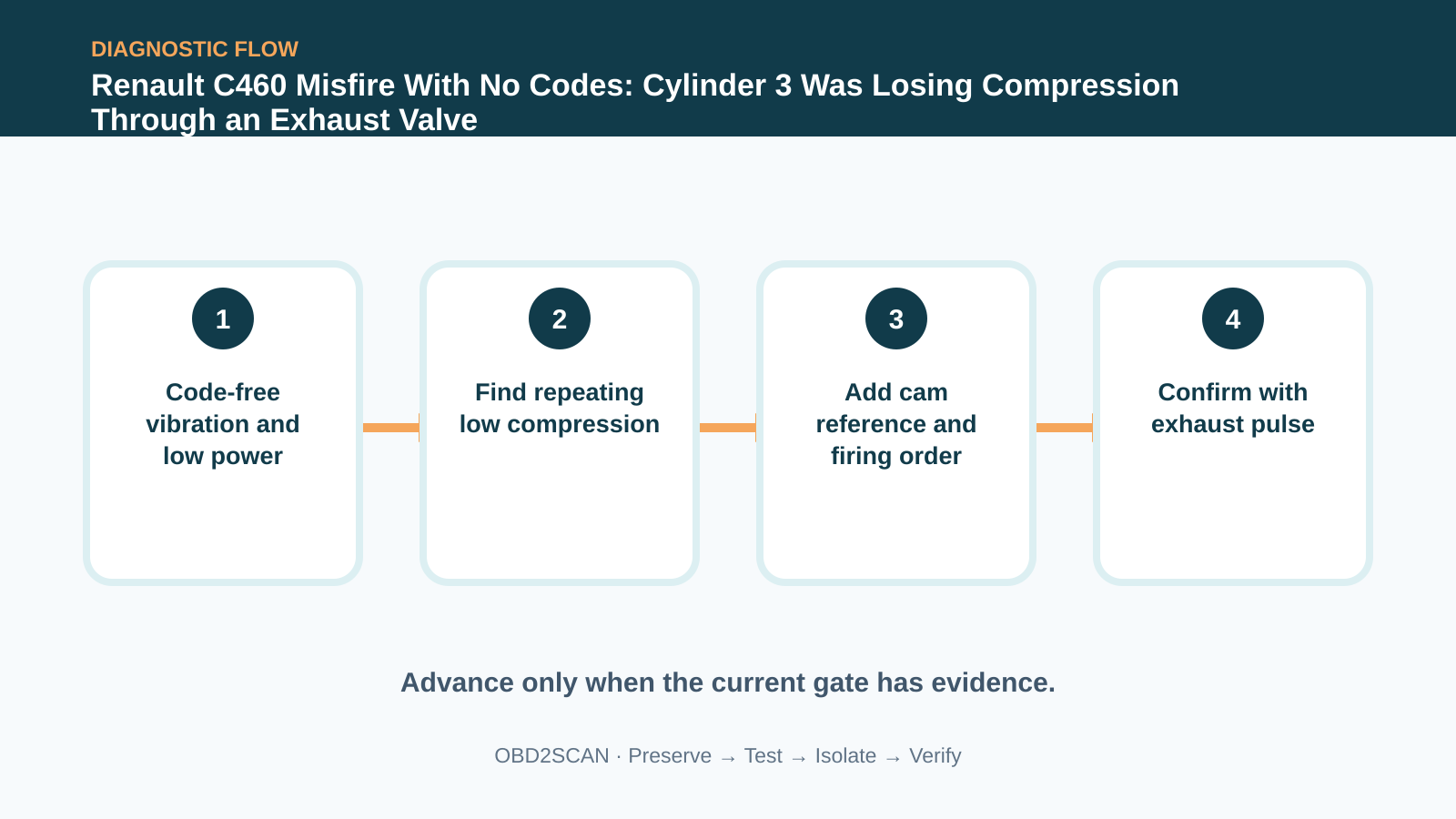
Relative compression exposed a repeating low event. A cam reference and the verified firing order placed it at cylinder three, while exhaust pulsation agreed that the cylinder leaked or breathed differently. Under the rocker cover, its exhaust adjuster had wound out and the locknut was loose, holding a valve partly open. Correcting all valve clearances and securing the adjusters restored uniform compression, exhaust pulses and smooth operation.
Quick answer: A repeating low-compression event mapped to cylinder three, and exhaust pulses agreed. Its loose adjuster held an exhaust valve partly open.
In this guide
- A code-free misfire still leaves physical evidence
- Turn starter current into a repeating cylinder pattern
- Add one trusted cylinder reference
- Use firing order to name cylinder three
- Ask the exhaust pulse to agree
- Open the cover only after the pattern converges
- Set every clearance and secure the adjusters
- Repeat compression, pulse and road behavior
A code-free misfire still leaves physical evidence
Start with a condition the technician can repeat: idle vibration, loss of pull under load, exhaust note and temperature. Save a global scan even when no warning is present; the absence of a DTC changes the path but does not validate compression, airflow or valve motion. Check oil level and quality and listen for abnormal valvetrain noise. Because this is a heavy truck, plan the test around safe parking, ventilation and lead routing. Do not road-test a severe misfire under full load merely to make it obvious.
Turn starter current into a repeating cylinder pattern
A high-current clamp around the starter supply can turn cranking effort into a cylinder pattern. Disable fueling under the approved procedure and capture several complete engine cycles at stable battery voltage. In this case, one low event repeated consistently. Relative compression ranks cylinder effort; it does not directly measure pressure or identify whether leakage passes rings, intake valve or exhaust valve. If battery speed changes across the capture, normalize the test or repeat it before assigning meaning to peak height.
Add one trusted cylinder reference
The low peak still had no name. The case used a camshaft reference and engine timing information related to the D11/D13 architecture, then applied the confirmed firing order. Any borrowed reference must be justified by matching timing architecture; similarity of engine appearance is not enough. Mark the known cam event, count through a full four-stroke cycle and calculate the cylinder positions. When available, an injector-current reference can provide a more direct identity check. Save the reasoning so another technician can reproduce cylinder three rather than accept a label on faith.
Use firing order to name cylinder three
With the pattern assigned, use the firing order as a prediction tool. If the next low event does not appear where the order says it should, reconsider signal polarity, channel delay, cylinder numbering or mechanical timing. This self-check is important on multi-bank or unfamiliar engines. Here, the repeatable low event aligned with cylinder three. That was enough to choose a focused mechanical test, not enough by itself to order a head or valve.
Ask the exhaust pulse to agree
Exhaust pulsation supplied independent agreement. Place a suitable pressure sensor according to its safety limits and capture several cycles at idle. A low-compression cylinder with an exhaust valve held open can disturb pressure before and after its expected firing event. Interpret the pattern alongside crank speed and cylinder identity; an exhaust restriction or another cylinder can affect neighbors. The point is convergence: starter effort and gas movement both directed attention to the same mechanical event.
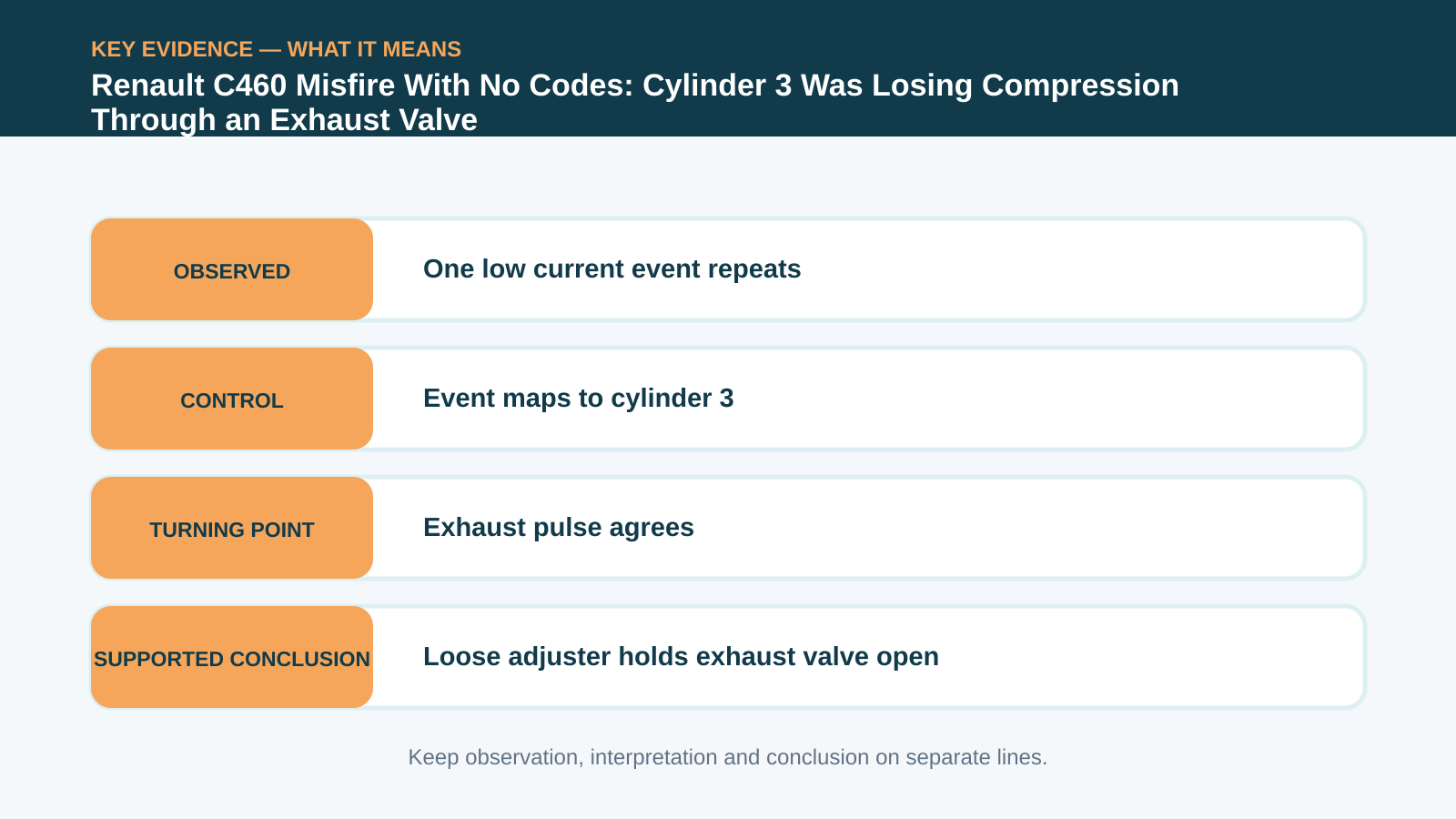
| Evidence | Result | Supported conclusion |
|---|---|---|
| Fault codes | No useful misfire DTC | Diagnosis must come from physical behavior |
| Relative compression | One repeating low event | One cylinder contributes less cranking resistance |
| Cam reference plus firing order | Event aligns with cylinder 3 | Mechanical inspection can be focused |
| Exhaust pulse | Uneven event at the same position | Exhaust-side leakage or flow fault gains support |
Open the cover only after the pattern converges
With the engine stopped and secured, the rocker cover came off. The cylinder-three exhaust adjuster had wound out, its locknut was loose and the valve was being held partly open. Inspect the valve tip, bridge, rocker, pushrod or cam interface as applicable and verify the adjuster threads are undamaged. A loose nut explains the loss of clearance, but ask why it moved: prior service, incorrect torque, wear or contamination may change the repair. Do not simply tighten the visibly loose piece and ignore every other clearance.
Set every clearance and secure the adjusters
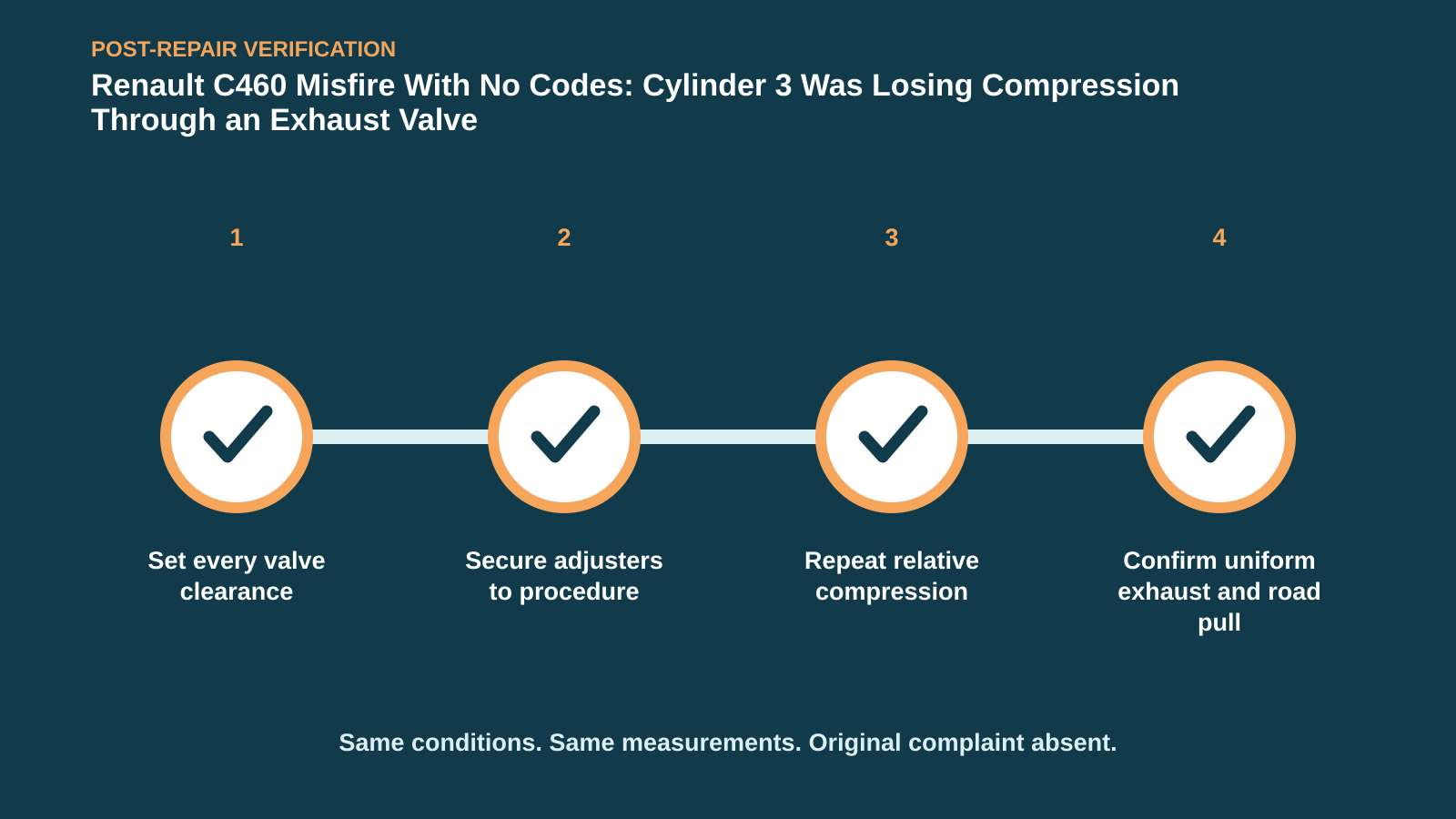
The documented repair reset all valve clearances using technical information, applied the specified retention method and torqued the locknuts. Rotate the engine and recheck the affected cylinder before fitting the cover. After starting, listen for abnormal noise and inspect for oil leaks. A component that held a valve open may have experienced heat, so any sealing concern deserves a compression or leak-down check rather than optimistic assembly.
Repeat compression, pulse and road behavior
Repeat the same relative-compression and exhaust-pulse tests. In the mature case, the cranking pattern became even, the exhaust trace uniform and the misfire disappeared; the truck returned to road service. Add a loaded drive, rescan and recheck any specified hot clearance. A smooth idle is persuasive to the driver, but matching before-and-after evidence is what demonstrates that the repaired valve event—not an unrelated warm-up change—closed the complaint.
No code named cylinder three. The cylinder named itself through a repeating current event, a trusted timing reference and the exhaust pulse. By the time the cover came off, the inspection had a destination instead of a hope.








Comments 0
Questions, fixes, and real-world diagnostic notes from readers.
Be the first to share a diagnostic result or ask a follow-up question.