
Range Rover Vogue Had 177 Fault Codes: One Broken ABS Ground Explained the Noise

177 Codes? Find The Silent Module
The Range Rover arrived with nearly every warning illuminated, no drive, one headlamp out and the powered tailgate inoperative. The global scan produced 177 faults across six pages. That number feels like 177 jobs only if the vehicle is viewed as 177 isolated computers. In a networked car, one silent controller can make many healthy modules complain at once.
An identified power or ground circuit should be tested under load, not merely checked for continuity. The MRCARTOOL B550 can support that kind of 9–30-volt circuit work. B550 can support loaded voltage, ground and continuity checks on an identified 9–30-volt circuit. Never use its power-injection function on CAN, module outputs or unidentified signal wires; it cannot perform the global scan or identify network dependencies.
The ABS module was the important non-communicating node. Its three fuses and power feeds were present, but both specified grounds failed a loaded 12-volt-lamp test. Wiring information placed the ground near the driver-front wheel arch, where removing the wheel and liner revealed a snapped connection. Repair restored ABS communication, cleared the warnings and returned the headlamp, tailgate and drive functions.
Quick answer: The ABS module was silent despite good powers. Both grounds failed under load, and a snapped wheel-arch earth explained 177 faults and several dead functions.

In this guide
- Six pages of codes are a map, not a parts list
- Find the controller everyone is waiting for
- Check every fuse but stop calling that a power test
- Load-test ABS power and grounds
- Use the wiring diagram to find the shared earth point
- Open the wheel arch only after the circuit points there
- Repair the ground for current and corrosion resistance
- Rescan every dependent function
Six pages of codes are a map, not a parts list
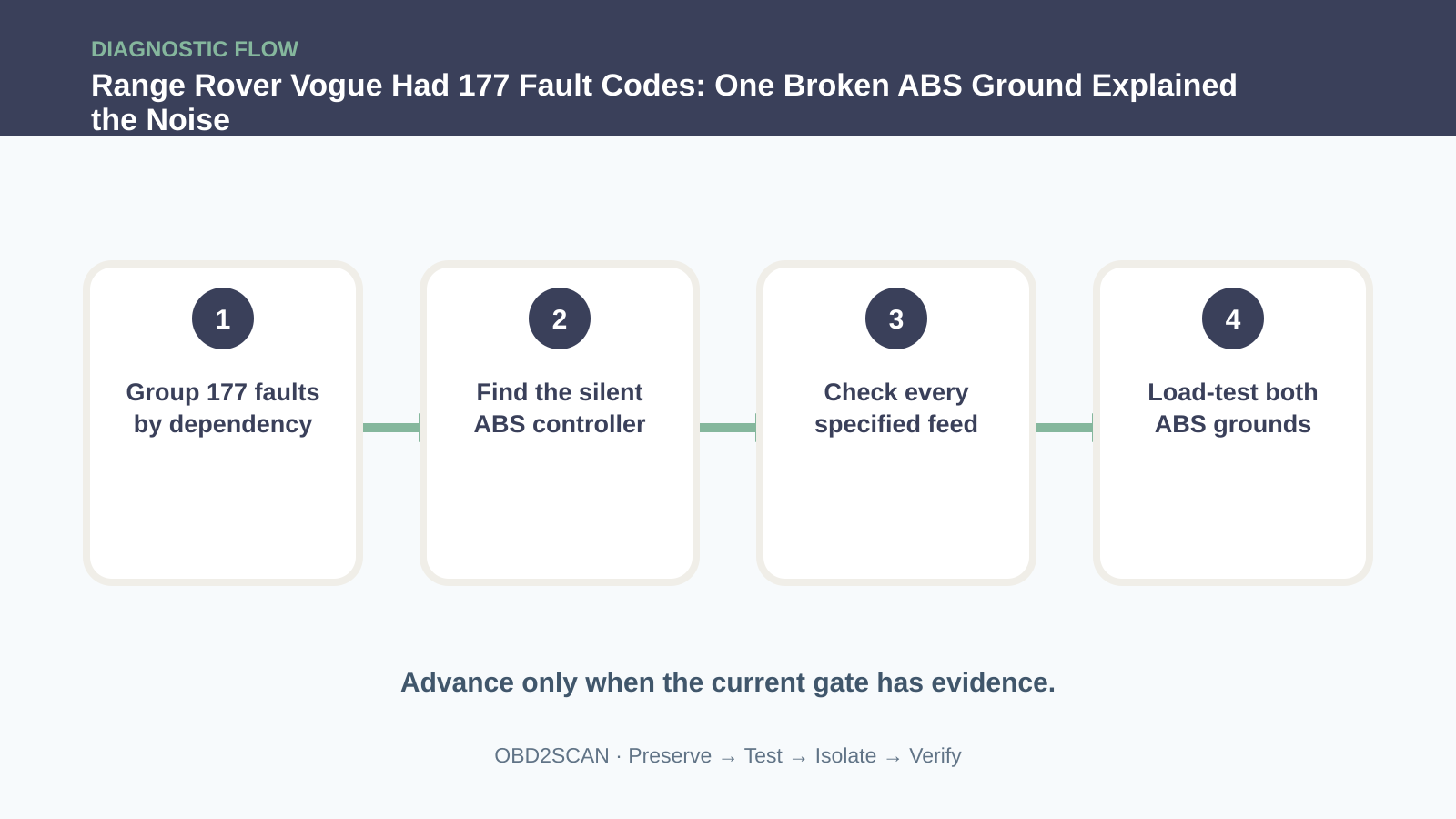
Save the full scan exactly as found. Group codes by status, reporting module and missing partner rather than reading them top to bottom. Note which controllers do not respond at all. Also record the human symptom sequence: did the warnings appear together, did drive disappear first, and which body functions failed? With no drive and safety-system warnings, move the vehicle only under approved workshop procedures. The first goal is not to clear the dashboard; it is to discover which shared dependency can explain the largest cluster.
Find the controller everyone is waiting for
Draw a simple network map from Land Rover information. A module mentioned in dozens of “lost communication with” codes is more interesting than a component named by one historical fault. In this case, ABS did not communicate. Modern vehicles use wheel-speed and stability data in transmission, engine and body decisions, so its absence can create apparently unrelated secondary complaints. That makes ABS the next test point, not an automatic order for an ABS controller.
Check every fuse but stop calling that a power test
Check all specified fuses with voltage on both sides under the relevant key state. The three ABS fuses passed, and power reached the module. A fuse inspection answers whether the element looks open; it does not prove the module can draw current through its entire supply path. Measure voltage at the connector with it loaded, inspect pin tension and compare against battery negative. Do the same for every ignition and permanent feed identified by the diagram.
Load-test ABS power and grounds
Grounds deserve the same loaded treatment. A digital meter can show near-zero volts or apparently good continuity through a corroded strand that cannot support module current. The case used a 12-volt test lamp to load both ABS grounds; neither could light it. Choose a load appropriate to the circuit and measure voltage drop while it is applied. Never bridge a module signal or network pin. Two failed grounds now explain why a powered controller remains completely silent.
Use the wiring diagram to find the shared earth point
The wiring diagram placed the earth point in the driver-front wheel-arch area. Only then did wheel and liner removal become justified. Support the vehicle safely, follow lifting procedures and inspect neighboring grounds, harness clips and water paths. The connection was physically snapped. Look for evidence of prior body work, corrosion, overtightening or movement so the repair addresses the environment rather than reconnecting a conductor into the same failure condition.
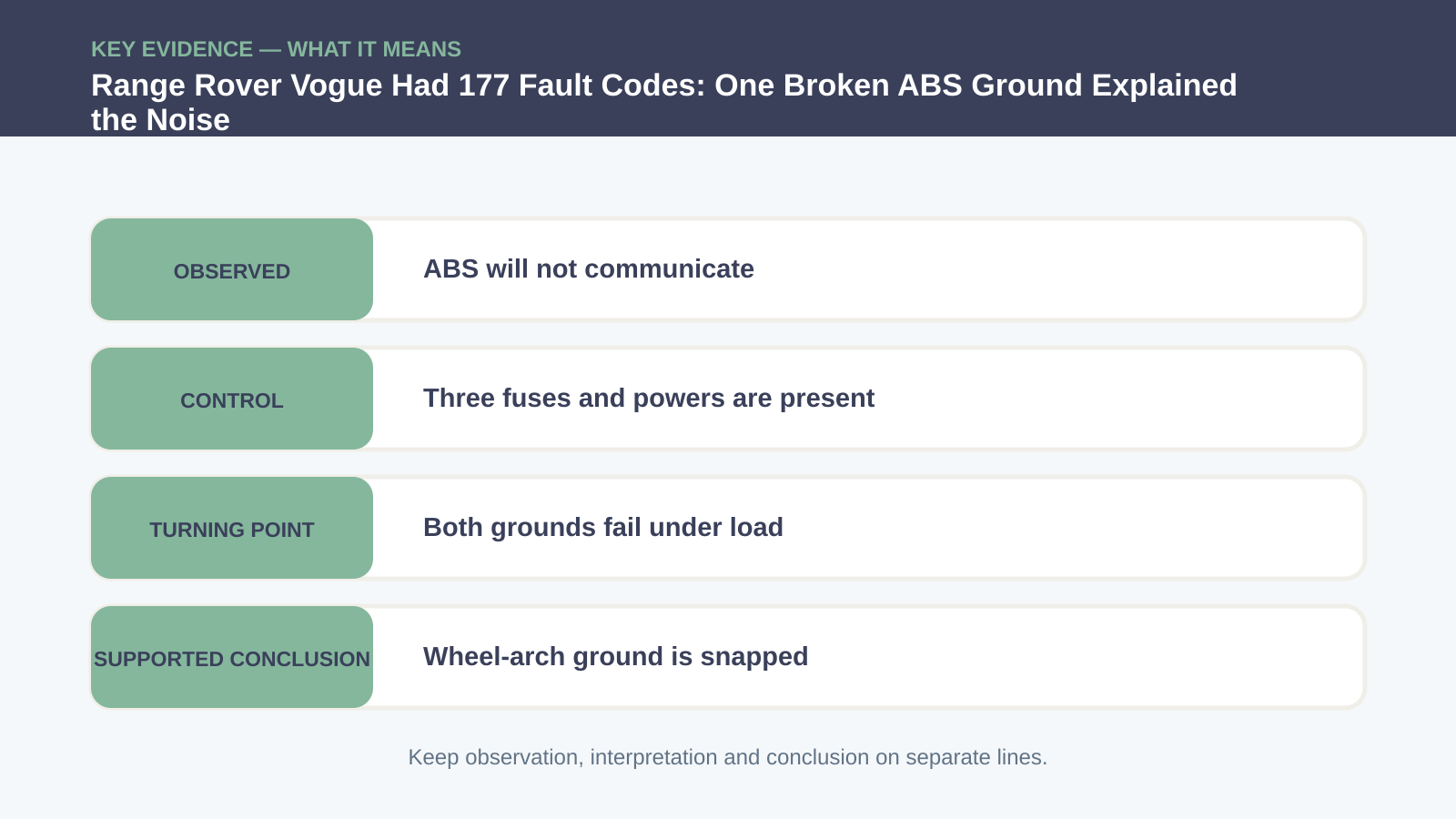
| Evidence | Interpretation |
|---|---|
| 177 faults across many modules | Widespread secondary complaints are likely |
| ABS does not communicate | One central data source is absent |
| Three fuses and power feeds pass | Move beyond the obvious supply checks |
| Both grounds fail under load | ABS cannot operate despite visible voltage |
| Snapped wheel-arch ground | Physical cause matches the loaded test |
Open the wheel arch only after the circuit points there
Restore clean conductive surfaces and the correct terminal, fastener, routing and corrosion protection. Do not stack extra grounds or move an engineered earth point without manufacturer guidance. Before reconnecting the controller, load-test the repaired path and measure voltage drop. Inspect the module connector for heat or water damage caused by the failed return. A low-resistance repair should also survive a gentle harness movement test without flicker.
Repair the ground for current and corrosion resistance
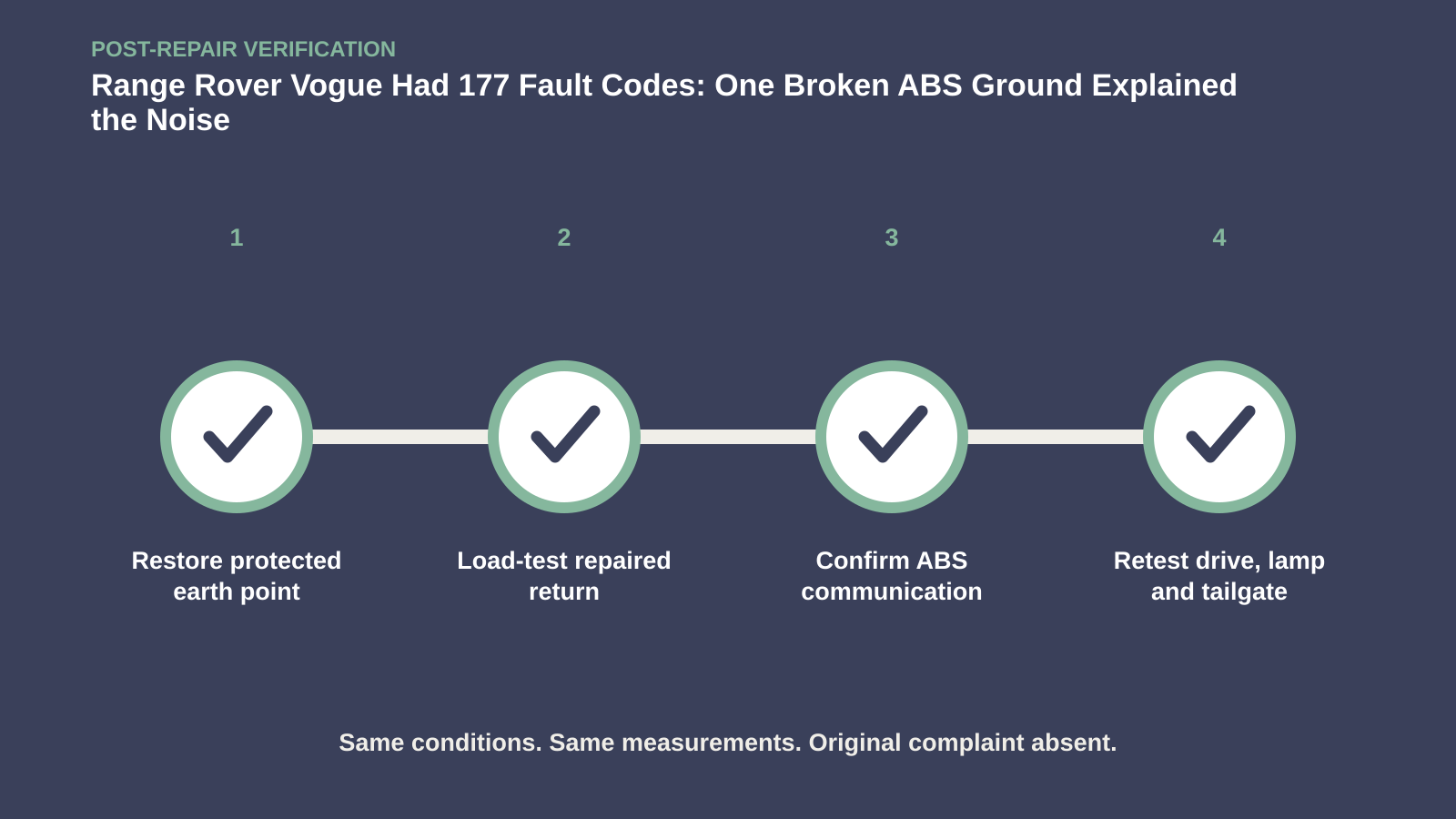
Reconnect, rescan and confirm that ABS now communicates before clearing faults. Start the vehicle and check whether drive is restored. Verify the previously failed headlamp and powered tailgate rather than assuming they were collateral. Clear the saved codes, cycle the ignition and perform required steering-angle, brake or stability calibrations. Road-test only after brakes and warning state pass static checks. The documented repair returned all listed functions and extinguished the warnings.
Rescan every dependent function
A final scan should contain no returning current communication faults; historical codes may need a valid drive cycle to retire. Save the after-scan beside the original six pages and explain to the owner why the count did not represent 177 broken parts. Reinspect the ground after water exposure if the failure showed corrosion. The proof chain is compact: one silent high-dependency module, power present, ground absent under load, physical break found, all dependent functions restored.
The scan was noisy because the car was telling the same story from dozens of viewpoints. Once the silent ABS module became the center of the map, a loaded ground test reduced six pages of faults to one broken connection.








Comments 0
Questions, fixes, and real-world diagnostic notes from readers.
Be the first to share a diagnostic result or ask a follow-up question.