
Manitou DEF Tank Was Full but the Display Read Empty: Decode the Sender Before Replacing It

Full Def Tank, Empty Display? Decode The Sender
The Manitou telehandler had enough diesel exhaust fluid to see in the tank, yet its display read empty and the machine was heading into derate. Filling it again would not reconcile those two realities. The useful question was whether the dashboard had invented an empty tank or was faithfully repeating bad information from the level sender.
The first useful tool class is a network-capable scope or meter that can confirm identified CAN-line condition, sender power and ground before deeper J1939 decoding. The AUTOOL DM303 is one accessible example for that supporting layer once the circuit is known. DM303 can support identified CAN physical-layer, power, ground and slow signal checks within its ratings. It is not a heavy-equipment scan tool or full J1939 logger, does not supply the SAE scaling data and cannot condemn a sender from one raw byte.
A capture from the suspect machine decoded to about 6.8 percent despite the physically full tank. A matched healthy Manitou reported 100 percent when full, and another level-related field moved sensibly at half-full. Replacing the sender resolved the warning. The display had not lost sight of the tank; the sender had been confidently describing the wrong one.
Quick answer: The dashboard repeated a sender value of about 6.8% even though the DEF tank was full. Matched healthy-machine data proved the sender was wrong; replacement restored level reporting.

In this guide
- Believe the tank and the dashboard at the same time
- Save the derate state before clearing anything
- Identify the sender on the J1939 network
- Translate the percentage field without overclaiming
- Use the physical-height field as a cross-check
- Borrow two healthy machines as controls
- Replace the sender only after the data disagrees
- Verify the display, code state and derate release
Believe the tank and the dashboard at the same time
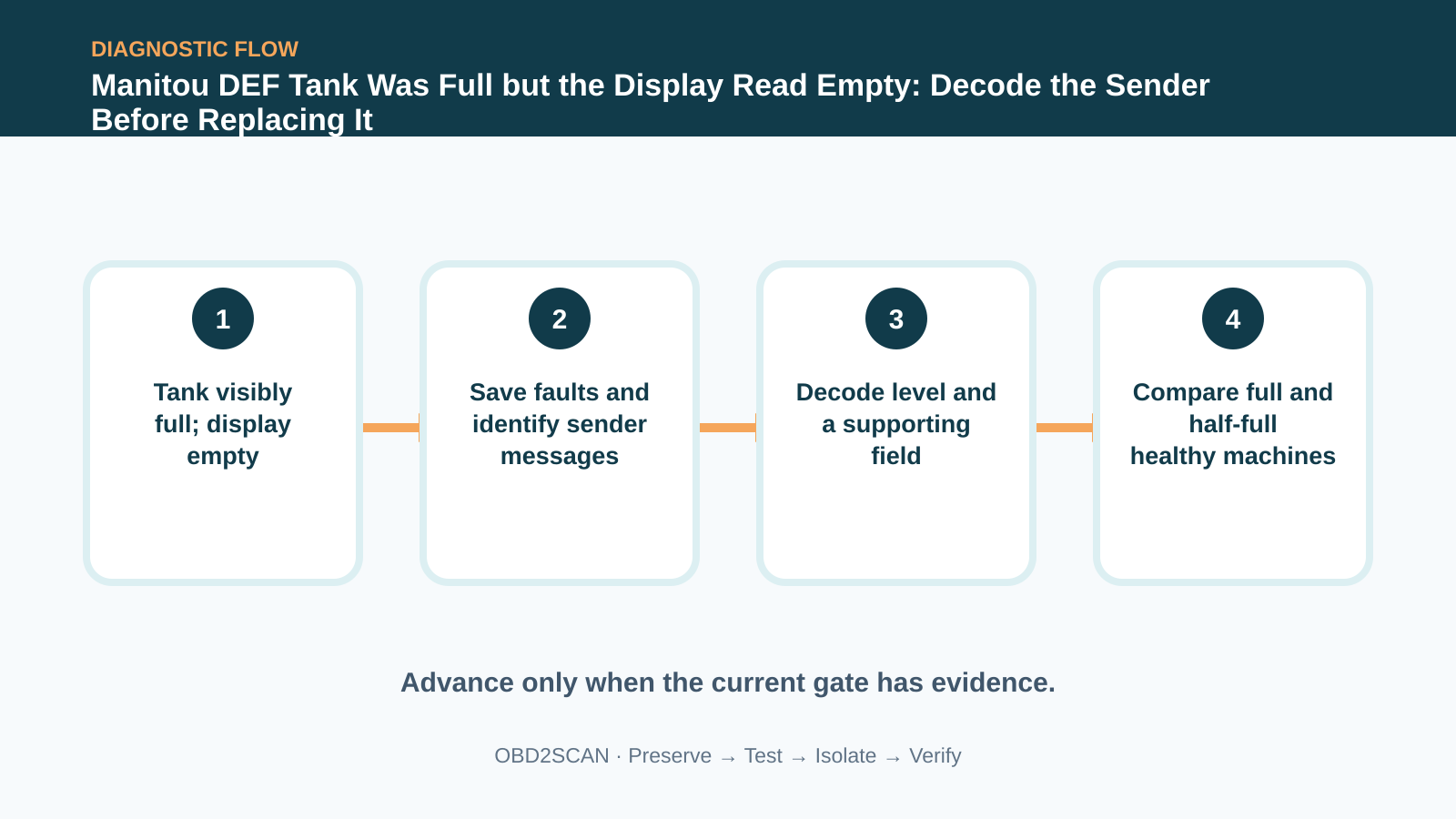
Treat the full tank and empty display as two valid observations until a test separates them. Photograph the visible fluid level and instrument panel, record the derate or countdown state, and note whether the reading changed after key cycles or movement. Check the correct fluid was added and that the tank has not been deformed or contaminated. Do not defeat emissions controls or keep operating through a mandatory shutdown. The aim is to preserve the contradiction before clearing codes or unplugging a sender changes the network state.
Save the derate state before clearing anything
Download the complete fault report and operational history first. Record engine hours, battery voltage and any level, quality, temperature, heater or communication faults. A level code can describe an implausible signal, an open circuit or a value that simply remains low; those are different jobs. Identify whether the display obtains level over J1939 rather than from a direct wire. If the machine has recently received a tank, sender or harness repair, add that timeline without assuming the latest part is guilty.
Identify the sender on the J1939 network
Use the wiring and network topology to locate the sender, its supply, ground and CAN branch. Inspect connectors for DEF crystallization, moisture, backed-out pins and harness tension. Measure power and ground with the sender connected so the circuit carries its normal load. Screen both CAN lines for gross physical-layer trouble, then ask whether the rest of the bus is communicating normally. A working dashboard plus many healthy controller messages argues against treating the entire network as dead, but it does not validate the sender’s data.
Translate the percentage field without overclaiming
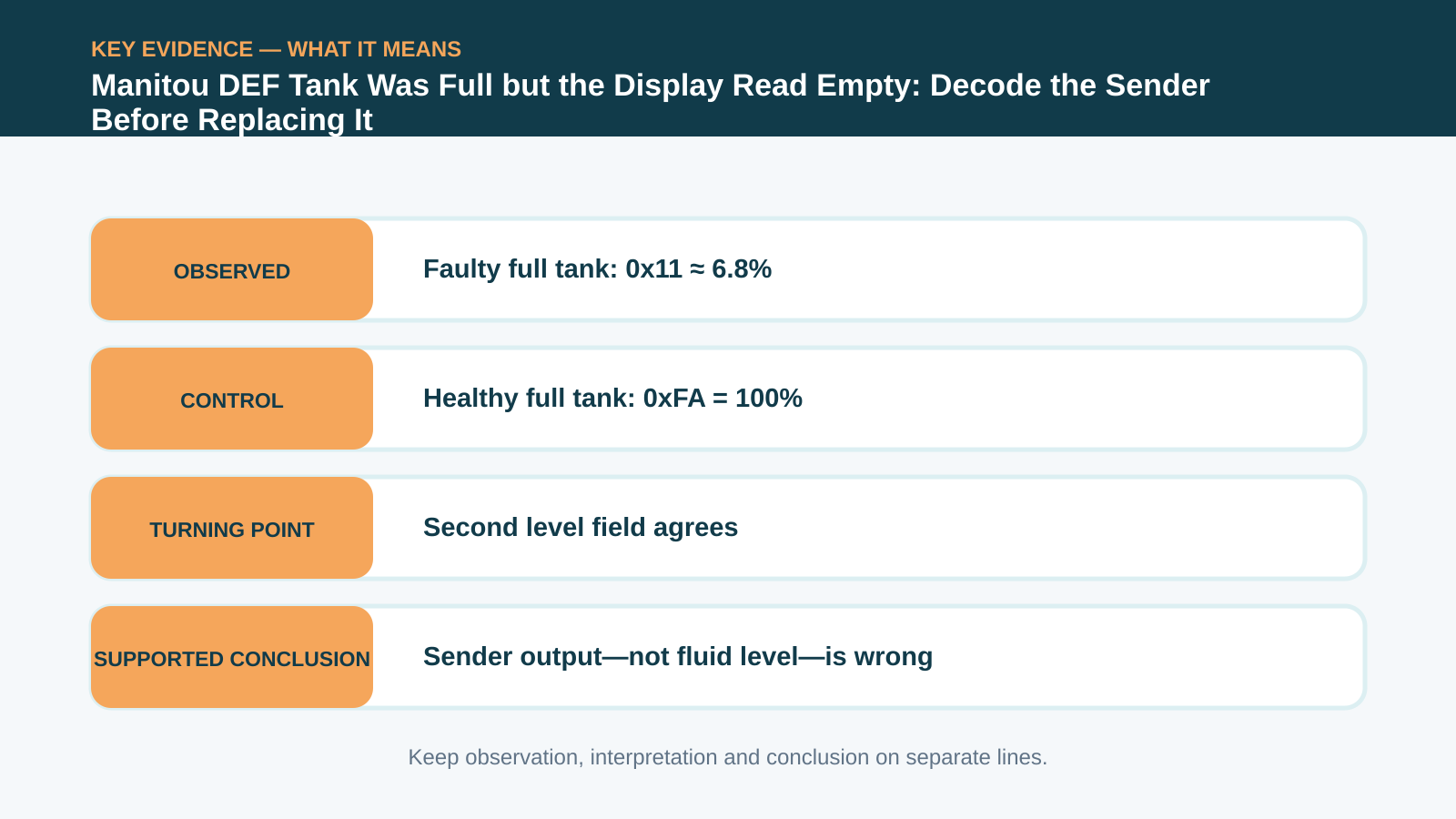
The useful J1939 packet carried a raw level value of 0x11. Applying the scaling used in the documented diagnosis converted that to roughly 6.8 percent. Decoding should be reproducible: save the arbitration identifier, byte position, scaling rule and capture conditions. Do not label every unknown byte or borrow a parameter definition from a different proprietary message. One decoded value is valuable because it answers a specific question—what level is the sender transmitting while the tank is visibly full?
| Evidence | Result in this case | What it supports |
|---|---|---|
| Physical tank inspection | Tank visibly full | Fluid is present |
| Faulty sender level byte | 0x11, about 6.8% | Sender reports near-empty |
| Healthy full machine | 0xFA, decoded as 100% | Display/network path can carry full |
| Healthy half-full comparison | Level fields change together | Interpretation follows real level |
Use the physical-height field as a cross-check
A second changing field appeared to describe physical fluid height. It supported the same low-level story on the faulty machine. That agreement strengthens the interpretation, but it does not make an undocumented byte magically certain. Describe it as a cross-check, not a fully reverse-engineered parameter. If the main percentage and a second level-related field both stay near empty while the tank is full, the sender assembly becomes more plausible than a dashboard that happens to corrupt two related values identically.
Borrow two healthy machines as controls
The strongest control group was not an internet screenshot. It was a healthy machine of the same type measured under matched conditions. A full known-good tank transmitted 0xFA, which decoded to 100 percent. A roughly half-full comparison placed the values between the two extremes. Match model, sender architecture, software where possible, key state and sampling method. Known-good data is powerful only when the comparison is similar enough that differences mean something.
Replace the sender only after the data disagrees
With physical level, sender output and healthy controls aligned, sender replacement was justified. Inspect the tank connector and mounting surface before installing it; a new sender should not inherit corrosion, crystallization or a strained loom. Follow Manitou procedures for draining, sealing, calibration or relearn. Keep DEF clean because introducing dirt during diagnosis can create a dosing problem that did not exist. The documented machine’s level fault resolved after the sender was replaced.
Verify the display, code state and derate release
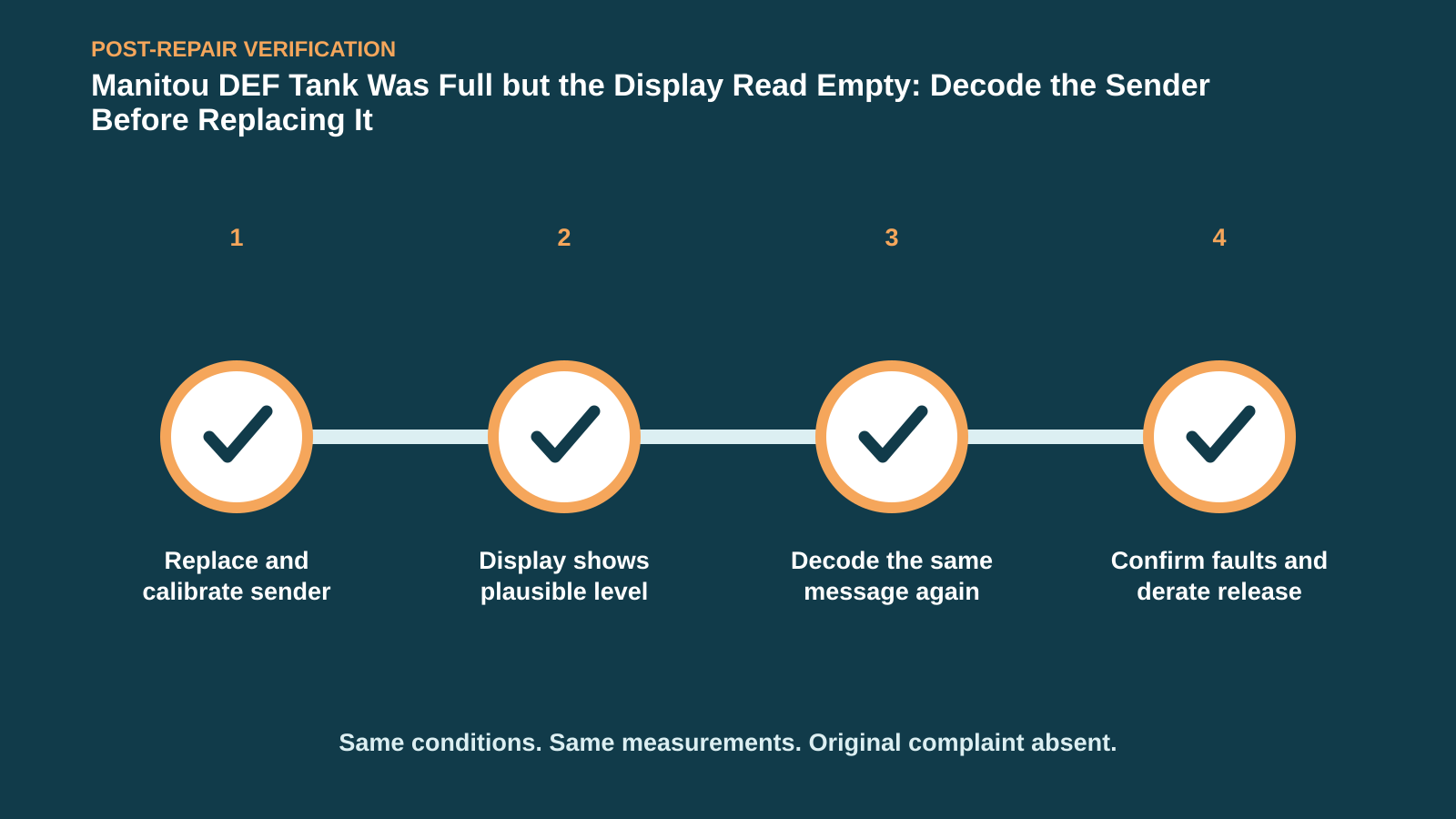
Verification needs more than a full-looking gauge. Confirm the displayed level is plausible, move the machine or allow any specified settling time, rescan the relevant controllers and check the derate release under the manufacturer procedure. Capture the new message and decode it with the same method used before repair. If possible, confirm the reading changes in the correct direction as level changes later in service. That same-condition network comparison is what turns a replaced sender into a verified repair.
A full tank did not make the dashboard wrong; it made the transmitted data testable. Once the sender’s near-empty message was compared with two healthy states, replacement became an evidence-based decision instead of an expensive guess.










Comments 0
Questions, fixes, and real-world diagnostic notes from readers.
Be the first to share a diagnostic result or ask a follow-up question.