
JCB JS220 Smoked and Stalled Under Load: Holding the EGR Closed Built the Known-Good Test

Black Smoke And Stall? Build A Controlled Egr Test
A JCB JS220 excavator emitted black smoke and stalled when maximum load was applied. Fuel injectors and turbo hardware could easily dominate the estimate. Instead, the technician changed one airflow variable under control: hold the EGR path closed for a short diagnostic comparison and watch whether manifold pressure and engine behavior recover.
An automotive meter/scope can support identified EGR feed, ground, command and position-signal checks before a controlled mechanical test. The AUTOOL DM303 is one example for that bounded circuit layer. DM303 can support identified EGR power, ground, command and position-signal checks within its ratings; it cannot safely force an unknown actuator pin, authorize operating with emissions equipment disabled or replace airflow, boost and mechanical checks.
With EGR held closed for diagnosis, the smoke and stall disappeared and MAP behavior changed in the expected direction. That was a known-good A/B state, not an emissions delete. Replacing the failed EGR valve restored commanded movement and normal loaded operation while returning the machine to compliant configuration.
Quick answer: A controlled closed-EGR test changed MAP behavior and removed smoke and stall. A functioning replacement valve reproduced the improvement compliantly.
In this guide
- Define the exact load that creates smoke and stall
- Check air supply before blaming fuel
- Compare EGR command with position
- Create a controlled closed-EGR reference
- Read the MAP change and engine response together
- Replace the valve instead of leaving the test state
- Confirm command, position and mechanical travel
- Verify the same maximum-load event
Define the exact load that creates smoke and stall
Define maximum load in a repeatable, safe way: attachment position, hydraulic demand, engine temperature, rpm and duration. Secure the work area, keep people outside swing and crush zones, and use an operator who can stop immediately. Check oil, coolant, air filter, intake hoses and exhaust restriction before provoking black smoke. If engine speed collapses unpredictably, smoke becomes excessive or hydraulic control is unsafe, stop. A heavy machine should not be held at stall merely to make a diagnostic graph more obvious.
Check air supply before blaming fuel
Black smoke means the combustion event has more fuel-derived carbon than available oxygen can burn, but it does not pick the failed part. Check intake restriction, boost leaks, turbo control, exhaust restriction and basic fuel data. Compare requested and actual boost or manifold pressure under the failed load. Inspect for collapsed hoses and blocked filters. An EGR valve that admits exhaust when fresh air is needed can create the same visible result as other air shortages, so the airflow system should be mapped before injectors are condemned.
Compare EGR command with position
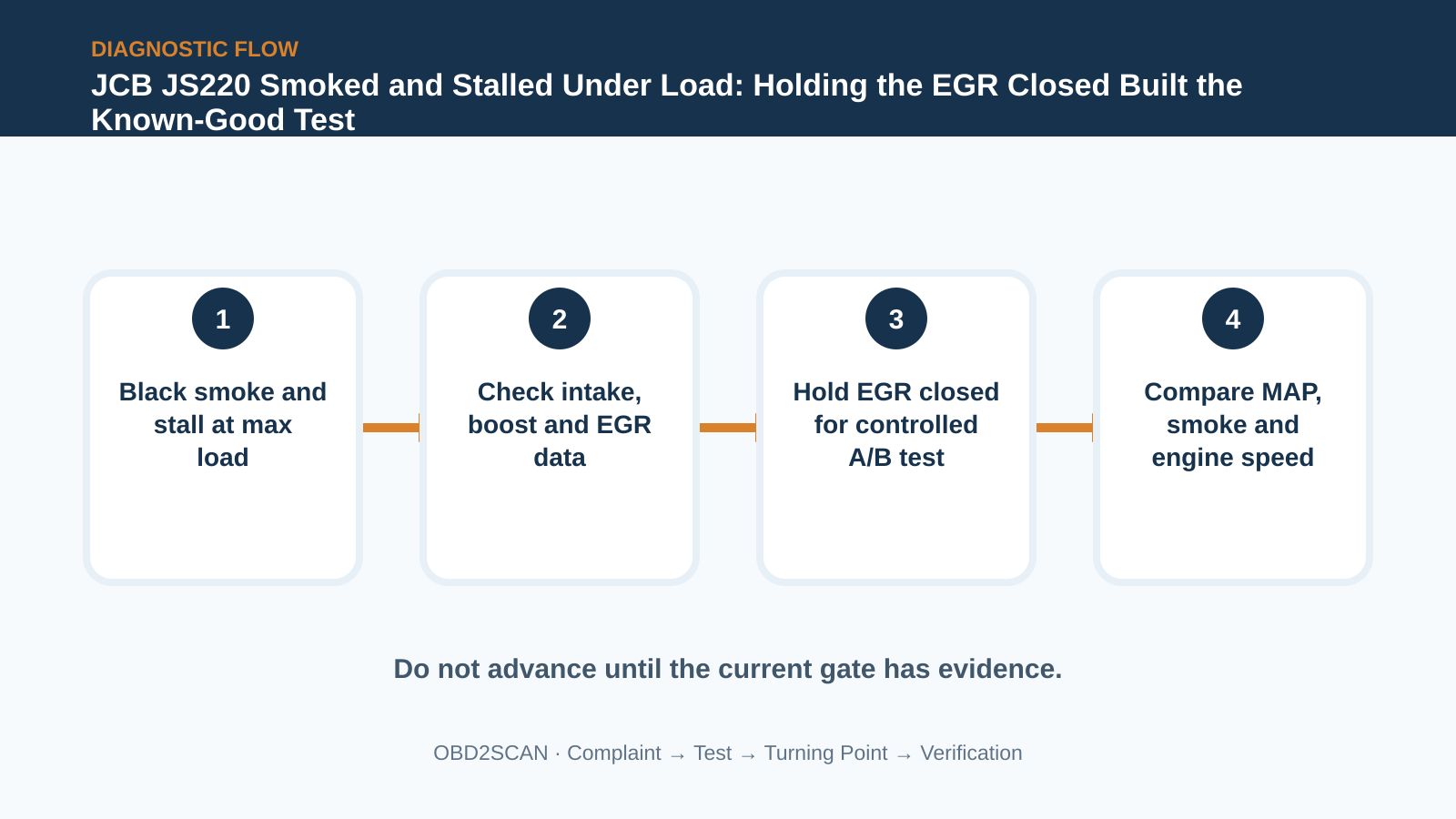
Observe EGR command and position through the whole load event. Confirm power, ground and reference circuits at identified points, then compare commanded versus actual travel. A matching scan value is not absolute proof if the sensor is biased or the mechanism detached, while a mismatch does not identify whether the valve, motor, wiring or soot restriction is responsible. Look at motor current and MAP response where possible. The strongest case connects electrical intention, mechanical position and the engine’s airflow response.
Create a controlled closed-EGR reference
The controlled reference was to keep EGR closed temporarily while repeating the same load. This must follow safe workshop procedure and remain a diagnostic test, not a permanent modification. If smoke clears, engine speed holds and manifold behavior improves with only that variable changed, unwanted EGR flow rises sharply in probability. If nothing changes, restore the system and move to the next air or fuel branch. Do not road-use or release a machine with emissions equipment disabled.
| State | Engine response | Diagnostic value |
|---|---|---|
| Original maximum load | Black smoke and stall | Defines failed condition |
| EGR commanded/observed | Position does not support required closure | Valve/control branch gains priority |
| EGR held closed for test | Smoke clears; engine holds load | One-variable A/B supports EGR cause |
| New valve installed | Command and position repeat; load passes | Compliant repair verified |
Read the MAP change and engine response together
Read the MAP change together with visible and mechanical behavior. A pressure improvement shows more suitable intake charge reaching the engine, while disappearance of smoke and stall connects that change to the complaint. Confirm the test fixture itself did not seal another leak or alter a sensor. Repeat once for consistency rather than many damaging stalls. The aim is a controlled known-good condition strong enough to authorize inspection and replacement—not to demonstrate that an engine can run indefinitely with the EGR closed.
Replace the valve instead of leaving the test state
Remove and inspect the valve and passages after cooling and isolating the machine. Distinguish soot accumulation, mechanical sticking, motor failure and position-sensor error because each affects the surrounding repair. Clean only when the procedure and component condition permit; replace the valve when wear or internal failure is confirmed. Restore gaskets, fasteners, coolant connections if present and harness routing. A new valve installed into a blocked passage or damaged loom may reproduce the same complaint.
Confirm command, position and mechanical travel
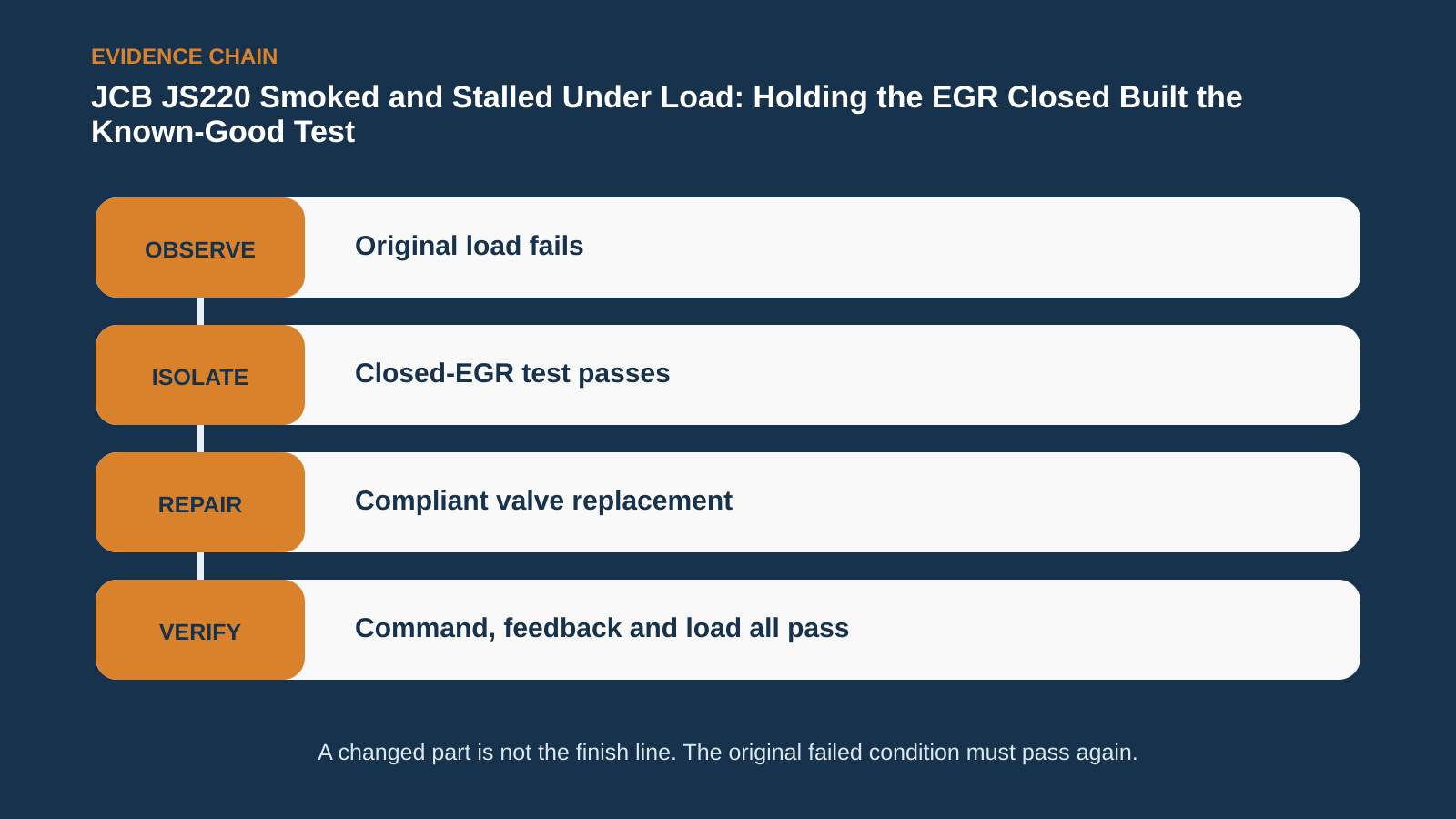
After installation, complete learn or calibration functions required by JCB. Observe command, feedback and movement through several key cycles, then warm the machine and repeat the original maximum-load event. Compare MAP, engine speed and smoke under the same attachment and hydraulic demand. Check for exhaust or coolant leaks and rescan. The case closes when the compliant system—not the temporary closed test—carries the load without smoke or stall.
Verify the same maximum-load event
Tell the operator what the test proved in plain language: temporarily stopping unintended exhaust flow restored the air charge; a replacement valve then achieved the same result under normal control. Record that distinction so nobody copies the temporary state as a shortcut. If another smoke condition remains at a different load, diagnose it separately. One successful EGR repair does not guarantee turbo, injector and intake health across every operating point.
The temporary closed-EGR state was valuable because it changed one variable and predicted the repair. The machine left with a functioning valve, not with the test condition—and that difference is essential to a responsible case study.


Comments 0
Questions, fixes, and real-world diagnostic notes from readers.
Be the first to share a diagnostic result or ask a follow-up question.