2017 Mercedes Arocs Fuel-Pressure Fault and Knock: Noise Led to a Cracked Injector

Fuel Knock And Limp Mode? Localize The Noise
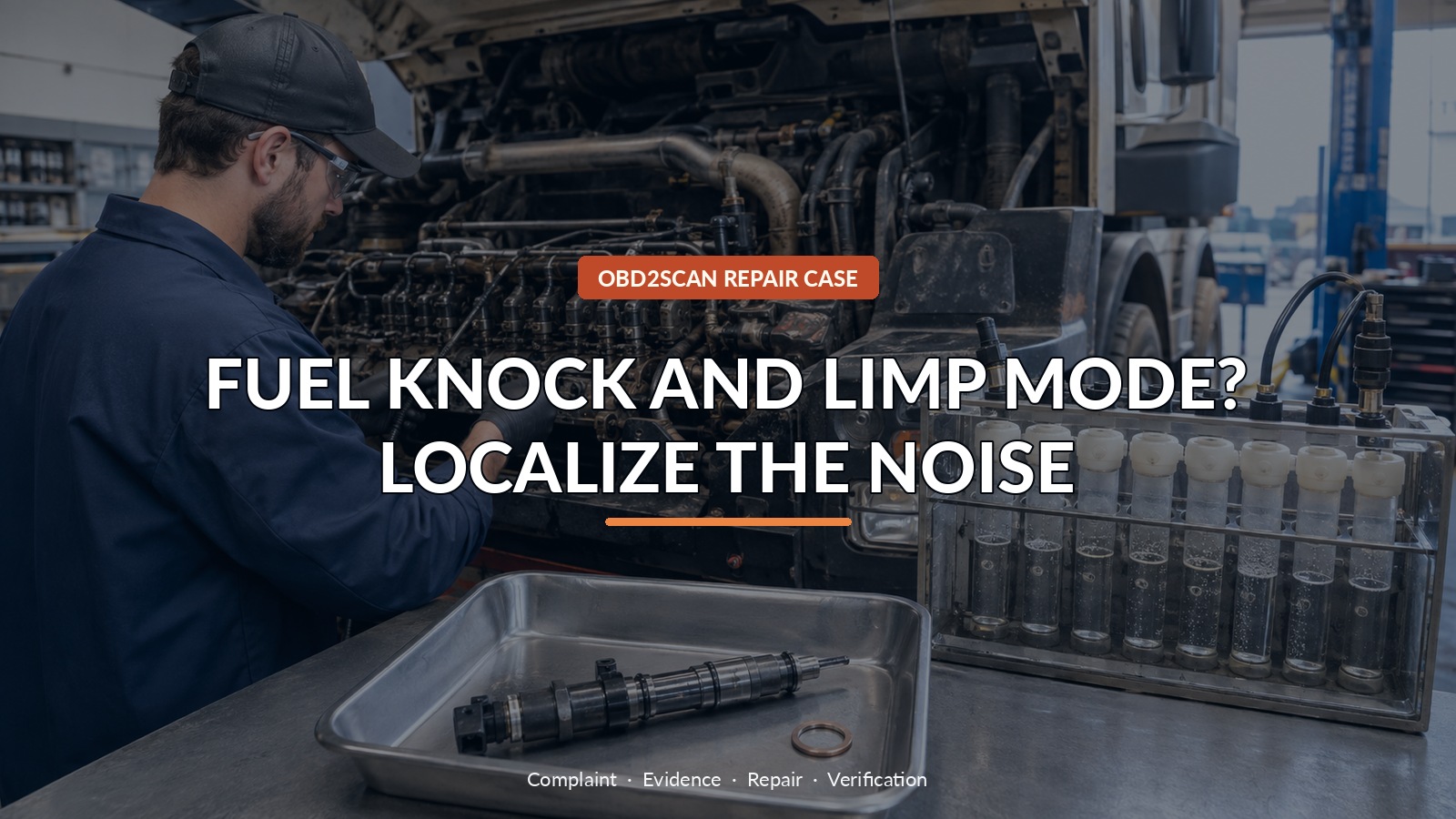
A 2017 Mercedes Arocs developed fuel-pressure trouble, limp behavior and a noise that belonged in the evidence—not in a guess. The driver could hear the engine complaining, but sound alone could not choose an injector. Return pressure, bubbles and vibration location converted that sensory report into a testable path toward cylinder four.
After pressure and vibration tests localize a cylinder and the high-pressure system is made safe, an articulating inspection camera can document a bore, sleeve or sealing surface. The AUTOOL SVB308 is one visual aid for that supporting task. SVB308 can document accessible injector bores, sleeves, sealing faces and leak traces after the system is depressurized and opened; it cannot test common-rail pressure, identify a hidden crack before removal or declare a sealing surface reusable from an image alone.
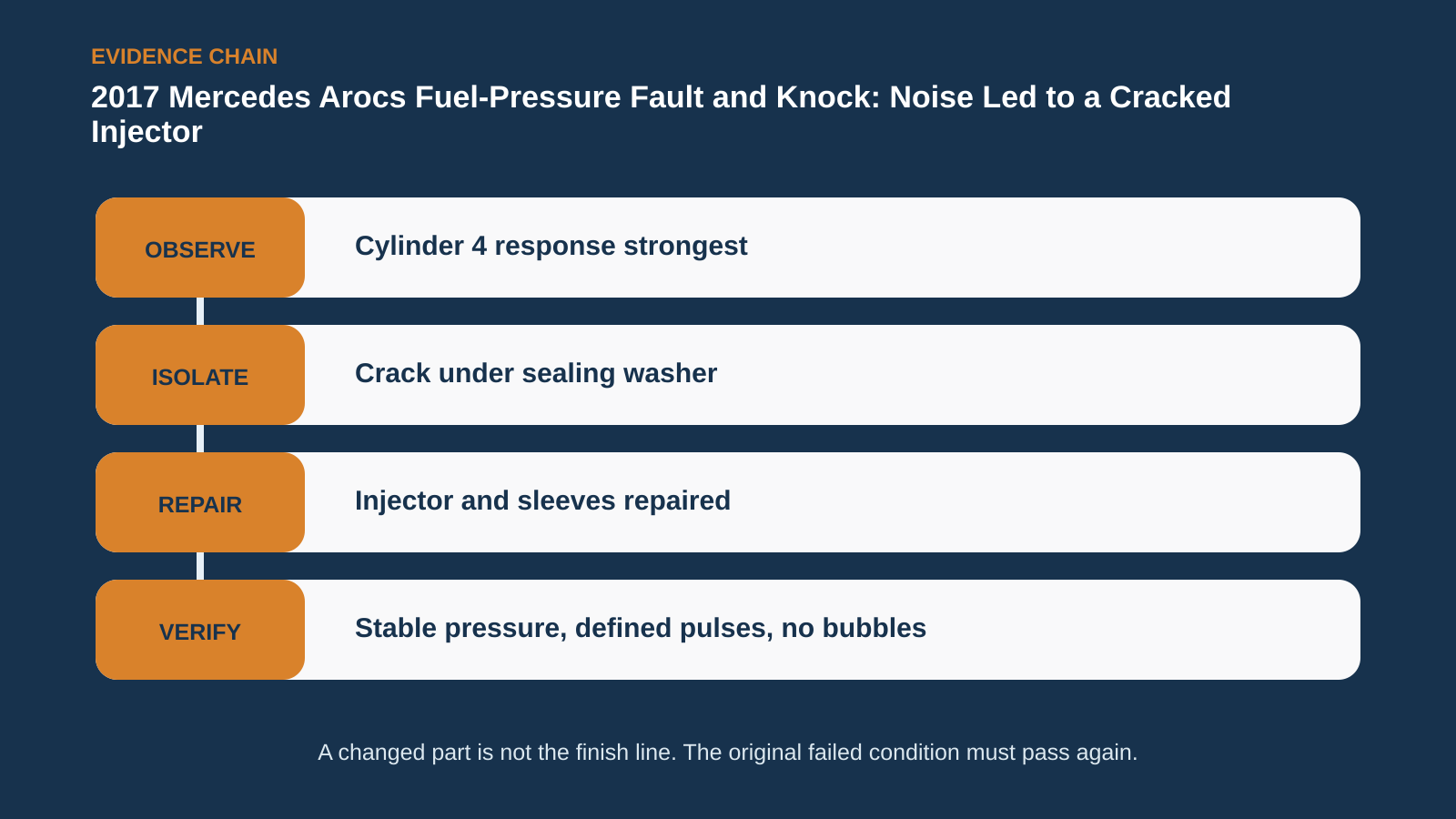
Injector four was removed only after independent clues converged. Beneath its sealing washer, the body was cracked. Replacing the injector and all six sleeves, bleeding fuel and cooling systems, and repeating pressure and return observations restored stable behavior. The camera can document access; it did not diagnose the crack from outside the assembled engine.
Quick answer: Return pressure, bubbles and vibration localized the fuel noise to cylinder four. Removal exposed a cracked injector beneath its sealing washer.
In this guide
- Record when the fuel noise appears
- Treat rail and return pressure as different questions
- Look for bubbles without guessing their source
- Use vibration to prioritize one cylinder
- Remove the injector only after evidence converges
- Inspect the body, sleeve and sealing face together
- Repair every confirmed sealing risk
- Verify pressure, bubbles, pulses and road behavior
Record when the fuel noise appears
Ask the driver to describe the noise without supplying a word. Is it a knock, hiss, pulse or scrape? When does it begin—cold, hot, idle, overrun or load? Save fuel-pressure codes, freeze-frame data and prior repairs. Check oil dilution, external fuel leakage and coolant level before running. Common-rail fuel can penetrate skin and cause severe injury; never search for a high-pressure leak with a hand or loosen a line on a running system. Stop and depressurize according to Mercedes procedure before any opening.
Treat rail and return pressure as different questions
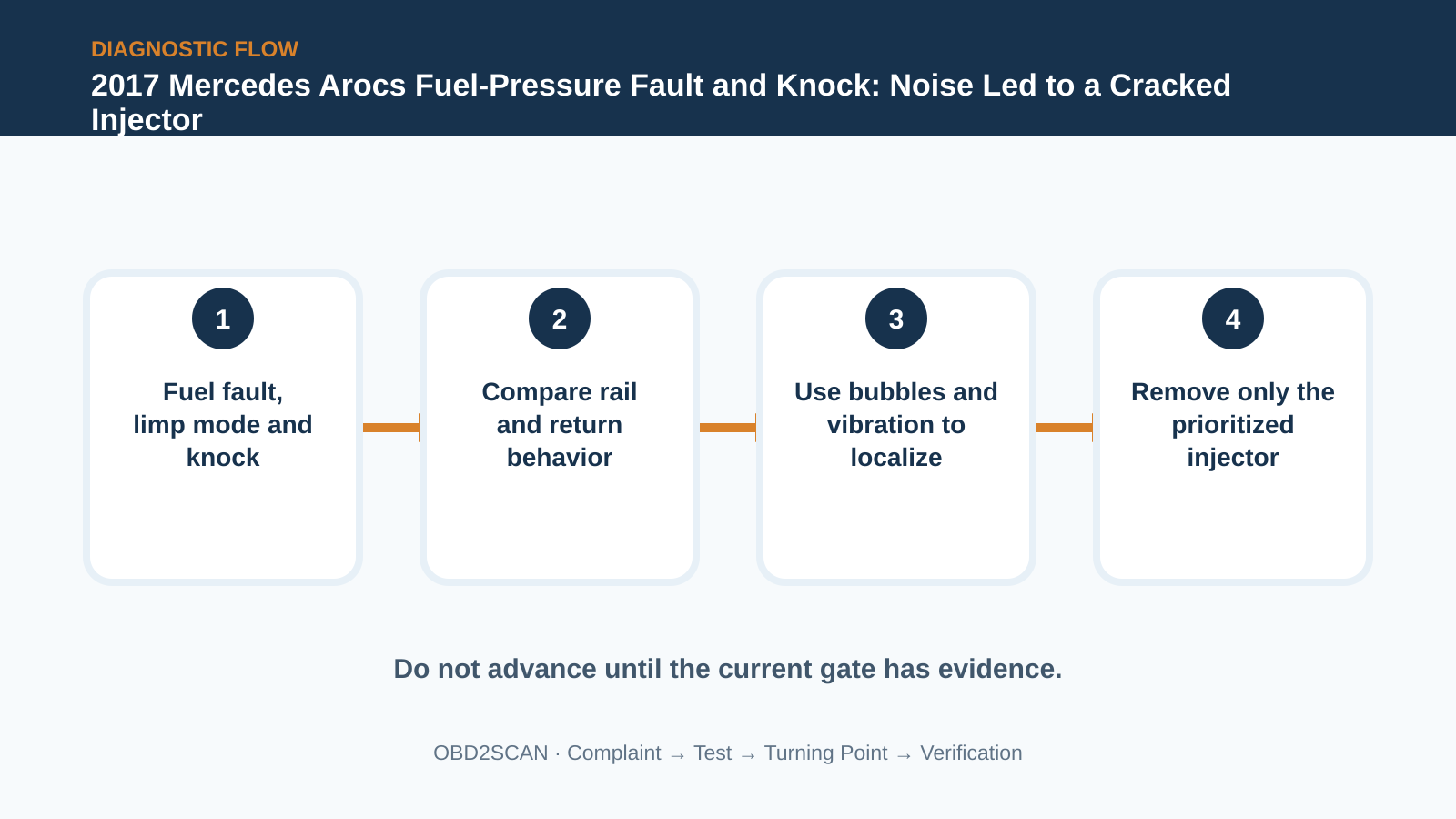
Rail pressure and return pressure answer different questions. Compare requested and actual rail pressure during the complaint, but also monitor the low-pressure and return paths where the source case directs. A pump can create pressure while an injector or sleeve disrupts another path. Use rated sensors, adapters and containment, and keep every person clear of high-pressure lines. Do not substitute a standard low-pressure gauge for common-rail measurement. The purpose is to learn where pressure behavior departs from normal, not simply to produce a number.
Look for bubbles without guessing their source
Bubbles can come from aeration, leakage, boiling or a test connection. Confirm they repeat with the noise and pressure disturbance, inspect connection integrity and compare return events. Photograph or record the flow only from a safe protected location. Bubbles are useful because they make an invisible event visible, but they do not identify cylinder four by themselves. Combine them with timing and vibration information so a leak at a fitting is not mistaken for an internal injector problem.
Use vibration to prioritize one cylinder
Place accelerometers or approved listening equipment at comparable points, then correlate the strongest response with injection events. Structural sound travels, so the loudest place to an ear may be a response surface rather than the source. In this case cylinder-four localization agreed with the abnormal fuel behavior. That convergence justified invasive inspection. A screwdriver used as a stethoscope near a running heavy diesel is not an acceptable substitute for safe sensor placement.
| Evidence layer | Finding | Decision earned |
|---|---|---|
| Driver noise report | Repeatable fuel-related knock | Define the test window |
| Pressure/return behavior | Abnormal return with bubbles | Fuel path needs localization |
| Vibration comparison | Strongest response at cylinder 4 | Prioritize injector 4 |
| Removed-part inspection | Crack beneath sealing washer | Injector replacement justified |
Remove the injector only after evidence converges
Depressurize, clean the work area and remove injector four using the specified method. Protect open fuel passages from contamination. The crack was hidden beneath the sealing washer, illustrating why external listening could not be the final proof. Inspect the injector body, sleeve, seal and bore as one interface. A borescope can document accessible surfaces after removal, but focus, lighting and perspective can exaggerate marks. Confirm questionable damage directly and against the service limit.
Inspect the body, sleeve and sealing face together
The repair included injector four and all six sleeves because the confirmed damage and sealing condition defined a broader, documented scope. That does not create a universal rule to replace six sleeves in every noise case. Follow Mercedes cleaning, seating, torque and coding procedures, renew single-use hardware and prevent debris entry. Bleed fuel and cooling systems as required. Check that return connections are secure before starting, and keep the first run controlled with immediate shutdown available.
Repair every confirmed sealing risk
Verification should mirror the case evidence. Compare rail and return pressure with the same scales, observe whether defined return pulses replace chaotic behavior and confirm bubbles disappear. Listen and measure at cylinder four again; then run the truck through the original load without limp mode. Inspect carefully for fuel and coolant leaks after heat soak. A quieter engine is meaningful, but stable pressure, clean return behavior, no leakage and a clean rescan make the repair defensible.
Verify pressure, bubbles, pulses and road behavior
Explain the chain to the owner in plain language: the noise focused attention, pressure and bubbles showed a fuel-path problem, vibration prioritized one cylinder, and removal revealed the crack. This avoids presenting expensive injector work as intuition. Save photographs of the cracked body and the post-repair traces. If a different knock remains, open a separate mechanical or combustion diagnosis instead of claiming that every sound disappeared with one injector.
The driver heard the first clue; measurement made it safe to act on. Noise, pressure, bubbles and location all pointed to injector four, and only then did disassembly reveal the crack that closed the argument.




Comments 0
Questions, fixes, and real-world diagnostic notes from readers.
Be the first to share a diagnostic result or ask a follow-up question.