
Honda Insight P1448 Used the 12-Volt Starter: One IMA Cooling Fan Was Blowing a Shared Fuse

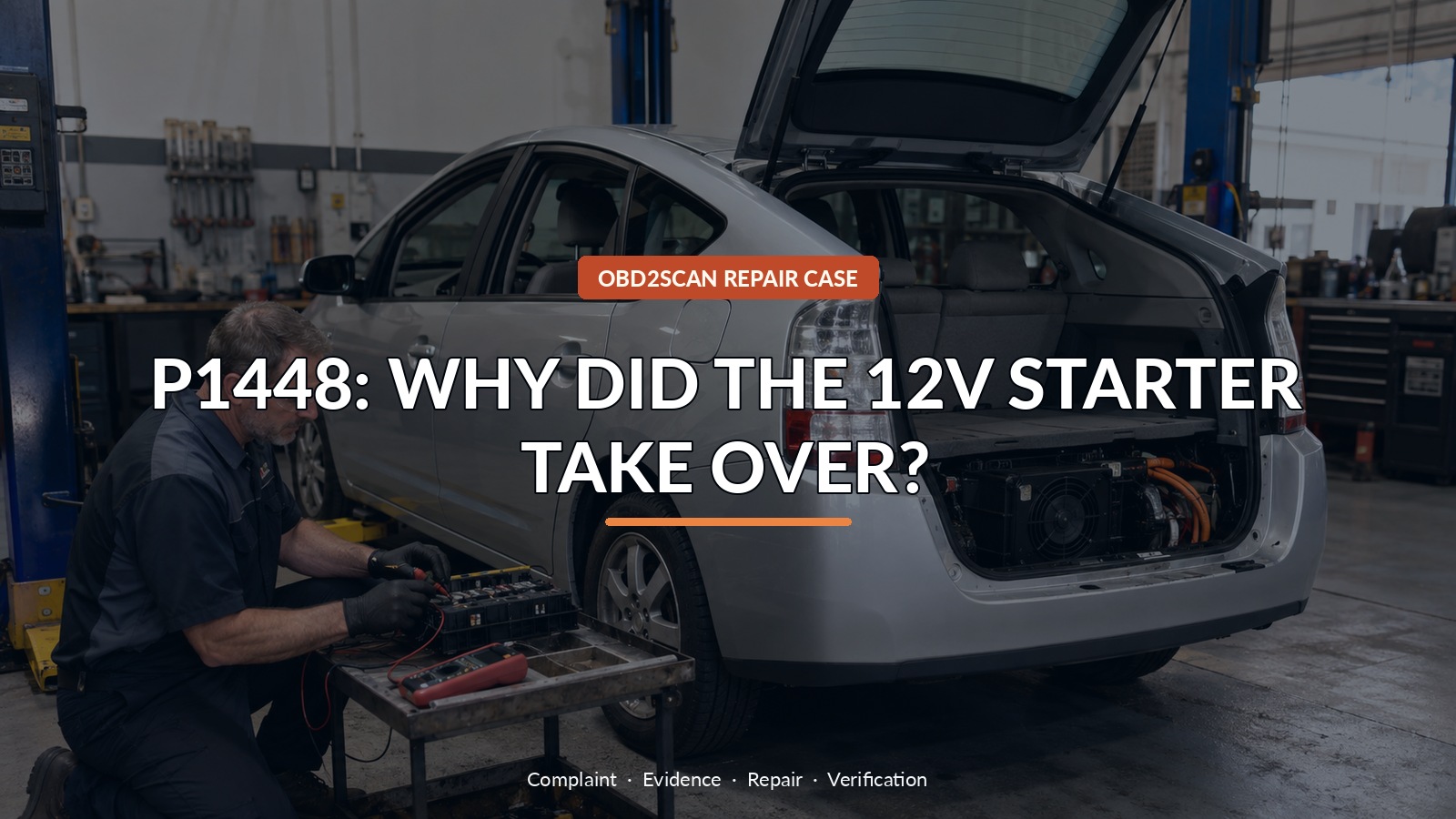
P1448: Why Did The 12V Starter Take Over?
The driver of the 2009 Honda Insight noticed something a scan report could not describe: the engine sounded slower and more conventional when it started. The IMA and 12-volt battery warnings were on. The sound mattered because Honda had fallen back from near-instant motor-generator starting to its ordinary 12-volt starter. That changed sound does not prove a failed cooling fan; it only identifies a useful moment in the system timeline. P1634 and P1448 looked like two systems, but one shared fuse connected the inverter’s low-voltage supply to a failed IPU cooling-fan module.
For the identified low-voltage portion, a circuit analyzer such as the MRCARTOOL B550 can help check a known fuse, feed, ground and loaded voltage drop without entering the high-voltage enclosure. B550 can support identified low-voltage fuse, feed, ground and voltage-drop checks by a trained user; it must not power an unknown fan-control terminal, enter the IPU or high-voltage area, capture the full 33 A pulse pattern or replace Honda’s isolation procedure.
This is not a home hybrid repair. Rear IPU access and any HV work require Honda procedures, training, PPE and rated equipment. The people-first lesson begins before disassembly: record the changed start sound, check the shared protection and reproduce the overload through a controlled active test.
Quick answer: The changed start sound revealed loss of motor-generator starting. An IPU fan pulled up to 33 A and opened a fuse shared with the inverter’s low-voltage supply.
In this guide
- The slower start sound was useful evidence
- Read P1634 and P1448 as one dependency
- Check why fuse 53 opened before fitting another
- Use a protected resettable fuse only within a professional test plan
- Let the fan active test reproduce the overload
- Keep the IPU and high-voltage boundary explicit
- Replace the confirmed fan module and correct fuse
- Verify motor start, 14-volt charging and repeated fan speeds
The slower start sound was useful evidence
With the engine running, system voltage remained near 11.9 V rather than rising toward the expected 14 V low-voltage charging level. The hybrid motor was not starting the engine and the DC/DC converter was not supporting the 12-volt bus. P1634 described a motor-power-inverter signal problem; P1448 described the IPU fan. Honda’s diagnostic order placed the inverter-related code first, but both circuits received ignition power through fuse 53.
Read P1634 and P1448 as one dependency
Fuse 53 was blown. Replacing it without asking why could restore the hybrid system for one start and strand the owner again. A dead short, intermittent overload or damaged wiring remained possible. The source case used a lower-rated resettable test fuse within a professional plan so a repeat fault could be observed without consuming fuses. That technique requires current limits, the correct circuit map and immediate shutdown; it is not a universal substitute for the specified fuse.
Check why fuse 53 opened before fitting another
With the protected supply restored, motor-generator starting and approximately 14 V charging returned. That showed the inverter side could work when it received power. The fan active test then tripped the protection and recreated the warning state. One commanded event connected the apparently separate symptoms: when the fan overloaded the shared feed, the inverter and DC/DC converter lost their ignition supply.
Use a protected resettable fuse only within a professional test plan
At the fan connector, supply voltage was intermittently dragged down while current jumped as high as about 33 A—far beyond what the 10 A production fuse should sustain. The pulsed overload explained why protection did not always open at the first instant. It also made a simple resistance check with the fan stopped a weak test. The defect lived in the powered electronics or motor behavior during command.
| Driver or test observation | System connection |
|---|---|
| Slower conventional start | Motor-generator start unavailable |
| 11.9 V while running | DC/DC converter not supporting 12 V bus |
| Fuse 53 open | Shared low-voltage supply interrupted |
| Fan active test recreates failure | Fan branch causes the shared shutdown |
| Fan current spikes near 33 A | Module overload explains blown 10 A fuse |
Let the fan active test reproduce the overload
Accessing the fan required removal of rear trim near the IPU. The high-voltage system was treated according to Honda information before any boundary was crossed. The fan was a brushless three-phase module rather than a simple two-wire motor. Internal phase resistance alone did not reveal a dramatic imbalance, illustrating why a board or transistor fault can draw excessive input current even when windings appear similar.
Keep the IPU and high-voltage boundary explicit
A replacement IPU cooling-fan module from a reputable source was fitted, the correct 10 A fuse restored and the circuit reassembled. Board-level repair may be possible for a specialist who can identify and validate a failed power transistor, but it was not assumed from the symptom. A used module is also not a guaranteed known-good part; record its source and verify every commanded speed.
Replace the confirmed fan module and correct fuse
After repair, the engine returned to normal motor-generator starting, the 12-volt bus charged near 14 V, and the fan completed active tests across its requested range without excessive draw or an open fuse. P1448 and P1634 were cleared after these foundations passed. Several restart and fan cycles were used because one quiet run would not challenge an intermittent power stage.
Verify motor start, 14-volt charging and repeated fan speeds
Another Insight showing an IMA warning may have a weak 12-volt battery, inverter, DC/DC, wiring, temperature, fan obstruction or high-voltage fault. Do not infer a fan from the starting sound alone. Use the sound as a timestamp, confirm low-voltage charging, inspect the specified fuse and follow Honda’s code priority. Stop if the work approaches HV components without the required competence.
The customer supplied the first useful waveform with their ears. A changed start sound led to the hybrid function that had dropped out; the shared fuse led to the branch that could remove it; the active test made the fan overload repeat on demand. This is what a helpful repair case should do: translate an ordinary observation into a safe test plan without encouraging anyone to enter a high-voltage system unqualified.





Comments 0
Questions, fixes, and real-world diagnostic notes from readers.
Be the first to share a diagnostic result or ask a follow-up question.