
BMW E87 Juddered at Low Speed: Corrosion Made the ABS Ring Touch the Sensor Once Per Turn

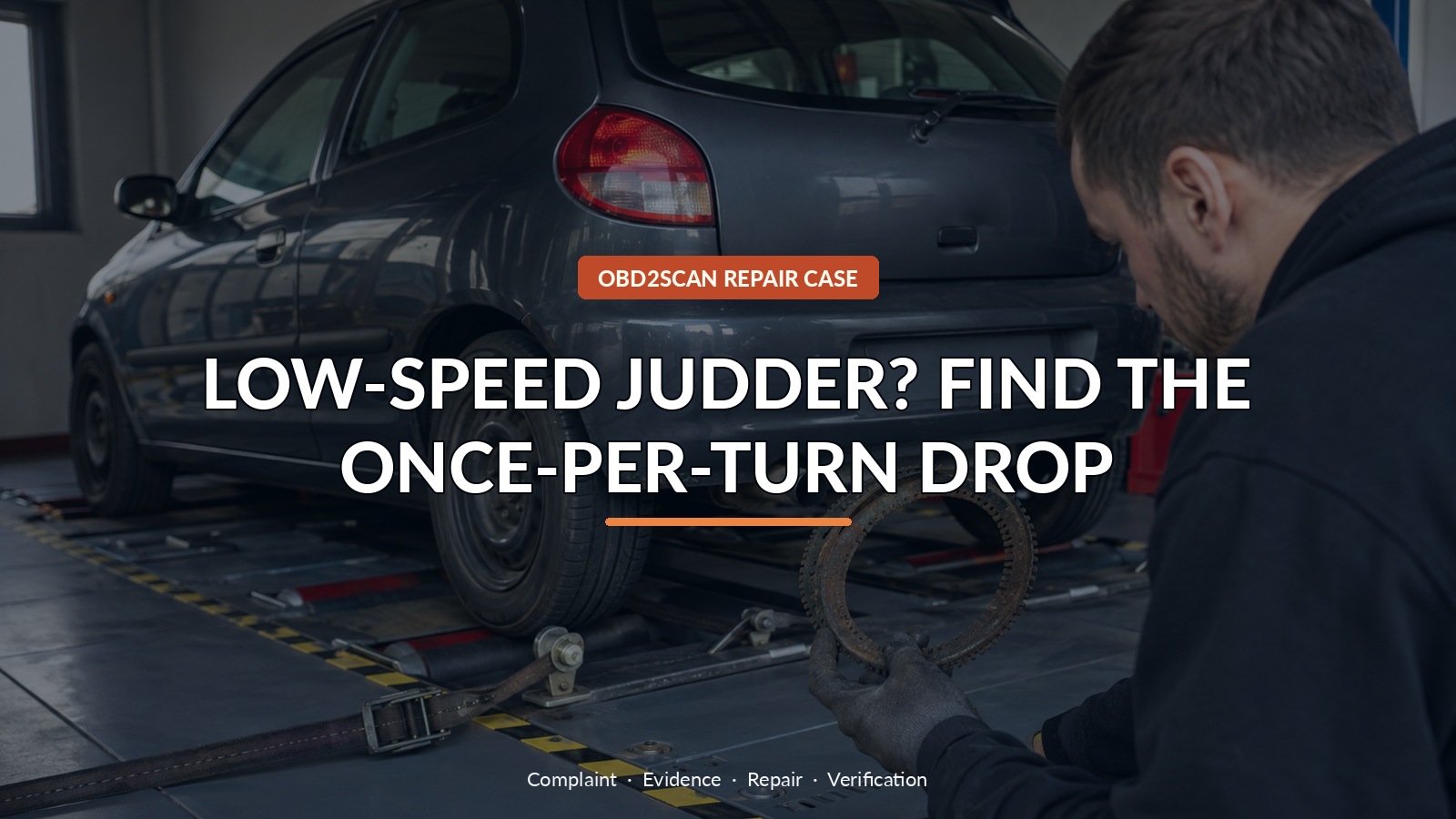
Low-Speed Judder? Find The Once-Per-Turn Drop
The BMW 120 M Sport juddered at low speed as if the brakes were being applied in pulses, and the traction-control lamp flashed. At higher speed the judder disappeared, although another warning could appear. Tires, pressures and visible ABS connections were correct. Live data showed the right-rear wheel speed dropping erratically. The sensor was still producing a signal; one part of the magnetic pickup ring was physically touching it on every revolution.
After the correct active-sensor circuit is identified, a compact automotive scope such as the AUTOOL DM303 can help compare accessible supply and signal frequency at low speed. DM303 can support accessible active-sensor supply and frequency/waveform checks where BMW data and safe wheel rotation permit; it cannot measure milliamp detail like the source setup, prove ring runout from a code or make an ABS road test safe.
Unexpected brake intervention is safety relevant. Reproduction belongs on a controlled test area or suitable equipment, with the vehicle secured before any wheel is rotated off the ground. This single E87 result is a method for turning a repeating signal defect into a physical location—not a universal ABS-ring diagnosis.
Quick answer: A right-rear speed drop repeated once per wheel turn. Corrosion distorted the magnetic ring by 1.70 mm until it touched the sensor and triggered traction control.
In this guide
- Unexpected brake intervention deserves a controlled test
- Tires and recent wheel work come before electronics
- Use paired wheel data to select a corner
- Verify the raw signal before trusting the graph
- One dropout per revolution points to geometry
- The witness mark explains the zero air gap
- Replace the distorted ring carrier and damaged sensor
- Retest crawl speed, straight driving and stored faults
Unexpected brake intervention deserves a controlled test
The basic inspection came first because wheel-speed plausibility depends on rolling circumference. Mixed sizes, low pressure, unusual wear or a temporary wheel can make one corner rotate at a different rate without any electrical fault. All four tires were checked for specification and condition. With that foundation stable, the repeatable low-speed intervention and code 5DC2 justified comparing left- and right-rear speed data during the same movement.
Tires and recent wheel work come before electronics
The scan graph showed sporadic right-rear speed while the left remained smooth. That selected a corner but not a component. The scan tool displays what the ABS module has sampled and processed; update rate can hide a brief defect. The possibilities still included sensor supply, wiring, the active sensor itself, air gap, magnetic pickup ring and the controller’s input. Raw signal evidence was needed before replacing the sensor named by location.
Use paired wheel data to select a corner
This active sensor switched only a few milliamps, so the source case used a low-current clamp and a current multiplier to make the detail visible. A lower-resolution tool may still reveal frequency or voltage change, but its limitations should be stated. The right-rear signal retained normal high and low current levels while its pulse frequency dropped briefly. That meant the sensor could switch; the spacing of magnetic events changed.
Verify the raw signal before trusting the graph
Graphing frequency made the pattern obvious: one drop occurred on every wheel revolution. A wiring fault responding to road vibration might be intermittent, but a defect locked precisely to one rotational position points toward circumference, air gap or encoder geometry. This is the turning point. Time on the screen became a location on the ring. Marking the tire at the dropout position made the next inspection efficient.
One dropout per revolution points to geometry
Removing the sensor revealed a bright witness mark where it had contacted the pickup ring. Rotating the driveshaft showed the ring moving toward and away from the sensor. Corrosion under the pressed-on encoder had swollen the underlying joint and distorted the ring to about 1.70 mm of runout. At the high point, the air gap collapsed to zero, disturbing the otherwise valid signal.
| Pattern | What it suggested |
|---|---|
| Right-rear differs from left-rear | Select that corner for raw testing |
| Sensor still switches between normal levels | Sensor circuit is active, not simply open |
| Frequency dips once each wheel turn | Search one circumferential location |
| Witness mark plus 1.70 mm runout | Ring physically contacts sensor because corrosion distorted it |
The witness mark explains the zero air gap
Because the magnetic ring was part of the right-rear driveshaft arrangement and the sensor tip had been contacted, both the driveshaft and sensor were replaced. Scraping corrosion and pushing the ring back into shape would leave uncertain air gap and magnetic geometry in a safety system. The mating bore, harness routing and bearing condition were inspected so the new parts did not inherit an installation problem.
Replace the distorted ring carrier and damaged sensor
The final road test returned to crawl speed, where false traction intervention had been reliable. Judder and warning illumination were gone, left and right speed data stayed aligned, and fault memory remained clear. A higher-speed straight comparison also checked that no proportional offset remained. Verification at only 30 mph would have missed the original low-speed complaint.
Retest crawl speed, straight driving and stored faults
Another BMW with low-speed ABS activation may have a cracked reluctor, weak magnetic ring, contaminated sensor, damaged bearing, tire mismatch or wiring fault. Use the repetition pattern to choose the physical inspection. Once-per-turn defects deserve a circumference check; random defects deserve movement, load and connector tests. Do not fit a sensor merely because its graph looks untidy.
The code pointed to a wheel. The waveform pointed to one moment in each revolution. The witness mark turned that moment into a place. That sequence is more useful than a parts list because it tells the next technician when to stop looking at electronics and inspect geometry. For the driver, note whether the judder happens only near walking speed and whether the traction lamp flashes at the same time.









Comments 0
Questions, fixes, and real-world diagnostic notes from readers.
Be the first to share a diagnostic result or ask a follow-up question.