
BMW 545i Lit Every Warning and Would Not Respond: The Alternator Spiked Above 17 Volts

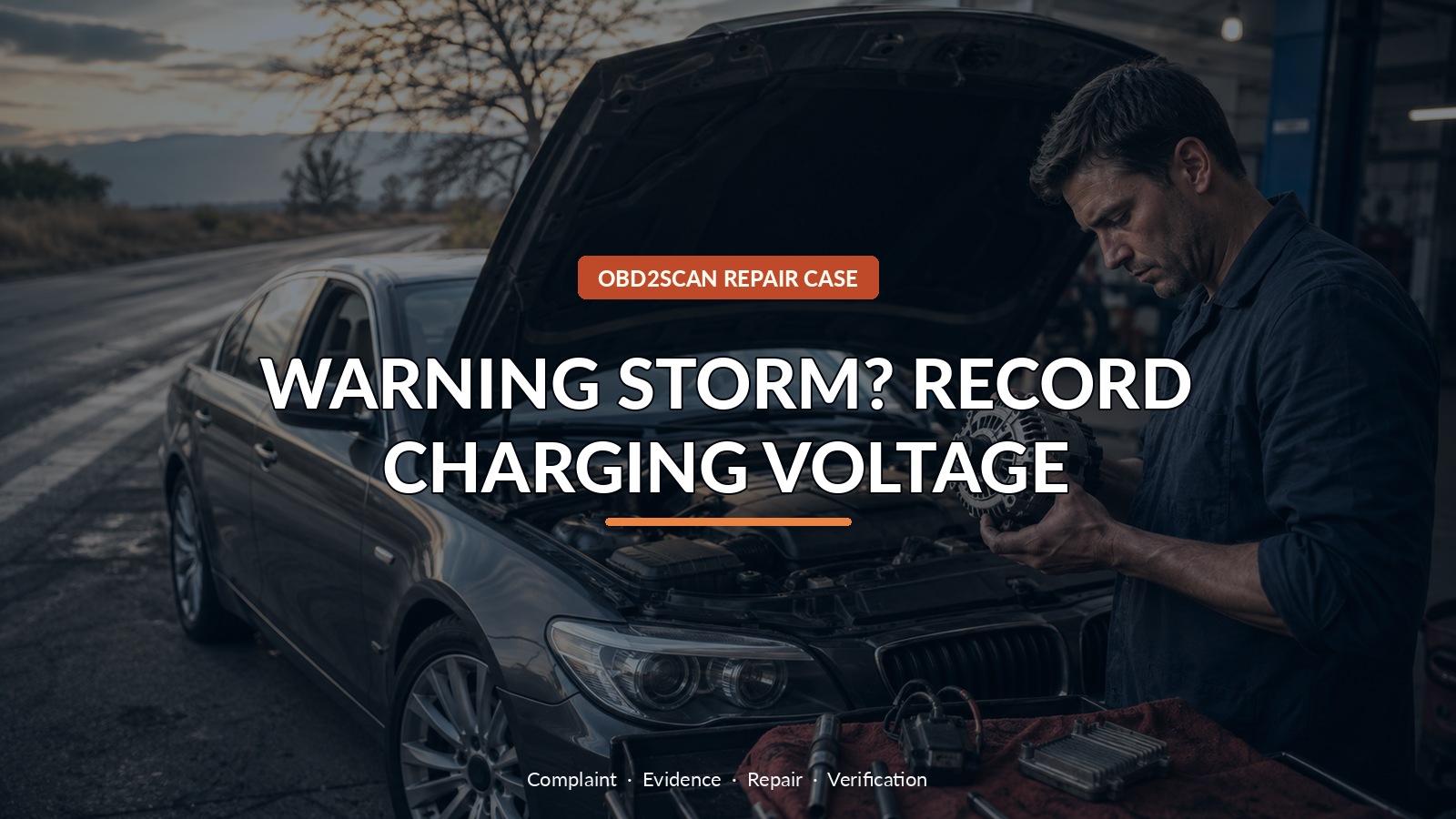
Warning Storm? Record Charging Voltage
The BMW 545i could drive normally for weeks, then light nearly every warning, hold the transmission in one gear and ignore the accelerator. On one occasion it would not crank until it had sat for five minutes. Four modules recorded overvoltage, two stored related supply faults, and the engine controller eventually logged an alternator communication error. Reading those records as a timeline—not a pile—showed that excessive voltage came before the lost communication.
A 12-volt battery and charging tester can establish the low-voltage baseline before network diagnosis. The AUTOOL BT960 is one route for compatible battery, starting and charging checks. BT960 can support compatible 12 V battery, starting and charging checks and may reveal an abnormal charging state; it cannot decode BMW BSD, capture every millisecond spike, prove the PCM innocent or authorize disconnecting a control line without service information.
This is one E60 charging case. Do not disconnect a smart-alternator control wire as a generic test. The proof depended on BMW’s documented fail-safe behavior: with BSD absent, this alternator should regulate itself rather than run uncontrolled.
Quick answer: Module history showed overvoltage before communication loss. With BSD control removed, output still exceeded 17 V, proving internal alternator regulation failure.
In this guide
- A dashboard full of faults can have one power cause
- Build a chronology from every module record
- Start with battery condition before chasing the bus
- Know what BSD changes and what it does not
- Ripple and abrupt current shifts point inside the alternator
- Use fail-safe self-regulation as the separating test
- Inspect the removed unit but repair for reliability
- Compare output voltage and ripple after replacement
A dashboard full of faults can have one power cause
A warning storm encourages one-code-at-a-time diagnosis. The distance records provided a better view. Body and airbag modules had seen overvoltage, then stability control and transmission recorded it, and only later did the PCM log alternator communication. Several modules were responding to a shared supply event. The order made a single upstream charging fault more plausible than simultaneous failure of braking, steering, transmission and throttle systems.
Build a chronology from every module record
Battery voltage initially sat around 12.2 V and charging appeared inefficient in a quick test. That did not contradict an overvoltage history; an intermittent regulator can undercharge during one visit and spike on another. The battery was charged and evaluated first so a weak state would not distort cranking or module behavior. Resting voltage alone could neither confirm nor clear the rare event.
Start with battery condition before chasing the bus
The E60 uses BMW’s BSD communication between the engine controller and alternator, with an intelligent battery sensor supplying additional information. The alternator was therefore not a simple lamp-excited unit. PCM command, battery-sensor input, communication wiring and internal regulation all remained possible. Understanding this architecture prevented a common mistake: treating any smart-charging fluctuation as a bad alternator or every communication code as a bad PCM.
Know what BSD changes and what it does not
A simultaneous capture of voltage, output current, ripple and BSD showed battery voltage rising to about 15.34 V while current changed abruptly. AC ripple was irregular, suggesting an internal phase, rectifier, brush or slip-ring condition. BSD messages continued through the captured shutdown, which showed the line remained active during that event. Communication presence did not reveal the proprietary command content, so it could not yet clear PCM control.
Ripple and abrupt current shifts point inside the alternator
The separating test came from service information: if the BSD wire is open, the alternator enters machine-sensed self-regulation. With the control input deliberately removed under an approved test plan, output still climbed beyond 17 V. The PCM could no longer be commanding that spike. The alternator’s internal regulation was responsible. This is a strong proof test because it changes one causal input and predicts what a healthy component should do.
| Evidence in sequence | Meaning |
|---|---|
| Multiple modules record overvoltage | Shared supply event, not many simultaneous module failures |
| Alternator communication code appears later | Possible consequence or related control fault |
| Irregular ripple with 15.34 V event | Internal alternator condition becomes credible |
| More than 17 V with BSD removed | Alternator fails its own self-regulation test |
| Stable ~14.81 V after replacement | Repair corrects the measured cause |
Use fail-safe self-regulation as the separating test
Removal revealed deeply grooved slip rings but no dramatic burn marks. The visible wear supported the unstable output, yet the repair decision also considered access and long-term reliability. Replacing only an internal communication/regulator module might address one part of the assembly, but the labor to reach the alternator and the worn rotor surface made a complete quality replacement the sensible customer repair.
Inspect the removed unit but repair for reliability
Post-repair capture showed stable output around 14.81 V with uniform DC behavior and much cleaner ripple. The car was exercised with electrical load and allowed to pass through operating states that change smart-charging demand. Fault memory was cleared only after the supply stayed controlled, and no new warning cascade appeared. To verify the repair, the workshop compared voltage and ripple under the same loaded conditions that had exposed the instability.
Compare output voltage and ripple after replacement
Another BMW with many warnings may have undervoltage, battery registration, ground, IBS, wiring or network faults. Save every module’s voltage and distance/time record before clearing. If overvoltage is present, stop prolonged driving because it can damage control units and the battery. A charging-system specialist should reproduce and log the event rather than rely on the dashboard returning to normal after a restart.
The warning lights were the loudest part of the event, but they were not the beginning. The chronology led upstream to voltage, and the fail-safe test separated external command from internal regulation. For an owner, photograph the warnings and note how long the car must sit before restarting. For a workshop, keep a voltage logger on the car long enough to catch the failure instead of returning it because today’s number looks normal.









Comments 0
Questions, fixes, and real-world diagnostic notes from readers.
Be the first to share a diagnostic result or ask a follow-up question.