
Subaru Legacy ABS Activated Over Speed Humps: The Rear Hubs Had the Wrong Magnetic Pole Count

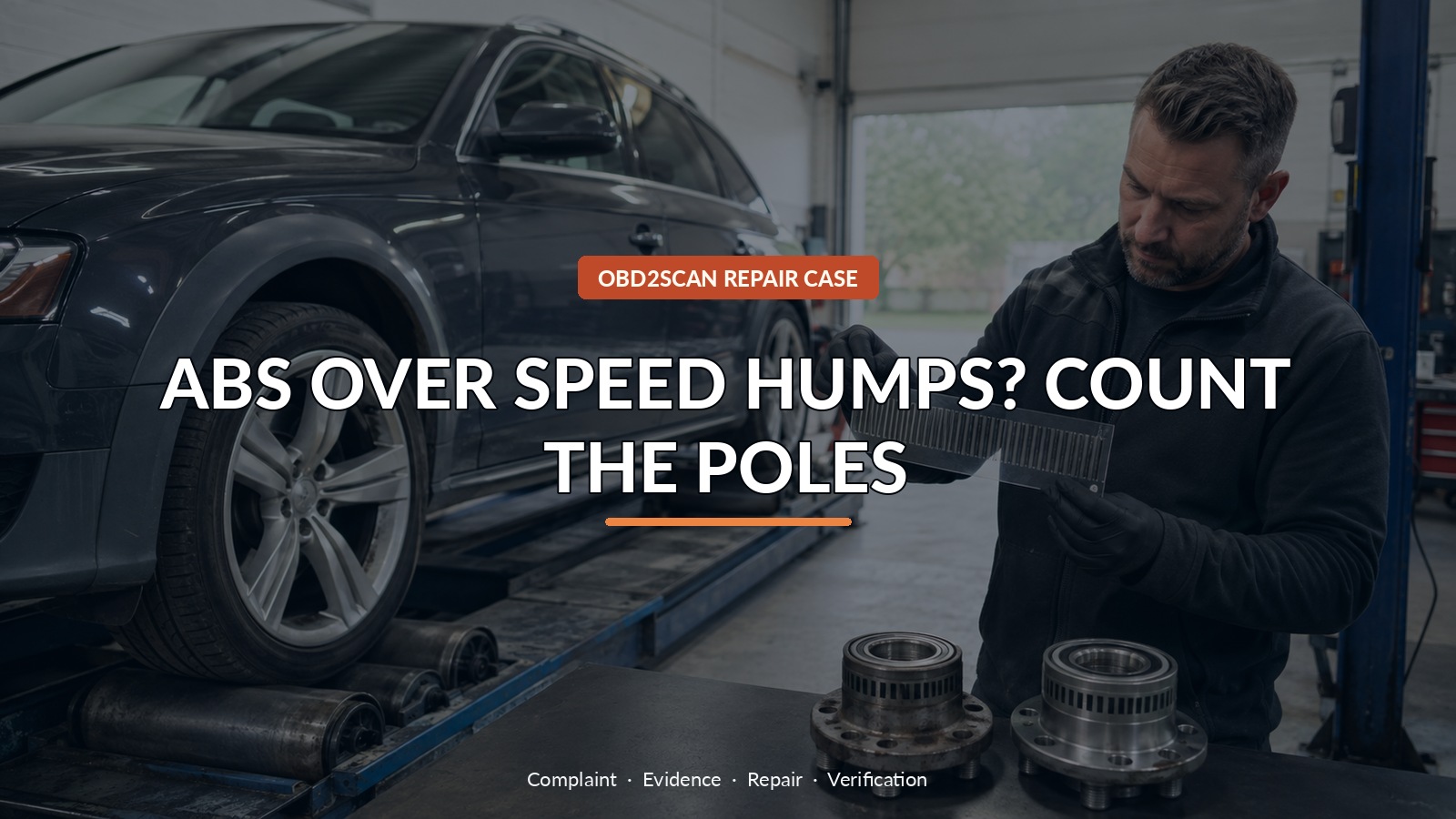
Abs Over Speed Humps? Count The Poles
The ABS on this Subaru Legacy SE did not wait for ice or a panic stop. It operated at low speed when the car crossed speed humps, pulsing the pedal when the driver was asking for an ordinary, gentle stop. Both rear wheel bearings had recently been replaced, and no obvious tire mismatch explained the complaint. The new hubs fitted the car and the sensors produced signals. They were still the wrong hubs.
After the vehicle is made safe, the useful tool category is one that can compare wheel-speed signals or at least examine supply, ground, frequency and waveform at an identified sensor circuit. A compact meter/scope such as the AUTOOL DM303 can help with accessible checks defined by the Subaru diagram. DM303 can support accessible wheel-speed supply, ground, frequency and waveform checks when Subaru wiring data and safe probing are available; it cannot count a concealed magnetic encoder by resistance alone, replace four-channel comparison, or make a brake-warning road test safe.
This case is a warning about dimensional fit versus functional fit. A bearing assembly can bolt into place, rotate quietly and generate a clean-looking signal while encoding the wrong number of events per wheel revolution.
Quick answer: Both new rear hubs fitted, but their 44-pole encoders made rear speed read low. Correct 48-pole hubs aligned all four signals and stopped false ABS operation.
In this guide
- Unexpected ABS intervention is a stop-and-diagnose symptom
- Tires and bearing history belong in the first interview
- Graph all four wheel speeds under the same bump
- Do not confuse pump noise with the event that triggered it
- Use higher road speed to expose proportional error
- Count magnetic poles per wheel revolution
- Install the correct 48-pole rear hubs
- Repeat both the hump and straight-road comparisons
Unexpected ABS intervention is a stop-and-diagnose symptom
Unexpected ABS operation changes braking feel and can lengthen a stop, so the first response is not another enthusiastic road test. Record the speed, surface and pedal input that produce it, inspect the warning lamps and tires, then move testing to a controlled area. If a warning remains active or braking is inconsistent, the vehicle should not be returned to normal traffic until the base brake and ABS systems have been checked. The hump in this story was a repeatable trigger, not a recommendation to keep provoking an unsafe condition.
Tires and bearing history belong in the first interview
The recent installation of both rear hubs was immediately relevant. So were tire size, pressure and rolling circumference, because the ABS controller judges speed relationships rather than reading a road-speed sign. All four tires were the correct size and nothing suggested one was dramatically underinflated. That left the new bearing history high on the list, but not convicted: wiring disturbed during installation, excessive air gap, connector tension and a damaged sensor could also change a rear signal over suspension movement.
Graph all four wheel speeds under the same bump
A four-wheel graph captured the event while the vehicle crossed the same hump slowly. Both front speeds remained coherent. Each rear trace dropped abruptly at the moment the ABS operated. Watching all four together prevented the pump noise and pedal vibration from becoming the diagnosis; those were the controller’s response. The useful evidence was the input disagreement immediately before the response. Because both rears behaved similarly, two identical replacement parts or something common to the rear specification deserved more attention than one random sensor.
Do not confuse pump noise with the event that triggered it
The hydraulic pump and solenoids were doing what the controller commanded after it inferred rear-wheel slip. There was no need to start by replacing the ABS unit. A clean electrical supply to a sensor also would not prove the speed information was numerically correct. This distinction matters whenever a control system reacts to believable but inaccurate data: the output component may be healthy, and the input may not be electrically open or shorted enough to set a DTC.
Use higher road speed to expose proportional error
At a higher steady road speed, the rear values sat approximately ten percent below the fronts rather than merely dropping over bumps. That proportional error was the clue a loose connector could not easily explain. A true wheel speed depends on how many magnetic encoder poles pass the sensor in one revolution. Fewer poles create fewer pulses even when the tire covers the same distance. The hump made the disagreement abrupt enough to trigger intervention; the straight-road comparison revealed that the ratio was wrong all the time.
Count magnetic poles per wheel revolution
The encoder rings were concealed in the hub seals, so they were checked with a magnetic viewing method while each wheel completed one full turn. The fitted rear hubs produced 44 magnetic poles where a known-correct specification produced 48. Both aftermarket units had arrived as one set and both were wrong in the same way. Resistance across an active wheel-speed sensor would not have discovered that. Part number, application data and pole count were more useful than whether the bearing simply fitted the knuckle.
| Check | Result | What it ruled in or out |
|---|---|---|
| Tire size and condition | Correct and consistent | No obvious rolling-circumference cause |
| Four-wheel trace over hump | Both rear speeds dropped | ABS response followed an input disagreement |
| Steady-speed comparison | Rear values about 10% low | Pointed to a proportional encoding error |
| Magnetic pole count | 44 rear versus 48 correct | Proved the fitted hubs were the wrong specification |
Install the correct 48-pole rear hubs
Correct 48-pole rear hub assemblies were installed with the sensors, mounting faces and harness routing inspected at the same time. Wheel bearings and ABS sensors are safety-critical; torque values, fastener replacement rules and air-gap arrangements must come from the correct Subaru service information. A magnetic encoder can also be damaged or installed facing away from its sensor, so the replacement label alone is not the final check.
Repeat both the hump and straight-road comparisons
Verification repeated two different conditions. On a straight, controlled drive, front and rear wheel-speed traces now overlaid rather than carrying a persistent ratio error. Across the original low-speed hump, the rear signals stayed aligned and the ABS did not intervene. That paired result is stronger than a warning lamp remaining off: it proves the numerical input was corrected and the customer’s actual braking complaint was gone.
The lesson is not that every post-bearing ABS complaint needs four new sensors. It is to compare the information each wheel sends before blaming the unit that reacts to it. If the fault began immediately after hub replacement, bring the invoice and part numbers to the diagnosis. A component can be brand new, correctly installed and still wrong for the control system that has to count it; verify both its specification and its live wheel-speed result.










Comments 0
Questions, fixes, and real-world diagnostic notes from readers.
Be the first to share a diagnostic result or ask a follow-up question.