
2022–2023 Civic C1110-13 and C1100-94? Preserve the Left-Rear EPB Evidence

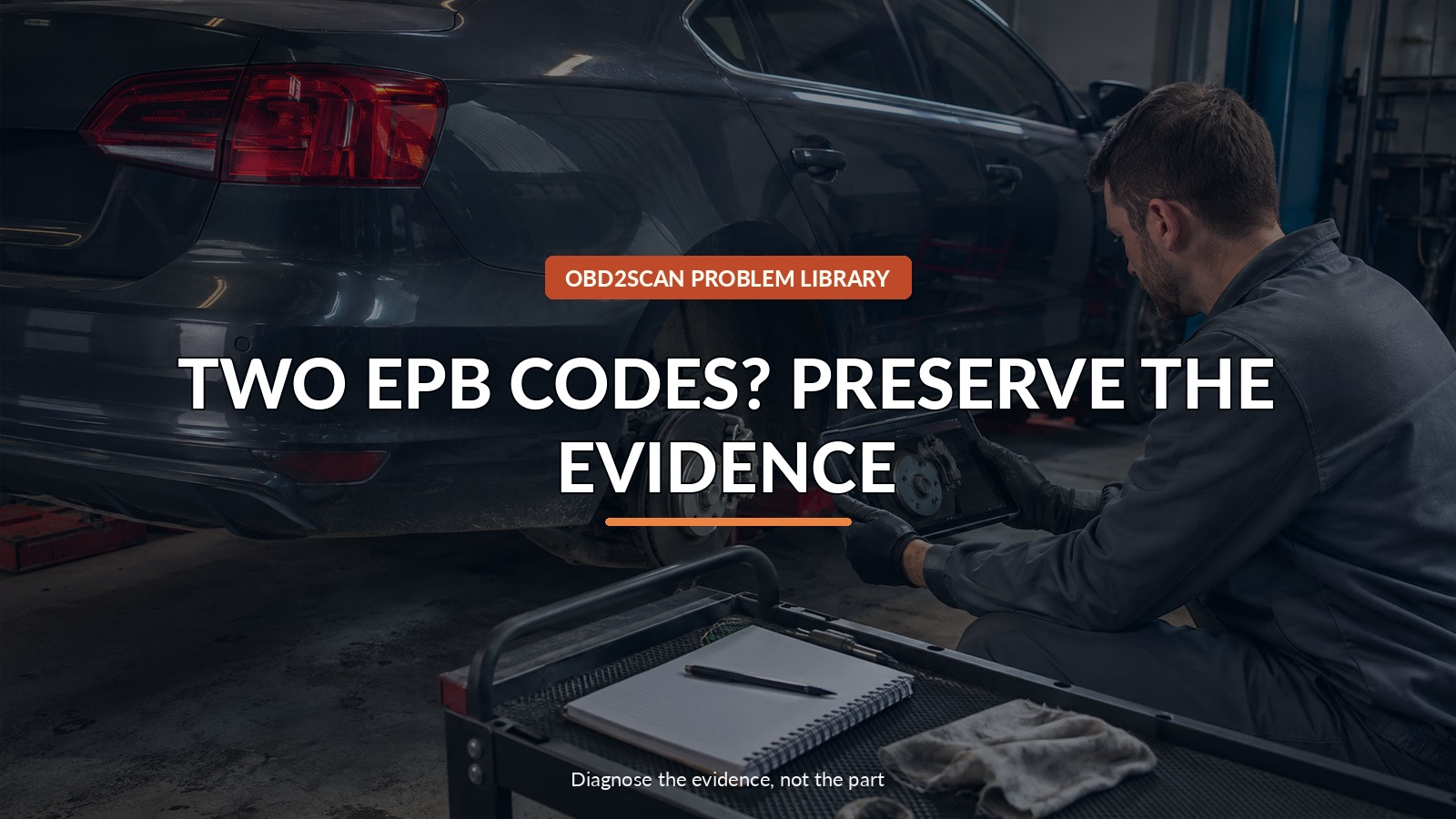
Two Epb Codes? Preserve The Evidence
If parking-brake operation is uncertain or a brake warning remains on, park on level ground, secure the car and arrange professional service. Save the complete all-DTC report. Honda’s request applies only when both C1110-13 and C1100-94 are stored on a qualifying automatic-transmission Civic and the left-rear brake assembly, motor, knuckle, harness and current visit remain undisturbed. The dealer should contact Honda TIS before repair or disassembly; this communication does not identify a universal failed part.
If Honda releases the car from the parts-collection path and the service procedure calls for circuit measurements, a power probe or circuit analyzer can compare supply, ground and actuator current without making the tool the diagnosis. The MRCARTOOL B550 fits that supporting role on an identified accessible low-voltage circuit. B550 can help a qualified technician compare identified low-voltage supply, ground, resistance and current behavior on an accessible EPB circuit after Honda releases the diagnostic path; it cannot safely release the parking brake, select a connector pin, substitute for an All-DTC report, preserve a parts-collection candidate after disassembly or authorize a repair.
This is one of those cases where doing less at the beginning preserves more useful evidence. Honda is looking for a very specific two-code, untouched left-rear EPB condition, so disassembly before the qualifier check can remove the vehicle from the program and blur the cause.
Quick answer: Secure the Civic, save both EPB codes and confirm every qualifier before disturbing the left-rear brake assembly or harness.
In this guide
- Secure the car before diagnosing the warnings
- Save both EPB codes and the full scan
- Confirm every Civic qualifier
- Do not erase an intermittent pattern
- Leave the left-rear assembly undisturbed
- Contact Honda TIS before repair
- Measure only when the approved path calls for it
- Document the final repair and brake check
Secure the car before diagnosing the warnings
A parking-brake warning deserves a different response from a convenience warning. Stop on level ground, shift to Park, chock a wheel if service personnel direct it, and do not rely on the electronic parking brake until its operation is confirmed. If the left rear brake appears applied, drags, will not release or produces abnormal heat, arrange a tow rather than forcing the vehicle to move. The accompanying LKAS and ACC warnings may be secondary effects of the EPB event, but they do not reduce the braking concern.
Save both EPB codes and the full scan
Run and save an All-DTC Check before clearing anything. Honda requires both C1110-13, left-rear electric parking brake actuator circuit open, and C1100-94, electric parking brake actuator malfunction. Capture current/history status, time, mileage and warning photos. One code without the other does not meet this parts-request gate. Network-related warnings in other modules can be important context, yet the pair—not the dashboard count—is the defining evidence. Avoid a battery disconnect or repeated parking-brake cycling that could change an intermittent connector or motor condition.
Confirm every Civic qualifier
The request covers 2022–2023 Civic LX, Sport, EX, EX-L and Touring vehicles with an automatic transmission. FHEV, Si and Type R versions are excluded. Honda also excludes cars with a collision history and those that already had the left-rear brake assembly, motor or knuckle assembly replaced for the issue. Confirm every item, not just model and year. A visually identical Civic outside these qualifiers still deserves diagnosis, but it should not be represented as the undisturbed vehicle Honda asked dealers to report.
| Qualifier | Required state |
|---|---|
| Model | 2022–2023 qualifying automatic-transmission Civic trim |
| Codes | Both C1110-13 and C1100-94 stored |
| History | No collision; no disqualifying left-rear replacements |
| Current visit | Harness and motor not repaired or disassembled |
Do not erase an intermittent pattern
Do not unplug the left-rear actuator, peel loom tape, spread a terminal, remove the motor or substitute parts before Honda TIS responds. Even a well-meant continuity check can temporarily restore contact or change witness marks. Note harness routing, moisture, rubbing or impact evidence only from a nonintrusive view. If a connector is already loose when the car arrives, photograph its untouched position. This restraint is not a refusal to diagnose; it protects the exact failure state so the manufacturer can distinguish wiring, terminal, motor and assembly causes.
Leave the left-rear assembly undisturbed
The dealer communication asks qualifying shops to email or call Technical Information & Support and provide model year, model, issue, VIN, dealer/contact details, mileage, confirmation of all qualifiers, the All-DTC printout and DPTS number. The article is time-limited dealer guidance rather than a public recall remedy. Owners should ask the dealer to check the latest TIS instructions and VIN programs. A service adviser should describe the symptom plainly and avoid promising a collected part, free repair or specific failed component before Honda accepts the case.
Contact Honda TIS before repair
If Honda does not accept the vehicle or later authorizes normal diagnosis, start from the current wiring diagram and connector views. Compare the left and right actuator circuits only where the architecture makes that comparison valid. Check supply and ground under commanded load, terminal fit with the specified gauge, harness movement and actuator current. Do not inject power blindly into a motor circuit controlled by a brake module. A resistance reading on an unloaded harness can look normal while a spread or corroded terminal fails when current rises.
Measure only when the approved path calls for it
The component that stores a code is not automatically the component that failed. A circuit-open code can result from a connector, conductor, module driver, terminal or actuator winding. Document the exact test, connector state and direction of current for each conclusion. If an actuator is removed, follow the service procedure for EPB service mode and mechanical brake inspection. If a wiring repair is made, restore routing, clips and sealing so suspension travel and road debris cannot recreate the problem. Never use clearing codes as the repair confirmation.
Document the final repair and brake check
After the approved repair, scan all modules, operate the parking brake through the factory verification and confirm that both rear sides apply and release normally. Check for drag, heat and warning return during a controlled drive. Recheck ACC and LKAS only after the brake module is healthy; secondary warnings may clear once valid messages return. Give the owner a simple record: original two codes, confirmed cause, repair performed and post-repair test. That explains why several lamps appeared without claiming that several systems failed independently.
The fastest way to help the person driving this Civic may be to stop before the first connector is opened. Secure the car, save the complete scan and check every qualifier. If Honda wants the untouched assembly, preserve it. If normal diagnosis proceeds, let loaded circuit evidence—not the number of dashboard warnings—identify the repair, then verify apply, release and warning-lamp behavior. That approach protects both braking safety and the information needed to solve the underlying problem.



Comments 0
Questions, fixes, and real-world diagnostic notes from readers.
Be the first to share a diagnostic result or ask a follow-up question.