
Durango P0452 After Long Idling? Prove the Circuit Before Chasing Condensation

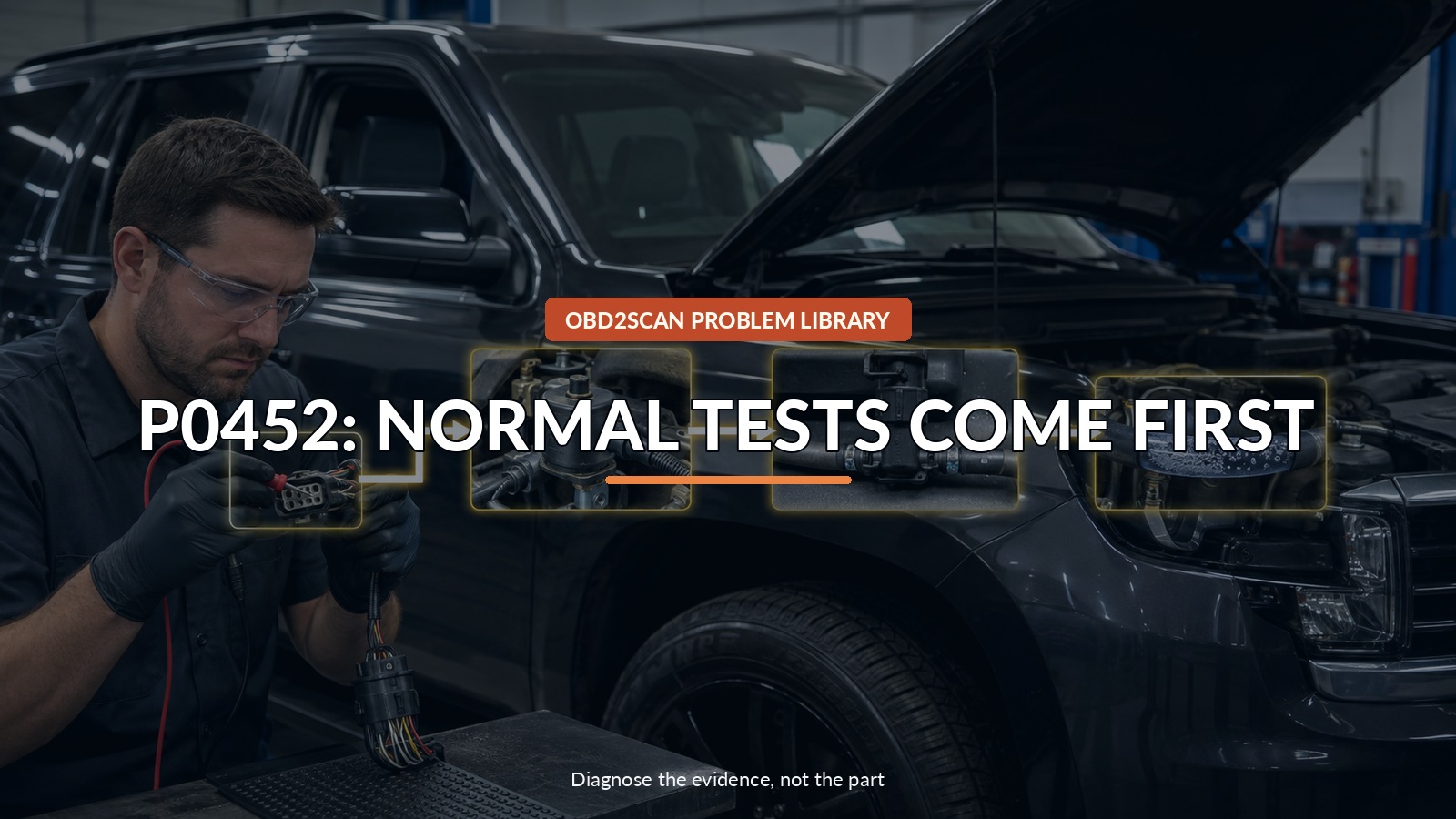
P0452: Normal Tests Come First
Save P0452 and the idle/short-trip history, then complete normal EVAP pressure-switch and circuit diagnostics; only when those tests find no faulty component or circuit does the bulletin’s condensation-in-purge-line branch become reasonable. Condensation in an EVAP purge line is memorable, which is exactly why it can become a shortcut. Stellantis TSB 14-003-25 prevents that shortcut: normal P0452 component and circuit diagnostics come first. Only a clean first branch plus the matching idle/short-trip history earns the unusual cause.
The useful tool category here is a regulated low-pressure smoke test for a specifically isolated EVAP leak path, but only after the safe test point and question are clear. The AUTOOL SDT203 is one practical route for that bounded measurement. SDT203 can introduce controlled smoke into a compatible isolated EVAP path within Stellantis pressure limits to find a physical leak; it cannot prove a pressure switch is stuck closed, validate its circuit, identify liquid condensation, clear a line with shop air, or justify fuel-tank removal.
A smoke machine answers ‘where can vapor escape?’ P0452 in this bulletin says the pressure switch is stuck closed, so leakage is only one possible question and may not be the important one.
Quick answer: Complete normal P0452 switch and circuit diagnosis first; only a clean result plus matching long-idle/short-trip history opens the condensation branch.
In this guide
- Save the idle and short-trip context
- Confirm the Durango build and ERC engine
- Translate P0452 without naming a failed part
- Finish normal component and circuit diagnosis first
- Use smoke only for the leak question
- Open the condensation branch only after a clean normal test
- Leave purge-line air and tank work to a qualified shop
- Verify the switch state over the original drive pattern
Save the idle and short-trip context
Ask what happened before the MIL: extended remote start, long curbside idle, repeated short trips, cold weather, refueling, or a normal highway drive. Save P0452 status, freeze frame, fuel level, ambient temperature, engine run time, and every other EVAP or voltage code. Do not clear the record merely to see whether it returns. A loose fuel cap is worth recording, but P0452’s failure wording is different from a simple large-leak code and should not be reduced to a cap guess.
Confirm the Durango build and ERC engine
The bulletin covers 2020–2024 Dodge Durango WD vehicles built on or before July 25, 2024 and equipped with the 3.6L ERC engine. Confirm the VIN, MDH/build information, engine sales code, prior EVAP work, and latest DealerCONNECT procedure. A 5.7L Durango or a vehicle built later needs its own path even if the driver idles frequently. Bulletin applicability is not a recall declaration and does not prove warranty coverage or the described cause on one particular vehicle.
Translate P0452 without naming a failed part
P0452 is described here as ‘EVAP Pressure Switch Stuck Closed.’ That can reflect the switch, its wiring or connector, power/ground/reference behavior, a line state, or a condition that prevents the expected pressure change. Save the exact module text because generic readers sometimes use different descriptions. Do not buy a pressure sensor from the code name. Start with the wiring diagram, connector state, scan value behavior, and the DTC-based tests for this engine and software level.
Finish normal component and circuit diagnosis first
Stellantis explicitly directs normal diagnostics to identify a faulty component or circuit. If those tests identify one, perform the indicated repair and stop borrowing the condensation branch. This means checking what the service flow asks under stable battery voltage, not just looking for damaged wires. Wiggle, voltage, continuity, or command tests must use approved back-probing and limits. An intermittent result deserves a saved waveform or scan log; ‘could not duplicate’ is not the same as ‘the circuit passed.’
| Result of normal diagnosis | Driving pattern fits | Correct direction |
|---|---|---|
| Faulty component or circuit found | Either | Repair the proven fault |
| No fault found | Long idle/short trips | Consider condensation branch |
| No fault found | Pattern does not fit | Continue normal intermittent diagnosis |
| Smoke escapes | Any | Locate/repair the leak; do not call it condensation proof |
Use smoke only for the leak question
When the actual diagnostic question is a physical leak, introduce smoke only through the approved path and pressure. Cap or command valves as the procedure requires, watch flow as well as visible smoke, and check the fuel cap, hoses, canister, connections, and purge route. Do not pressurize a fuel-vapor system with unrestricted shop air or oxygen. No smoke does not prove the pressure-switch circuit is correct, and visible smoke does not prove liquid condensation caused P0452.
Open the condensation branch only after a clean normal test
The bulletin’s second branch opens when normal diagnosis finds no faulty component or circuit and excessive fuel condensation is suspected in the purge line. That sequence matters. Long idling and short-trip use support the theory because vapor and temperature history change, but they do not prove liquid is present. A qualified technician follows the bulletin’s disconnection and clearing method, observes what exits, and protects the canister, solenoid, lines, and work area from contamination or uncontrolled pressure.
Leave purge-line air and tank work to a qualified shop
The repair continues with fuel-tank removal and installation of an upper heat shield. Tank work combines gasoline vapor, weight, line/connector access, lifting, ventilation, and fire controls. It is not a driveway extension of smoke testing. Do not crawl under an unsupported SUV, improvise a heat barrier, or blow through connected components. Give the shop the saved normal-test results and use history so it can show why the unusual branch was chosen rather than treating the shield as a universal P0452 cure.
Verify the switch state over the original drive pattern
After the proven repair, clear codes only after the original report is saved. Confirm pressure-switch state changes as expected, all EVAP connectors and lines are secure, no vapor/fuel leak exists, and no new code appears. Then challenge the original pattern over comparable idle and short-trip conditions, followed by a normal drive that can run the relevant monitor. A single dark MIL after clearing is not verification; monitor completion and a stable switch signal are the meaningful result.
The bulletin’s most valuable instruction is its order. Ordinary component and circuit evidence must fail to explain P0452 before condensation becomes the working theory; a memorable cause should never outrun the first diagnostic gate.



Comments 0
Questions, fixes, and real-world diagnostic notes from readers.
Be the first to share a diagnostic result or ask a follow-up question.