
Grand Cherokee Misfire With Low Oil? Inspect the Umbrella Valve Seal

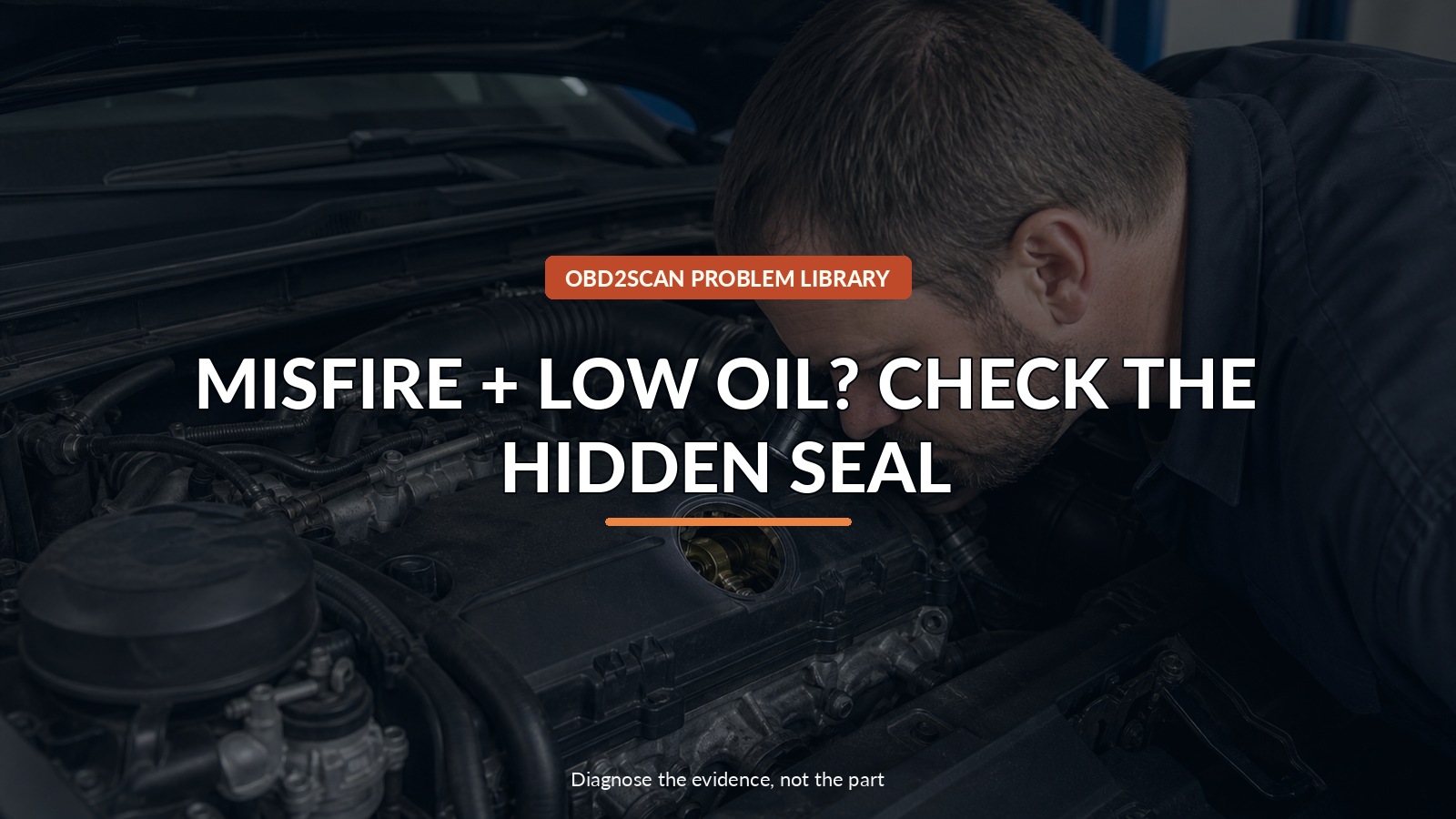
Misfire + Low Oil? Check The Hidden Seal
Stop and correct an unsafe oil level according to the owner’s manual; do not keep driving a noisy, low-pressure or severely misfiring engine. For the scoped 2.0L Grand Cherokee, Stellantis requires both relevant misfire DTCs and low oil before the special path continues. A qualified technician removes the PCV valve through the approved contact zone and uses a borescope to see whether the umbrella valve seal is present. Misfire codes with normal oil level do not qualify.
A small articulating borescope can inspect the PCV passage without turning the first check into major disassembly. The AUTOOL SVB208-HD is one practical viewing option. SVB208-HD can record the reachable PCV chamber through the prescribed opening after the engine is safely prepared; it cannot remove the PCV valve without damage, identify oil-consumption causes outside the visible chamber, measure oil level, replace the cylinder-head cover, run the wiTECH PCM reset or prove a misfire is repaired.
A misfire and disappearing engine oil are often diagnosed as two jobs. On a narrow group of 2.0L Grand Cherokees, they form an AND gate: only when both are present does a tiny missing seal beneath the valve cover become the focused next inspection. Keep the logic strict. Misfire alone is not enough, low oil alone is not enough and a blurry picture is not enough. The vehicle, symptoms and visual evidence must agree.
Quick answer: Protect the engine, document both misfire and oil loss, then use a clear PCV-passage view to prove whether the umbrella seal is missing.
In this guide
- Check oil level before chasing P0300
- Require both low oil and a listed misfire code
- Confirm the 2.0L, build date and VIN
- Remove the PCV valve only at the approved zone
- Aim the scope into the PCV chamber
- Decide present versus missing—not maybe
- Replace the cover only when the seal is absent
- Restore oil, reset the PCM and verify
Check oil level before chasing P0300
If the red oil-pressure warning appears, the engine knocks or the malfunction lamp flashes, reduce load and stop safely. Shut the engine off and check the level only on level ground after the wait specified in the owner’s manual. Do not continue driving to see whether the misfire clears. A flashing MIL can indicate catalyst-damaging misfire, while low pressure can damage the engine quickly. Arrange transport when the safe level cannot be restored with the exact specified oil or when a warning persists.
Require both low oil and a listed misfire code
Before adding oil or clearing codes, record dipstick level, mileage since the last service, quantity added, visible smoke, odor, starting behavior and every DTC with freeze-frame. Note whether P0300, P0301, P0302, P0303 or P0304 is current and whether oil loss occurred without an external puddle. Photograph external leaks before cleaning. A running consumption log—date, odometer, level and added quantity—turns ‘uses oil’ into evidence a dealer can compare with misfire timing.
Confirm the 2.0L, build date and VIN
TSB 09-017-26 Rev. A addresses certain 2026–2027 Grand Cherokee and Grand Cherokee L vehicles with the 2.0L engine, sales code EC7, built on or before August 15, 2026. Confirm VIN, engine and build date and retrieve the latest revision. Similar codes on the 3.6L, vehicles outside the fence or engines with a different oil-loss pattern need their own diagnosis. Technical bulletin applicability does not itself decide warranty coverage.
Remove the PCV valve only at the approved zone
First eliminate what the AND gate does not excuse. Check oil level and grade, inspect filter and drain sealing, valve cover and turbo-related areas, and look for coolant contamination or external loss. Review fuel trims and misfire counters, then test ignition, injector and mechanical branches as current information directs. A loose coil connector can cause a misfire while an unrelated oil leak lowers the level. The seal path becomes persuasive only when the scoped vehicle has both the code family and otherwise unexplained consumption.
Aim the scope into the PCV chamber
With the engine off and cool, the bulletin directs visual inspection through the PCV opening for the umbrella valve seal. Use the specified access and lighting, protect the opening from debris and capture a sharp image with recognizable orientation. Do not drop a camera tip, poke the valve or use compressed air to move it. The question is binary: is the seal visibly installed where the reference shows it? Shadow, oil film or a view of the wrong passage must be corrected before a conclusion.
| Gate | Required evidence | If absent |
|---|---|---|
| Correct 2.0L VIN/build scope | Vehicle record | Use another diagnostic path |
| Misfire code P0300–P0304 | Saved scan/freeze-frame | Diagnose oil loss separately |
| Documented low oil/consumption | Repeatable level record | Diagnose misfire separately |
| Missing umbrella seal in clear image | Oriented borescope photo | Do not apply the cover branch |
Decide present versus missing—not maybe
If the seal is missing on an eligible vehicle, follow the current valve-cover replacement procedure rather than improvising a loose seal installation. Keep dirt out of the valvetrain, use the specified fastener sequence and renew one-time-use components. If the seal is present, the bulletin branch closes and diagnosis returns to the saved evidence. Do not replace the cover solely because oil is low, and do not condemn rings or a cylinder solely because one misfire code named it.
Replace the cover only when the seal is absent
After the scoped repair, restore the exact oil level and follow the PCM reset or adaptation steps stated in the current bulletin. Save pre- and post-scan reports, run the required relearn and observe cylinder-specific misfire counts at cold start, warm idle and the original load. Check crankcase pressure behavior and external sealing without opening a hot system. Clear codes only after the original record is retained; otherwise a returning code loses the comparison that makes verification useful.
Restore oil, reset the PCM and verify
Oil-consumption verification takes distance, not one idle session. Establish a witnessed full mark, seal or document the fill point if the service process requires it, and recheck at agreed mileage on level ground under the same wait method. Pair that log with misfire counts and cold-start behavior. If oil still falls or P0300–P0304 returns, provide the borescope image, repair record and measurements and reopen mechanical, turbo, PCV, ignition or fueling diagnosis instead of repeating the cover.
This is a four-gate diagnosis, not a shortcut from P0300 to a valve cover. Protect the engine first, prove oil loss and misfire together, confirm the exact 2.0L build and capture an unmistakable view of the umbrella seal. The same discipline also tells the shop when the bulletin is not the answer.





Comments 0
Questions, fixes, and real-world diagnostic notes from readers.
Be the first to share a diagnostic result or ask a follow-up question.