
2021 Cayenne GTS or Turbo P014800/P310B00? Separate Low- and High-Pressure Fuel

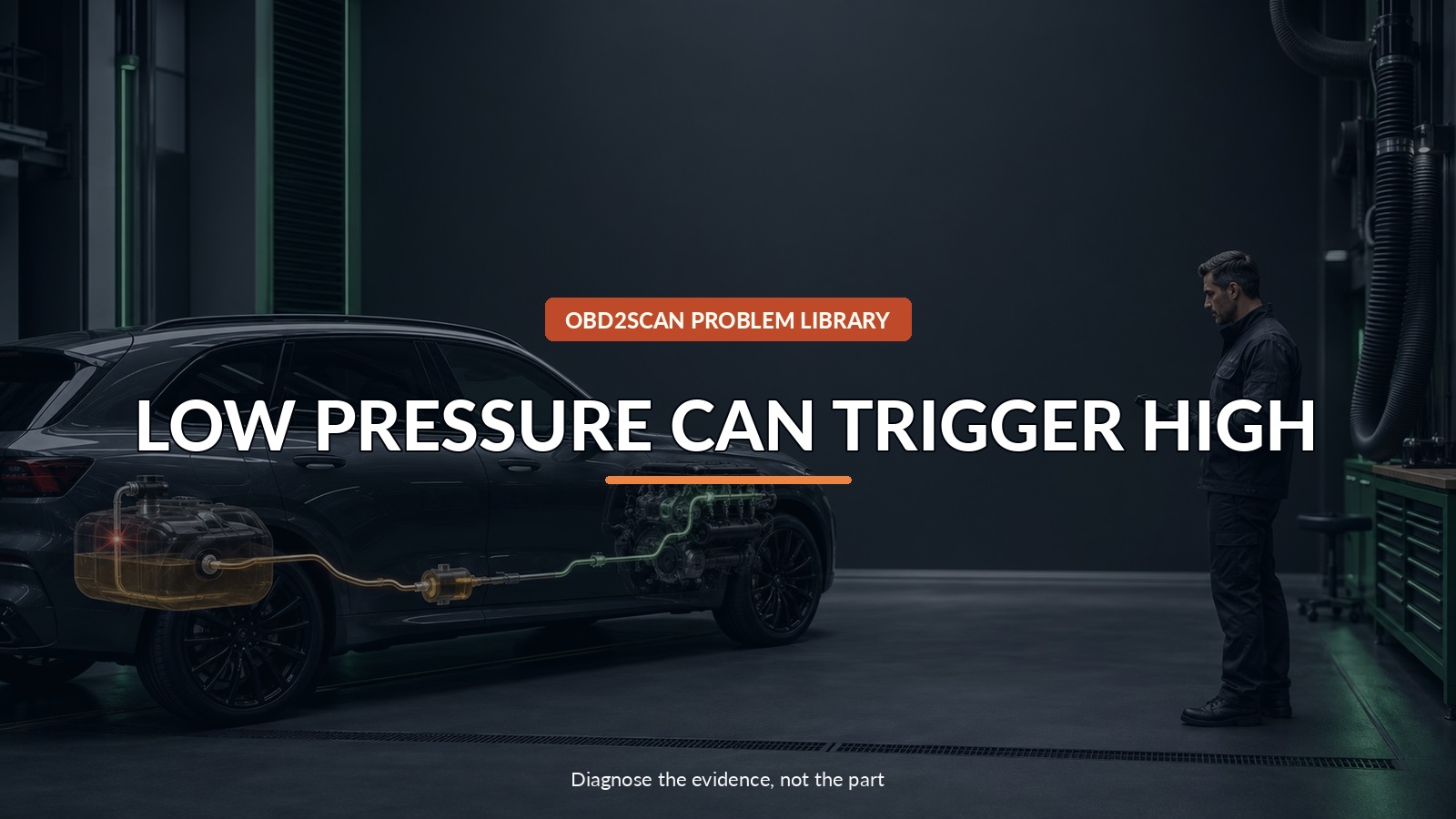
Low Pressure Can Trigger High
P014800 and P310B00 can appear together on a 2021 Cayenne GTS or Turbo with a check-engine light and sometimes reduced power. Although one fault description mentions the high-pressure fuel system, Porsche ATI 2327.2 places this scoped pair in the low-pressure supply branch and directs low-pressure fuel-pump replacement. Preserve both codes and confirm the exact model type before crossing from diagnosis into parts.
When Porsche’s procedure calls for a physical low-side measurement and the connection is compatible, a digital fuel-pressure gauge can document pressure and temperature over time. The AUTOOL PT635 fuel pressure gauge is one possible route. It cannot be connected casually to a direct-injection high-pressure rail, identify line damage versus pump performance, clear PIWIS faults, or make gasoline exposure safe.
Draw the system as two levels: tank-side low pressure supplies engine-side high pressure. A high-side complaint can begin upstream.
Quick answer: Stop for fuel odor or wetness, preserve both codes, confirm the four 2021 model types, and keep low- and high-pressure fuel evidence separate.
In this guide
- Stop first for odor or visible fuel
- Preserve both code texts and reduced power
- Confirm the four 2021 model types
- Draw the low-to-high pressure map
- Inspect the low-pressure route for damage
- Measure only at the approved test point
- Let Porsche control the pump branch
- Verify pressure, code state, odor, and loaded power
Stop first for odor or visible fuel
Porsche notes that vibration and available clearance can be associated with fuel-line damage and leakage. If you smell strong raw fuel, see wetness, observe dripping, or find damaged underbody components, switch off sources of ignition, do not start the engine and move people away. Arrange professional recovery to a ventilated repair area.
Do not use a lamp, phone, improvised electrical tool or open flame to search for gasoline. Fuel-system diagnosis requires fire protection, rated equipment and controlled pressure release.
Preserve both code texts and reduced power
Save the complete DME fault memory, status, freeze frame, commanded and actual pressures, fuel level, temperature, rpm and load. Record whether reduced power occurred, when the MIL came on, whether starting changed, and whether the event followed refueling, impact or recent fuel work.
Do not reduce the record to “P310B means high-pressure pump.” Porsche’s document pairs P014800, Fuel Delivery Error, with P310B00, High Pressure Fuel System Bank 2 Pressure, while explaining a low-pressure tolerance condition.
Confirm the four 2021 model types
ATI 2327.2 applies to 2021 Cayenne GTS and Turbo model types 9YABG1, 9YACF1, 9YBBG1 and 9YBCF1. Confirm model type and VIN with current Porsche service data. A base Cayenne, a different model year or an unpaired code needs its own diagnosis.
The bulletin is written for trained Porsche technicians and says PIWIS/workshop information takes precedence. It is not a recall notice or blanket warranty promise; check VIN programs separately.
Draw the low-to-high pressure map
The in-tank or low-pressure side must deliver enough fuel at the specified pressure and volume to the engine-side high-pressure pump. If the supply falls outside tolerance, the high-pressure stage may be unable to meet its target even when the high-pressure hardware is not the root cause.
| Evidence | Low-side question | High-side question |
|---|---|---|
| Key-on/prime | Does supply rise correctly? | Is a high-side command expected yet? |
| Cranking/running | Does low pressure hold under demand? | Does actual follow commanded? |
| Residual state | Does supply decay within spec? | Is the test designed to judge this stage? |
| Electrical data | Does pump voltage/current support output? | Are control and sensor signals plausible? |
Specifications and test points must come from current Porsche information, not generic pressure ranges.
Inspect the low-pressure route for damage
Porsche’s technical background describes about 19 mm of modeled clearance and says component vibration over time could damage a fuel line and cause a leak. Inspect the routed line, supports, contacts, abrasion and wetness under safe access. Do not treat the stated clearance as a field pass/fail measurement unless Porsche procedure says to do so.
A dry line today does not prove pump delivery is correct; a damaged line changes the job immediately from performance diagnosis to leak safety.
Measure only at the approved test point
Relieve residual pressure, use the Porsche-specified connection and rated adapter, route hoses away from heat and motion, and leak-check the setup before starting. Never attach a conventional hose or low-pressure kit to a GDI high-pressure rail simply because the gauge’s display has a large maximum number.
Record pressure against time and operating state rather than taking one photograph of a number. Compare physical pressure with scan data only when the two sensors/test points represent the same part of the system.
Let Porsche control the pump branch
For the exact models and faults, the current bulletin directs replacement of the low-pressure fuel pump under workshop manual procedure 206619. That direction is narrower than “replace a pump for low pressure” and broader than a generic gauge verdict; PIWIS and the latest workshop information control the repair.
Do not substitute an unverified pump, reuse prohibited seals, or open the tank without ventilation, battery isolation, cleanliness and fuel handling procedures.
Verify pressure, code state, odor, and loaded power
After the approved repair, inspect every connection for leakage before and during initial operation. Save a post-repair PIWIS report, compare commanded and actual values under the same safe conditions, and challenge the original load that produced reduced power.
Verification means no fuel odor or wetness, correct low-side performance, no returning P014800/P310B00, normal starting and restored power under a controlled drive. A MIL that stays off while the fault monitor has not run is not yet the same result.




Comments 0
Questions, fixes, and real-world diagnostic notes from readers.
Be the first to share a diagnostic result or ask a follow-up question.