
Mercedes M254 Red Cooling Warning? A Loose Pump Plug Is One Fast Check—not Permission to Drive

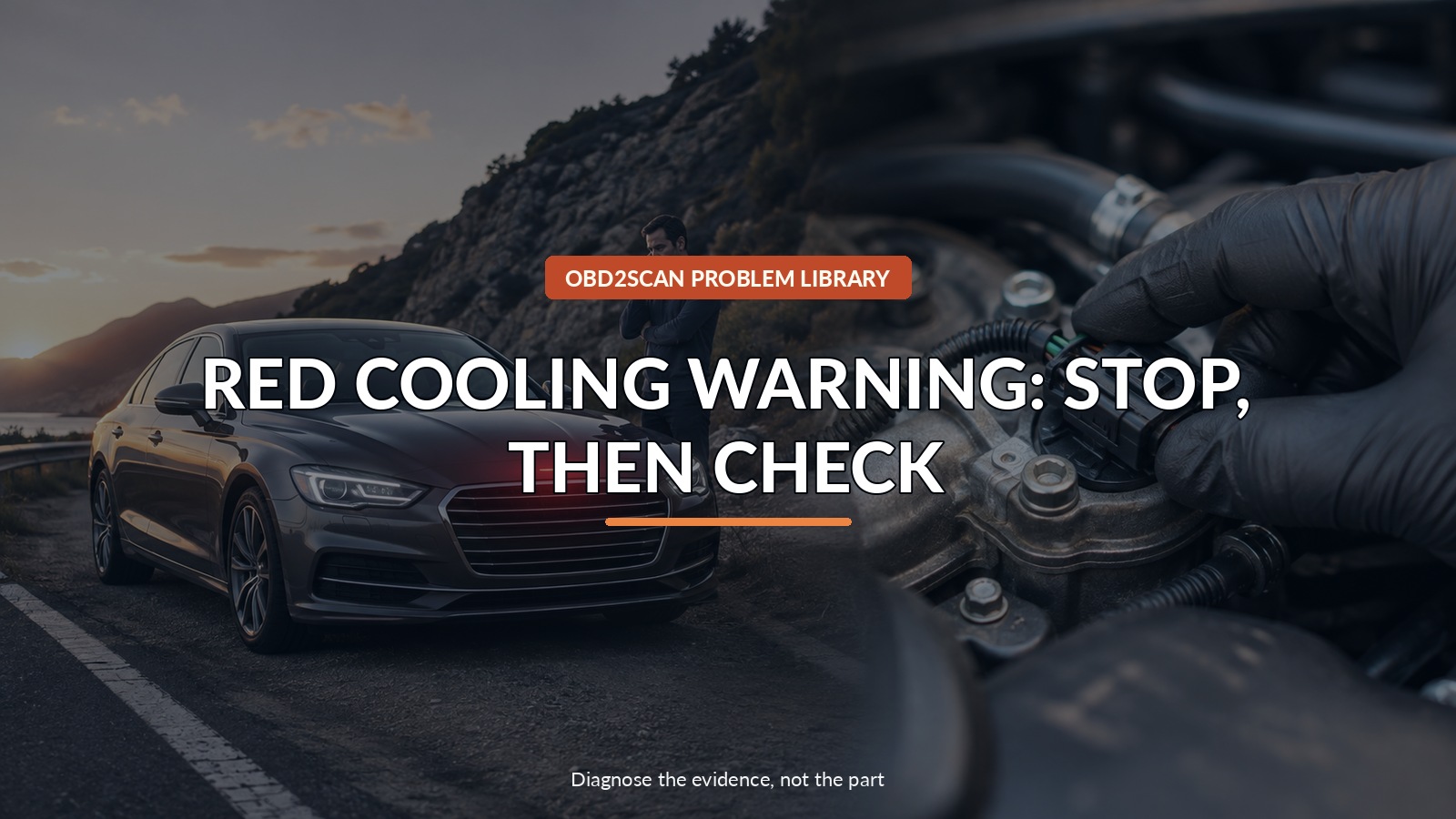
Red Cooling Warning: Stop, Then Check
A red cooling-system warning means reduce load, stop safely, shut down, and do not open the hot system; after recovery, a trained technician should save P21814B/P2B8500 and gently check the high-temperature coolant-pump connector housing for looseness before deeper XENTRY diagnosis. This article has two audiences and two clocks. The driver needs a decision in seconds: a red cooling warning is not a ‘drive home gently’ message. The technician, after the vehicle is recovered and cool, gets a fast physical check that can preserve a loose-connector finding before deeper diagnosis.
The useful tool category here is a circuit tester used only on an identified low-voltage pump circuit under the wiring diagram, but only after the safe test point and question are clear. The MRCARTOOL B550 is one practical route for that bounded measurement. B550 can help a trained technician document identified low-voltage supply, ground, continuity, or voltage drop against the Mercedes wiring diagram; it cannot make an overheated engine safe, be used to power CAN/module circuits indiscriminately, prove coolant circulation, or replace the physical connector-retention check.
The product appears here as a supporting measurement route, not as the solution. Mercedes’ first named action is a gentle physical retention check at the correct high-temperature coolant-pump connector.
Quick answer: A red M254 cooling warning means stop and recover the car; when cool, a trained technician can preserve the codes and check pump-connector retention.
In this guide
- Treat red as a stop instruction
- Preserve the warning and both possible codes
- Wait before touching the coolant system
- Identify the correct high-temperature pump
- Pull gently on the housing, not the wires
- Measure only after the circuit is identified
- Build the TIPS case when the plug is loose
- Verify temperature, pump command, output, and connector retention
Treat red as a stop instruction
Move out of traffic, turn off unnecessary load, stop as soon as safely possible, and shut the engine down. If steam, coolant loss, severe shaking, or reduced power is present, do not restart. Continuing can turn a connector or pump-control problem into cylinder-head, turbocharger, or cooling-system damage. Photograph the red message and note speed, load, outside temperature, heater output, and whether the warning appeared suddenly. Arrange towing rather than attempting repeated short drives to see whether the message resets.
Preserve the warning and both possible codes
After recovery, save the initial quick test before clearing anything. Mercedes lists P21814B for a cooling-system overtemperature fault and P2B8500 for coolant-pump rpm too low; one or both may be present with reduced output, rough running, or the MIL. Record current/history state, coolant temperature, commanded and actual pump behavior if available, low-voltage condition, and related faults. The code set supports a direction but does not prove the pump motor, connector, thermostat, coolant level, or circulation path by itself.
| Person | Do now | Do not do |
|---|---|---|
| Driver | Reduce load, stop safely, shut down, arrange recovery | Open hot cap or keep driving for data |
| Technician | Preserve quick test and inspect connector retention | Pull wires or assume plug is the only cause |
| Diagnostic lead | Create TIPS case with photos when loose | Promise coverage from the bulletin |
| Final checker | Verify temperature, pump behavior, and connector | Treat a cleared warning as proof |
Wait before touching the coolant system
Let the engine cool completely before any reservoir or hose inspection. Never open a hot pressurized cap. Check cold level, leakage, damaged hoses, belt-driven components where applicable, and signs of previous overheating under current Mercedes guidance. If coolant is low, find the cause rather than topping off and returning the car. The wrong coolant mixture or uncontrolled bleeding can create another temperature problem. Serious overheating may require mechanical-damage checks even if the original electrical fault is later found.
Identify the correct high-temperature pump
LI20.10-P-078510 applies to passenger cars with the M254 engine and names high-temperature coolant pump designations M43/10 or M75/11. Exact fitment and connector location depend on the VIN and service information. Identify the component through XENTRY/WIS before touching it; a nearby auxiliary pump is not interchangeable evidence. Record harness routing, lock position, witness marks, coolant contamination, and prior repair. Do not infer that every M254 red warning has this connector condition.
Pull gently on the housing, not the wires
Mercedes directs a gentle pull on the connector housing to check whether the plug is loose. Pull the housing—not the wires—and photograph it before reseating or moving the harness. A connector that comes away without proper lock retention is meaningful. Also inspect terminal seating and housing damage only as WIS permits. Repeatedly unplugging a marginal connection can erase witness marks or create a new problem, so preserve the as-found state before any cleaning, terminal adjustment, or parts decision.
Measure only after the circuit is identified
Electrical measurements come after the circuit and safe probing method are identified. Under stable voltage, compare supply, ground voltage drop, command, and continuity with WIS specifications. Never apply power or ground indiscriminately to a module-controlled, PWM, LIN, or CAN-related circuit. A good static voltage with the connector unloaded may hide terminal resistance; a continuity beep cannot prove current-carrying ability. Correlate any measurement with commanded versus actual pump behavior and coolant temperature rather than treating the meter as a pump verdict.
Build the TIPS case when the plug is loose
When a loose plug is found, Mercedes asks the technician to create a TIPS case to the powertrain team inbox with the initial quick test, details and photographs of engine or cooling-system damage, and other relevant information. That case preserves both the electrical cause and consequences. Ask the repair order to include the connector location/designation, as-found photo, code report, overheat duration, leakage/level findings, and any mechanical assessment. The bulletin itself explicitly does not guarantee a defect or warranty coverage.
Verify temperature, pump command, output, and connector retention
After the authorized correction, fill and bleed by current WIS, restore harness retention, and run the specified function/quick tests. Confirm actual pump rpm follows command, temperature stabilizes under a controlled load, heater output is normal, no leaks exist, and P21814B/P2B8500 do not return. Inspect for secondary overheat damage before release. The final proof is a stable thermal system and secured connector over the original operating condition—not a temporarily dark red warning after a battery reset.
A two-minute connector check can be valuable only after the vehicle is safely stopped and the original state is preserved. Keeping driver triage and technician diagnosis separate prevents a useful bulletin clue from becoming dangerous permission to continue driving.







Comments 0
Questions, fixes, and real-world diagnostic notes from readers.
Be the first to share a diagnostic result or ask a follow-up question.