
BMW PHEV BA0023 or BA0008 With No Charging Complaint? Check Software Before the CCU

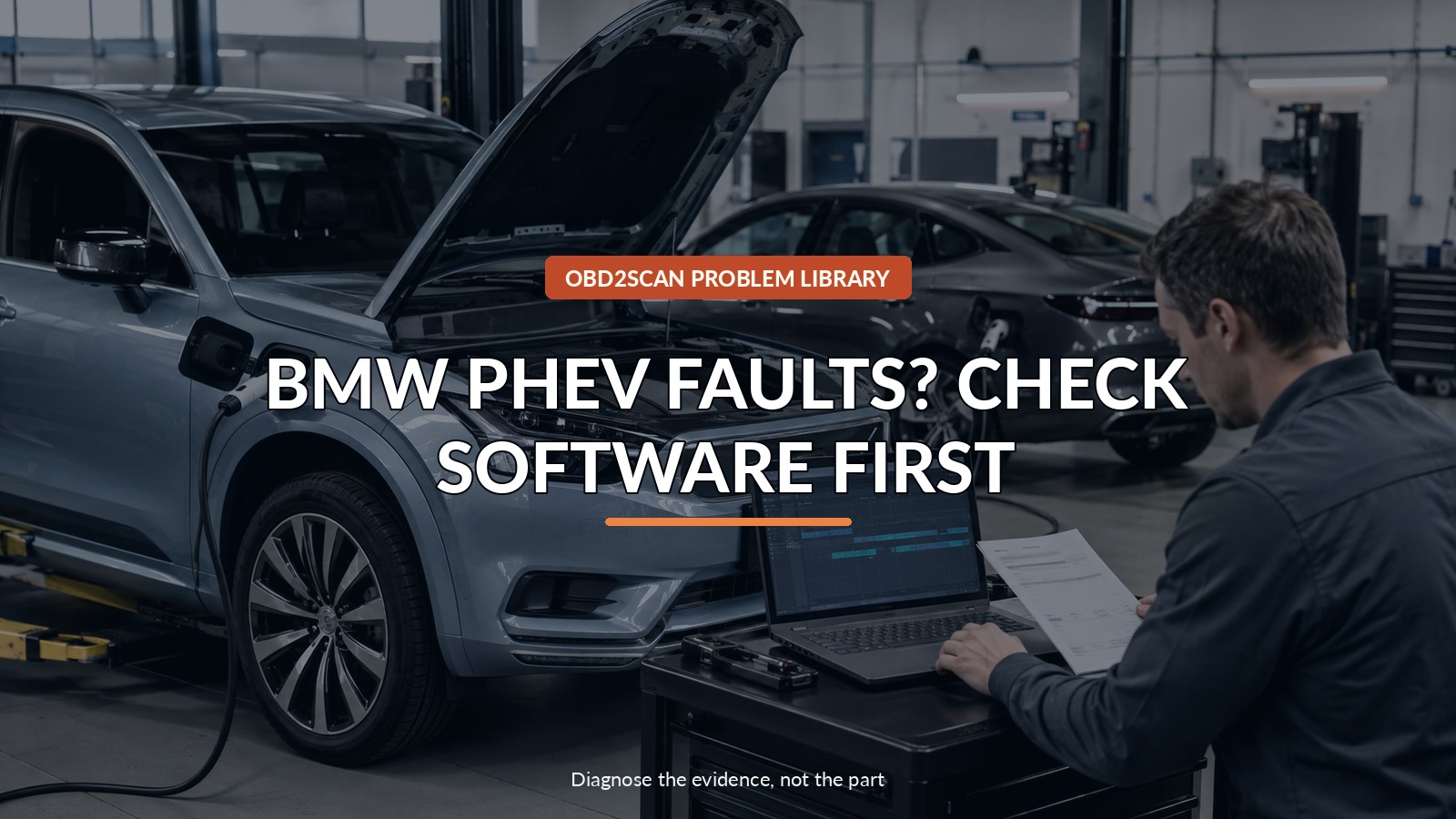
Bmw Phev Faults? Check Software First
First confirm whether AC charging actually fails, stops early or reports a charger fault. If charging and driving are normal and only BA0023/BA0008 are stored, BMW’s January 2026 bulletin points to a CCU software window and specifically says not to replace the CCU for that isolated condition. Because its target software was future-dated at publication, today’s ISTA plan and current integration level must control.
If ISTA’s current plan calls for programming, stable workshop power is part of the operation. The AUTOOL EM385 is one support option when its battery mode, regional supply and BMW connection method are all confirmed. EM385 can provide adjustable workshop power support, including listed lithium-battery modes, when BMW’s exact programming setup and battery architecture are confirmed; it cannot service the high-voltage pack, select or install an BMW I-level, run ISTA, make a faulty charger safe or prove the CCU hardware is good.
Two facts can be true at once: the malfunction lamp deserves a scan, and the charging control unit may still charge normally. The repair turns on actual charging behavior, fault context and the software level installed today. Treat the January 2026 bulletin like a dated map. It explains the territory that BMW knew then, but the live ISTA measures plan in September 2026 tells the technician which road is open now.
Quick answer: Confirm whether AC charging actually fails, preserve BA0023/BA0008 and let today’s ISTA plan and current I-level decide software versus hardware.
In this guide
- Separate a warning lamp from a failed charge
- Save BA0023 and BA0008 before disconnecting
- Read the current integration level
- Use the January bulletin as a dated snapshot
- Do not replace the CCU for the isolated pattern
- Stabilize the low-voltage system professionally
- Let ISTA choose today’s measures
- Verify AC charging, sleep and a fresh fault scan
Separate a warning lamp from a failed charge
Before booking the car as a charging failure, document one normal and one problematic session. Note AC source, wall box or portable cable, state of charge, departure timer, ambient temperature, start/stop time and every message in the car and app. Try another known-compatible AC station only if the vehicle and equipment appear safe. If the connector overheats, the cable is damaged, charging repeatedly stops or a high-voltage warning appears, discontinue use and arrange qualified BMW service. A lamp-only case is different from a functional failure.
Save BA0023 and BA0008 before disconnecting
Request a full BMW fault report before clearing BA0023 and BA0008. Record whether each is present, sporadic or history and capture any high-voltage isolation, charging-socket, grid, temperature or communication companions. A generic description may call them charging-control faults without explaining why the controller set them. Check the 12-volt battery foundation because unstable low voltage can complicate module communication, but do not make a healthy 12-volt result prove the CCU is healthy.
Read the current integration level
ISTA can display the vehicle’s current integration level (I-level), which represents the software package installed across the vehicle. BMW’s SI B61 01 26 identifies an affected range beginning with a 2024 release and extending through 2025-11 software. Compare the complete vehicle-specific value, not a phone app’s module version. Confirm the model is one listed in the bulletin: later X5 plug-in hybrid, XM, 550e, 750e or M5 plug-in-hybrid variants. Similar symptoms on another BMW need their own current plan.
| Situation | Bulletin fit | Direction |
|---|---|---|
| MIL, BA0023/BA0008, AC charging normal | Possible scoped software case | Check model and current I-level |
| AC charging actually fails | Not the isolated no-complaint case | Run full current ISTA plan |
| Newer software already installed | Old update assumption weak | Diagnose current evidence |
| High-voltage/connector safety warning | Safety branch | Stop charging and obtain qualified service |
Use the January bulletin as a dated snapshot
The bulletin was published January 2, 2026 and said a corrected integration level was expected from March 2026. That wording was future tense then. Now, do not tell an owner to wait until March or assume every newer package contains the final repair. The shop should load current ISTA, run the measures plan and check superseding service information. Record the version actually recommended and installed. Dating the claim prevents an old PDF from overruling a newer campaign, quality measure or diagnostic route.
Do not replace the CCU for the isolated pattern
For the isolated pattern—AC charging works, there is no drivability complaint and BA0023/BA0008 fall in the identified software window—BMW says not to replace the Combined Charging Unit. This is an important cost boundary, not a declaration that CCUs never fail. Actual no-charge, repeated session interruption, high-voltage safety faults, connector damage or a failed current test plan changes the branch. Ask the estimate to show the evidence that moves the vehicle from software-only handling to hardware replacement.
Stabilize the low-voltage system professionally
Programming a modern PHEV can keep many modules awake and draw substantial 12-volt current. A professional supply must match BMW’s required mode and connection points, remain stable through the full session and be monitored. EM385’s lithium charging capability does not mean it should be connected to the high-voltage traction battery; programming support is on the specified low-voltage architecture only. Keep high-voltage covers closed, use trained personnel and follow BMW workshop safety rules. Do not improvise a target voltage from another model.
Let ISTA choose today’s measures
ISTA controls diagnosis, programming, measures-plan dependencies and post-programming initialization. Let it identify whether the vehicle needs a full package or another action. Preserve customer settings and charging schedules where the procedure allows, and maintain network connectivity. If the session is interrupted, keep stable power and use BMW recovery instructions instead of cycling the vehicle repeatedly. A power supply cannot fix a lost subscription, wrong file or communication fault; it only removes one preventable source of programming failure.
Verify AC charging, sleep and a fresh fault scan
After service, perform a fresh vehicle test and a real AC charging session. Confirm the connector locks, energy flow begins, the session continues beyond its former failure point and departure schedules still work. Let the vehicle sleep and restart, then check the MIL and BA0023/BA0008 status. If charging was normal before, the proof is not merely a dark lamp—it is normal charging plus current software and no returning relevant faults. If a complaint remains, reopen the functional charging diagnosis rather than programming the same package again.
The useful BMW answer is neither ‘ignore the light’ nor ‘replace the charger.’ Verify what AC charging actually does, preserve the fault set, compare today’s integration level and let current ISTA interpret a bulletin that was future-looking when published. In the isolated software case, that evidence protects a good CCU. In a real charging failure, it prevents the software note from delaying the diagnosis the car actually needs.







Comments 0
Questions, fixes, and real-world diagnostic notes from readers.
Be the first to share a diagnostic result or ask a follow-up question.