
Mercedes S580 P061197 With No Drivability Issue? Do the Checks Before Hardware

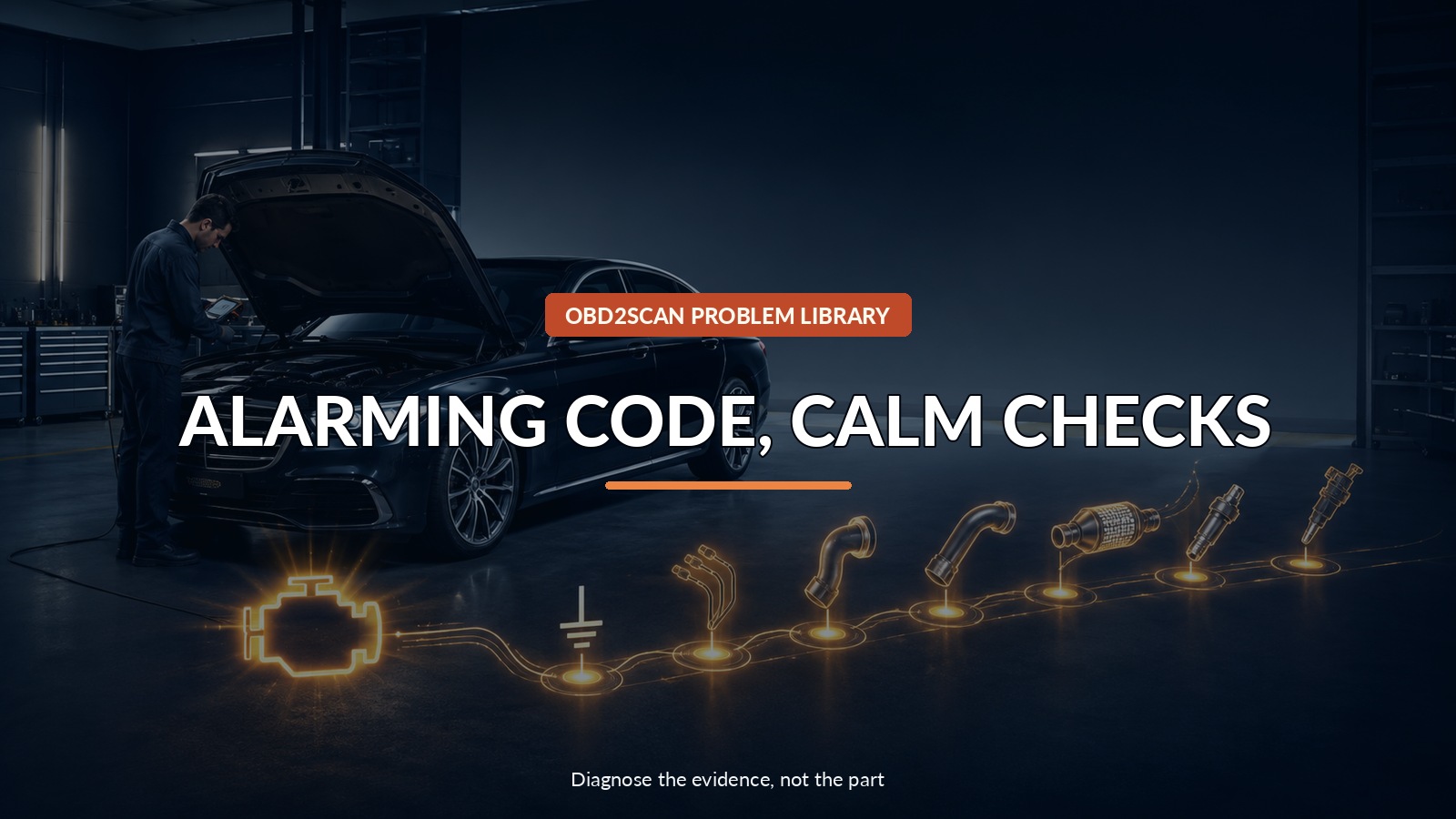
Alarming Code, Calm Checks
P061197 has an alarming description: the fuel-injector control unit has a malfunction and its output stage is restricted. Mercedes-Benz LI07.61-P-080241 Version 2 says that, on the scoped S580, the check-engine light can appear with no drivability concern and lists ME software as the cause. It still requires a disciplined series of physical checks before the car is released. The code text is not a control-unit purchase order.
One of those checks is a professional smoke test of the intake and exhaust systems. The AUTOOL SDT203 automotive smoke tester can visualize a compatible leak with pressure and flow feedback under the Mercedes procedure. It cannot test ECU grounds or injector wiring, inspect catalysts, run XENTRY lambda tests, code swapped injectors, install software, or justify smoke pressure without OEM limits.
This is a calm exclusion story: confirm the exact complaint, preserve software context, then close each physical branch in the order Mercedes gives.
Quick answer: When the scoped S580 has P061197 but drives normally, preserve software context and complete Mercedes’ staged ground, wiring, smoke, catalyst, lambda and injector checks before hardware.
In this guide
- Do not let the fault text order a control unit
- Confirm there is truly no drivability concern
- Preserve software and full fault context
- Clean grounds and inspect all eight injector circuits
- Smoke-test intake and exhaust as separate systems
- Look at catalysts and guide all four lambda tests
- Swap injectors 1 and 6 only at the final gate
- Verify without converting silence into proof
Do not let the fault text order a control unit
A DTC describes what a controller observed. It does not prove that the component named in the sentence is internally failed. Before clearing anything, save the complete XENTRY quick test, active/stored status, event data, ME software level, battery voltage and any other injector, lambda, misfire or network faults.
Ask what the driver actually experienced. Was there only a MIL, or also roughness, reduced power, hard starting, fuel odor, abnormal exhaust, overheating or another warning? A real drivability complaint does not fit the bulletin’s “no drivability concerns” condition and needs wider diagnosis.
Confirm there is truly no drivability concern
The document applies to model series 223 equipped with the M176 engine. Confirm VIN, engine designation and current bulletin because the header and control-unit text should be reconciled through Mercedes service information for the exact vehicle. Do not export the path to another S-Class engine or a similar P0611-family code.
If the engine misfires severely, fuel odor is present, exhaust is glowing, or a safety warning appears, stop driving and arrange professional service. “Software cause” is not permission to ignore a changed engine.
Preserve software and full fault context
Record the installed ME software and check for current XENTRY measures or updates. The bulletin states optimized software was in development; software availability and instructions are time-sensitive, so the workshop must use the live Mercedes system rather than a date promised in an older PDF.
Also verify 12V support. Programming or prolonged guided testing with unstable voltage can create communication failures and damage. Use the Mercedes-approved power-supply procedure when required.
Clean grounds and inspect all eight injector circuits
Mercedes first directs technicians to clean the N3/10 and ignition-coil ground points W11/3 and W25, then check ECU plugs and wiring to all eight injectors. Photograph corrosion, loose fasteners, damaged seals, terminal position, harness contact and previous repair before cleaning or moving it.
Use wiring diagrams and approved terminal tools. Check voltage drop under relevant load rather than trusting unloaded continuity alone. Never apply external power to an unknown ECU output or pierce insulation where a sealed back-probe is available.
Smoke-test intake and exhaust as separate systems
An intake leak can distort mixture control; an exhaust leak can admit oxygen and influence lambda interpretation. Test each system at the connection, pressure and valve state Mercedes specifies. Keep the engine cool where required, block or command paths correctly, and ventilate the bay.
| Smoke result | Meaning | What it does not prove |
|---|---|---|
| Visible intake leak | Repair and retest that path | ECU output-stage failure |
| Visible exhaust leak | Repair and retest that path | Catalyst condition |
| No visible leak | One exclusion step closed | Entire engine/ME system healthy |
| Smoke at an unintended open path | Test setup must be corrected | Vehicle leak |
Look at catalysts and guide all four lambda tests
The bulletin next calls for catalyst inspection with a borescope and XENTRY guided tests for all four lambda sensors. Catalyst inspection needs a cool exhaust, approved access and careful probe control. A single dark or bright image is not a flow or efficiency test; document both orientation and the suspected damage.
Run each lambda guided test without substituting a generic universal voltage rule. Sensor type, heater control and interpretation are application-specific. Save the results so “all four checked” means four traceable outcomes.
Swap injectors 1 and 6 only at the final gate
Only if the preceding checks are good does Mercedes direct swapping injectors 1 and 6, coding them in their new positions in the ME, clearing the faults and performing quality control. High-pressure fuel work, sealing, torque, coding and fire safety make this a trained-professional step.
Do not swap several injectors, omit coding or treat a moved code as the only possible result. Record which injector moved, new seal/part requirements, coding confirmation and before/after fault state.
Verify without converting silence into proof
Mercedes says the car can be released if the complaint is no longer present after the steps. Perform the current QC, confirm no fuel or exhaust leaks, verify smooth starting and running, and save the final XENTRY report. Challenge the operating condition that set the code where the procedure allows.
If the MIL remains off but the relevant monitor has not run, say so. If P061197 returns, preserve its new context and consult current Mercedes technical direction rather than replacing the ME from the wording alone. A quiet dashboard is reassuring; a completed, documented check sequence is proof.


Comments 0
Questions, fixes, and real-world diagnostic notes from readers.
Be the first to share a diagnostic result or ask a follow-up question.