
Hyundai Sonata P0451 or P14EE? Save the Code Before the Campaign Rewrites It

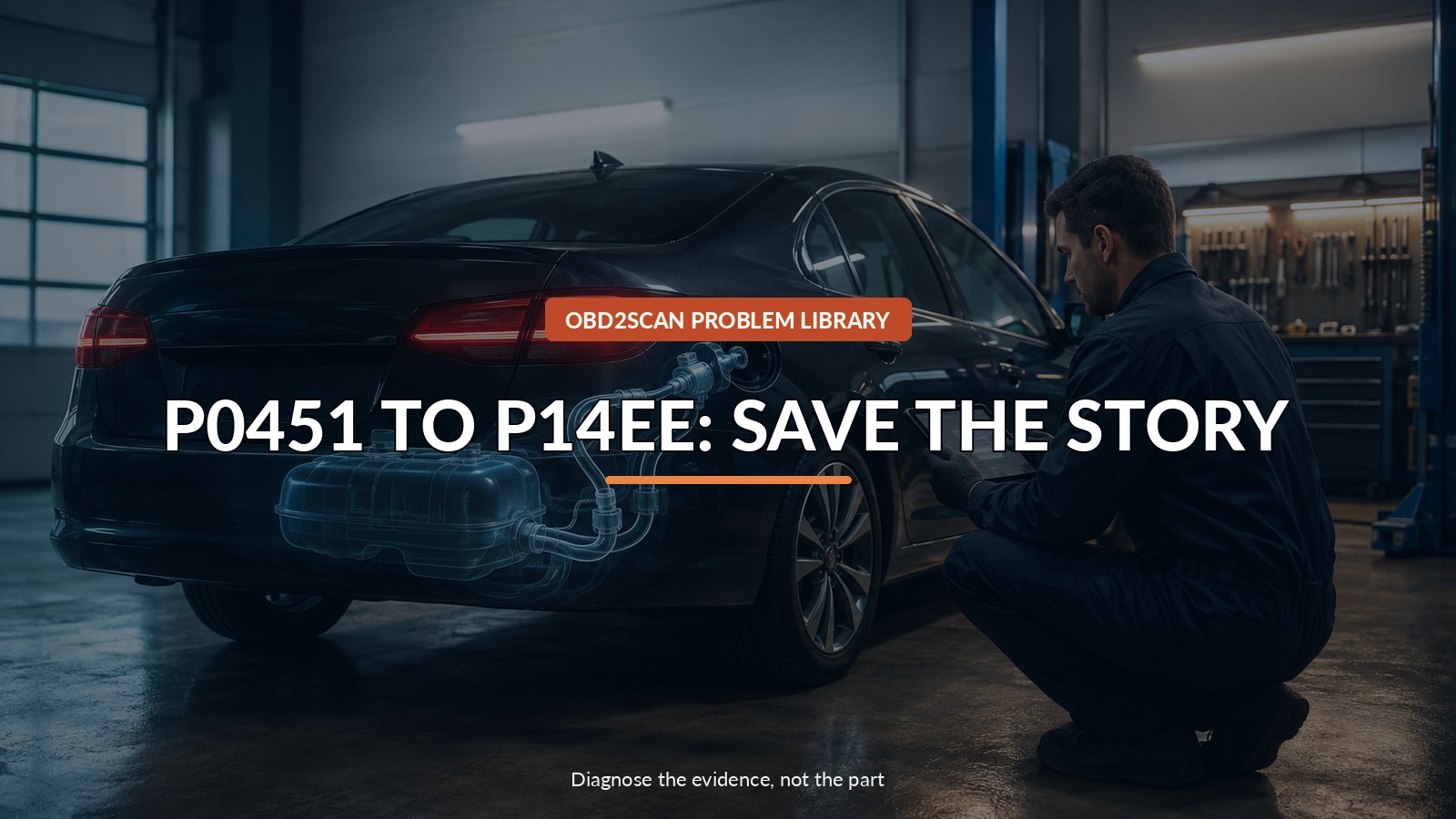
P0451 To P14Ee: Save The Story
Photograph the warning, save every EVAP code and freeze-frame record, and check the VIN before clearing anything. On a covered 1.6T Sonata, Hyundai’s campaign can turn the original P0451 story into a post-update P14EE00 check-valve decision rather than a generic sensor replacement. That change in code wording is part of the repair logic, not evidence that a second fault suddenly appeared.
If Hyundai’s sequence later leaves a genuine leak question, controlled air and smoke can make a small vapor escape visible; an AUTOOL SDT205 is one way to add that evidence on a compatible system. It is not the campaign’s check-valve rig, however, and it cannot judge tank expansion, inspect the fuel-pump cover, update the ECU, or prove that P0451 means a leak.
Think of this diagnosis as a timeline: what the car stored before the campaign step, what changed after programming, and what the controlled check-valve test proved. Keeping those moments separate prevents a rewritten code from rewriting the history.
Quick answer: Save the original EVAP code and campaign state before repair because Hyundai’s check-valve campaign can change P0451 into P14EE after the ECM update.
In this guide
- Preserve the code Hyundai may supersede
- Check VIN prefix and production date together
- Start with the check valve—not a parts search
- Read the tank-band gap as a physical gate
- Inspect the fuel-pump cover without masking evidence
- Update the ECU only inside the campaign path
- Let P14EE00 decide what happens next
- Verify fuel safety, code state, and campaign completion
Preserve the code Hyundai may supersede
Start with the car exactly as it arrived. Record whether the malfunction indicator lamp is steady, whether fuel odor is present, the fuel level, all current and history codes, and any available freeze frame. Do not erase P0451 simply to see whether it returns. Hyundai’s updated calibration replaces that older diagnostic label with P14EE00, so the before-and-after record explains why the technician may finish with a different code than the owner first saw.
This is especially useful if the car recently failed an emissions inspection. Ask for the original test sheet, but do not promise that completing the campaign will instantly clear a permanent code or set every readiness monitor. Those are separate verification steps.
Check VIN prefix and production date together
The model badge alone is not enough. Hyundai’s January 2025 bulletin covers certain 2021–2023 Sonata DN8 1.6T vehicles produced from April 2, 2021 through October 7, 2023 with a VIN beginning KMH, and certain 2020–2022 Sonata DN8A 1.6T vehicles produced from October 22, 2019 through February 17, 2022 with a VIN beginning 5NP. Campaign status still has to be checked for the individual VIN.
Use this short gate before discussing parts:
| What you have | What it means next |
|---|---|
| Wrong engine, date, VIN prefix, or closed campaign | Diagnose P0451 by the current service information |
| Eligible VIN with the original calibration | Follow campaign 9B1 from the check-valve inspection |
| Update completed and P14EE00 sets | Return to Hyundai’s specified check-valve decision |
| Strong fuel odor, visible wet fuel, or tank damage | Stop ordinary testing and arrange fuel-system safety inspection |
A technical service campaign is not the same thing as a safety recall, and coverage is VIN-specific. The lookup result and repair order are better evidence than a screenshot from a general code site.
Start with the check valve—not a parts search
Hyundai does not begin by replacing the fuel-tank-pressure sensor. The bulletin removes the PCSV check valve and tests it with a specified directional air setup. Connection direction matters: a reversed valve or a poor seal at the adapter can make the result meaningless. The prescribed pressure is also part of the method, not a target to improvise with shop air.
In Hyundai’s test, the right-angle hose end is partially submerged to watch for bubbles; the whole valve must not be submerged. No bubbles means the valve passes and the workflow moves to the ECU update. Bubbles mean the valve fails and the technician must measure the fuel-tank-band gap before deciding how large the physical repair becomes.
Read the tank-band gap as a physical gate
After a failed check-valve test, the bulletin measures the gap between the fuel tank and tank band at a specific groove. The dividing line is 25 mm. A gap of 25 mm or less leads to check-valve replacement and then the software update. A gap greater than 25 mm opens the deeper fuel-pump-service-cover and tank inspection.
This is why a photo of a ruler somewhere near the tank is not enough. Location, viewing angle, and the exact contact points determine whether the measurement represents the bulletin. Hyundai also asks the dealer to retain a validation photo tied to the VIN and repair date. For an owner, the useful question is simple: “What was the measured gap, and which branch did it open?”
Inspect the fuel-pump cover without masking evidence
The larger-gap path checks whether tank expansion has affected the service-cover area or the floor pan. Access requires fuel-pressure relief, electrical isolation, rear-seat removal, and close attention to fuel vapor. This is trained fuel-system work, not a reason to lift a cushion in a driveway.
If the cover area is normal, Hyundai’s flowchart calls for replacement of the check valve, fuel tank, heat protector, and tank bands before the update. If a gap or floor-pan damage is present, the dealer opens a Techline case, photographs the condition, and follows further direction. That distinction matters: the campaign is not a blanket instruction to order a tank, and visible body contact is not a routine DIY repair.
Update the ECU only inside the campaign path
The calibration update belongs after the physical inspection branch, not before it. Programming requires the correct Hyundai event, stable battery support, and confirmation that the new ROM ID installed. Interrupting a module update can create a much larger problem than the original warning lamp.
Ask the shop to preserve the pre-update code report and document the completed event. Incidental codes caused by fuse removal, battery disconnection, or programming should be distinguished from the original EVAP complaint, then cleared only after the procedure is complete. A generic scanner can read many emissions codes, but it does not substitute for the campaign programming system or Hyundai’s validation record.
Let P14EE00 decide what happens next
After the update, P14EE00 is meaningful in a very specific way: the revised logic uses it to indicate that the check valve needs replacement. It should not be blended with the original P0451 as though two independent components failed. The clean narrative is “old calibration and P0451,” followed by “inspection and update,” followed by either no returning fault or a P14EE00-controlled check-valve action.
If another EVAP code appears, or if the car is outside the production fence, return to normal diagnostics. That may include electrical checks, commanded purge and vent tests, pressure-sensor data, or a regulated leak test. Smoke is useful when the question is “where does vapor escape?” It is poor evidence for tank expansion, incorrect terminal logic, a calibration state, or a one-way valve that was never tested in the specified direction.
Verify fuel safety, code state, and campaign completion
The repair is not finished when the lamp is switched off. Confirm that the engine starts and idles normally, there is no fuel or vapor leak, the pump service cover and rear seat are correctly restored, the intended software level is present, and no campaign-related code returns. If the vehicle must complete readiness monitors, follow the applicable drive-cycle guidance instead of repeatedly clearing memory.
The owner should leave with four plain answers: whether the VIN was eligible, whether the check valve bubbled, what the tank-band gap measured, and whether P14EE00 appeared after programming. Those facts explain the repair far better than a receipt that only says “EVAP service.”


Comments 0
Questions, fixes, and real-world diagnostic notes from readers.
Be the first to share a diagnostic result or ask a follow-up question.