
Hyundai Hybrid P1BB200 and Limp Mode? Do Not Treat the 12V Lithium Pack Like a Starter Battery

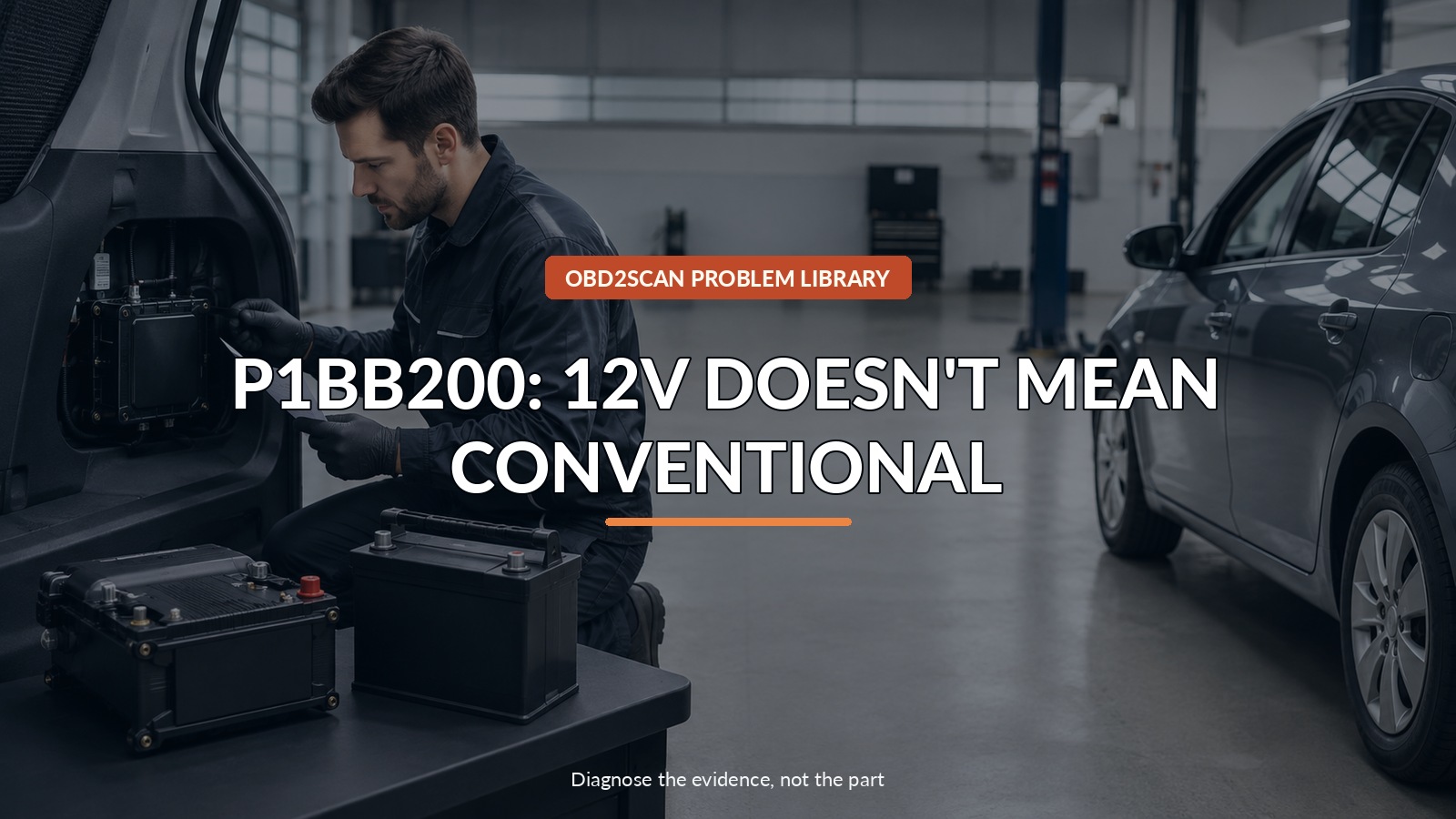
P1Bb200: 12V Doesn’T Mean Conventional
Move out of traffic if limp mode limits acceleration, save P1BB200 and verify the VIN in Hyundai’s current campaign system. Do not clamp on a conventional battery tester or disconnect the pack based only on ’12V.’ Hyundai’s branch checks the BMS ROM ID and uses controlled GDS programming with strict voltage and ignition prerequisites. The number on the label describes nominal system voltage; it does not define chemistry, access, isolation or a safe test connection.
The useful tool category here is architecture-approved lithium-battery observation only after Hyundai documentation identifies a safe connection and test, but only after the safe test point and decision are clear. The AUTOOL BT960 is one practical route for that bounded step. BT960 lists lithium-battery, voltage and leakage-current functions, but that capability does not establish a safe connection to Hyundai’s integrated 12V lithium architecture. It cannot read the BMS ROM ID, perform Event 796/1037/1038 programming, make high-voltage components safe or replace Hyundai’s campaign procedure.
Draw a hard boundary between familiar and equivalent. A conventional 12V starter battery and Hyundai’s integrated 12V lithium system may supply similar nominal voltage, yet demand different tools and procedures. Campaign 9B4 begins with VIN and BMS software identity—not with a clamp-on verdict.
Quick answer: Exit traffic if limp mode limits acceleration, save P1BB200 and verify VIN/BMS ROM without treating the integrated 12V lithium pack like a starter battery.
In this guide
- Get out of traffic if limp mode changes acceleration
- Save P1BB200 before cycling the vehicle
- Identify the battery architecture before touching terminals
- Match model, production range and open campaign
- Read the current BMS ROM ID
- Protect programming voltage without entering Ready mode
- Recover a failed update only through Hyundai’s path
- Verify Ready mode, all-system code state and campaign completion
Get out of traffic if limp mode changes acceleration
If limp mode reduces acceleration, move out of active traffic without demanding full power. Use hazard lights as appropriate and stop in a safe place. Record the warning and whether Ready mode remained available, but do not keep cycling the vehicle to see whether power returns. If it cannot maintain safe speed, has a burning smell, smoke, unusual heat or another hybrid warning, arrange a tow following Hyundai’s instructions. P1BB200 describes a controller finding; it is not a roadside declaration that the battery is physically safe.
Save P1BB200 before cycling the vehicle
Save P1BB200 with status, freeze-frame and a complete all-system report before clearing. Record state of charge indications, ambient temperature, recent jump-start or 12V reset, charging history and exactly when limp mode began. Low-voltage and communication codes from other modules may describe the same event or reveal a different foundation problem. Photograph the cluster and note whether a restart changed the condition. A disappearing warning after a key cycle still leaves the VIN/software question unanswered.
Identify the battery architecture before touching terminals
Identify the vehicle’s 12V architecture from the VIN and current Hyundai service information before touching terminals. Do not assume there is a conventional removable lead-acid battery under the hood, and do not attach a tester because its menu says ‘lithium.’ Hyundai’s integrated low-voltage lithium design, reset features and relationship to the hybrid system require defined connection points and states. Avoid orange high-voltage components entirely unless trained and equipped under Hyundai’s high-voltage procedure.
Match model, production range and open campaign
Campaign 9B4 covers certain 2021–2023 Elantra Hybrid built December 15, 2020–February 13, 2023; 2020–2022 Sonata Hybrid built January 29, 2020–March 8, 2022; and 2022–2024 Tucson Hybrid built January 20, 2021–December 18, 2023. Those dates describe the published population, not the individual result. Hyundai tells dealers to check the Vehicle Information screen in WEBDCS. The VIN’s current open/completed record controls campaign action.
| Familiar shortcut | Why it fails here |
|---|---|
| ‘It says 12V, so use a starter-battery tester’ | Nominal voltage does not define architecture or safe connection |
| ‘P1BB200 means replace the lithium pack’ | Hyundai’s campaign first checks VIN and BMS ROM |
| ‘The warning cleared after restart’ | Intermittent state does not prove current software |
| ‘Any update event for this model will work’ | Platform, ROM table and current GDS event must match |
Read the current BMS ROM ID
A qualified technician connects GDS-Smart and reads the BMS ROM ID before choosing an update. Event numbers in the bulletin differ by platform: 796 for DN8, 1037 for CN7 and 1038 for NX4, or a later listed event in the GDS BMS update screen. Matching the model name without the ROM table can lead to the wrong assumption that software is old. Record the original ROM ID, applicable event and completed new ID so the result is auditable after the warning is gone.
Protect programming voltage without entering Ready mode
Hyundai requires at least 11V battery voltage for the update and more than 30% tablet charge, while warning against starting the vehicle or entering Ready mode during programming. Those requirements are not permission to improvise a support connection on the integrated pack. Use the Hyundai-approved support arrangement and keep loads, wireless interruptions and ignition changes controlled. Stable voltage enables programming; it does not choose the file, communicate with the BMS or make high-voltage work safe.
Recover a failed update only through Hyundai’s path
If an update is interrupted or the module does not accept it, stop random key cycling and follow GDS recovery/manual-update guidance for the correct platform and ROM. Preserve error messages and the point of failure. Do not substitute a battery reset, disconnect the integrated pack or repeat an event selected by vehicle name alone. A failed programming session can create a new no-Ready condition that obscures the original P1BB200 complaint, so escalation belongs inside Hyundai’s current support process.
Verify Ready mode, all-system code state and campaign completion
After successful programming, follow Hyundai’s specified ignition cycle, clear DTCs and run an all-system rescan. Confirm the vehicle enters Ready mode normally, the original warning and limp behavior are absent, and the campaign shows completed in the VIN record. Review any remaining code separately. A short stationary success is not proof of all hybrid operation, but a controlled road verification should happen only after the software record and safety checks are complete.
The most useful service note contains the VIN, production date, P1BB200 freeze-frame, all-system scan, exact battery architecture, current campaign status, original/new ROM IDs and completed event. That information solves the driver’s reduced-power problem while protecting them from the most dangerous shortcut in this case: treating every battery with twelve volts in its name as the same battery.



Comments 0
Questions, fixes, and real-world diagnostic notes from readers.
Be the first to share a diagnostic result or ask a follow-up question.