
P0300 Random/Multiple Misfire? Find the Pattern Before Replacing Coils

P0300 means the controller detected misfire activity that was random, moved among cylinders, or could not be assigned to one cylinder under the conditions stored. It does not prove that every cylinder is failing or that the ignition coils are bad. If the lamp flashes or the engine shakes hard, stop driving to protect the catalyst; otherwise save freeze-frame, cylinder misfire counters, related codes, and the exact cold/idle/load pattern before clearing.
What to do first
- A flashing malfunction lamp, severe shaking, raw-fuel odor, smoke, a glowing catalyst, or major power loss is a stop-driving condition.
- Save current, pending, permanent, and history codes plus freeze-frame before swapping or clearing anything.
- Record whether the first start cold, warm idle, acceleration, steady cruise, rain, or refueling reproduces the event.
- Do not pull ignition leads, create an open spark, or open a pressurized fuel system as a driveway test.
In this guide
1. What the symptom means—and does not prove
Misfire monitoring uses crankshaft-speed variation and model-specific logic. P0300 can represent a shared cause, several independent cylinder causes, an intermittent mechanical event, or even an application-specific software condition. Cylinder counters and operating conditions are clues; they must be interpreted with service information because monitor sensitivity and counter behavior differ.
It does not independently prove
- that all coils or spark plugs need replacement;
- that the fuel is lean or rich;
- that the misfire is ignition-related;
- that compression is acceptable;
- that a model-specific injector, valve, or software bulletin applies;
- that clearing the lamp corrected the event;
2. Save the evidence and make only low-risk checks
- code status, freeze-frame, and readiness;
- cylinder-specific counts before and during the complaint;
- cold-soak time, coolant temperature, load, gear, RPM, speed, and weather;
- fuel source and refueling timing;
- plug/coil/injector work, oil/coolant use, overheating, and software history;
Preserve this record before resets, repeated starts, part swaps, or fluid additions change the condition. Related background: spark-plug comparison guide rough-idle workflow.
3. Use the pattern to choose the next test
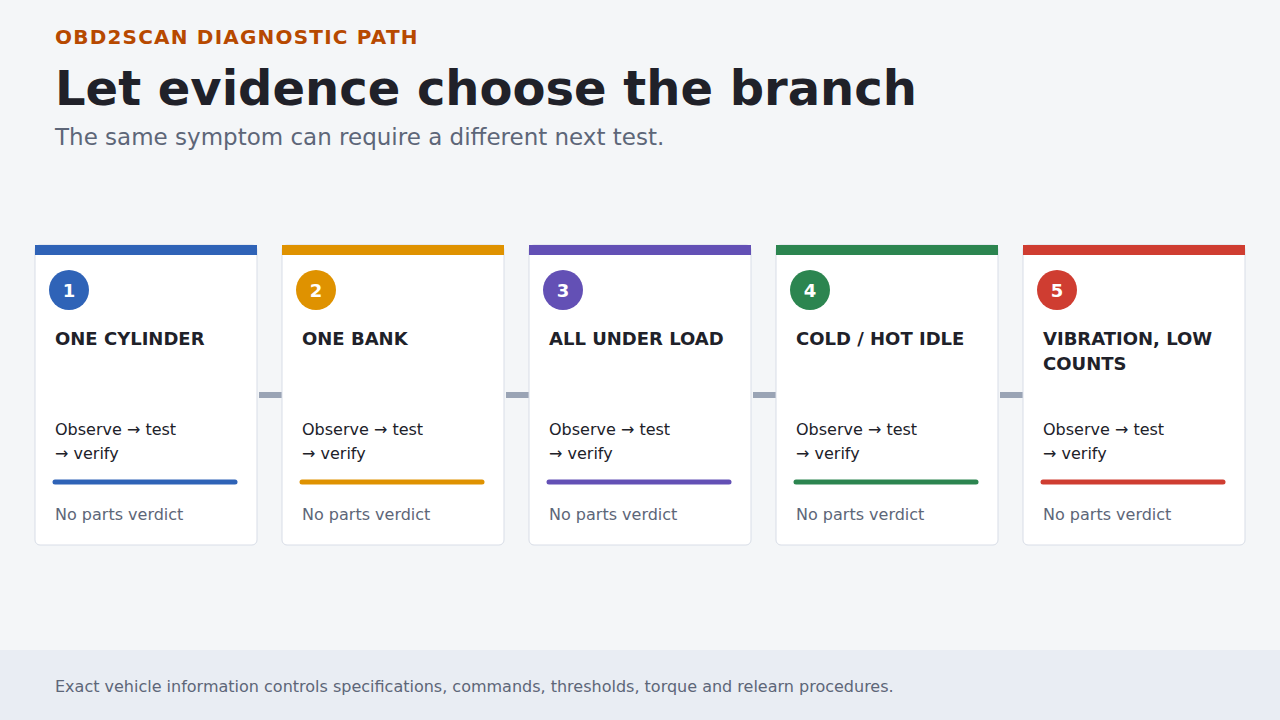
1. One cylinder repeatedly leads the count
What the pattern changes: A plug, coil, injector, wiring, compression, valve, or localized leak branch is more efficient than replacing a full set. If one cylinder consistently leads the misfire count, the MRCARTOOL H90 spark-plug tester can provide a quick plug-to-plug bench comparison, but the result should be checked against coil, injector, compression, and wiring evidence.
Next proof: A controlled component substitution can be useful only when the part and procedure are safe and the fault is shown to move; otherwise test circuit, injector contribution, and mechanics.
2. Several cylinders on one bank move together
What the pattern changes: Bank-specific air, fuel, exhaust feedback, timing, or mechanical control becomes more plausible.
Next proof: Compare the other bank under the same conditions and inspect shared bank hardware before judging individual coils.
3. All cylinders react under load
What the pattern changes: Fuel delivery, airflow calculation, shared ignition power/ground, restricted exhaust, or control voltage can affect the whole engine.
Next proof: Measure the shared system while the failure is present; a quiet fuel pump or clean air filter does not prove delivery.
4. Cold start or hot idle is the trigger
What the pattern changes: Deposit-related valve behavior, injector leakage/imbalance, intake sealing, purge flow, and calibration can be temperature-specific.
Next proof: Preserve the soak time and temperature. Search exact VIN, engine, software level, and bulletin applicability before parts.
5. Counts are low but the driver feels a vibration
What the pattern changes: Mount, driveline, accessory, idle-control, or monitor sensitivity may be confused with combustion misfire.
Next proof: Correlate scan counts, crank variation, sound, and operating state rather than labeling every shake P0300.
Safety boundary
Exact service information controls specifications and invasive procedures. Fuel/refrigerant systems, hot or rotating parts, brake hydraulics, lifted vehicles, high-current circuits, pressure testing, forced commands, and road reproduction belong with trained personnel and the correct equipment.
4. Give the shop a reproducible handoff
- VIN/engine/software level;
- all DTCs and freeze-frame;
- misfire counters by cylinder;
- precise cold/idle/load trigger;
- ignition, injector, leak and mechanical test results;
Ask for the failed test and the before/after result—not only the name of the installed part. A model-specific bulletin is useful only after VIN, engine, software, code set, and symptom applicability match.
5. Verify the repair under the original condition
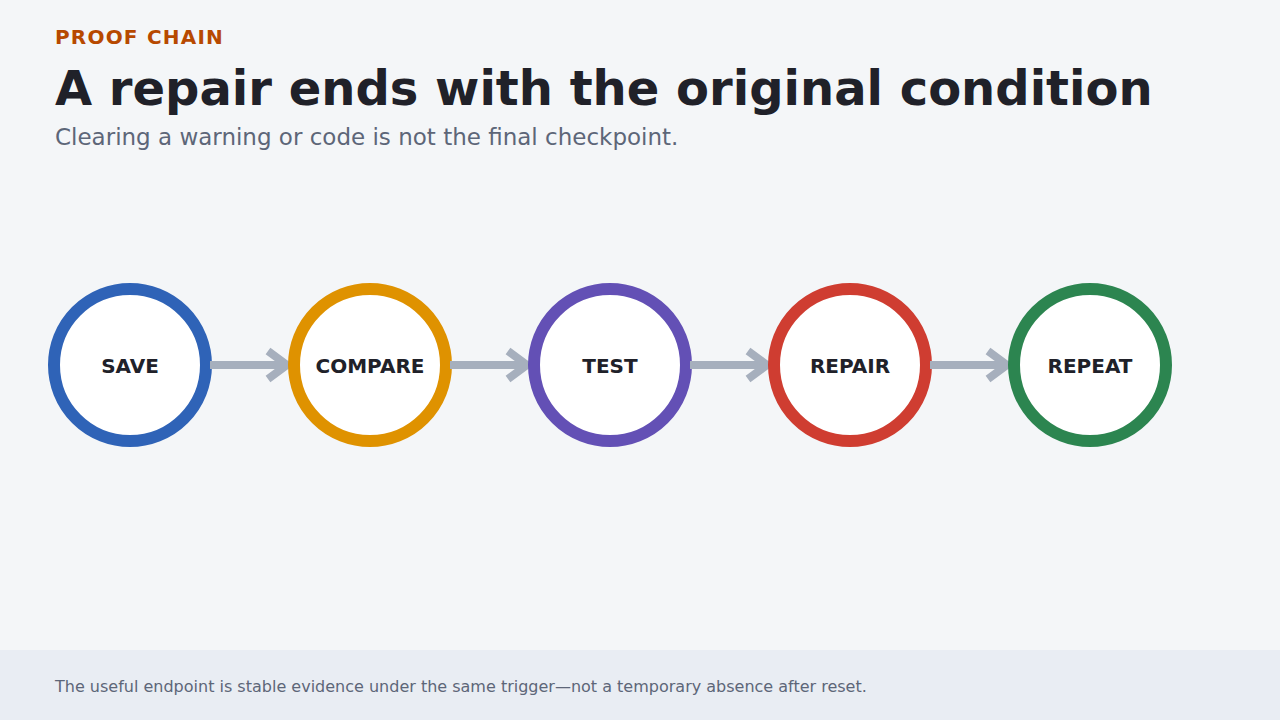
Repeat the same cold soak, idle, load, or road condition that originally accumulated misfires. The engine should remain smooth, relevant cylinder counters should not build abnormally, no current or pending misfire code should return, and the misfire monitor should complete. One smooth idle in the repair bay is not sufficient when the original fault occurred only under load or after a cold soak.
Official and primary technical references
- GM bulletin 16-NA-383 — General Motors / NHTSA
- Honda warranty extension bulletin — Honda / NHTSA
- Mazda P0300 service bulletin — Mazda / NHTSA
The useful outcome
You should finish with the original condition precisely recorded, the unsafe possibilities controlled, one failed path proven, and a repeat test showing the symptom or warning is genuinely resolved.








Comments 0
Questions, fixes, and real-world diagnostic notes from readers.
Be the first to share a diagnostic result or ask a follow-up question.