
How to Test a Car Battery with a Multimeter—Without Overreading the Number

A battery showing normal open-circuit voltage can still fail under starter load, and a low reading may reflect discharge rather than a failed battery. Use DC volts, put the black lead in COM and the red lead in the voltage jack, measure directly across the terminals, and label the vehicle state for every reading.
What to do first
- Before connecting, confirm the red lead is in the V/Ω jack—not an A or mA current jack—and select DC volts.
- Take separate rested, cranking, and engine-running readings; do not compare numbers taken under different loads as if they were the same test.
- Use voltage as screening evidence. Battery capacity, starter current, cable voltage drop, charging control, temperature, and battery chemistry may require additional tests.
In this guide

1. Inspect before touching the probes
Work in a ventilated area with the ignition and accessories off. Do not test a cracked, leaking, swollen, frozen, or very hot battery. Remove metal jewelry, keep sparks and flame away, and follow the vehicle procedure before disconnecting anything; some vehicles require memory, registration, or high-voltage precautions.
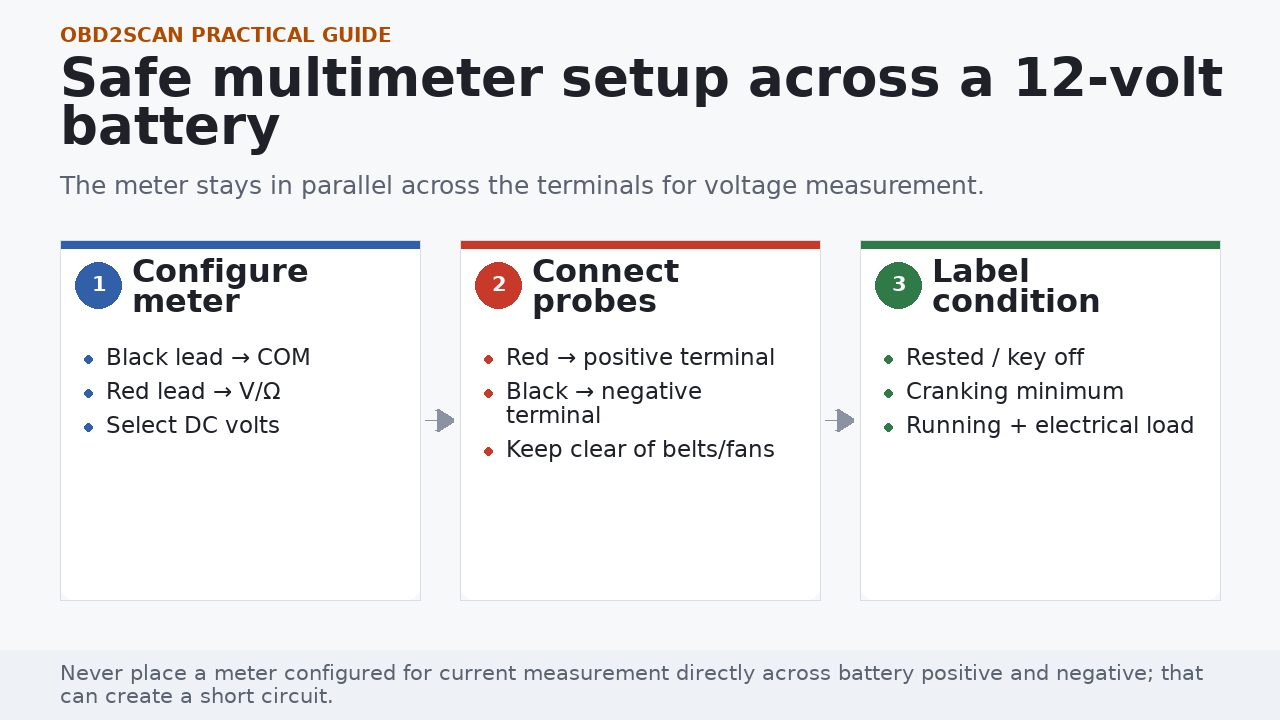
Avoid the current jack
For this procedure the red lead belongs in the voltage input. A lead left in a high-current input can short the battery if the probes are placed across its terminals.
2. Take three labeled readings
- Rested/key-off: measure after the battery has stabilized according to the battery or service procedure. Record ambient temperature and recent charging or driving.
- Cranking: if safe and supported by the meter, capture minimum voltage while a helper starts the engine. Stop repeated cranking if the engine does not start.
- Engine running: measure at idle and under a specified electrical load, then compare with OEM charging-system information rather than a universal alternator number.
Fluke uses about 12.6 V as a fully charged reference for a conventional 12-volt lead-acid battery. Treat it as context, not a pass/fail line for every chemistry, temperature, surface-charge state, or vehicle. A battery can show that voltage and still have insufficient capacity under load. For these labeled voltage checks, the AUTOOL DM303 automotive multimeter combines standard multimeter measurements with automotive circuit-test functions, helping confirm the electrical pattern before the battery or alternator is condemned.
3. Interpret the pattern, not one number
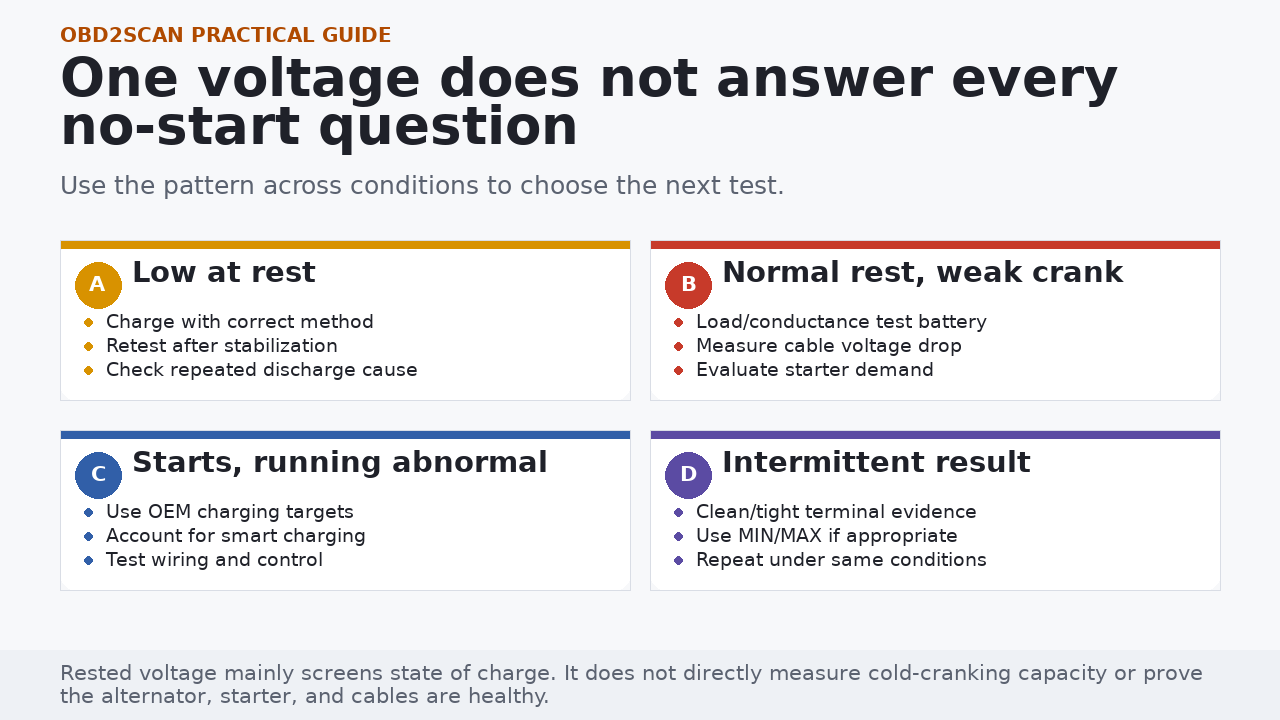
| Pattern | What it supports | Next useful check |
|---|---|---|
| Low rested voltage | Battery is discharged under the test conditions | Charge correctly, stabilize, retest, then find why charge was lost. |
| Rested reading looks normal; voltage collapses while cranking | Capacity, connection, cable, or starter-load problem remains | Battery load/conductance plus positive and ground voltage-drop tests. |
| Jump starts but own battery does not | Extra voltage/current changed the circuit | Do not assume battery alone; inspect terminals, cables, grounds, starter demand, and charging. |
| Running voltage differs from a generic chart | No conclusion on a modern controlled system | Use OEM operating conditions, commanded charging data, and wiring tests. |
4. Make the result repeatable
- Record where the probes touched: battery posts, cable clamps, engine ground, or remote jump points are not interchangeable locations.
- Record exact vehicle state, electrical loads, temperature, time since charging, and whether the stop/start system was active.
- If the reading changes when a clamp is moved, stop and inspect the connection before condemning the battery.
- For hybrids and EVs, this article covers only the low-voltage battery; do not access orange high-voltage components without required training and procedures.
The meter narrows the next test
A good screening result identifies whether to charge and retest, load-test the battery, measure cable voltage drop, evaluate starter current, or follow the controlled charging-system procedure.
Official references
Use these sources for the principles in this guide, then use the owner’s manual and current service information for your exact vehicle.
- Fluke: How to Measure Battery Voltage with a Multimeter (fluke.com)
- Fluke 88 V Automotive Multimeter User Manual (assets.fluke.com)
The useful outcome
You now have three readings with conditions attached. Use them to select the next measurement—charge and retest, battery capacity, cable voltage drop, starter demand, or vehicle-specific charging control—instead of replacing a part because of one dashboard-sized number.







Comments 0
Questions, fixes, and real-world diagnostic notes from readers.
Be the first to share a diagnostic result or ask a follow-up question.