
How to Use the FXTUL BF608 Motorcycle Brake Fluid Changer

The FXTUL BF608 is a powered motorcycle brake-fluid changer. This guide combines the exact BF608 controls and printed quick guide with FXTUL’s first-party brake-fluid workflow; the exact motorcycle procedure still controls fluid type, bleed order, nipple torque and ABS work.
Quick answer: Use the BF608 only with the exact motorcycle bleed procedure and fresh specified fluid. Protect the finish, prime the filling hose before connecting it to the reservoir, attach the recovery bottle at the first prescribed bleed point, start at minimum pressure and raise it only within the lower vehicle/BF608 limit. Close each nipple before moving, then stop and fully depressurize the machine before disconnecting. Finish only after firm lever feel, leak, level and ABS checks pass.
In this guide
Before you start
Brake work is safety-critical, and brake fluid can damage paint and plastics. The BF608 can supply fresh fluid and recover displaced fluid, but it cannot determine the motorcycle’s fluid type, reservoir adapter, bleed order, nipple torque or ABS activation procedure. Keep the exact motorcycle service information open, stabilize the motorcycle and protect every exposed finish before opening the hydraulic system.
- confirm the exact motorcycle fluid specification, bleed order, nipple torque and linked/ABS service requirements;
- match the BF608 nameplate to the available 110V or 220V grounded supply;
- prepare a sealed fresh-fluid container, an empty upright recovery bottle and the exact reservoir adapter;
- inspect the filling, pressure-balance, suction and recovery hoses plus every connector and seal;
- cover painted and plastic surfaces and keep clean-up materials ready for immediate spill control; and
- secure the motorcycle and route every hose away from steering, hot parts, sharp edges and walking paths.
Keep the manual supplied with the BF608 beside the exact motorcycle service information. The physical unit labels and delivered manual control if an older web image differs.
BF608 controls and specifications
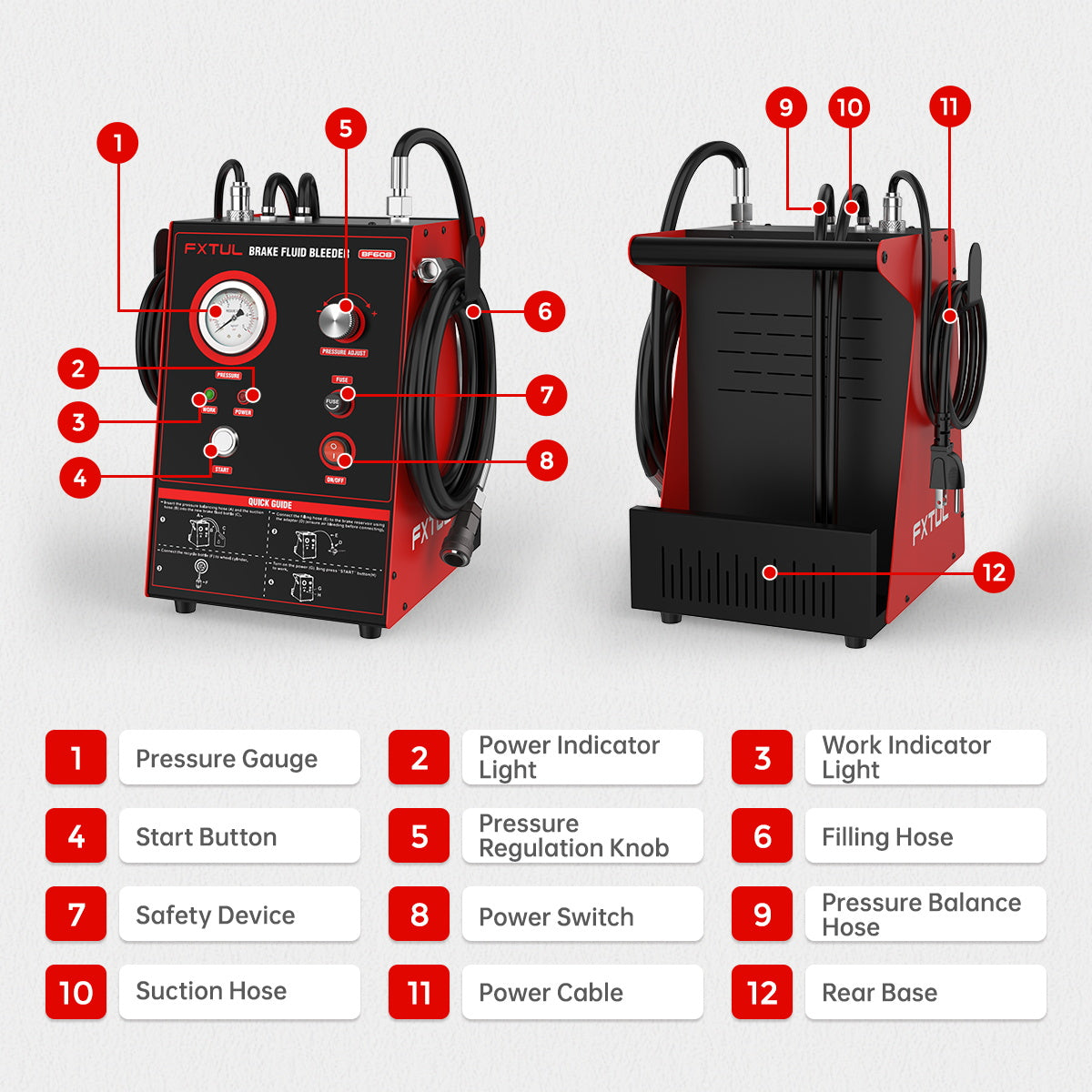
The current product record highlights Separate fresh and recovered fluid paths, Controlled pulsed exchange, Fresh-fluid level protection, Recovery function, Corrosion-resistant hoses. Confirm each relevant control on the physical unit before use; related FXTUL models can look similar while using different ranges, air sources or operating modes.
| Specification or function | Current model |
|---|---|
| Power variants | 110V or 220V; match the delivered nameplate |
| Maximum power | 35W |
| Working pressure | 0.5-2.5bar |
| Output pressure | 0.7-2.5bar |
| Output flow rate | 1.6L/min |
| Filling hose length | 3.5m |
| Operating temperature | -10°C to 60°C |
| Product weight | 5.19kg |
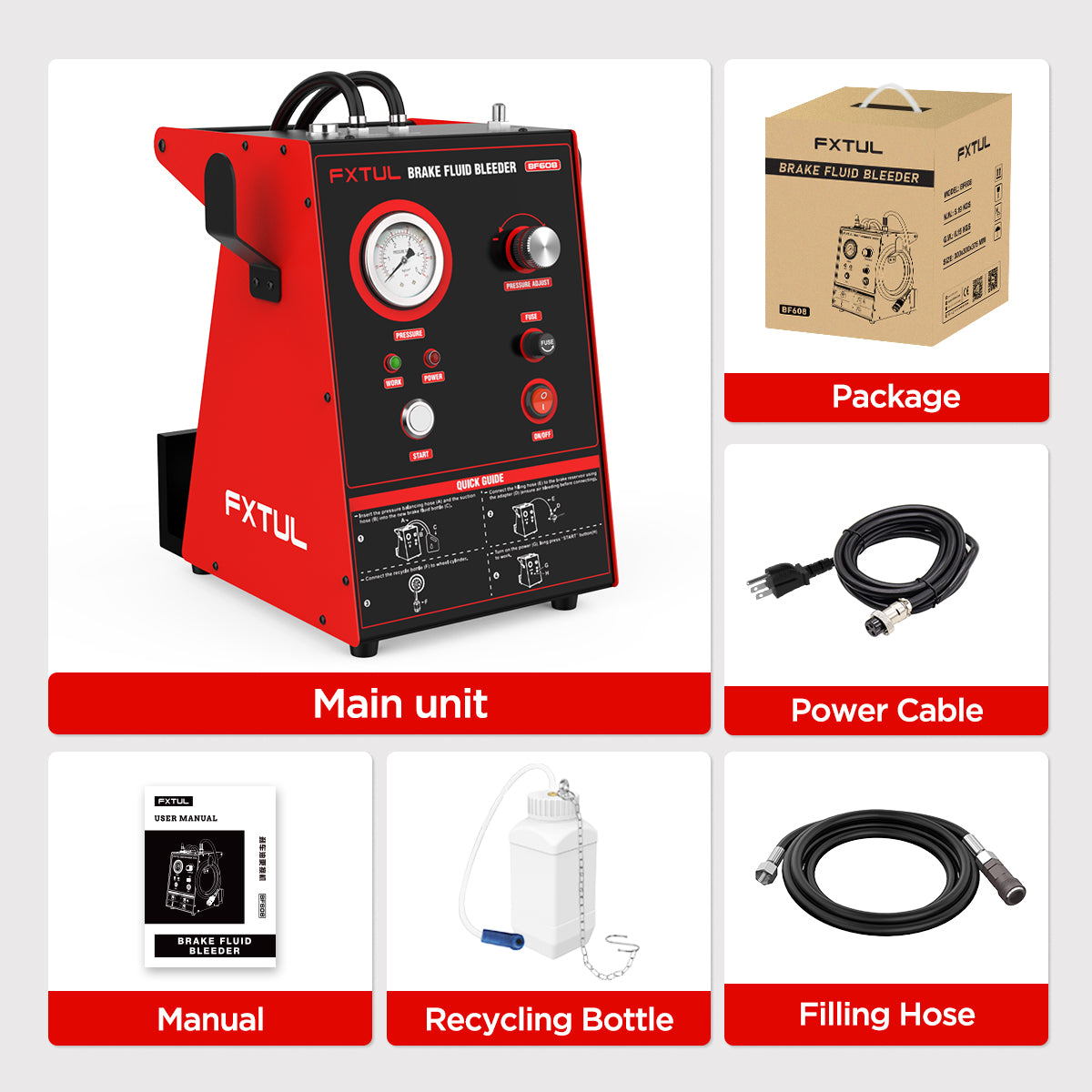
| Available packages | BF608 only, or BF608 with a 9-piece or 17-piece motorcycle brake-fluid adapter set |
| Fluid boundary | Use only the brake-fluid type required by the motorcycle and permitted by the delivered BF608 instructions |
The current BF608 gallery lists 0.5-2.5bar working pressure, 0.7-2.5bar output pressure, 1.6L/min output flow, a 3.5m filling hose and 35W maximum power. These machine figures are not universal motorcycle settings. Use the lowest pressure permitted by the motorcycle procedure and the delivered BF608 instructions, begin at minimum adjustment and never use pressure to overcome a blocked adapter, closed path or incorrect bleed order.
How to use the BF608
Step 1: Confirm the motorcycle procedure, fluid and BF608 voltage
Open the exact motorcycle brake-bleeding procedure and identify its fluid specification, reservoir adapter, bleed order, ABS service requirements and final checks. Confirm the BF608 nameplate matches the available 110V or 220V supply. Do not use silicone DOT 5 or mix fluid types unless both the motorcycle and the delivered BF608 instructions explicitly permit that setup.
Before moving on, confirm the specified fresh fluid, protected painted surfaces, correct BF608 supply voltage, intact fresh and recovery paths, and the exact motorcycle bleed and ABS procedure.
Step 2: Protect the motorcycle and inspect every fluid path
Stabilize the motorcycle upright as its service procedure requires. Cover painted and plastic surfaces because brake fluid can damage finishes. Inspect the BF608 filling, pressure-balance and suction hoses, metal connectors, fresh-fluid bottle, recovery bottle, adapter and power cable; replace any contaminated, swollen, cracked or leaking part before use.
Step 3: Prepare a sealed fresh-fluid supply
Use a new, clean container of the exact specified brake fluid. Insert the pressure-balance and suction hoses into the fresh-fluid bottle as shown on the BF608 quick guide, keep both ends correctly positioned and prevent dirt or old fluid from entering the fresh path. Do not combine leftover fluid from an open or unidentified container.
Step 4: Prime the filling hose before it reaches the reservoir
Fit the correct motorcycle reservoir adapter to the BF608 filling hose and prime the fresh-fluid path by the delivered control sequence until the hose and adapter contain clean fluid without visible air. Capture priming discharge safely. The product quick guide expressly requires air bleeding before the filling connection is made.
Step 5: Attach the adapter to the brake-fluid reservoir
With the machine stopped and pressure released, seat the exact adapter squarely on the correct reservoir and secure it without distorting the cap, gasket or reservoir body. Route the 3.5m filling hose without kinks, hot surfaces, steering interference or tension, then make a low-pressure sealing check before proceeding.
Step 6: Connect the recovery bottle at the first bleed point
Follow the motorcycle maker's bleed order. Fit a clean recovery hose and bottle to the first caliper bleed nipple, keep the bottle upright and use the correct wrench so the nipple can be opened and closed without rounding it. On linked or ABS systems, follow the exact scan-tool, pump or valve sequence rather than assuming a conventional order.
Step 7: Power on and establish only the permitted pressure
Turn the pressure-adjustment knob toward minimum before power-on. Switch on the BF608, use the START control as indicated by the unit, then raise pressure gradually while watching the gauge. Stay within the lower of the motorcycle procedure and the BF608 working boundary; the current product image lists 0.5-2.5bar working pressure and 0.7-2.5bar output pressure.
Step 8: Open the bleed nipple and monitor both fluid paths
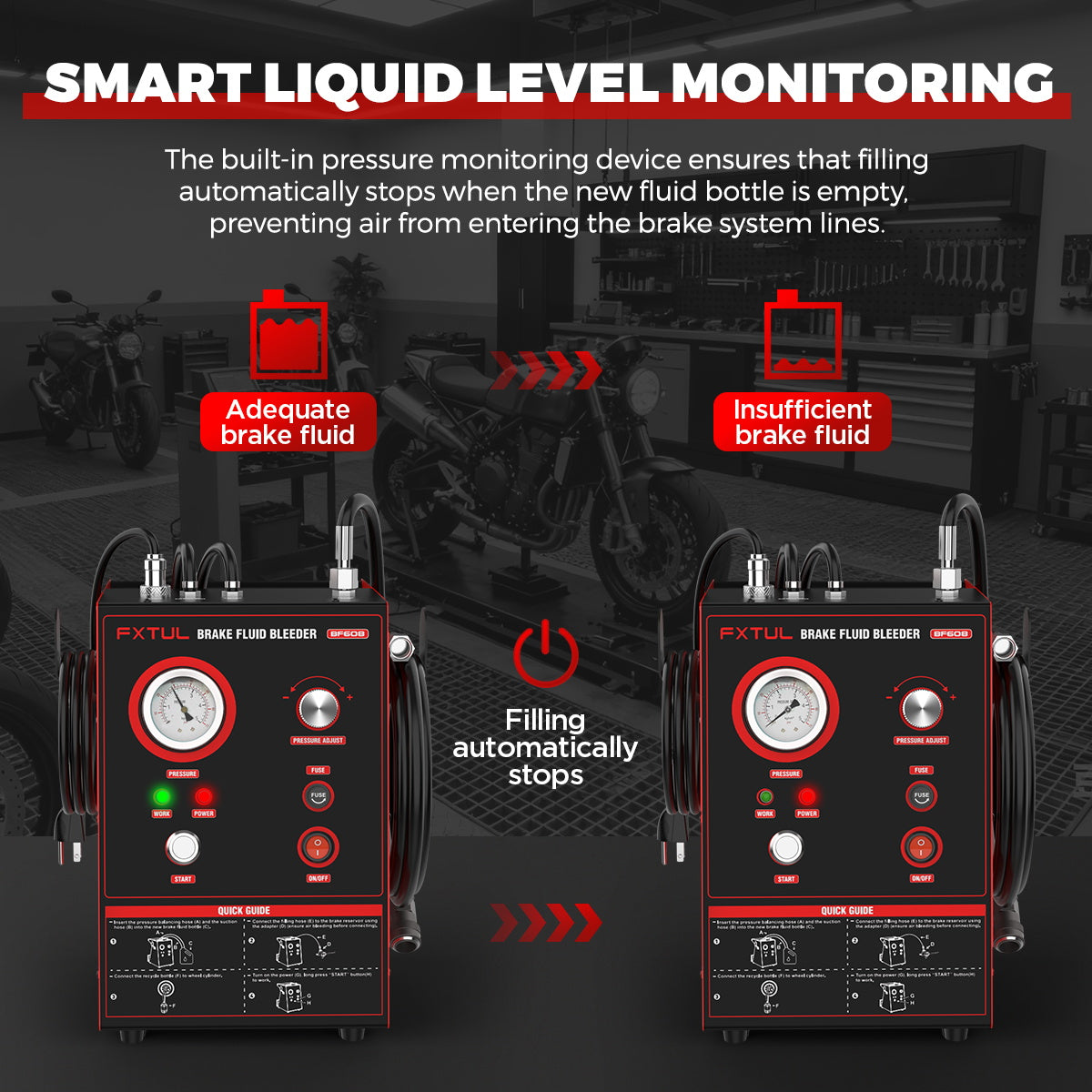
Open the nipple only enough to produce controlled flow into the recovery bottle. Watch for old fluid and bubbles leaving while the BF608 supplies clean fluid and maintains the reservoir. Do not let the fresh bottle empty; treat automatic low-level stop as backup protection, not permission to leave the process unattended.
Step 9: Close the nipple before moving to the next point
When the exiting fluid is clean and bubble-free under the motorcycle procedure, close the bleed nipple to its specified torque before removing the recovery hose. Check the reservoir connection, BF608 gauge and fresh-fluid level, then move to the next bleed point and repeat the same controlled sequence.
Step 10: Stop the BF608 and release pressure before disconnection
After the final bleed point, stop the work cycle, switch the BF608 off and release pressure by the delivered method until the gauge and hose state confirm it is safe. Never loosen the reservoir adapter, bottle hoses or a machine connector while the fresh-fluid path remains pressurized.
Step 11: Restore the reservoir and clean every spill
Remove the adapter without tipping fluid onto the motorcycle, set the reservoir to the vehicle-specified final level and reinstall its diaphragm, cap and fasteners correctly. Clean any spill immediately by the motorcycle maker's approved method, cap the BF608 hoses and segregate recovered fluid from unused fresh fluid.
Step 12: Verify lever feel, leaks and ABS completion
Operate the brake control while stationary and confirm firm repeatable feel, correct travel and no leakage at the reservoir, lines, calipers or bleed nipples. Complete every vehicle-specific ABS activation, warning-light, pressure, torque and road-test requirement. Do not ride if feel is soft, travel changes, a warning remains or any leak is present.
Before riding, confirm BF608 pressure is released, the reservoir is at the specified final level and correctly capped, brake feel is firm and repeatable, every bleed point is dry, and no brake or ABS warning remains.
Read and verify the result
A completed exchange is more than clear fluid in the recovery hose. The motorcycle must have the correct final reservoir level, correctly closed bleed points, a dry hydraulic system, firm repeatable lever or pedal feel and no brake or ABS warning. If the system required an ABS actuation or a second conventional bleed, complete that exact procedure before judging the result.
- Hold the brake control under the motorcycle maker’s specified check and confirm travel does not increase.
- Inspect the reservoir, adapter area, every opened nipple, hose union and caliper for fresh leakage.
- Verify final fluid level with the motorcycle in the specified attitude and reinstall the diaphragm and cap correctly.
- Confirm every warning indicator and ABS service step is complete; the BF608 does not command ABS valves by itself.
- Perform only the maker-approved stationary and low-speed functional checks before normal road use.
Stop immediately for a leak, falling or unstable gauge pressure, an empty fresh-fluid supply, visible air entering the filling path, a loose reservoir adapter, unexpected ABS behavior or soft/increasing brake-control travel. Switch the BF608 off and release pressure safely; do not ride until the hydraulic system has been correctly diagnosed and restored.
Common mistakes and care
- Brake fluid damages many painted and plastic surfaces; protect the motorcycle and clean spills immediately by the vehicle-approved method.
- Use only fresh brake fluid specified for the exact motorcycle and permitted by the delivered BF608 instructions; never mix fluid families.
- Do not exceed the lower pressure limit established by the motorcycle service procedure and the BF608.
- Do not let the fresh supply empty or allow air to enter the filling hose, reservoir or hydraulic circuit.
- Linked and ABS brake systems may require a model-specific bleed order and scan-tool activation; follow the motorcycle procedure.
- Never disconnect a pressurized hose or reservoir adapter, and never ride with soft lever feel, a leak or a brake warning.
- Do not mix DOT fluid families, reuse recovered fluid or pour leftover open-container fluid back into the fresh supply.
- Do not connect the filling hose before it has been primed bubble-free.
- Do not assume the farthest-caliper rule applies to every motorcycle; linked and ABS systems can require a different order.
- Do not open multiple bleed nipples at once or remove the recovery hose before its nipple is closed.
- Do not treat automatic low-fluid stop as unattended-operation permission, and never loosen a pressurized connection.
Frequently asked questions
Can the BF608 determine which brake fluid the motorcycle needs?
No. Use fresh fluid from a sealed container that exactly matches the motorcycle specification and is permitted by the delivered BF608 instructions. Never mix an unknown fluid, recovered fluid or a different DOT family into the fresh supply.
Is there one BF608 bleed order for every motorcycle?
No. Caliper layout, linked brakes and ABS hydraulic units can change the order and may require a scan-tool activation routine. Follow the exact motorcycle procedure rather than copying an order from another model.
Can I disconnect the reservoir adapter as soon as the BF608 is switched off?
No. Power-off does not prove the filling path is depressurized. Use the delivered pressure-release method and confirm the gauge and hose state are safe before loosening the adapter or any fluid connection.
Final BF608 checklist
- Exact fluid, adapter, bleed order, torque and ABS procedure confirmed
- Motorcycle stable and finish protected; machine, hoses and recovery bottle inspected
- Fresh-fluid bottle clean and sealed; balance and suction hoses positioned correctly
- Filling hose primed without visible air before reservoir connection
- Pressure kept within the lower motorcycle and BF608 boundary
- Every bleed nipple closed correctly before moving the recovery hose
- Machine stopped and pressure released before adapter disconnection
- Final level, cap, lever feel, leak inspection and ABS checks passed
The BF608 makes a one-person fluid exchange more controlled only when the operator controls the details: correct fluid, bubble-free priming, exact bleed order, conservative pressure and complete post-service verification. The motorcycle procedure remains the authority for every connection and acceptance check.



Comments 0
Questions, fixes, and real-world diagnostic notes from readers.
Be the first to share a diagnostic result or ask a follow-up question.