Blue, White, or Black Exhaust Smoke? Use Timing and Fluid Loss to Decode It

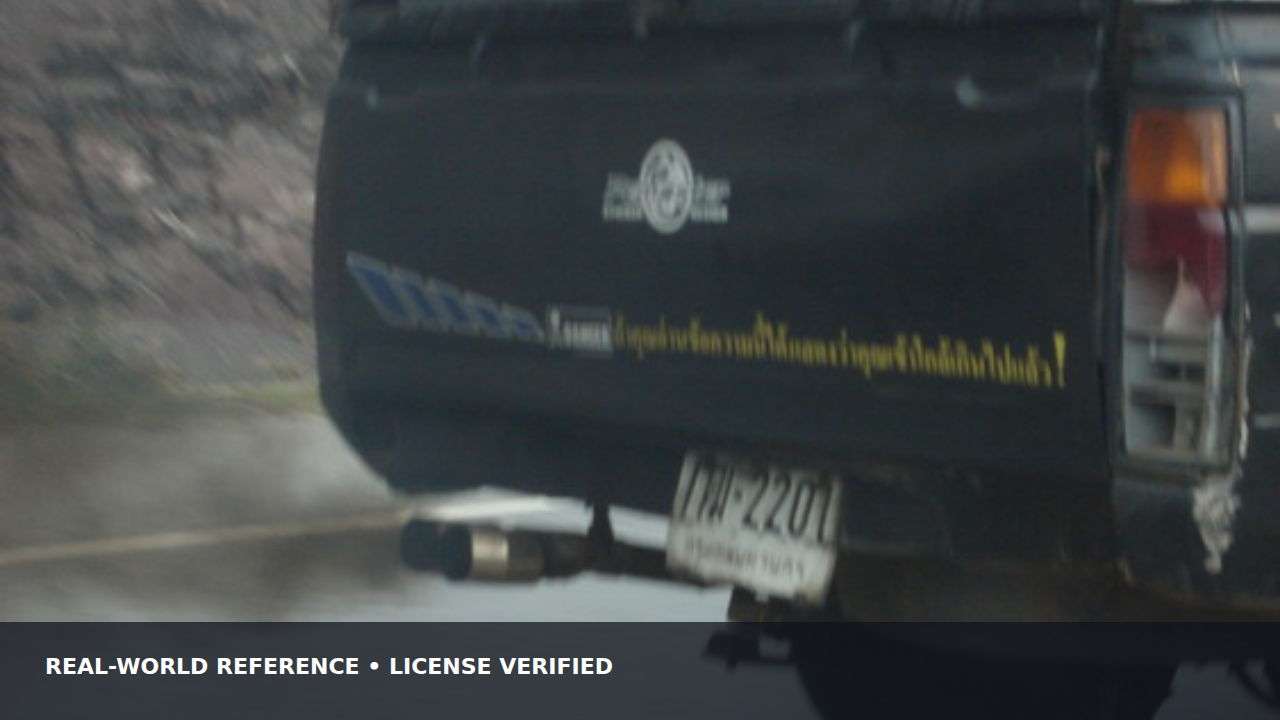
Exhaust color is a starting clue, not a diagnosis. Thin white vapor that disappears after a cold start can be normal condensation; persistent blue-gray smoke points toward oil entering combustion; persistent white steam with coolant loss raises an internal coolant path; dark smoke points toward too much fuel or too little air, especially on a gasoline engine. Stop driving for dense smoke, overheating, rapid oil/coolant loss, severe misfire, runaway engine speed, or smoke entering the cabin.
What to do first
- Confirm the material comes from the tailpipe, not oil/coolant dripping onto hot components in the engine bay.
- Stop for overheating, warning lamps, rapid fluid loss, dense continuous smoke, severe power loss, or diesel engine runaway.
- After full cooldown on level ground, record oil and coolant levels; never open a hot coolant cap.
- Photograph/video the cold start and note duration, odor, load, and whether smoke persists fully warm.
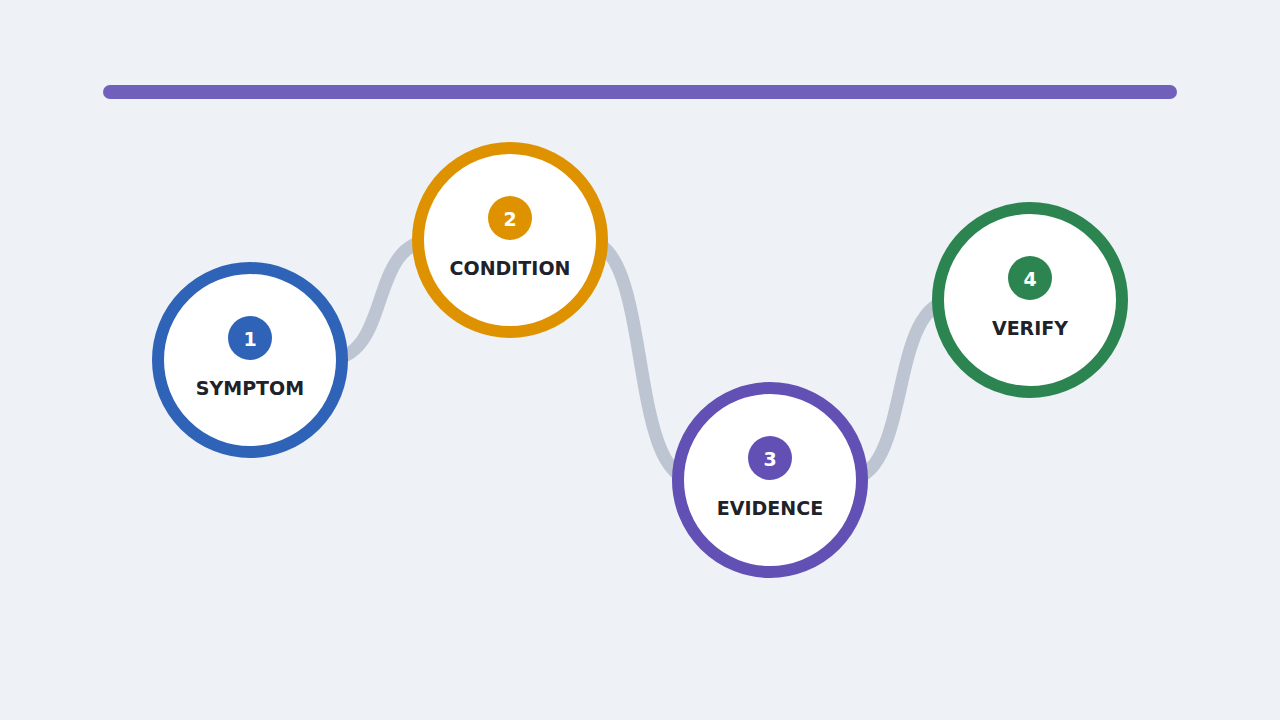
In this guide
1. What the symptom means—and does not prove
Perceived color changes with light, temperature, fuel type and aftertreatment. Timing and consumption trends make it useful: a brief cold puff differs from smoke after long idle, on acceleration, on deceleration, or under boost. Gasoline and diesel causes also differ, so color should select tests rather than select an engine repair.
It does not independently prove
- that white vapor is a head gasket;
- that blue smoke identifies rings rather than seals/turbo/PCV;
- that black smoke identifies an injector;
- that no puddle excludes internal coolant loss;
- that smoke from the engine bay is exhaust smoke;
- that an additive can verify or repair the cause;
2. Save the evidence and make only low-risk checks
- cold-only, hot, idle, acceleration, deceleration, or boost condition;
- duration and density in consistent light;
- oil/coolant/fuel consumption trend;
- odor, misfire, temperature and warning lamps;
- engine/fuel type, turbo/aftertreatment, related codes and recent work;
Preserve this record before resets, repeated starts, part swaps, or fluid additions change the condition. Related background: oil leak versus consumption cooling-system pressure test.
3. Use the pattern to choose the next test
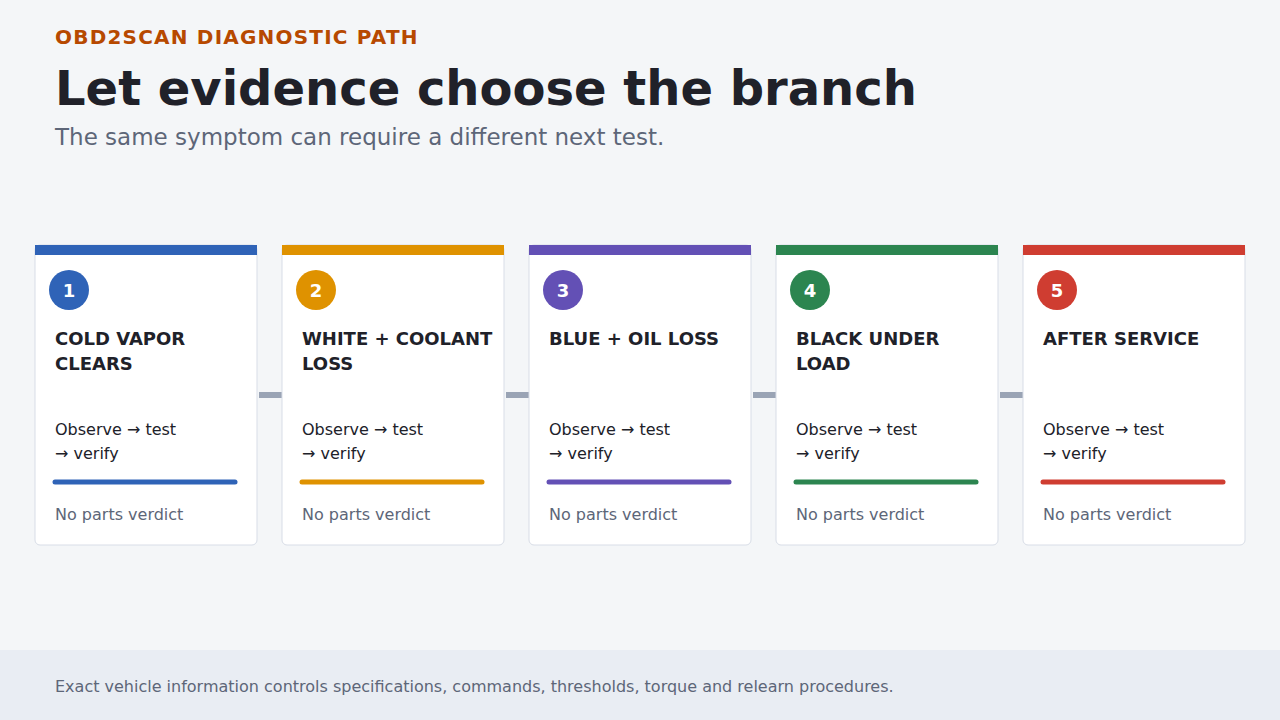
1. Thin white vapor disappears as the exhaust warms
What the pattern changes: Water is a normal combustion product and condensation is common in cold or humid conditions.
Next proof: Monitor only if fluids are stable, the vapor fully clears, no sweet odor/overheating appears, and operation is normal.
2. Persistent white steam accompanies coolant loss
What the pattern changes: Coolant may enter through a head gasket, casting, EGR cooler, exhaust heat-recovery component, intake path, or another model-specific heat exchanger.
Next proof: Pressure-test and isolate the cooling/exhaust/combustion path; do not assume the head gasket from color alone.
3. Blue-gray smoke accompanies oil loss
What the pattern changes: Valve seals/guides, rings/cylinders, turbo seals/drains, PCV control, overfill, or incorrect oil can introduce oil. When smoke timing and fluid loss point toward an internal engine path, the MRCARTOOL N180 articulating borescope can provide a quick visual look inside an accessible cylinder, but the images still need compression, leak-down, and cooling-system evidence.
Next proof: Use when-it-smokes, plug/cylinder comparison, crankcase pressure, compression/leak-down, and turbo evidence to locate the path.
4. Black/dark smoke appears under load
What the pattern changes: Excess fuel, inadequate air, boost/EGR control, injector delivery, sensor bias, or aftertreatment malfunction can produce soot or rich operation.
Next proof: Save codes and fuel-control/airflow/boost data, then test the commanded-versus-actual system instead of replacing injectors by color.
5. Smoke begins after a recent service
What the pattern changes: Overfilled oil, spilled fluids, disconnected intake/PCV plumbing, wrong fluid, injector work, or trapped residue may be causal.
Next proof: Stop and compare the work performed with measured levels and physical routing before further operation.
Safety boundary
Exact service information controls specifications and invasive procedures. Fuel/refrigerant systems, hot or rotating parts, brake hydraulics, lifted vehicles, high-current circuits, pressure testing, forced commands, and road reproduction belong with trained personnel and the correct equipment.
4. Give the shop a reproducible handoff
- video of exact smoke condition;
- cold/hot/load timing;
- oil and coolant trend;
- engine/fuel/turbo/aftertreatment;
- codes and pressure/compression/fuel-control findings;
Ask for the failed test and the before/after result—not only the name of the installed part. A model-specific bulletin is useful only after VIN, engine, software, code set, and symptom applicability match.
5. Verify the repair under the original condition
Repeat the original cold-start, long-idle, acceleration, deceleration, or load condition after repair. The abnormal smoke and odor should be absent, oil and coolant should remain stable across multiple heat cycles and measured distance, no related pending code or misfire should return, and any cooling, fuel-control, compression, turbo or aftertreatment test should meet exact specifications.
Official and primary technical references
- Perkins engine troubleshooting guide — Perkins
- Perkins blue-smoke guidance — Perkins
- Ford SSM 48345 — Ford / NHTSA
- Ford customer program 18M06 — Ford / NHTSA
The useful outcome
You should finish with the original condition precisely recorded, the unsafe possibilities controlled, one failed path proven, and a repeat test showing the symptom or warning is genuinely resolved.






Comments 0
Questions, fixes, and real-world diagnostic notes from readers.
Be the first to share a diagnostic result or ask a follow-up question.