
2026–2027 Ram HD Overheating? The Thermostat Date Code Matters

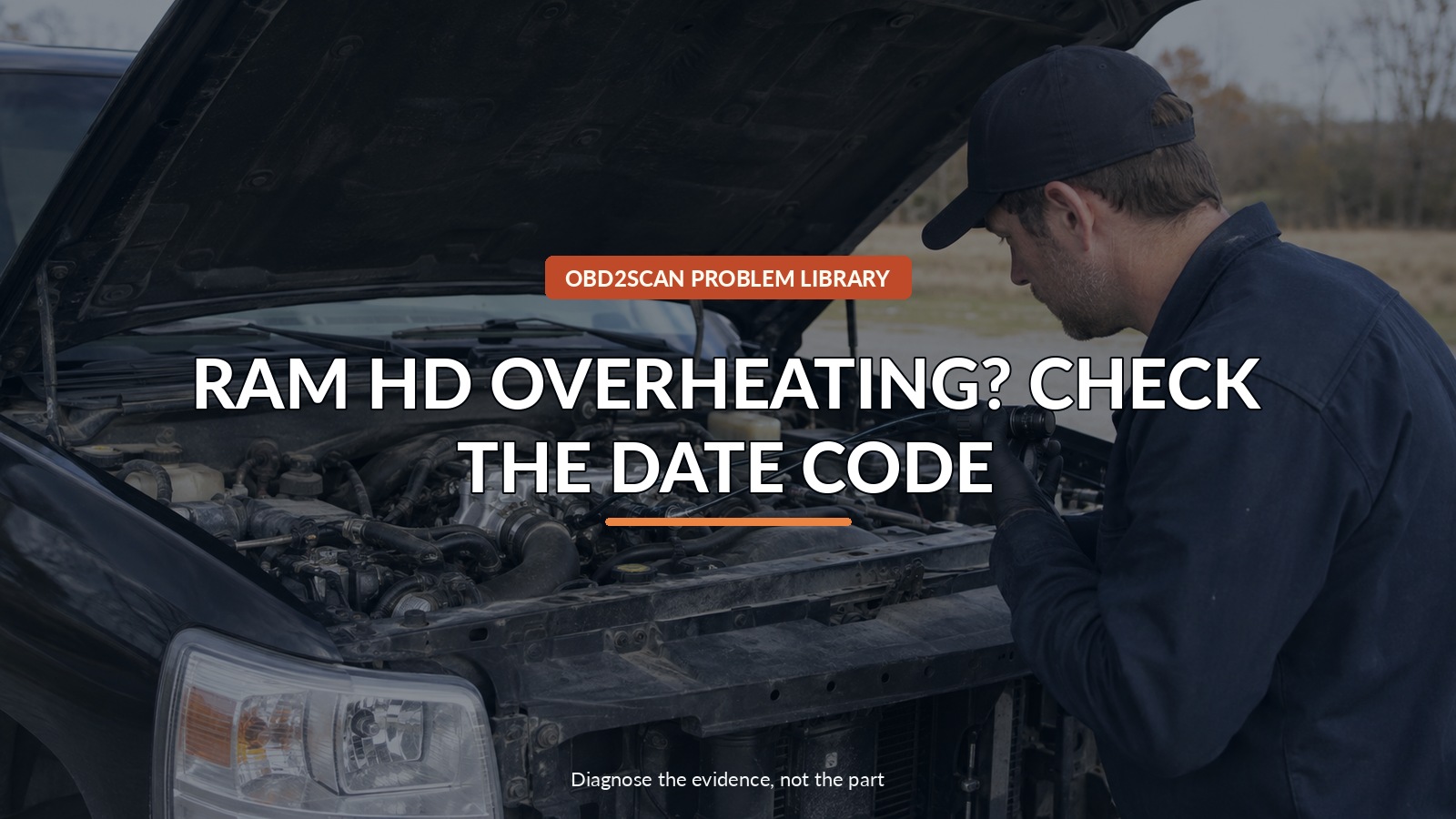
Ram Hd Overheating? Check The Date Code
If the gauge reads hot, the overheat symbol appears or steam is visible, pull over safely, shut the engine down and arrange help; never open a hot cooling system. On a VIN/build-matched 6.4L Ram HD, Stellantis directs a borescope view of the thermostat date code. Codes 3375 or 3365 lead to thermostat replacement under the bulletin; any other code ends this specific RSU path and returns diagnosis to the actual evidence.
Once the system is cold and the OEM access route is understood, a flexible inspection camera can read a hidden thermostat mark without blind disassembly. The MRCARTOOL N220 is one possible visual route. N220 can articulate into a reachable, cooled inspection area and record a legible thermostat code when the current service procedure defines safe access; it cannot make a hot engine safe, confirm thermostat opening by image alone, select the VIN/RSU, drain coolant, replace the thermostat or verify the complete cooling system.
An overheating warning compresses every decision into a few anxious seconds. The first answer is not a thermostat number; it is how to stop without turning a cooling fault into engine damage, then how a shop can inspect one hidden manufacturing mark after the engine is truly cold. Think in three temperatures: unsafe now, safe to inspect later and stable after repair. The date code only belongs in the middle stage.
Quick answer: Stop and cool the truck safely, confirm VIN and build scope, then preserve a sharp thermostat date-code image before replacement.
In this guide
- Treat the hot gauge as a stop signal
- Let the engine become fully cold
- Check the exact VIN, build and 6.4L engine
- Reach the thermostat label without touching hot parts
- Photograph the date code clearly
- Use 3375 or 3365 as the bulletin gate
- Replace only through the current service procedure
- Heat-cycle and verify the entire cooling system
Treat the hot gauge as a stop signal
If the gauge enters the hot zone, an overtemperature warning appears, power falls or steam is visible, reduce load, signal and stop in the safest available location. Switch off the engine and arrange roadside help if the warning persists. Never remove a hot pressure cap and do not place hands near an electric fan that may start unexpectedly. Steam burns and scalding coolant can cause severe injury. A truck towing a trailer needs a recovery plan that accounts for the combined weight rather than a risky roadside inspection.
Let the engine become fully cold
Before shutdown, if it can be done without distraction, note ambient temperature, road grade, trailer load, speed, warning text and whether the heater suddenly went cold. After stopping, photograph any puddle from a distance and record whether the cooling fan was audible. Do not keep restarting to generate a video. Once safely transported, preserve freeze-frame data and the full module scan before codes are cleared. Overheat context tells the shop whether it should begin with loss of coolant, airflow, combustion, pump circulation or the thermostat branch.
Check the exact VIN, build and 6.4L engine
The Stellantis bulletin is tightly fenced: certain 2026–2027 Ram 2500/3500 heavy-duty vehicles with the 6.4L gasoline engine, built from April 23 through May 6, 2026. Confirm VIN, engine sales code and build record. Similar symptoms on a Cummins diesel, Ram 1500 or vehicle outside the dates are not admitted by a matching headline. Ask for the current revision of TSB 07-006-26 and check for campaigns or later repair information before parts are ordered.
Reach the thermostat label without touching hot parts
Wait until the engine is completely cold. Then a technician should inspect coolant level and mixture, pressure-test for external leaks as specified, examine hoses and radiator, check fan operation and look for oil/coolant contamination. A low reservoir, active leak, damaged belt or repeat pressure loss needs its own repair. Adding coolant to a hot system is dangerous, and repeatedly topping off a cold system without finding the loss can delay an important leak diagnosis.
Photograph the date code clearly
The bulletin uses a borescope through the prescribed access point to view the thermostat date code. That inspection needs a clean lens, stable orientation and a photograph sharp enough to preserve every character. Do not force a camera against the thermostat, drop attachments into the passage or confuse casting marks with the printed code. The two identified codes are 3375 and 3365. A verbal ‘looked like one of them’ is not adequate; attach the image to the job record.
| Decision point | Evidence | Action |
|---|---|---|
| Hot warning or steam now | Cluster/physical warning | Stop, cool, recover safely |
| Correct VIN, engine and build window | Vehicle record | Consider the bulletin |
| Cold borescope image shows 3375/3365 | Legible date-code photo | Follow thermostat replacement procedure |
| Other code or failed cooling check | Documented result | Continue normal cooling diagnosis |
Use 3375 or 3365 as the bulletin gate
If the legible date code is 3375 or 3365 and the vehicle passes the applicability gates, the bulletin directs thermostat replacement using current service information. If another code is present, this bulletin’s replacement branch ends; it does not declare the cooling system healthy. Continue diagnosis using leak, fan, pump, radiator, sensor, combustion-gas and flow evidence as appropriate. Never install a thermostat on the strength of the build window alone, and never reuse questionable coolant or sealing materials outside the current procedure.
Replace only through the current service procedure
After replacement, refill with the specified coolant and vacuum-fill or bleed according to the Ram procedure. Confirm heater output, fan command, stable pressure and absence of trapped air. Inspect every disturbed joint when cold and again at operating temperature. Use scan data to compare commanded and measured coolant temperature, but do not treat one sensor value as proof of uniform engine temperature. A controlled stationary warm-up should occur in a ventilated area, and any road/load test must stop at the first renewed warning.
Heat-cycle and verify the entire cooling system
Verification recreates the operating demand without gambling the engine. Begin unloaded, then only with an approved staged load or tow test if the vehicle remains stable and the service procedure calls for it. Save the peak coolant temperature, fan state and post-cooldown level. Reinspect for seepage the next morning. If overheating returns, do not replace the new thermostat again by default; provide the date-code image and before/after temperature record and reopen the broader cooling-system path.
The two date codes are useful only after the human safety decision and the exact vehicle gates. Stop the hot truck, wait for a fully cold system, preserve a legible borescope image and let that evidence determine whether the thermostat bulletin applies. A different mark is not a dead end; it is the point where ordinary cooling diagnosis resumes.






Comments 0
Questions, fixes, and real-world diagnostic notes from readers.
Be the first to share a diagnostic result or ask a follow-up question.