
2019 Ram 2500/3500 Hot Front Brake or Drag? Check Recall V98 Before Diagnosis

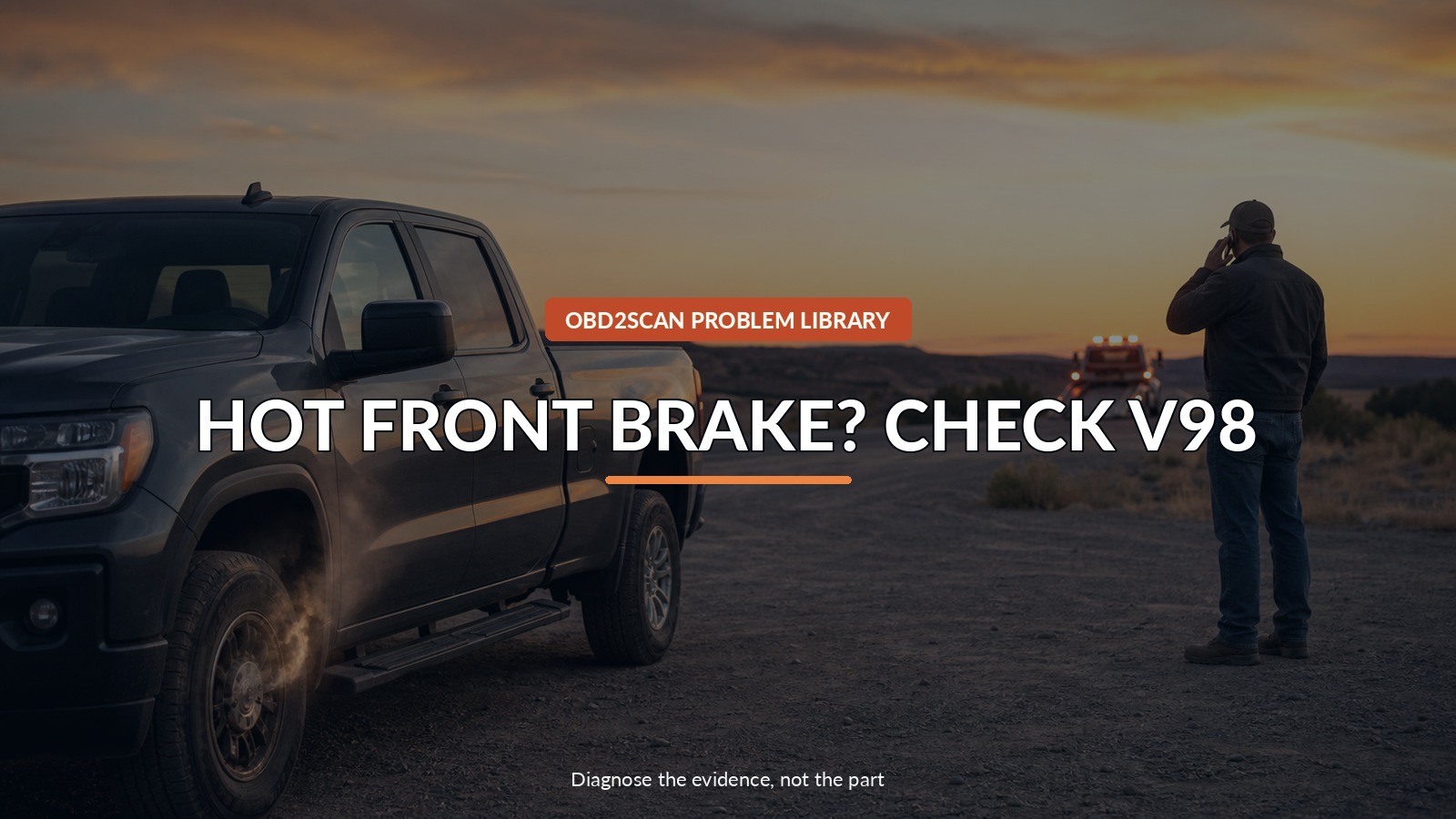
Hot Front Brake? Check V98
If a 2019 Ram 2500, 3500, or 3500 Cab Chassis develops a hot front brake, smoke, strong odor, pull, or poor coast-down, stop driving. Keep away from the hot wheel and check the VIN for NHTSA recall 19V-635 / FCA V98 before ordinary diagnosis. The recall covers certain trucks—not every 2019 Ram—and an open campaign belongs in the dealer remedy process.
When recall status and mechanical inspection still leave a trapped-pressure question, a professional can compare hydraulic pressure at selected points. The AUTOOL PT660 dual-channel brake-pressure gauge is one route for that controlled bay test. It cannot cool a brake, support the truck, identify a seized caliper from pressure alone, replace the recall remedy, or make a hot pressurized circuit safe.
This problem has a gate before the diagnostic tree. VIN recall status decides whether the first destination is an authorized recall repair—not whether the brake feels severe enough.
Quick answer: Stop driving a 2019 Ram HD with a hot or dragging front brake and run the VIN through recall 19V-635/V98 before ordinary hydraulic diagnosis.
In this guide
Make heat the stop-driving signal
Pull over on a firm level area away from dry grass, fuel, and traffic. Apply the parking brake only if it can be done safely and is not part of the overheated condition; chock as appropriate. Do not touch the wheel, rotor, caliper, or brake fluid. Do not pour water on a hot brake because rapid cooling can crack or distort components and create steam injury.
Smoke, flames, a sinking pedal, severe pull, locked wheel, or reduced braking requires emergency assistance and professional recovery. Tell the tow operator that a brake may be dragging and the wheel may not roll freely.
From a safe distance, note which corner smells or smokes, whether the truck pulls, when the event began, towing/load, brake use, outside temperature, speed, and any warning. A non-contact temperature comparison can be recorded only after stopping safely; surface finish and airflow make the number relative, and approaching a smoking wheel for a reading is not worth the risk.
Allow the brake to cool naturally. A wheel that releases after cooling is still defective.
Run the VIN through the recall gate
NHTSA recall 19V-635 concerns certain 2019 Ram 2500, 3500, and 3500 Cab Chassis vehicles. The filing describes front brake caliper corrosion that may cause seal swelling, brake drag, overheating, and increased crash risk. FCA identifies the campaign as V98.
Enter the full 17-character VIN at NHTSA’s recall lookup and contact a Ram dealer to confirm open/completed status, eligibility, and remedy. Save the result and date. A model/year match cannot tell whether one VIN was built in the affected population or whether the remedy was already recorded.
If V98 is open, follow the dealer’s transport and remedy instructions. Recall work is performed without charge under the campaign terms. Do not disassemble the caliper first and risk obscuring the condition or complicating remedy eligibility.
If the database says completed, obtain the completion date and repair record. A completed recall does not make a current hot brake imaginary; it means the active complaint now needs diagnosis while the prior remedy is verified.
Separate the recall remedy from ordinary diagnosis
The recall remedy addresses the defect and population described in its documents. Ordinary brake drag can also result from seized or contaminated caliper hardware, restricted hose, trapped master-cylinder/ABS pressure, incorrect adjustment, damaged bearing, parking-brake hardware, improper prior repair, or a friction component installed incorrectly.
Start cold with the truck on a rated lift and supported at approved points. Inspect wheel/tire, bearing play, rotor discoloration/cracking, pad thickness and taper, caliper boots and slides, hose routing, fluid leaks, and heat damage to seals, ABS wiring, hub components, and tire.
Compare both front wheels rather than judging one in isolation. Rotate by hand only when the truck is safely supported and the transmission/parking system is secured by procedure. Record drag before disturbing the caliper.
Do not inhale brake dust or clean with compressed air. Use approved brake-cleaning and dust-control methods.
Split mechanical drag from trapped pressure
The central question is whether the brake remains applied mechanically after hydraulic command should be released, or whether pressure is being held in the circuit.
A qualified technician can observe drag, apply/release the pedal, and use the service manual to isolate the branch. If safely releasing pressure at a prescribed test point immediately frees the wheel, a hydraulic restriction upstream becomes more plausible. If the wheel remains tight with pressure proven released, mechanical caliper, slide, pad, rotor, or bearing causes move upward.
Opening a bleeder is not a casual roadside test. Brake fluid is hazardous, the circuit can be hot and pressurized, air can enter, and the vehicle may lose braking. Capture and dispose of fluid correctly and bleed/verify the system afterward.
Compare pedal return, pushrod/free-play requirements, hose behavior, ABS hydraulic-unit commands/codes, and left/right circuit evidence. A brake hose can fail internally while appearing normal outside. A seized caliper can coexist with residual pressure after heat expands fluid; diagnostic order matters.
Compare pressure only in a controlled bay
Use the exact Ram hydraulic diagram, adapter, pressure range, pedal application, safety shield, and rated hoses. Zero the gauge, check fittings, and route lines away from moving or hot components. Never drive on public roads with test hoses installed unless the manufacturer provides a specific secured procedure and trained personnel.
Dual-channel comparison is valuable only when both channels see equivalent test points and the same pedal event. Record rise, peak/hold as required, and release toward zero. The useful evidence may be one side retaining pressure after the other releases—not a universal peak number.
A pressure difference does not identify whether the restriction lies in a hose, ABS hydraulic unit, master cylinder, valve, or test setup. Move the measurement point according to the factory tree until the boundary is isolated.
Inspect the damage heat may leave behind
Correcting the original drag does not automatically restore overheated parts. Follow Ram limits for rotor thickness/runout/heat damage, pad condition, caliper seals and slides, hose, bearing, ABS sensor/wiring, wheel, and tire. Replace only what fails specification or the recall remedy requires.
Flush or bleed only when the repair and fluid condition require it, using the specified brake fluid and sequence. Never mix an incompatible fluid or use a generic color/moisture guess as a replacement rule.
Record the recall result, wheel-temperature pattern, drag measurements, mechanical inspection, hydraulic isolation, heat-damage assessment, exact repair, fluid service, torque values, and final road test.
Verify cold release and hot-road behavior
With the system cold, confirm both front wheels release normally, pedal feel is correct, no leaks exist, and ABS/brake warnings complete their normal check. Perform a cautious bedding/verification drive prescribed for the repair, using controlled stops and avoiding traffic risk.
Return and compare front-wheel temperatures from a safe distance under the same measurement method. Recheck free rotation after cooling, inspect for leaks and odor, and scan ABS/chassis modules. Repeat after a representative loaded drive only when the first test is normal.
The case closes when recall status/remedy is documented, the proven drag cause is corrected, heat-damaged parts meet specification or are replaced, both circuits release, temperatures remain balanced for the conditions, and no warning or pull returns.




Comments 0
Questions, fixes, and real-world diagnostic notes from readers.
Be the first to share a diagnostic result or ask a follow-up question.