
2026 BMW X5 Exhaust Smell From the Engine Bay? Check the Open Campaign Before Driving

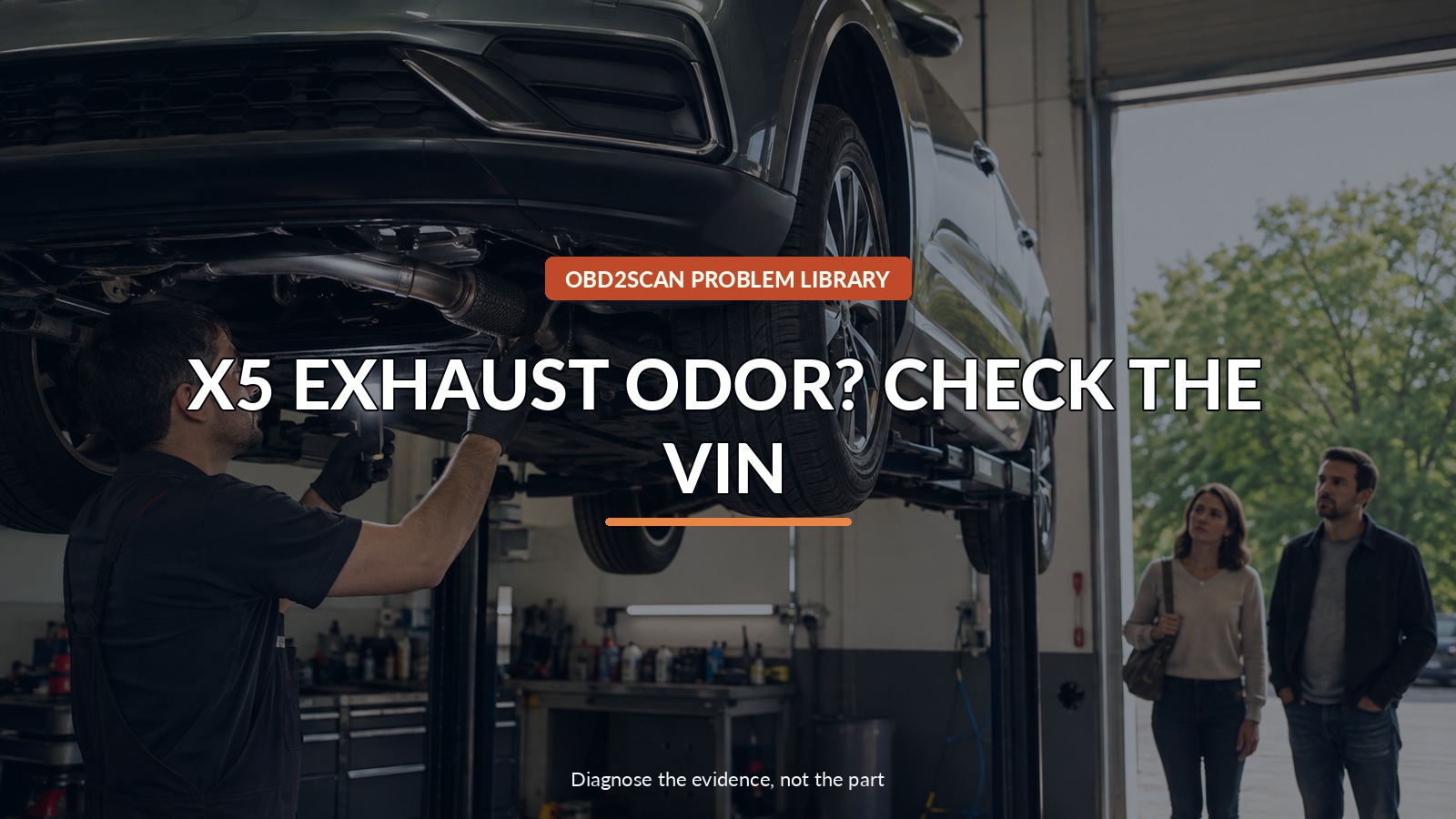
X5 Exhaust Odor? Check The Vin
If exhaust odor enters the cabin, anyone feels dizzy or nauseated, or smoke or concentrated heat is visible, stop in fresh air, switch off and arrange a tow. Affected VINs in BMW’s narrow May 2026 production group may be missing the exhaust sealing ring between the lower and upper catalysts. The remedy is campaign verification and replacement of that ring through the current repair instruction—not tightening random clamps or masking the odor.
After the exhaust is stone cold and the approved access path is open, an articulating inspection camera can help document a joint that is difficult to see directly. An AUTOOL SVB305 can support that visual handoff. SVB305 can help document a cooled, difficult-to-see converter joint from a safe access angle after BMW’s procedure permits inspection; it cannot confirm campaign inclusion, detect carbon monoxide, make hot exhaust safe, prove sealing under load from an image alone or replace the specified sealing ring and torque procedure.
An exhaust smell is not a cabin-comfort complaint to monitor for a few weeks. The first decision is exposure safety; the second is whether this particular 2026 X5 is one of the few VINs whose catalyst joint may have left production without its sealing ring.
Quick answer: Move occupants into fresh air, cool the exhaust and check the VIN for BMW’s narrow X5 campaign before inspecting the catalyst sealing-ring joint.
In this guide
- Leave the cabin and stop for symptoms
- Do not inspect a hot catalyst joint
- Record when and where the odor appears
- Check the VIN for the open delivery-stop campaign
- Confirm the May 2–7 production scope
- Inspect the converter junction only when cooled
- Replace the sealing ring through the repair instruction
- Verify the repair without breathing the test
Leave the cabin and stop for symptoms
If fumes enter the cabin, open windows only long enough to reach a safe place, stop outside away from traffic and switch the engine off. Move everyone into fresh air. Headache, dizziness, nausea, weakness or confusion can be signs of harmful exposure; seek medical help when symptoms are significant or persist. Carbon monoxide itself has no reliable warning smell, so the presence or absence of odor cannot prove the air is safe. Do not idle the vehicle in a garage for diagnosis, and do not continue driving merely because the warning lamps remain off.
Do not inspect a hot catalyst joint
Catalytic converters and adjacent pipes remain hot long after shutdown. Do not reach behind heat shields, apply liquid, block the tailpipe or insert a camera near a running assembly. Allow a full cool-down on proper support. If smoke, melting material or concentrated heat is visible under the hood, keep away and call emergency or roadside assistance as conditions require. The bulletin’s missing ring can release hot exhaust into the engine compartment; this is not the same as a cold cosmetic gap that can be safely touched from above.
Record when and where the odor appears
Tell the technician whether the odor appears at idle, on acceleration, with the HVAC in fresh-air or recirculation mode, only after a cold start, or after engine work. Record any ticking or puffing sound without standing over the engine bay. Note the first date, outside temperature and whether the smell reaches the passenger compartment. A video cannot capture odor, but it can show operating state and sound. These observations help separate a front catalyst-junction leak from tailpipe odor, spilled fluid, a rear exhaust leak or an HVAC intake problem.
Check the VIN for the open delivery-stop campaign
BMW issued a delivery stop for a small number of vehicles. Ask the retailer to enter the VIN in AIR, Aftersales Workplace, Campaign Summary or Warranty Vehicle Inquiry and check whether SIB 18 01 26 is open and remedy available. A technical bulletin is not the same as a broad public recall, and an owner should not infer coverage from model appearance. Request the status on the repair order. If the campaign is open, its procedure controls; if it is closed or not applicable, the odor still requires normal exhaust diagnosis rather than dismissal.
| Situation | Action |
|---|---|
| Fumes in cabin or occupant symptoms | Stop in fresh air; arrange assistance |
| VIN shows SIB 18 01 26 open | Follow the BMW sealing-ring campaign |
| Similar odor but VIN not included | Perform normal exhaust and HVAC-intake diagnosis |
| Odor remains after campaign repair | Inspect the entire system; do not repeat parts by assumption |
Confirm the May 2–7 production scope
The listed population is the G05 X5, model year 2026, produced from May 2 through May 7, 2026. Registration date and dealer delivery date do not establish production date. A different X5 engine, a vehicle built outside those six days or another BMW with a similar odor needs its own service information. Check for previous catalyst, turbocharger or exhaust work because an alignment or gasket problem after repair can imitate the smell. The narrow scope makes VIN verification more reliable than a visual guess at the joint.
Inspect the converter junction only when cooled
Once the system is cold and safely supported, the technician can inspect the junction between the lower and upper catalytic converters for the sealing ring, soot tracking, misalignment or heat effects. A small camera can record the hidden side without dismantling solely for a photograph, but perspective matters: a dark line is not proof the ring is absent. Compare the view with BMW’s current repair illustration. Do not run the engine with hands or camera near belts, fans or hot exhaust to hunt for a puff.
Replace the sealing ring through the repair instruction
For an affected vehicle, BMW directs technicians to the current repair instruction for removing and reinstalling or replacing the lower catalytic converter connection and fitting the sealing ring. Use VIN-selected parts, renew specified one-time hardware and follow the alignment and torque sequence. Do not compensate for a missing ring by overtightening fasteners, adding exhaust paste where it is not specified or bending shields. The campaign is a defined manufacturing correction; unrelated cracks, collision damage or modified exhaust components require separate documentation and authorization.
Verify the repair without breathing the test
Verify in a ventilated facility with professional exhaust extraction, not by leaning over the open hood and inhaling. Inspect the cold joint, start the vehicle through the approved process, listen for leakage and use appropriate gas detection or other BMW tests if required. Confirm no heat damage remains and that HVAC operation does not draw fumes into the cabin. Record the campaign closure, ring installation and before/after evidence. If odor remains, reopen the full exhaust and HVAC intake inspection rather than assuming the new ring must be leaking.
The fastest safe answer for the driver is to stop treating the smell as a nuisance. Get into fresh air, let the exhaust cool and have the VIN checked. For the small May 2–7 production group, BMW identifies a missing ring at one catalyst junction and supplies the repair path. A camera may help document that cooled joint, but campaign status, the specified ring and a ventilated post-repair check—not a smell test—decide whether the X5 is safe to return.






Comments 0
Questions, fixes, and real-world diagnostic notes from readers.
Be the first to share a diagnostic result or ask a follow-up question.