
Engine Cranks but Won’t Start? Find the Missing Requirement Before Replacing Parts

If the starter is turning the engine but the engine never runs, the starter is not automatically the failed part. The next job is to identify which requirement for running is missing: valid start authorization and engine-speed information, fuel delivery and injector command, ignition, or mechanical compression and timing. Stop repeated attempts long enough to preserve the warning messages, scan data, sound, temperature, and recent-service context that separate those branches.
What to do first
- Confirm that the engine itself is rotating—not merely a starter motor spinning freely—and distinguish normal cranking from slow or uneven cranking.
- Record every instrument message, the security indicator, fuel level, outside/engine temperature, recent repair or refueling, and whether a second known-good key changes the result where the owner’s manual permits that check.
- Scan before clearing anything. Save current, pending, and history codes plus freeze-frame and available start-authorisation, engine-speed, cam/crank synchronization, system-voltage, and fuel-pressure data.
- Stop if you see a fuel leak, smell heavy raw fuel, see smoke, hear metal contact or an abnormal loss of compression rhythm, or discover a damaged belt or exposed moving part.
In this guide
1. Name the starting symptom precisely
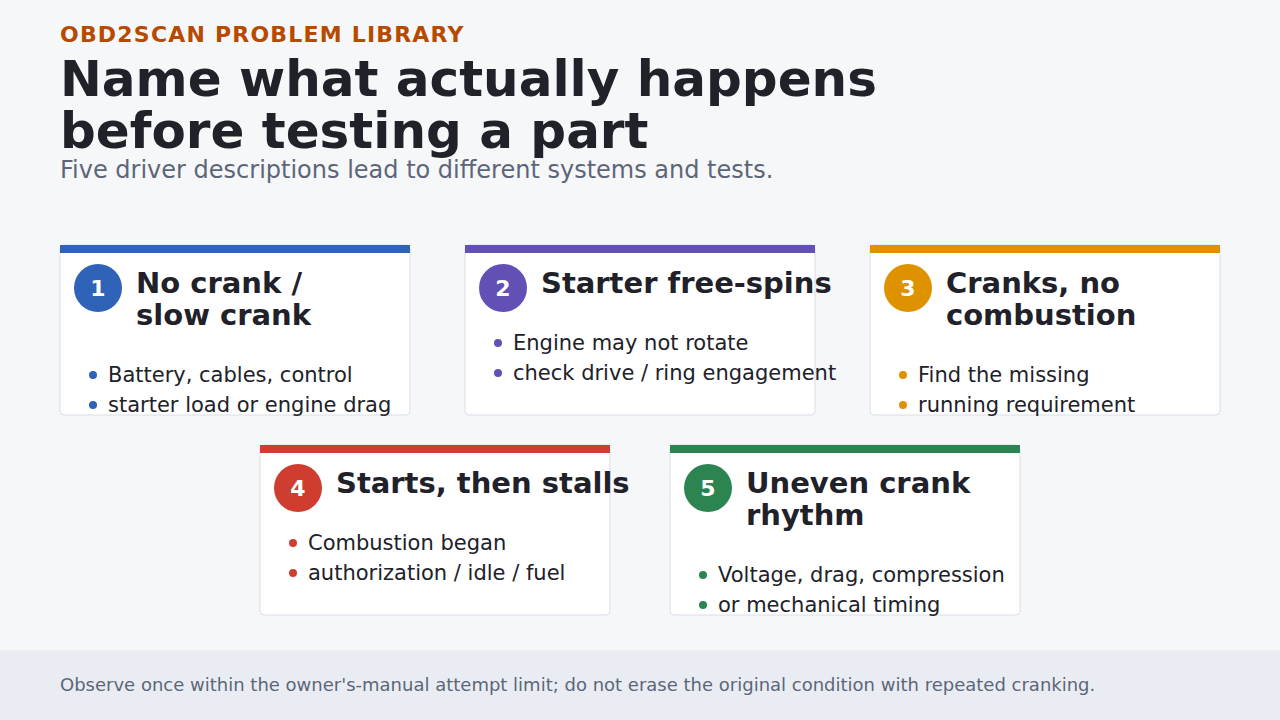
“Won’t start” combines several faults that follow different diagnostic paths. Listen and watch once, without extending the attempt beyond the owner’s-manual limit:
- No crank: the engine does not rotate. Clicking, silence, or one heavy movement keeps the investigation in the battery, cables, grounds, starter control, interlocks, starter, or a mechanically locked engine.
- Slow or uneven crank: the engine rotates, but the speed or rhythm is abnormal. Battery state, voltage drop, starter load, oil viscosity, or mechanical resistance can still prevent a start.
- Starter free-spins: a fast electric whir occurs without the normal pulsing sound of engine compression. Starter drive or ring-gear engagement belongs ahead of fuel or ignition guesses.
- Cranks but does not run: the engine rotates at a credible rhythm yet never sustains combustion. This is the article’s main path.
- Starts and immediately stalls: combustion began. Authorization, idle airflow, fuel continuation, control, or a severe load may belong ahead of a pure no-start path.
Avoid repeated cranking
Repeated attempts can overheat a starter, discharge the battery, flood some engines, dilute oil with fuel, or erase the original condition when voltage collapses. Follow the exact vehicle manual for attempt duration and waiting time. Work outdoors or with approved exhaust extraction, keep clear of belts and fans, and never create a spark or open a pressurized fuel system as a casual driveway test.
2. Preserve the first clues before testing
The best evidence often exists before a tool touches the car. Write down whether the fault is cold-only, hot-only, after a short soak, after refueling, after rain, or immediately after service. Note whether the cranking sound changed suddenly and whether the tachometer moves, while remembering that cluster behavior varies by vehicle.
- Read the messages. A start-authorisation or key message belongs on a different branch from a fuel-pressure code. Try only owner-manual-approved key procedures; do not bypass an immobilizer.
- Verify the fuel fact. Read the gauge, ask when and where the vehicle was refueled, and consider wrong or contaminated fuel when the timing fits. A gauge indication is useful context, not proof of pressure at the engine.
- Inspect recent work. Look for a connector left loose, a duct displaced, a ground not secured, a fuse removed, or an oil/filter configuration that does not match the exact vehicle. Do not disturb parts before photographing their found condition.
- Scan all relevant modules. Preserve code status and freeze-frame before clearing. A body, security, network, or low-voltage fault may explain why the engine controller is not authorizing fuel or ignition.
- Watch data during one controlled attempt. Available engine RPM, start authorization, cam/crank sync, system voltage, throttle, temperatures, and commanded fuel information help choose a branch. A zero or implausible value is a clue to test its signal, power, ground, wiring, target, and mechanical relationship—not permission to buy the named sensor.
If the scan tool loses communication or multiple modules report low voltage, stabilize and test the 12V electrical supply before treating every secondary code as a separate failure. The related battery multimeter guide explains why a resting reading alone does not prove cranking performance.
3. Find the missing requirement for running
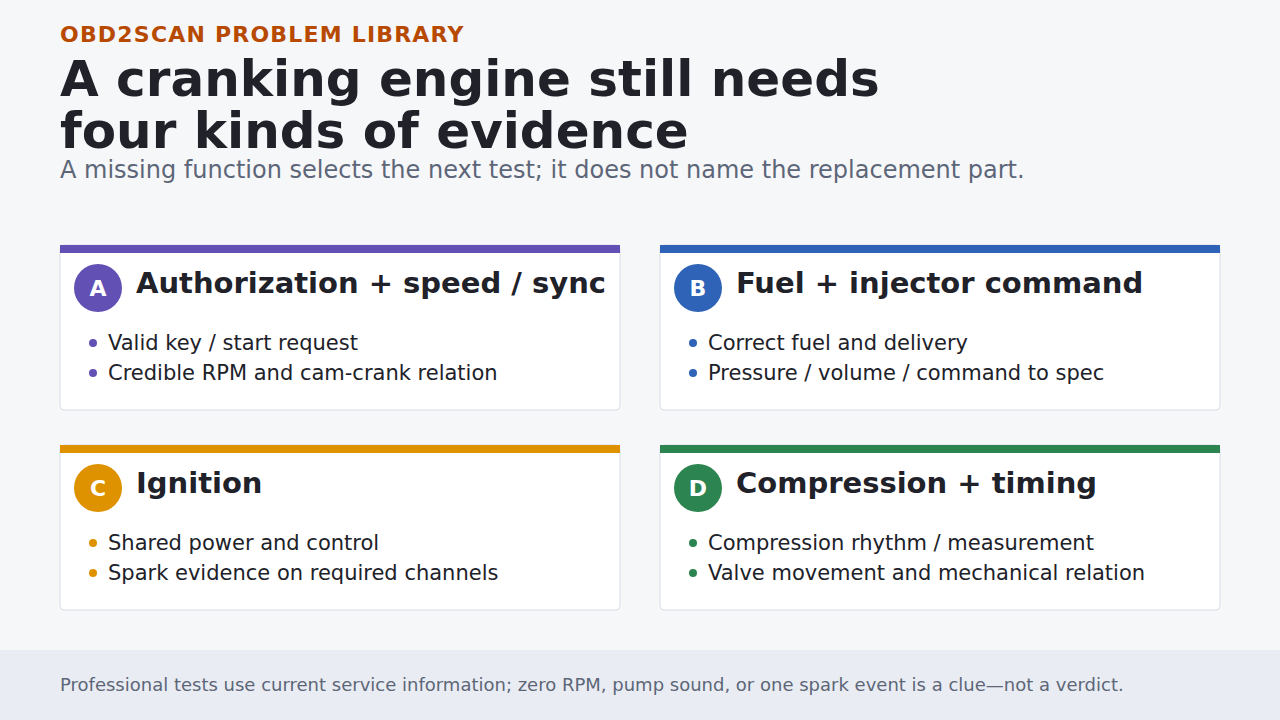
Authorization and synchronization
If the controller does not recognize a valid key/start request, or if engine-speed and cam/crank relationship data are absent or implausible, fuel and ignition may be intentionally withheld. The next proof is the vehicle-specific immobilizer, power/ground, network, sensor-circuit, target-wheel, and mechanical-synchronization procedure. Replacing a crankshaft sensor because the RPM PID reads zero skips most of that circuit. When cranking data points to a missing power, ground, or command path, the MRCARTOOL B550 circuit analyzer can speed up first-pass circuit checks before a starter, relay, sensor, or control module is condemned.
Fuel delivery and injector command
A running engine needs suitable fuel, delivered at the required condition, plus an injector command. Pump sound does not prove pressure or volume, and a pressure PID does not prove every injector is delivering correctly. A trained technician should compare command, electrical supply, pressure/volume, and fuel quality using the specified equipment. Opening a fuel rail or spraying fuel into an intake is not an acceptable shortcut.
Ignition
A single coil or plug failure more often produces a misfire than a total no-start, while a shared ignition power, control, synchronization, or severely fouled-plug condition can affect the whole engine. Spark testing involves ignition voltage and fuel-vapor risk; the useful public decision is whether professional testing found ignition on all required channels and whether that result agrees with injector command and synchronization.
Compression and mechanical timing
When credible fuel pressure, injector command, and ignition are present, mechanical evidence moves forward. Compression rhythm, relative compression, measured compression/leakage, valve-train movement, and cam/crank relationship can reveal a timing or valve-control fault. These results must be measured and documented; “it has spark and fuel” is not proof that the engine can compress the mixture at the correct time.
Shared failures matter
No spark and no injector command together often point toward a shared authorization, synchronization, power, ground, or controller-input problem. One missing function should not trigger replacement of several downstream parts at once.
4. Use vehicle-specific information after the split
OEM bulletins show why the symptom alone cannot name the part. An Isuzu bulletin for specific 6.0L applications describes proper fuel pressure, spark, and injector pulse accompanied by low compression and valve-train evidence from a sheared camshaft locating pin. A GM bulletin for listed small-engine applications sends technicians through the base crank-no-start diagnosis before a model-specific cam-reluctor inspection. A JLR communication for listed hot no-start applications begins with recent service and the exact oil-filter configuration.
Those examples are not a menu of likely failures for every car. They establish the correct order:
- identify the missing function;
- check current service information, recalls, campaigns, and bulletins for the exact VIN, engine, calibration, condition, and code set;
- apply the bulletin only if every applicability condition matches;
- document the test that confirms the cause before ordering parts.
The OBD-II evidence workflow provides a fuller method for saving code status and freeze-frame without treating a code label as a diagnosis.
5. Build a useful handoff and verify the result
Give the shop a reproducible condition
- VIN, engine, mileage, and fuel type
- cold/hot/soak state and outside temperature
- normal, slow, uneven, or free-spinning crank sound
- instrument and security messages, plus which key was used
- all code statuses, freeze-frame, and one cranking data capture
- fuel/refueling history and every recent repair
- what was inspected, moved, charged, cleared, or jump-started
After repair, recreate the original temperature and soak condition. Confirm normal cranking, a prompt start, stable running, expected charging voltage/control, no abnormal noise or leakage, and no returning current or pending faults after the applicable monitor and restart sequence. A single successful warm start does not verify a cold-only complaint, and clearing codes does not verify any repair.
Official references
- DENSO: Starter System Diagnosis
- Isuzu bulletin IB16-J-001C
- GM bulletin 21-NA-268
- JLR hot crank/no-start technical communication
Use the owner’s manual and current service information for the exact vehicle as the controlling procedure.
The useful outcome
You should finish with one clearly named starting symptom and one missing-function branch. That is enough to choose the next proof without replacing the starter, battery, fuel pump, crank sensor, coils, and catalytic converter in sequence.







Comments 0
Questions, fixes, and real-world diagnostic notes from readers.
Be the first to share a diagnostic result or ask a follow-up question.