
2008–2011 Land Rover LR2 Noisy or Heavy Steering? Check Fluid Flow First

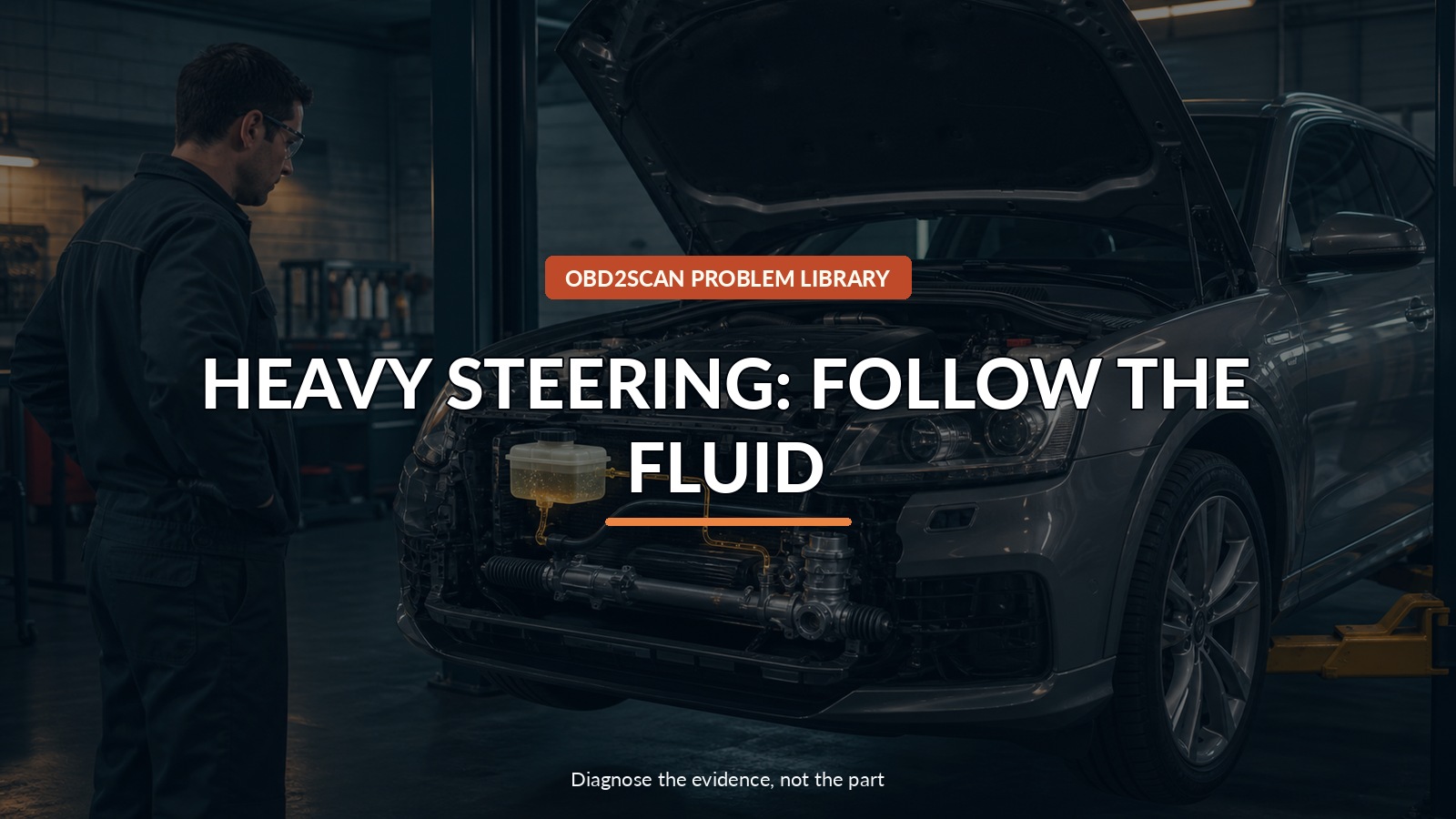
Heavy Steering: Follow The Fluid
A noisy power-steering pump is not always a failed pump. In the covered LR2 population, Land Rover traced a chain from weld-spatter contamination to a restricted reservoir filter, then to aerated fluid and noisy or heavy steering. The bulletin even warns that the pump does not automatically need replacement. Follow the fluid before buying the loudest component.
A comparative fluid-condition tester can add one observation when an uncontaminated sample and the suspect sample are handled consistently. The AUTOOL AS507 power steering fluid tester can screen optical transmittance, impurity trend, and temperature. It cannot identify weld spatter or metal chemistry, prove the reservoir filter is blocked, measure pump pressure or flow, or authorize pump, gear, or reservoir replacement.
The diagnostic story is a cause chain: debris restricts return flow; restriction encourages aeration; aerated fluid makes noise and can reduce assist. VIN position then decides whether the published path begins with a flush or includes steering-gear and reservoir work.
Quick answer: Use the VIN branch, watch the reservoir for aeration, and follow contamination through filter restriction and flow before condemning a noisy power-steering pump.
In this guide
- Stop loading the steering at full lock
- Use the VIN to choose the branch
- Watch the reservoir before listening to the pump
- Build the contamination-to-bubble chain
- Treat fluid screening as comparative evidence
- Follow the flush and hardware sequence exactly
- Pressure-test only after the branch earns it
- Verify assist, noise, level, and aeration together
Stop loading the steering at full lock
If assist becomes unpredictable, steering binds, fluid pours out, or a warning appears, stop driving and arrange professional inspection. Do not hold the wheel against either stop to “make the noise happen.” Full-lock operation raises hydraulic load and temperature and can damage a system that is already starved.
Record whether noise occurs cold, warm, during parking, after a long drive, in one direction, or at all steering angles. Note steering effort, knocking through the wheel, fluid level, foam or bubbles, leak evidence, and recent pump, reservoir, rack, hose, collision, or engine-bay work. Film the reservoir only from a safe stationary position.
Use the VIN to choose the branch
LTB00272NAS3 covers 2008–2011 LR2 vehicles in VIN range 8H000212–BH211570. Within that population, the bulletin uses VIN breakpoints to choose different workshop actions. Confirm the full VIN, model year, fluid specification, installed reservoir and gear, prior repairs, and latest JLR procedure.
Do not apply one internet flush sequence to every LR2. Earlier vehicles may require a different combination of steering-gear, reservoir, and system-flush work; later vehicles begin with flushing and move to pressure testing if the concern remains. The VIN is a decision input, not administrative detail.
Watch the reservoir before listening to the pump
With the vehicle stationary and the system at the specified level and temperature, observe the reservoir under the service procedure. Land Rover notes that disturbing or moving the reservoir can reveal air bubbles associated with a blocked filter. Do not open a hot reservoir or introduce dirt.
Document fluid level, color, clarity, foam, bubble persistence, return-flow behavior, temperature, and whether the symptom changes as the system warms. A few transient bubbles after service differ from continuous aeration. Low level can pull air into the pump, while an external leak can lower level without filter blockage.
| Observation | Cause-chain question | What it does not prove |
|---|---|---|
| Persistent foam or bubbles | Is return flow restricted or air entering? | Pump replacement is required |
| Dark/opaque sample | Is contamination or aging present? | Weld spatter is the contaminant |
| Correct clear fluid but heavy assist | Is hydraulic pressure/flow or mechanical steering abnormal? | Reservoir filter is open |
| Noise only at full lock | Was the system being loaded beyond a useful test? | Normal operation everywhere else |
Build the contamination-to-bubble chain
The bulletin describes welding spatter generated during manufacture as a possible contaminant. Debris can travel through the hydraulic circuit and collect at the reservoir filter. Restricted flow then starves or aerates the pump, creating a sound that points listeners toward the pump even when the pump is reacting to an upstream condition.
Inspect captured fluid and removed components only under contamination-control procedures. A magnet may distinguish some ferrous material, but not every contaminant is magnetic and not every sparkle is weld spatter. Preserve a sample in a clean labeled container if professional analysis is needed. Do not pour questionable fluid back into the system.
Treat fluid screening as comparative evidence
Use the exact specified fluid as the known-good reference, with equal sample depth, clean optics, similar temperature, and no bubbles. Record results rather than labeling a sample simply “bad.” Optical transmittance can shift with dye, age, suspended particles, water, or incompatible fluid.
A comparative screen can justify closer inspection or a controlled exchange. It cannot identify particle size, material, additive depletion, or filter restriction. If chemistry or metal identity changes the repair decision, laboratory analysis is the stronger route.
Follow the flush and hardware sequence exactly
Steering-fluid service requires the current JLR fluid, hose routing, capture, bleeding, and environmental procedure. Prevent the reservoir from running dry; do not use shop air to force fluid through the system; keep hands and hoses clear of moving belts; and dispose of fluid properly.
Follow the VIN-specific branch rather than repeating flushes until the color looks acceptable. Where the bulletin calls for reservoir or steering-gear replacement, use the specified parts and fastener rules. Land Rover’s warning about the pump is important: pump noise during starvation is not, by itself, a pump condemnation test.
Pressure-test only after the branch earns it
For the later-VIN branch, Land Rover directs flushing first and a pressure test if the complaint is unresolved. Pressure testing uses a rated gauge and shutoff arrangement placed according to the workshop manual. Excessive dead-heading can damage the pump and heat the fluid, so the timed procedure is professional-only.
Compare pressure and flow behavior at specified temperature and engine speed with steering load controlled. Low pressure can reflect pump output, drive, supply restriction, leakage, test setup, or internal bypass. A normal optical fluid reading cannot answer that hydraulic question.
Verify assist, noise, level, and aeration together
After the correct repair, bleed exactly as specified and let foam dissipate. Confirm stable level with no external leaks, smooth assist in both directions, no knock, no persistent reservoir bubbles, and normal sound without holding the wheel at the stops. Repeat cold and fully warm observations.
Reinspect hose routing and connections after a controlled road test. The job passes when the whole cause chain is broken—clean/stable fluid behavior, unrestricted return, consistent assist, and no abnormal noise—not simply when a freshly filled reservoir looks clear for five minutes.








Comments 0
Questions, fixes, and real-world diagnostic notes from readers.
Be the first to share a diagnostic result or ask a follow-up question.