
2023–2024 Ford EcoBoost P0301–P0304? Let Spark-Plug Damage Trigger the Borescope

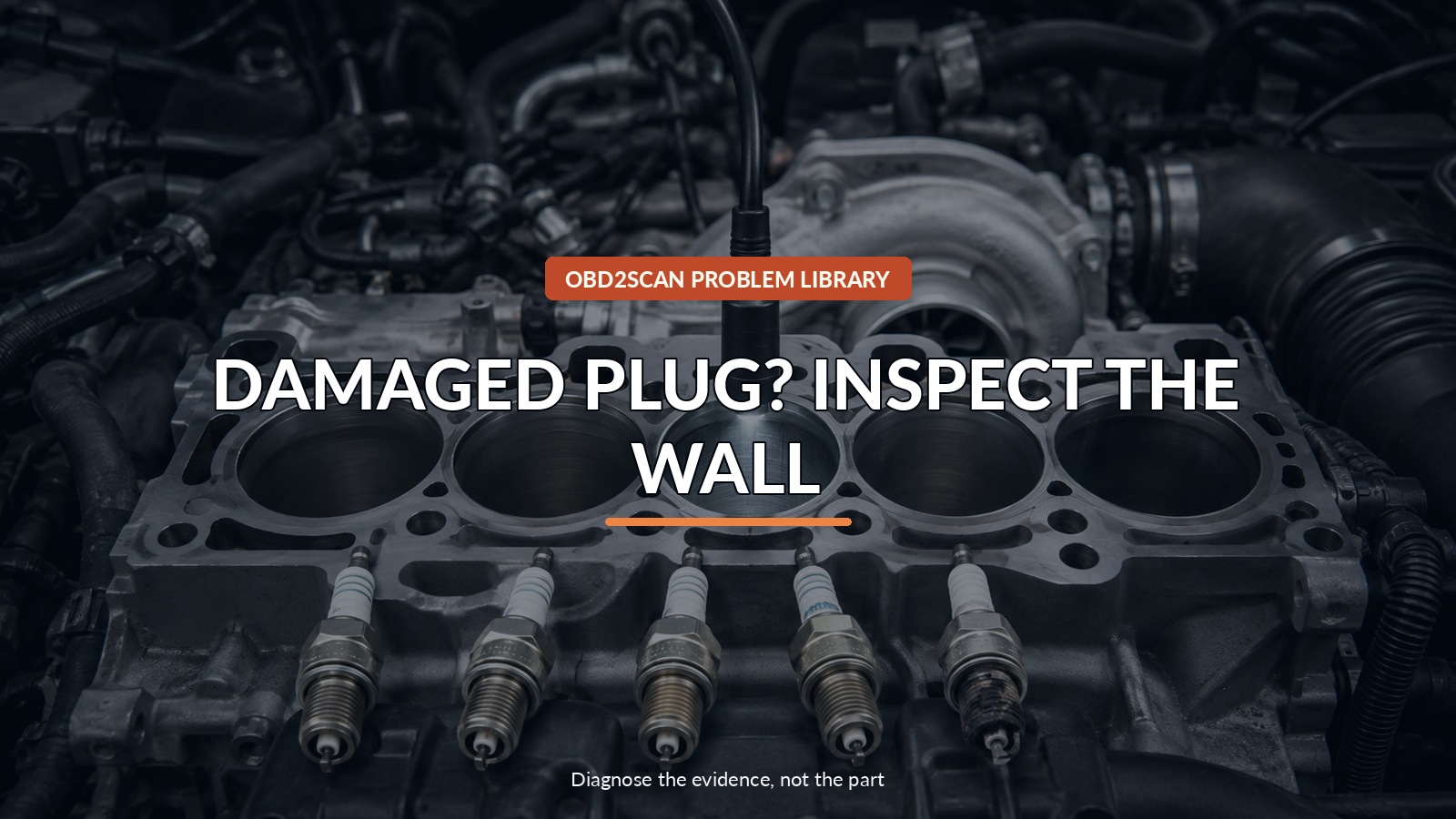
Damaged Plug? Inspect The Wall
On the Ford and Lincoln vehicles covered by SSM 52630, a P0301–P0304 misfire does not send a camera into the cylinder automatically. First, all spark plugs are removed and indexed. If every plug is undamaged, the shortcut ends and normal diagnosis resumes. Only an actually damaged plug earns the corresponding cylinder-wall inspection.
For that earned view, a small articulating camera can record the wall from several consistent angles. The AUTOOL SVB305 automotive borescope is one route to photo/video evidence. It cannot measure compression, determine score depth from a wide-angle image, prove what caused a mark, inspect a hot running cylinder, or authorize long-block replacement.
The order matters because a camera can always find something interesting. The plug decides whether that “something” belongs to this Ford branch.
Quick answer: Index and inspect all plugs; an undamaged set exits this shortcut, while actual plug damage earns a corresponding cylinder-wall borescope record.
In this guide
- Protect the catalyst and preserve the code set
- Check the four-vehicle engine fence
- Index and photograph every plug
- Let an undamaged set exit this shortcut
- Let actual damage earn the cylinder view
- Record the wall in repeatable passes
- Keep scoring separate from its cause
- Verify the repaired cylinder under the original condition
Protect the catalyst and preserve the code set
If the MIL flashes or the engine runs violently, stop driving and shut down safely. Continued misfire can overheat the catalyst and may worsen cylinder damage. Save all powertrain codes, pending/permanent status, freeze frame, misfire counters, power balance, fuel trims, coolant temperature, load, rpm, and recent fuel or service history.
Record whether the event is cold-only, warm idle, acceleration, deceleration, or continuous. Note mechanical noise, smoke, oil consumption, coolant loss, and cranking changes. Do not clear the code or swap coils before the original cylinder identity is preserved.
Check the four-vehicle engine fence
SSM 52630 describes certain 2023–2024 Escape and Corsair vehicles with 1.5L or 2.0L EcoBoost, 2024 Mustang with 2.3L EcoBoost, and 2024 Nautilus. Confirm VIN, engine, build, current OASIS messages, and Ford Workshop Manual information.
The SSM was published in 2024 and told dealers to monitor OASIS for additional information. Current guidance must therefore control today. A P030x on another EcoBoost family may still justify normal plug or cylinder diagnosis, but it does not inherit this exact long-block branch.
Index and photograph every plug
Follow the cold-engine, connector, coil, plug-well cleaning, removal, and torque process in the Workshop Manual. Label trays by cylinder and do not swap evidence. Photograph each plug from the same angles: insulator nose, electrodes, ground strap, shell, terminal, and any broken fragment.
Compare cracks, missing ceramic, bent or missing electrodes, impact, abnormal gap, oil/fuel fouling, overheating, and deposits. A fouled plug is not necessarily the “damage” meant by the SSM, and a fragment must be accounted for. Preserve loose material; do not blow it deeper into the cylinder.
| Plug set result | Next move | Prohibited shortcut |
|---|---|---|
| All plugs free of damage | Return to normal diagnostics | Replace plugs or inspect walls under this SSM |
| One or more plugs physically damaged | Inspect corresponding cylinder wall | Assume long-block damage |
| Cylinder identity lost | Rebuild evidence before deciding | Assign a wall finding to a code by memory |
| Damage ambiguous | Obtain expert/OEM review | Round ambiguity toward engine replacement |
Let an undamaged set exit this shortcut
Ford says plug replacement is unnecessary under this SSM if all plugs are free of damage. Respect the exit. Reinstall serviceable plugs only if current procedure allows and continue ignition, injector, air leak, compression, fuel, wiring, software, and mechanical diagnosis based on the failure state.
A misfire that follows a controlled coil or plug move belongs to that moved-component branch. A misfire that stays may justify compression or leakage tests. The SSM is not a complete P030x diagnostic tree; it is a damage-triggered inspection shortcut.
Let actual damage earn the cylinder view
If a plug is damaged, position the piston and valves as required, ensure the engine is cool and disabled, and enter through the corresponding plug bore without contacting the wall. Start with a wide orientation view. Then sweep the circumference in overlapping passes, recording crown, wall, and the relationship to any suspected contact area.
Use the same illumination and focal distance for comparison cylinders where the procedure permits. Rotate or move the engine only with approved methods. Never crank with the probe inserted. Stop if the probe snags, the tip overheats, or a fragment remains unaccounted for.
Record the wall in repeatable passes
Distinguish a normal honing pattern, oil film, reflection, carbon shadow, vertical mark, material transfer, gouge, and obvious score. A single close-up lacks scale and orientation. Save one landmark, a slow full-wall pass, two angles of the mark, and a control cylinder if authorized.
Ford’s SSM separates scored/scraped/damaged walls from walls without those findings. The image record should be reviewable by the technician who makes that decision. Camera resolution and articulation help access; they do not supply metrology or repair authority.
Keep scoring separate from its cause
If the wall is damaged, SSM 52630 directs long-block replacement for its covered condition. The visible damage still does not, by itself, explain whether plug breakage, foreign material, piston contact, lubrication, overheating, detonation, manufacturing, or another event caused it. Preserve the plug, debris, oil/coolant evidence, codes, and images.
If the wall is not damaged, the 2024 SSM directed replacement of damaged plugs and customer advice while engineering investigated. Because service information may have advanced, check current OASIS rather than treating that historical wording as permanent policy.
Verify the repaired cylinder under the original condition
After the current approved repair, account for all parts and fragments, restore plugs/coils/connectors at specified torque, check fluids, and scan the complete vehicle. Repeat the original cold start, warm idle, or controlled load while watching cylinder contribution and misfire counters.
Verification requires no flashing MIL, no returning P0301–P0304, stable contribution, normal mechanical sound, and no related oil/coolant symptom. Save the final scan and operating conditions beside the indexed plug and wall images. A quiet five-minute idle cannot close a complaint that occurred only under acceleration or after an overnight soak.









Comments 0
Questions, fixes, and real-world diagnostic notes from readers.
Be the first to share a diagnostic result or ask a follow-up question.