
P0420 Code? Prove the Cause Before Replacing the Catalytic Converter

P0420 means the engine controller completed its catalyst monitor for Bank 1 and judged catalyst-system efficiency below the calibrated threshold. It does not say “replace the catalytic converter,” and it does not by itself prove an oxygen sensor is faulty. Preserve the code status, freeze-frame, readiness monitors, related faults, oil/coolant/fuel history, and recent exhaust or engine work before anything is cleared.
What to do first
- If the malfunction lamp is flashing, the engine is misfiring severely, power is greatly reduced, the converter glows, or you smell intense heat/sulfur or see smoke, stop driving and arrange inspection.
- If the lamp is steady and the vehicle otherwise runs normally, avoid replacing or cleaning anything until all codes, freeze-frame, monitor status, and recent service history are saved.
- Identify the exact engine and Bank 1 layout from service information; Bank 1 is not universally the left or right side.
- Diagnose related misfire, mixture, air/fuel-sensor, oxygen-sensor, temperature, and fuel-control faults before judging catalyst efficiency.

In this guide
1. What P0420 does and does not say
A gasoline catalyst stores and releases oxygen while converting regulated exhaust pollutants. Under specific enabling conditions, the controller evaluates sensor behavior before and after the catalyst. If the calculated Bank 1 result falls below the vehicle’s calibrated threshold on the required trips, P0420 can mature.
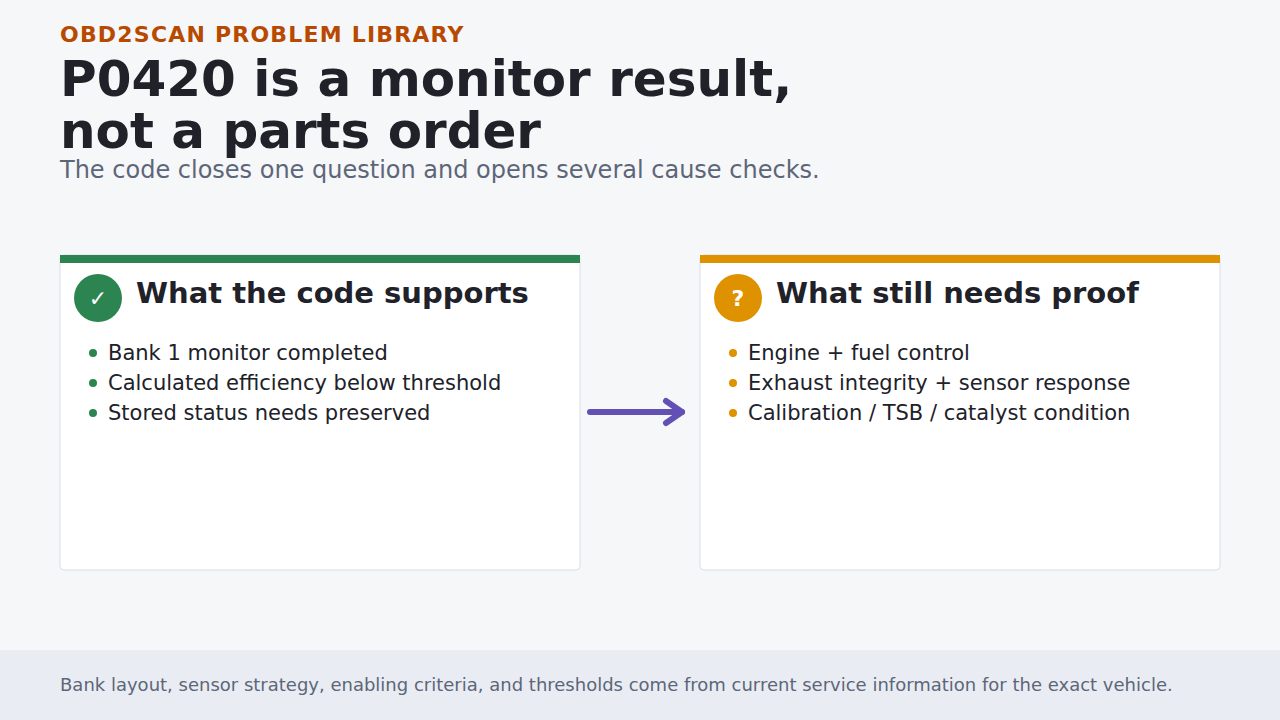
The code supports
- the controller ran the Bank 1 catalyst monitor under its enabling logic;
- the measured or calculated system response was below its threshold;
- the condition was sufficient for the DTC status now stored.
The code does not independently prove
- the catalyst substrate alone is worn out;
- the downstream oxygen sensor alone is bad;
- an upstream air/fuel sensor is accurate;
- there is no exhaust leak;
- the engine has not been misfiring, burning oil/coolant, or running with incorrect mixture;
- the vehicle has the latest calibration or no applicable campaign/bulletin;
- a replacement catalyst will be legal and correct for the vehicle’s emissions application.
Sensor graphs need context
A rear sensor that looks active can support further testing, but waveform shape depends on operating state, sensor type, monitor strategy, exhaust integrity, and controller commands. Do not apply a generic screenshot or “the rear line should be flat” as a universal part verdict.
2. Save the monitor story before clearing
- Code status: record current, pending, permanent, and history status, not merely the P0420 label.
- Freeze-frame: save speed, load, RPM, coolant temperature, fuel trims, airflow/load, loop status, voltage, and other available values.
- Readiness: note catalyst, oxygen-sensor, oxygen-heater, misfire, fuel-system, and comprehensive-component status. A cleared code resets much of this evidence.
- Related DTCs: mixture, misfire, sensor-heater, temperature, airflow, fuel-pressure, and exhaust-related faults can change the diagnostic order.
- History: document oil or coolant consumption, overheating, poor running, recent tune-up/exhaust work, fuel source, additive use, software work, and whether the fault followed a long trip or unusual fuel fill.
- Inspection: when cold and safely accessible, look for collision damage, loose hardware, disturbed sensor wiring, or visible leakage evidence. Do not touch or work beneath a hot or unsupported vehicle.
The OBD-II evidence workflow explains how to retain this record before a reset turns a repeatable monitor failure into a waiting game.
3. Diagnose in the right order
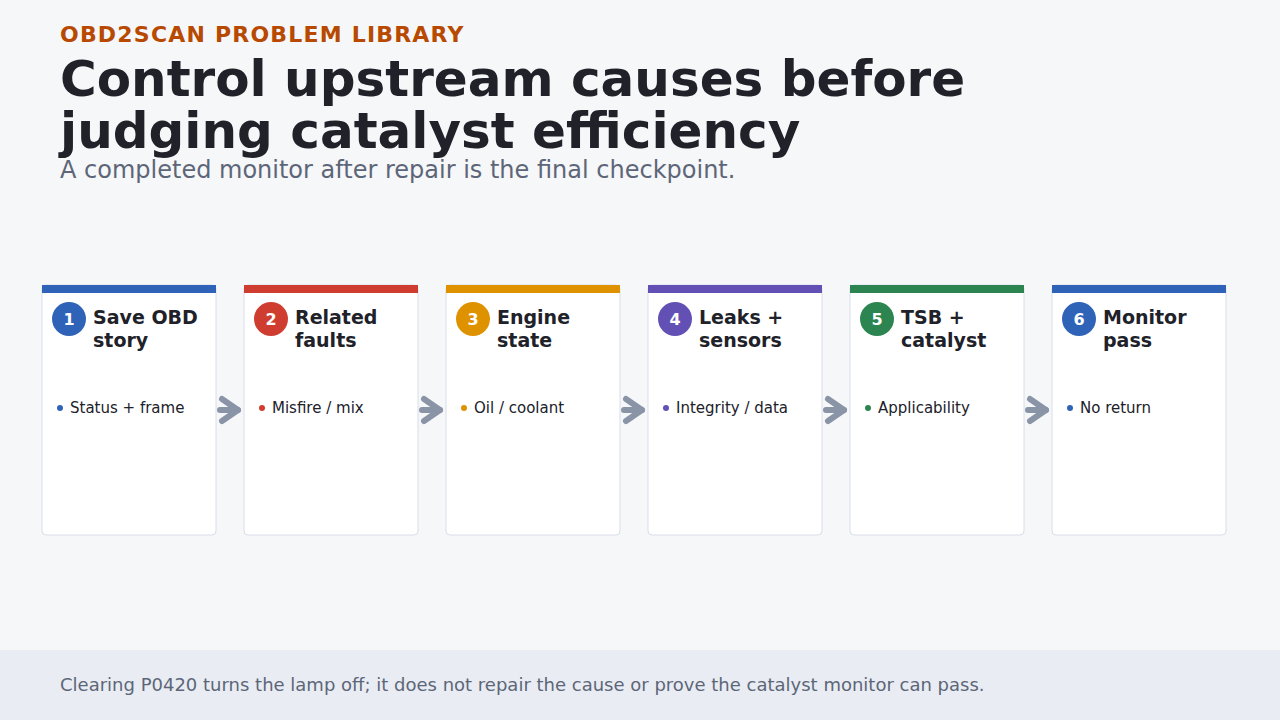
Step 1: resolve related faults and unsafe running
Subaru’s procedure for its listed vehicles begins with a general inspection and directs technicians to diagnose listed misfire, mixture, and sensor faults first. That order is broadly useful even though its exact code list and steps remain Subaru-specific. A converter exposed to ongoing misfire, incorrect mixture, oil, or coolant can be the victim rather than the first cause.
If the engine runs rough, the related rough-idle workflow helps separate whole-engine from cylinder-specific evidence without turning fuel trims into a universal threshold.
Step 2: establish engine condition
Record oil and coolant level trends, smoke, misfire history, compression/mechanical evidence when indicated, and fuel control under the condition that set the code. Subaru’s applicable procedure explicitly checks oil level and white-smoke/mechanical evidence before moving deeper into catalyst diagnosis. Repair the cause of contamination or abnormal combustion before installing a part that can be damaged again.
Step 3: test exhaust integrity
Leaks can alter the oxygen seen by the sensors and the monitor’s conclusion. Inspect joints, manifolds, pipes, sensor bosses, and hardware using the exact service method. GM documents professional smoke/low-pressure/ultrasonic approaches for hard-to-find intake or exhaust leaks after normal diagnosis, and one model-specific bulletin requires an applicable clamp leak to be repaired before converter consideration. Do not improvise by pressurizing a hot exhaust or sealing it without the prescribed equipment.
Step 4: verify sensor response and control
Check sensor power, ground, heater, wiring, plausibility, response, and commanded mixture behavior with the manufacturer’s test. Subaru’s applicable active test asks whether the air/fuel sensor reaches commanded targets; that is much stronger evidence than replacing a downstream sensor because its graph “looks busy.”
Step 5: judge the catalyst after the upstream system is controlled
Only after related faults, engine condition, leakage, sensor performance, and exact-vehicle information have been addressed does the catalyst become an interpretable decision. Record the test and the reason the converter failed, including any upstream condition that must be repaired with it.
Hot exhaust and lifting risk
Catalysts and pipes can remain hot enough to burn or ignite materials after shutdown. Leak testing, sensor removal, under-vehicle inspection, forced mixture control, and monitor road tests require the correct equipment, lifting support, ventilation, and service procedure.
4. Use exact-vehicle bulletins and warranty information
Before ordering parts, search by VIN, engine, calibration, model year, code set, and exact condition. The reason is visible in OEM evidence:
- Ford bulletin 22-2260 applies only to specified 2.7L F-150, Expedition, and Navigator applications and describes high-sulfur fuel plus a specific de-sulfation procedure.
- GM PIP5110 applies only to listed truck/van applications and directs an exhaust-clamp leak repair before considering a converter.
- Subaru 09-110-23 provides its own related-code, inspection, active-test, and monitor-drive sequence for the listed models.
These are examples of why a generic parts sequence is unsafe, not repairs to copy onto a different vehicle. Also check emissions warranty and replacement-catalyst rules before purchase. In California and states following its requirements, a physically fitting aftermarket catalyst may still be the wrong legal application; use the correct vehicle/emissions label and current regulator/manufacturer information.
5. Verify the repair with a completed monitor
Useful shop handoff
- VIN, engine, emissions label, mileage, and Bank 1 layout;
- all DTC statuses, freeze-frame, readiness, and software/calibration information;
- oil/coolant use, smoke, misfire, overheating, fuel, and recent repair history;
- exhaust-leak test and sensor-response results;
- applicable bulletin/campaign/warranty check;
- before/after monitor and road-test record.
Clearing P0420 and seeing the lamp go out is not verification. Recreate the service-information enabling conditions safely, allow the relevant monitors to complete, confirm no current or pending related faults return, and document the resulting sensor/control behavior. For emissions retest, readiness requirements matter; do not clear codes immediately before an inspection and assume the vehicle is ready.
Official references
The useful outcome
You should finish with a documented monitor failure, every upstream cause controlled, an exact-vehicle applicability check, and a completed post-repair monitor—not a converter purchased from the code name alone.


Comments 0
Questions, fixes, and real-world diagnostic notes from readers.
Be the first to share a diagnostic result or ask a follow-up question.