
Volkswagen P0301–P0308 With P1250? Fill the Tank Before Firing the Parts Cannon

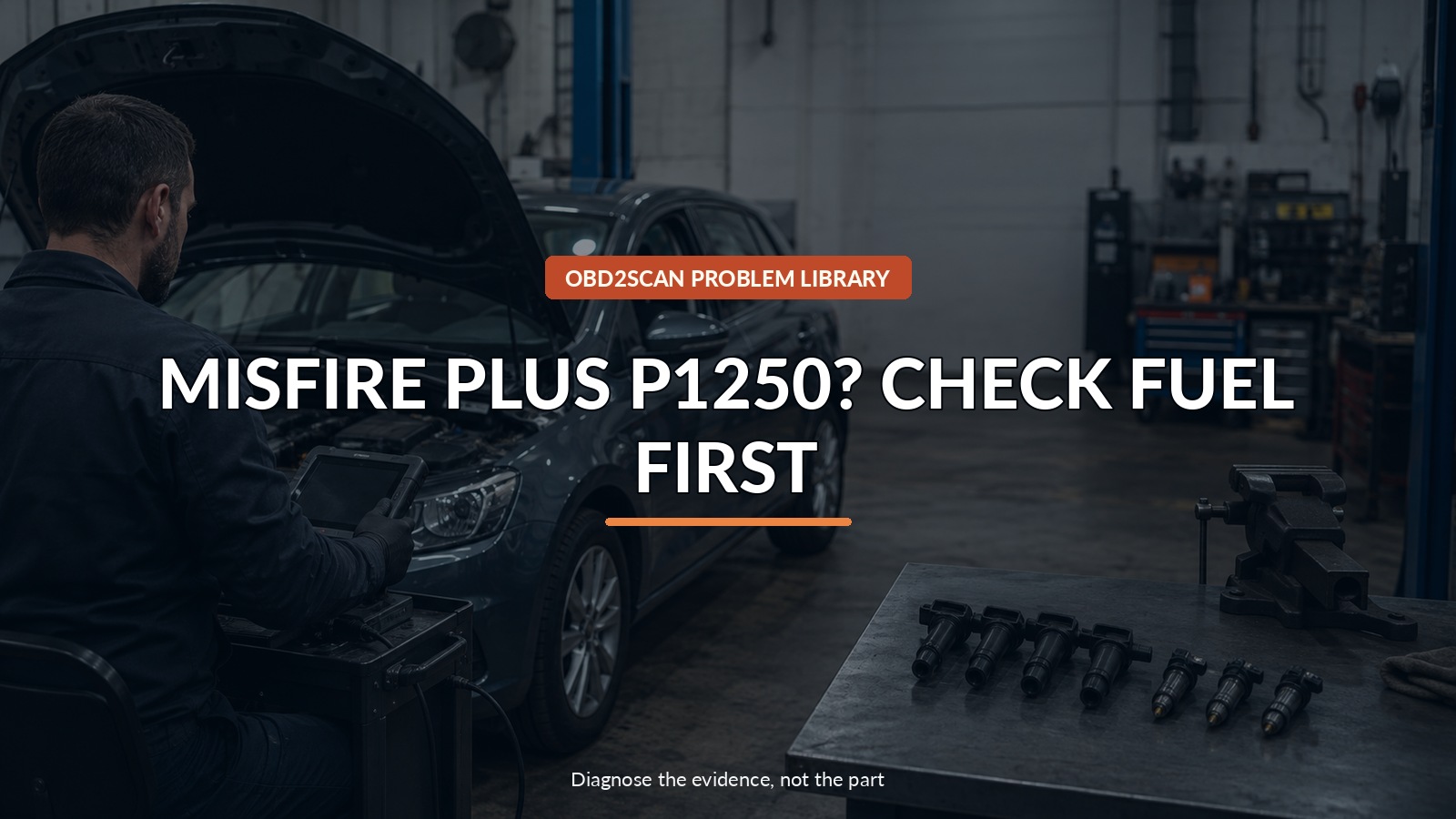
Misfire Plus P1250? Check Fuel First
Save fuel level, load, rpm, temperature and every companion code before clearing anything. When a covered gasoline Volkswagen stores P0301–P0308 with P1250, restore adequate fuel and reproduce the original conditions before buying parts. If the misfire remains, follow Volkswagen’s full guided sequence and replace only the component the fault follows. Do not keep driving under load if the MIL flashes or the engine shakes strongly; unburned fuel can overheat the catalyst. A steady light with normal running still deserves a preserved scan before the tank is filled or codes are erased.
The useful tool category here is off-car injector flow and leakage comparison after the on-car evidence points to an injector, but only after the safe test point and decision are clear. The AUTOOL CT500 is one practical route for that bounded step. CT500 can compare removed compatible injectors for flow, spray pattern and leakage after the on-vehicle diagnosis earns that step; it cannot prove low fuel caused the event, test an injector in the engine, identify the misfiring cylinder by itself or justify replacing a full set.
This case works like a cross-examination. The misfire code names a cylinder, but the fuel-level code supplies the circumstances. Volkswagen asks what the car was doing, what the weather and load were, and whether the fault follows a component before allowing that component to be convicted.
Quick answer: Save freeze-frame and fuel level; when P0301–P0308 appears with P1250, restore adequate fuel before swapping or replacing one proven component.
In this guide
- Photograph the fuel gauge and save freeze-frame
- Read P1250 as context, not background noise
- Restore fuel before erasing the event
- Separate one-cylinder from multiple-cylinder patterns
- Check campaigns and software before swapping parts
- Make a suspected part carry the fault to another cylinder
- Bench-test an injector only after the in-car branch
- Recreate the original load and verify one repair
Photograph the fuel gauge and save freeze-frame
Photograph the gauge and record estimated range before adding fuel. Save fuel level, rpm, load, vehicle speed, coolant and intake temperature, system voltage and code status from freeze-frame. Ask whether the event occurred while turning, accelerating, rolling to a stop or starting cold. Note road roughness and fuel source. That snapshot matters because filling the tank fixes the low-level condition but also removes evidence. If the engine is actively misfiring or the MIL flashes, stop the test and avoid a long drive intended only to make a code repeat.
Read P1250 as context, not background noise
For P0301 through P0308 accompanied by P1250, Volkswagen says the faults likely occurred because fuel level was low rather than because a component failed. ‘Likely’ is an ordering instruction, not proof. Put in adequate correct fuel, keep the original report, and see whether the engine now starts and runs normally. Do not use P1250 to dismiss a persistent single-cylinder miss, fuel odor, hard start or abnormal mechanical noise. Those observations keep other branches open.
Restore fuel before erasing the event
After fuel is restored, do not immediately clear the codes and declare success. Note how much fuel was added, then check current and pending misfire counts at idle and under a safe version of the original load. Volkswagen also directs technicians to address other entries before the misfire when those codes could explain it. Low rail pressure, reference-voltage faults or air-metering problems can affect several cylinders. The full scan establishes whether P1250 is the useful context or merely a fellow traveler.
| Pattern after adequate fuel | Next question |
|---|---|
| No roughness and no returning cylinder counts | Low-fuel event is supported; verify before parts |
| One cylinder repeats | Make a single suspected component carry the fault |
| Several cylinders repeat | Look for common fuel, air, electrical, software or mechanical cause |
| Misfire remains in the cylinder after swaps | Test injector leakage, then compression as directed |
Separate one-cylinder from multiple-cylinder patterns
A cylinder-specific P030x pattern and a P0300 multiple-cylinder pattern are not the same job. One cylinder suggests a comparison against its neighbors. Several cylinders invite a common influence such as fuel quality, pressure, air, ground, software or mechanical timing. Volkswagen warns that P0300 alone is not a reason to replace all injectors, plugs or coils. Use the misfire monitor to decide whether counts are continuous or sporadic and whether the pattern belongs to one bank, one crank pair or the whole engine.
Check campaigns and software before swapping parts
Before swapping parts, review open campaigns, applicable TSBs, software updates and the vehicle’s prior repair history. A recent plug, coil or injector service can introduce a connector, terminal or installation problem. Poor fuel quality may produce sporadic misfires without P130A. This is why the bulletin asks the shop to duplicate the customer’s environment. The code was generated by software under enable conditions; current software and the original conditions belong in the diagnosis before new hardware.
Make a suspected part carry the fault to another cylinder
When Guided Fault Finding permits, exchange one suspected plug, coil or injector with a known location and keep a map. Re-read the DTC memory after the same controlled condition. If the misfire moves with the component, that is stronger evidence than appearance. If it stays in the original cylinder, stop swapping and move to injector leakage or compression as the Volkswagen sequence directs. Replace one proven defective component at a time; a successful migration does not justify renewing the entire set.
Bench-test an injector only after the in-car branch
An injector bench becomes relevant only after safe removal and the in-vehicle sequence have made injector performance the remaining question. Compare compatible injectors under identical fluid, pressure and pulse settings for spray, flow and leakage. Preserve positions and results. A clean-looking spray does not prove the electrical command, installed seal or in-cylinder behavior, and bench fluid is not gasoline. If injectors pass or the fault never moves, follow the mechanical compression branch rather than repeating cleaning until the result looks convenient.
Recreate the original load and verify one repair
Verification should recreate the original temperature, load and speed as closely and safely as possible with adequate fuel. Monitor cylinder counts, fuel trims and the return of P030x, P1250 or P130A. Confirm readiness according to Volkswagen’s procedure instead of judging only a dark MIL immediately after clearing. If the misfire does not return, document the fuel-level correction and avoid selling parts. If it returns, the preserved pre- and post-fuel comparison now gives Guided Fault Finding a much cleaner starting point.
A strong work order includes the original fuel level, amount added, all codes and freeze-frame, fuel source, event conditions, misfire counts, software/campaign check and every component swap by cylinder. That evidence answers the owner’s need—whether the car is safe and what actually needs repair—while denying the parts cannon the vague permission of a familiar P030x label.




Comments 0
Questions, fixes, and real-world diagnostic notes from readers.
Be the first to share a diagnostic result or ask a follow-up question.