
Kia P0087 or Hesitation Under Acceleration? Compare Fuel Pressure at Two Points

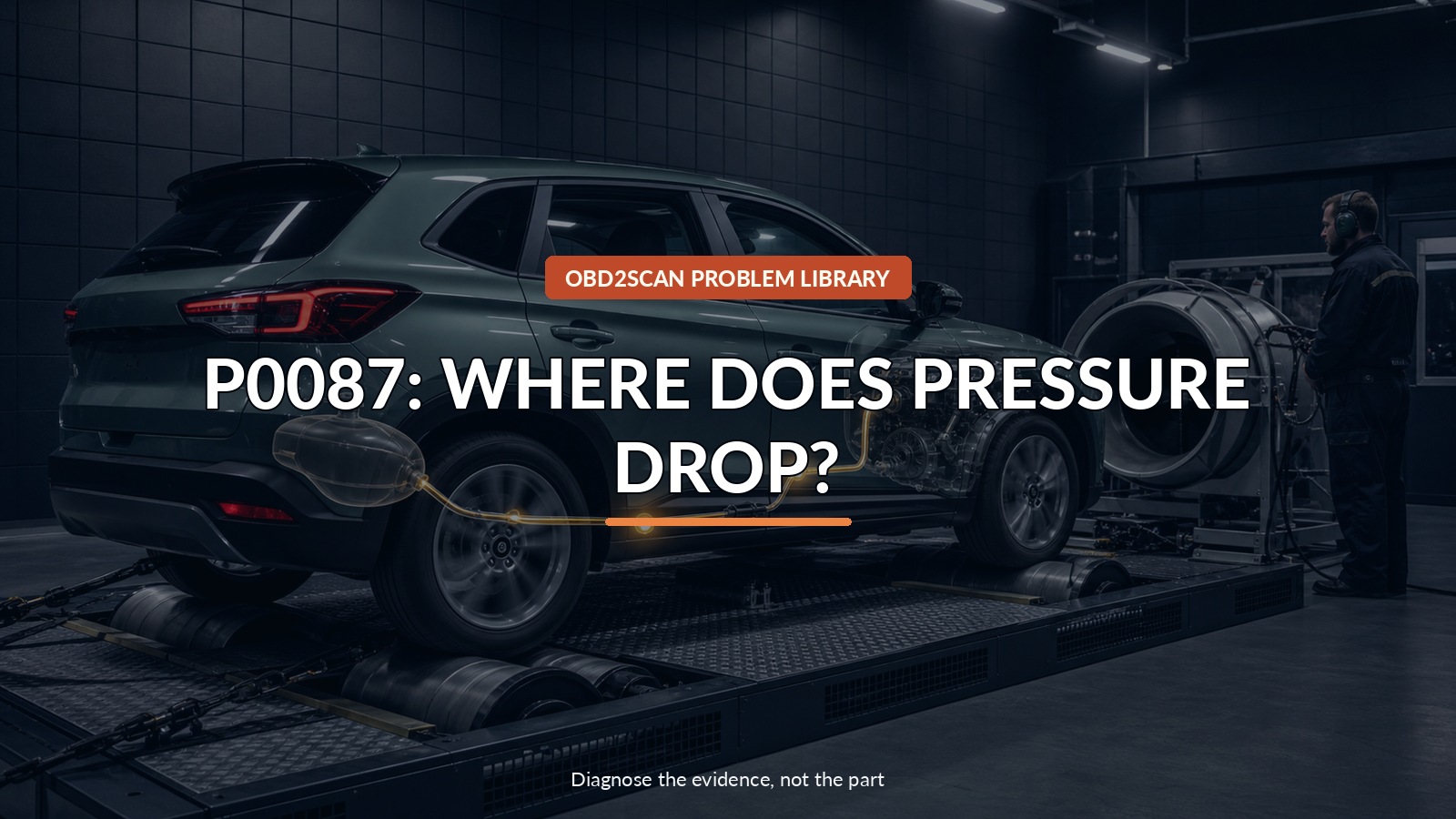
P0087: Where Does Pressure Drop?
A Kia that hesitates only when accelerating can return to the shop with no warning lamp and normal idle pressure. Preserve the load event and history codes before they disappear. The important question is not simply whether pressure fell, but where between the tank and high-pressure pump the loss began.
For the low-pressure side, a fuel-pressure kit with the exact adapter can move the same measurement between two service points. The AUTOOL PT635 fuel-pressure gauge can support a compatible low-pressure test. It cannot connect to the GDI rail, create a safe road load by itself, distinguish pump command from restriction without scan data, or make leaking gasoline safe.
Kia PS476 Rev. 1 uses a two-point comparison: measure near the tank-pump outlet, then ask the same question at the high-pressure-pump feed. That relay-race logic locates pressure loss far better than replacing the part named by P0087.
Quick answer: Preserve the load event, then compare low-side fuel pressure at the tank outlet and high-pressure-pump feed under the same acceleration condition.
In this guide
- Capture the load event before it disappears
- Confirm model, engine, and pressure specification
- Start at the low-pressure pump outlet
- Move the same question downstream
- Read equal and unequal pressure patterns
- Keep the GDI rail outside the wrong tool
- Build a two-location shop handoff
- Verify under the original acceleration load
Capture the load event before it disappears
Save all current, pending, and history codes, especially P0087, with freeze frame. Record fuel level, fuel source, ambient temperature, engine temperature, speed, gear, throttle/load, commanded and actual rail pressure, low-side pressure data if available, misfire counts, and whether cycling the key changes the symptom.
Do not reproduce severe power loss in traffic. Use a controlled shop load or chassis dynamometer when professional equipment and ventilation are available. If fuel odor, wet fittings, damaged lines, or fire risk appears, stop immediately, remove ignition sources, and follow fuel-spill procedures.
Confirm model, engine, and pressure specification
The Kia bulletin addresses specified 2014–2016 Soul, 2015–2016 Forte with GDI, and 2014–2015 Sorento applications. The bulletin lists engine-specific pressure values; one internet number cannot be applied to every engine.
Verify VIN, engine code, low-pressure architecture, exact test adapters, and current Kia service information. Check for related campaigns or prior fuel-system repairs by VIN. Confirm that fuel quantity and quality are adequate before opening a line.
Start at the low-pressure pump outlet
Following the depressurization and connection procedure, measure the supply as close to the tank-pump outlet as the Kia procedure specifies. Record prime pressure, idle pressure, and pressure during the reproducible load. Add commanded pump duty or supply voltage when available.
A low outlet reading under load can result from a weak pump, electrical supply problem, restricted pickup, low fuel, contaminated fuel, or a test connection that is itself restrictive. Do not blame the line downstream when pressure is already missing upstream.
Move the same question downstream
Relocate the approved gauge connection to the feed of the engine-driven high-pressure pump. Reproduce the same fuel level, temperature, and load. The comparison is only useful when the conditions match.
| Tank outlet under load | HP-pump feed under load | Strongest next question |
|---|---|---|
| In specification | In specification | Is commanded versus actual GDI rail pressure diverging? |
| Low | Low | Why is supply weak at the pump outlet? |
| In specification | Low | Is the connecting line or in-line path restricted? |
| Unstable at both | Unstable at both | Is pump command, voltage, fuel pickup, or test setup changing? |
The downstream gauge does not belong on the high-pressure GDI rail. Direct-injection pressure is hazardous and requires dedicated equipment and procedures.
Read equal and unequal pressure patterns
Kia’s published example locates a restricted fuel line when pressure is acceptable at the pump outlet but low at the high-pressure-pump feed during the same complaint. Confirm that pattern more than once before replacing the line.
If both points are low, measure voltage drop and command to the in-tank pump under load. If both low-side points pass but actual rail pressure still falls behind command, continue with the high-pressure system, sensor plausibility, injectors, and mechanical pump procedure. P0087 describes rail pressure below target; it does not identify which stage caused it.
Keep the GDI rail outside the wrong tool
Never adapt a general low-pressure gauge to the GDI rail. Fuel can be at extremely high pressure, remain trapped after shutdown, penetrate skin, and ignite. Rail testing and component removal require the model-specific depressurization process, rated equipment, eye protection, ventilation, and trained handling.
Also avoid pinching a fuel hose as a shortcut. Modern lines can be damaged internally and a temporary restriction changes the very result being measured.
Build a two-location shop handoff
Give the shop two synchronized records rather than “pressure was low”: exact connection point, adapter, fuel level, temperature, engine load, pump command/voltage, pressure at the start of acceleration, lowest pressure, and recovery time. Include scan rail command versus actual and the original freeze frame.
Label each gauge photo “tank outlet” or “HP-pump feed.” Unlabeled snapshots often create more ambiguity than evidence.
Verify under the original acceleration load
After repair, inspect every opened connection for leaks, restore retainers and shields, and repeat the same controlled load with similar fuel level. Both low-side test points should remain within the engine-specific specification while actual rail pressure follows command and hesitation does not return.
Complete a leak check after shutdown and a full module scan. A normal idle is not sufficient verification for a failure that existed only under acceleration.
Do not erase a fuel-quality branch
If the event started immediately after refueling, save the receipt, station, grade, gallons, and remaining sample opportunity. Water or incorrect fuel can affect more than one pressure stage and may damage components if repeated load testing continues. A pressure difference between the two low-side points can still identify a restriction, but it does not rule out contaminated fuel elsewhere. When the evidence points toward fuel quality, the shop should sample it safely before draining or diluting the tank, document appearance and phase separation, and keep that finding separate from the bulletin’s restricted-line pattern.





Comments 0
Questions, fixes, and real-world diagnostic notes from readers.
Be the first to share a diagnostic result or ask a follow-up question.