
2005 Nissan X-Trail Rough Idle and Stalling: One Successful Repair Did Not Explain Both Symptoms

Quick answer: A rough idle and an intermittent stall may need separate explanations. Agree on which symptom each proposed repair is expected to resolve before approving the complete job.
A repair can be correct and still incomplete. If rough idle improves but the vehicle continues to stall, the useful question is which complaint the first intervention actually addressed. Agree on that distinction before authorizing the job, so a partial success becomes information rather than an argument about whether anything was fixed.
In this guide
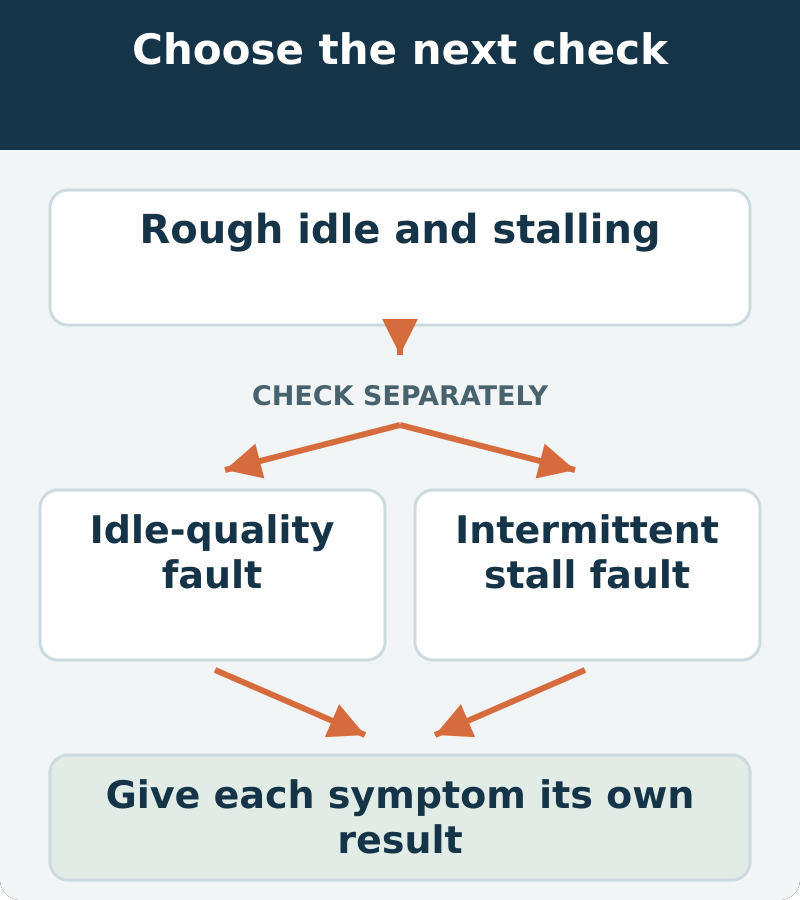
Give each symptom its own line on the job card
Write “rough idle” and “intermittent stalling” separately, with the conditions you observed for each. Do not assume they occur at the same time or share the same trigger unless that is what happened. Include whether the engine restarts and any warning information already recorded.
Unpredictable cutting out needs a recovery and professional test plan. Do not deliberately continue through traffic to capture another event. The owner’s useful contribution is a clear symptom record. Two lines on the job card make it harder for one improvement to erase the other complaint from the handover conversation, and easier for a technician to judge each proposed intervention fairly.
Why a single fault code does not require a single cause
A fault code describes a condition recognized by a particular system. It does not dictate the total number of contributing defects in the vehicle. Equally, two symptoms do not prove two faults. The investigation has to establish the relationships rather than choose the neatest story.
Ask what evidence connects each symptom to the proposed cause. A cylinder-related observation and a fuel-control concern may require different checks, and neither should be converted into a part decision from one value alone. The purpose of keeping the complaints separate is to preserve that reasoning. It is not to demand two repairs whenever the driver notices two forms of poor running.
Match the proposed work to the promised improvement
Before approving a staged job, agree on the expected result of each supported intervention:
| Proposed stage | Agreement to make |
|---|---|
| Work addressing uneven running | Which finding supports it, and what idle improvement is expected? |
| Work addressing the cutting out | What separate evidence supports that diagnosis? |
| Final setup and checks | How will both original complaints be checked? |
This is a planning matrix, not a prescription for injectors and a valve on every X-Trail. It helps distinguish a necessary partial repair from an unsupported promise of a complete cure. Any further authorization should follow the findings.
What a partial success should change
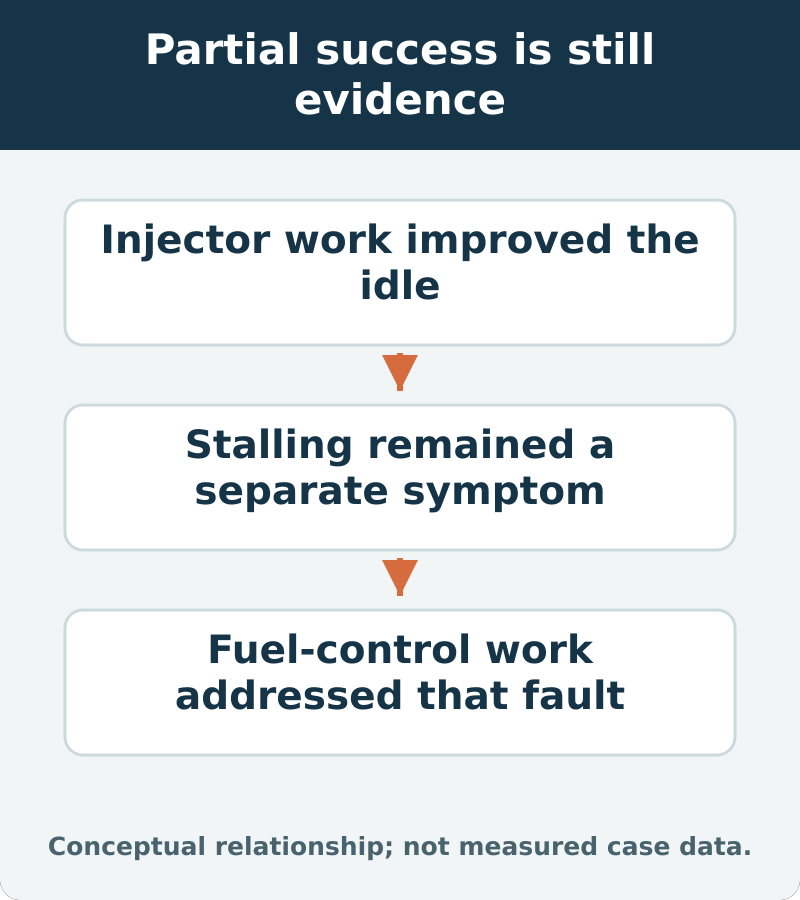
If one symptom improves, give that result its proper credit. It can support the intervention while showing that the remaining complaint needs continued investigation. Declaring the first repair useless would discard information; declaring the whole vehicle fixed would discard the unresolved symptom.
Ask the workshop what the change rules in or leaves open. Do not infer that injectors can never contribute to stalling simply because a different component addressed the remaining stall in this account. The useful conclusion is local to the evidence. A staged diagnosis should become more specific after each result, not more committed to a blanket rule about which component causes which symptom.
In the published Professional Motor Mechanic case by Josh Jones, the X-Trail had a weak cylinder and intermittent stalling with P0089. After mechanical checks, injector work improved idle quality but did not stop the cutting out. A separately investigated suction-control valve was replaced and adaptations completed, followed by a successful road test. The author describes two contributing faults.
Complete the fuel-control setup as well as the hardware
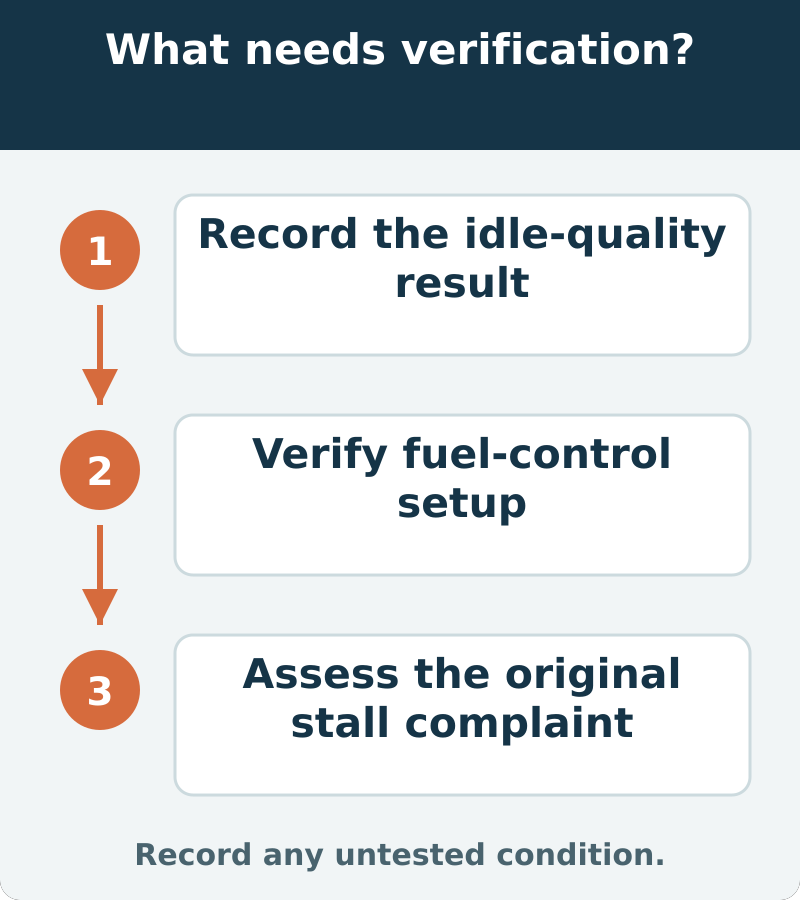
Fuel-system hardware and its required setup are separate completion requirements. Ask which adaptation or learning work applies to the confirmed repair and how completion is established. Repeatedly clearing learned information without a reason is not a substitute for following the correct procedure.
Common-rail service requires approved equipment, handling and safe pressure control. Do not open a line, improvise a leakage test or apply a universal injector-correction threshold from another engine. A correction value is information to interpret, not independent proof of a defective injector. The repairer’s scope should connect the mechanical findings, the supported parts work and the necessary configuration or learning steps.
Keep both symptoms in the final acceptance record
The final discussion should return to both job-card lines. Ask what established acceptable idle quality and how the intermittent cutting-out concern was assessed safely. If one remains unresolved, identify it explicitly rather than burying it beneath a general note that the vehicle drives better.
Keep the sequence of findings and improvements in the invoice history. That record is useful if another technician later needs to distinguish a recurring complaint from a new one. The practical lesson is fair to both owner and repairer: a partial success can be genuine, but it must be described as partial until the other original problem has received its own supported answer.









Comments 0
Questions, fixes, and real-world diagnostic notes from readers.
Be the first to share a diagnostic result or ask a follow-up question.