
2007 Chevy Aveo Overheats Around Town: A Turning Pump Shaft Did Not Mean Coolant Flow

Quick answer: Cooling depends on fluid circulation as well as fan operation. A drive turning the pump does not prove the impeller is transferring that motion to coolant.
A visible drive can be turning while the hidden part that does the useful work is not transmitting motion properly. That distinction matters in a cooling-system diagnosis. Before another radiator or thermostat is ordered, ask what has established coolant circulation, not only whether the fan and external drive can be seen moving.
In this guide
A town-only overheat still needs stopping
Short local journeys are not automatically gentle enough to make overheating harmless. If the temperature warning appears, stop safely and obtain advice about further operation. Do not use a faster road as a workaround because the display seemed better there on an earlier trip.
Tell the repairer where and when the concern occurred, along with the recent cooling work. Distinguish an observed gauge rise from steam, fluid loss or a warning message. These details help plan assessment without demanding another overheat. The fact that a complaint favors one use pattern is a diagnostic clue, not permission to continue using the car under that pattern.
What turning at the front of the engine does not prove
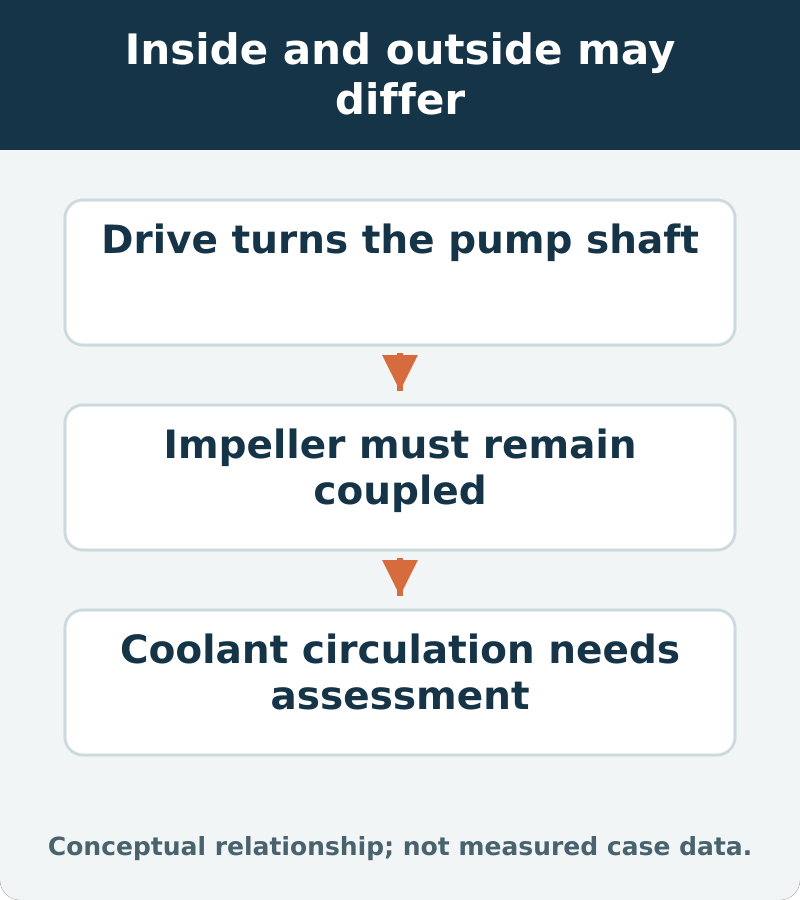
The drive supplies motion to a pump shaft, and the pumping element must use that motion to move coolant. If the connection between those parts is compromised, visible external movement may not establish the intended internal work.
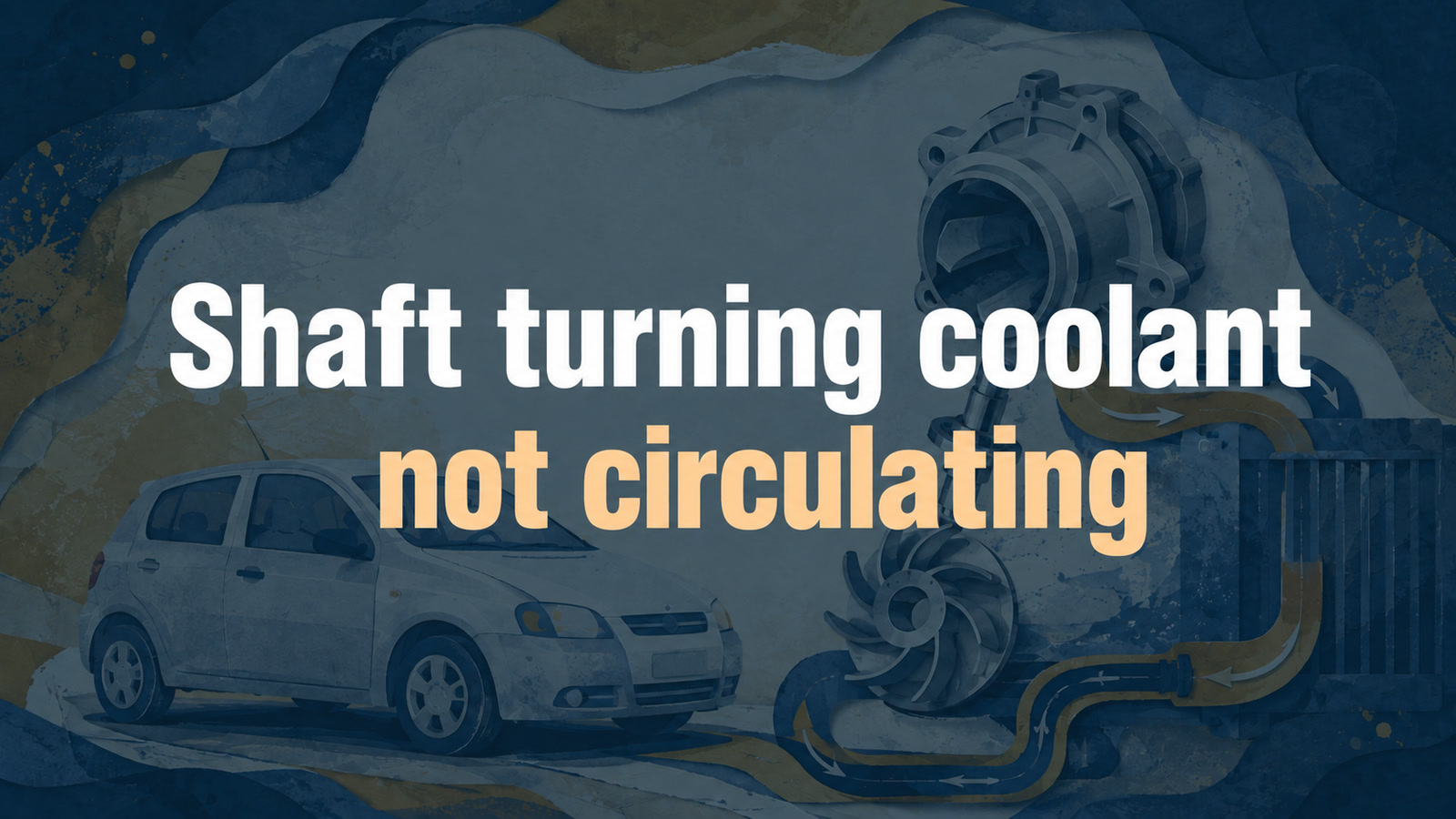
Think of a handle turning without securely driving what it is attached to. The analogy explains a coupling problem; it does not identify the condition of your pump remotely. The cutaway-style artwork is conceptual and contains no component dimensions or flow measurements. A workshop still needs the appropriate inspection and testing to decide whether this possibility applies to the actual Aveo.
Separate circulation from airflow
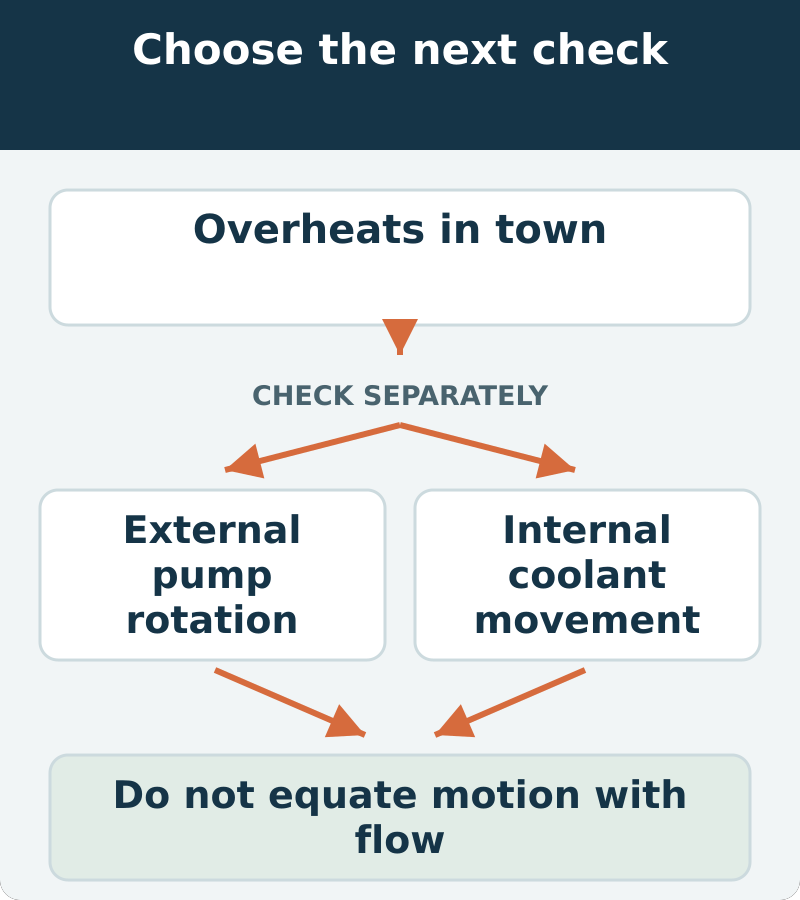
Cooling depends on several functions working together. Airflow across heat-exchange surfaces and coolant circulation through the intended route are distinct requirements. A satisfactory fan observation does not answer every circulation question, just as a new radiator does not prove every pump condition.
Ask the technician which requirement each completed check established. This helps make sense of a repair history containing several new parts without implying that all earlier work was unnecessary. The correct next step should address an unresolved requirement. It should not simply move to the next component on a familiar list because the previous replacement did not change the complaint.
In the published ALLDATA case, the Aveo continued overheating on short town trips after radiator, thermostat and coolant work. Fan operation had been checked. Pump inspection found an impeller slipping on its shaft. Water-pump replacement resolved the reported concern. The original diagnostic hose-opening shortcut is unsafe and is not adopted here.
Use a safe circulation assessment
Circulation assessment belongs in a controlled procedure suited to the engine and cooling system. Never remove a hose from a hot or running engine to look for flow. Hot pressurized coolant can cause serious injury, and an improvised demonstration is not needed to understand the diagnostic question.
Ask the workshop which safe method it will use and what finding would justify pump inspection. This article supplies no universal flow target or hand-temperature verdict. The original historical account contains a shortcut that is not adopted here. A useful explanation can preserve the mechanical lesson without copying an unsafe way of exposing it.
Why the surrounding drive deserves inspection
If pump work is supported, the estimate should identify the required installation, related drive assessment and correct cooling-system completion procedure. Ask what adjacent components need inspection because of access, wear or the confirmed damage. That is different from assuming they all require replacement.
The exact engine specification governs the work. Do not infer a belt arrangement, replacement interval or refill sequence from a generic diagram. A good estimate explains the necessary scope and separates any optional work. It should also state how the original overheating concern will be assessed after the pump and cooling system are correctly reassembled.
The finished repair must hold temperature and coolant
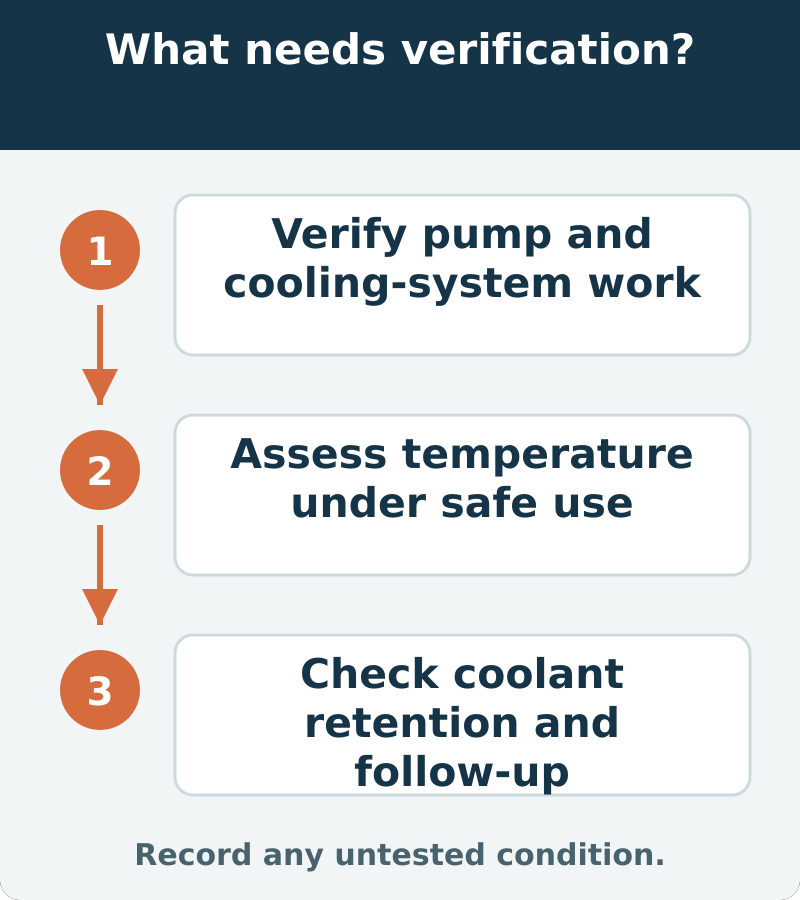
At collection, ask about coolant containment, the required refill checks and temperature behavior under the relevant safe assessment. A pump replaced on the invoice is not itself the complete outcome. The system must be ready to function as a whole.
Also ask whether the previous overheating requires further inspection or follow-up. Improved temperature control does not automatically establish that no earlier heat-related damage occurred. Keep the repair sequence and final findings in the vehicle history. The lesson is a useful distinction between motion and work: a turning drive can be real evidence while still leaving the hidden transfer of motion unproven.









Comments 0
Questions, fixes, and real-world diagnostic notes from readers.
Be the first to share a diagnostic result or ask a follow-up question.