
2014 Volvo S60 Parking Assist Has Many Codes: Do Not Order Eight Sensors Yet

Quick answer: When front and rear parking sensors all lose communication, investigate shared support and the controller before assuming that every sensor failed together.
Until the system is verified, park using direct observation and appropriate assistance. Do not use a person as a test obstacle or assume silence means the space behind the car is clear.
Shared electrical support needs testing against the correct diagram. A meter such as the AUTOOL DM301 can help with appropriate passive voltage checks; reading parking-assist faults and live states requires compatible vehicle diagnostics.
In this guide
Count the affected areas, not just the codes
A long fault list can make a repair sound expensive before diagnosis begins. First ask how those entries are distributed. Are they concentrated at one corner, grouped on one end of the vehicle, or spread across front and rear? That pattern can be more informative than the number of lines on the printout.
Keep the original scan and distinguish current from recorded faults where the system provides that information. Several entries may describe different consequences of one missing requirement. Conversely, a crowded list does not guarantee a single cause. Grouping is a way to choose the next check, not a mathematical rule that reduces every eight-code complaint to one replacement.
What shared support can explain
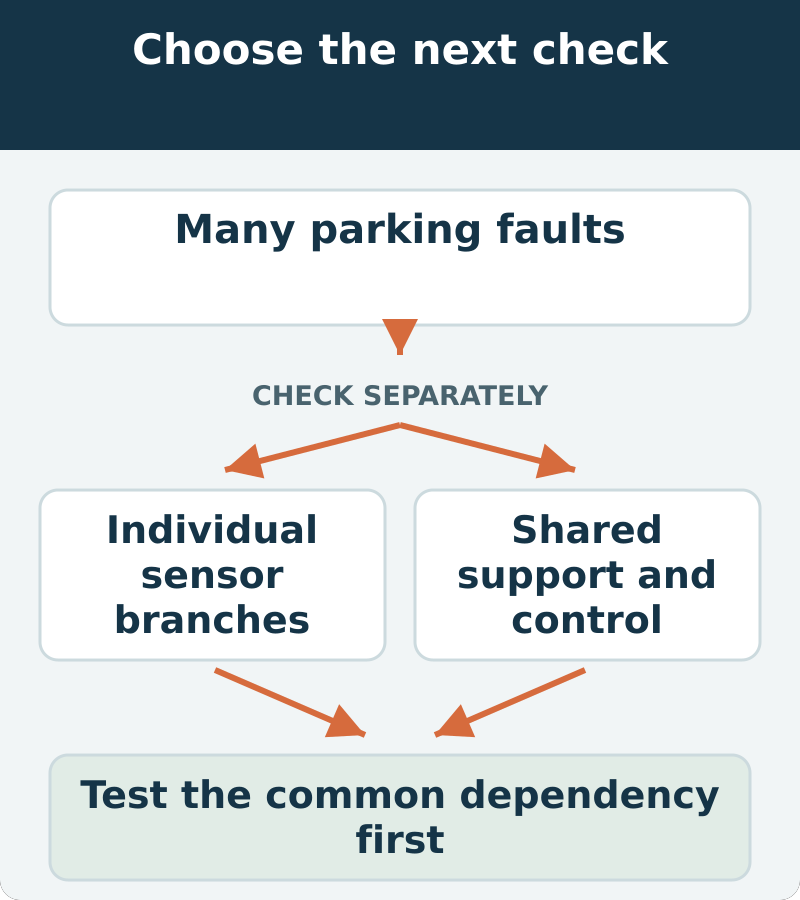
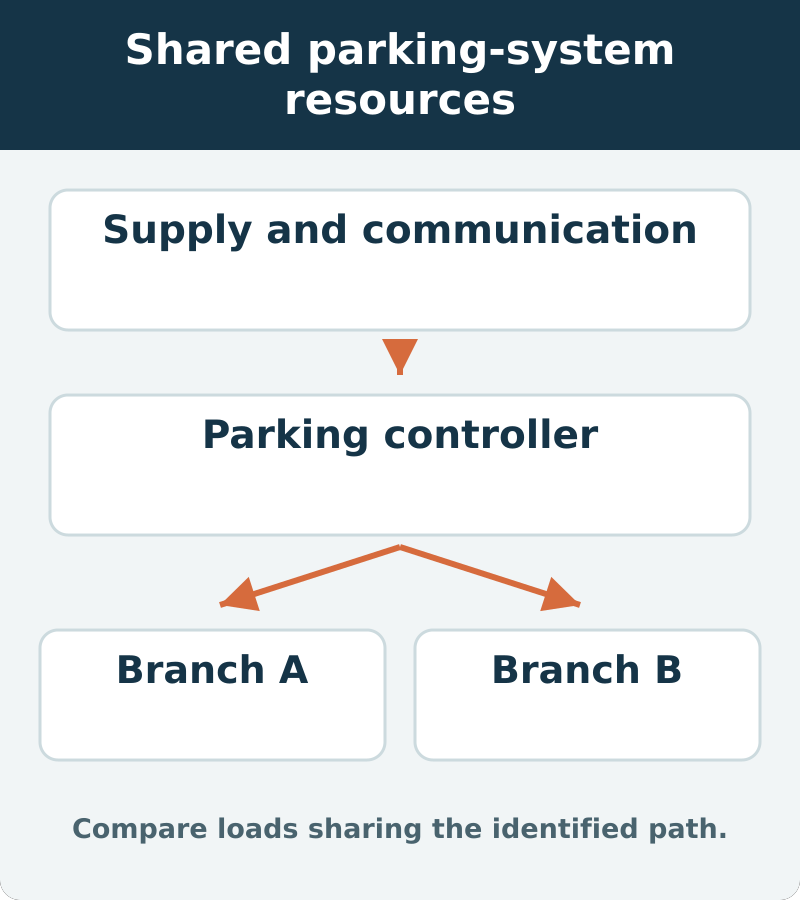
Multiple components can depend on a common supply, connection or controller. If a shared requirement is lost, several otherwise serviceable devices may become unavailable together. The actual wiring arrangement determines which relationship is relevant; it should not be guessed from the physical location of the sensors.
In ALLDATA’s S60 case, a 2014 T5 AWD had multiple front and rear sensor communication and supply faults. Initial sensor and connector inspection did not locate the cause. Burned components were found in the parking-assist module, whose replacement restored operation. Detailed supply measurements and the origin of the damage were not published.
One bad sensor is still a possibility
Looking for a shared explanation does not mean declaring every sensor healthy. Depending on the actual circuit design and failure, an individual branch may affect a wider part of the system. The technician needs the manufacturer’s diagnostic route to determine whether that possibility applies and how to separate it safely.
Ask what evidence would favor an individual branch over a shared supply or module. A useful answer explains the comparison to be made and the expected distinction. It does not require you to disconnect sensors at random. Casual unplugging can change the fault picture without producing an interpretable test, particularly when the original scan has not been saved.
Why a damaged controller needs context
Visible damage makes a component an important repair concern, but appearance alone does not explain how the damage occurred. The cause may require additional investigation, and the surrounding circuits may need checks before a replacement is exposed to the same operating environment. Do not assume a new module automatically removes every contributing condition.
This is a question for the workshop, not an invitation to open the controller yourself. Ask whether the observed damage was documented, whether relevant external support was verified and whether any cause of recurrence was identified. Where the cause remains unknown, that uncertainty should be stated plainly rather than filled with an unsupported water-ingress or voltage-surge story.
Questions before approving the module
The estimate should answer three practical questions. What findings support replacing this component? What part identification and configuration requirements apply? What checks will establish that the complete parking-assist function has returned? Those answers are more useful than a promise that a replacement will clear a screen full of codes.
Also separate necessary work from optional precautions. If the workshop proposes additional sensors or wiring repairs, each should have its own reason. A controller-centered diagnosis does not justify leaving documented connector damage untreated, but neither does it justify replacing every device named in the original list without evidence that it needs attention.
Test coverage around the whole car
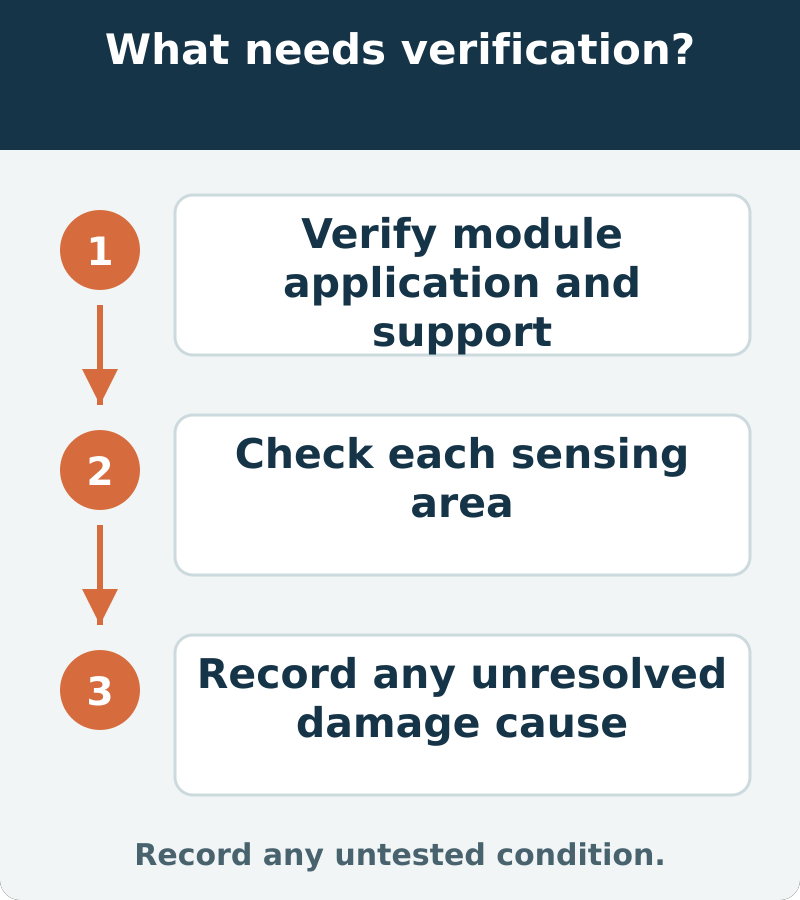
Verification should cover the affected areas, not just the first sensor that begins responding. Have the workshop use its specified safe test method to assess front and rear coverage, indications and fault status. The test environment and objects should be suitable for the system; no person should be placed in the vehicle’s path to prove detection.
At collection, understand what normal indications look and sound like and what to do if the warning returns. Parking assistance remains assistance, not permission to stop observing the surroundings. A good repair outcome restores the system and gives you a clear record of what was tested across the car, rather than merely reporting that the warning disappeared.









Comments 0
Questions, fixes, and real-world diagnostic notes from readers.
Be the first to share a diagnostic result or ask a follow-up question.