
2014 Kia Optima Window Runs Backwards After Repair: Check the Assembly Match

Quick answer: Reversed window travel immediately after a regulator job is a reason to review the installed assembly before blaming the switch.
Keep hands clear of the glass and stop operating it if travel is abnormal. Do not reverse wires or defeat anti-pinch protection to make the direction look right.
When the assembly identity is established, passive circuit measurements can help distinguish a command problem from a downstream mismatch. A MRCARTOOL B550 can assist those checks at permitted points; it cannot certify that a used motor, regulator and controller belong together.
In this guide
What stayed original and what changed?
Start with the parts invoice, not the next parts catalogue. Was the regulator mechanism replaced alone? Did the replacement arrive with a motor? Was a control module transferred from the original unit? “Complete assembly” can conceal several different combinations, and those combinations matter when the behavior changes immediately after installation.
A simple before-and-after list makes the conversation concrete. Include part identification where available and distinguish retained components from supplied ones. You are not trying to prove that used parts are a bad choice. You are checking whether the economical replacement preserved the combination the vehicle expects, rather than merely fitting inside the door.
| Part | Record to retain |
|---|---|
| Regulator | Application, side and supplied mechanism |
| Motor | Retained or supplied; confirmed identification |
| Controller | Retained or supplied; compatibility and setup requirements |
Three parts share one window movement
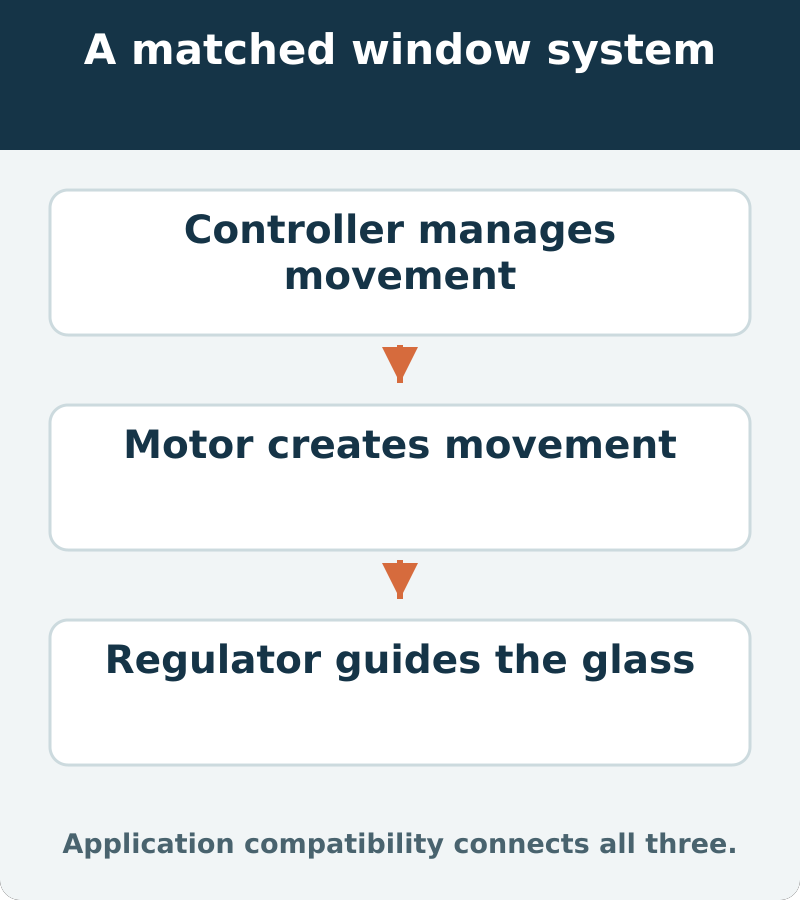
The regulator provides the mechanical movement, the motor supplies the drive and the control arrangement determines how that drive responds. Compatibility involves their interaction. A matching mounting pattern alone does not establish the correct control behavior, and a familiar electrical connector is not an interchange guarantee.
ALLDATA’s Optima report describes a 2014 2.4L car fitted with a used regulator and motor while retaining its original module. Travel became reversed and limited. Switch checks were normal. Installing the original motor and module together on the replacement regulator restored operation. The donor vehicle and an internal electrical cause were not identified.
Why the switch was not the next purchase
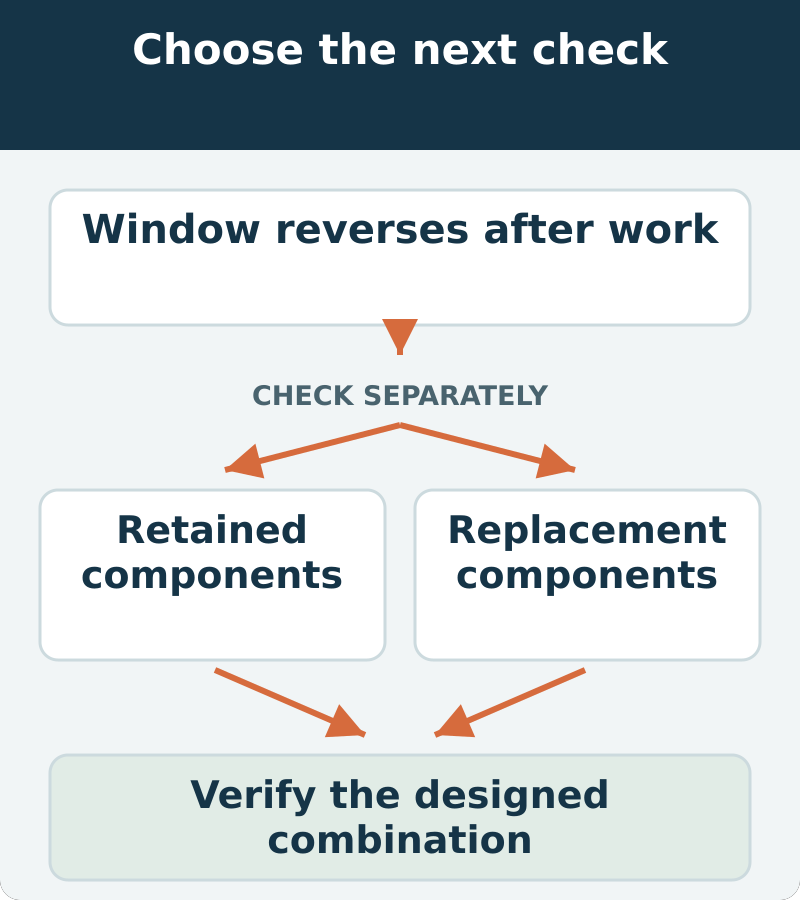
A switch complaint and an assembly complaint can produce similar experiences at the driver’s hand. The distinction lies in whether the requested action is being communicated correctly and what happens after that request. A normal command check shifts the question downstream; it does not make another switch a more promising guess.
Ask the workshop what established that the command matched the driver’s request. A clear explanation should identify the appropriate diagnostic observation, not merely say that the switch clicked or illuminated. At the same time, a correct command does not reveal every internal detail of the receiving assembly. It narrows the route; the parts match still needs verification.
What a used-part seller should confirm
Before another unit is ordered, have the seller and installer resolve the same short set of details:
- The recipient vehicle’s exact application and the side being repaired.
- The replacement’s identification and documented interchange suitability.
- Which motor and electronics are included, and which must be retained.
- Any application-specific setup required after installation.
Keep those answers with the invoice. A statement that a part came from “an Optima” is less useful than traceable identification for the particular assembly. If the supplier cannot establish compatibility, uncertainty belongs in the purchase decision before installation labor is repeated—not in a wiring workaround afterward.
Restore the designed combination
Changing connections until the glass moves the desired way can hide the actual mismatch while leaving other behavior wrong. Correct direction is only one requirement. Travel recognition, stopping behavior and any fitted automatic functions also need to work as intended. A convincing repair therefore restores a verified configuration instead of compensating for an unknown one.
The reported transfer of original components is evidence about that car, not a universal instruction to reuse every old motor. A damaged original part should not be retained simply to imitate a successful story. The installer must establish mechanical condition, correct application and the necessary setup for the parts actually being fitted.
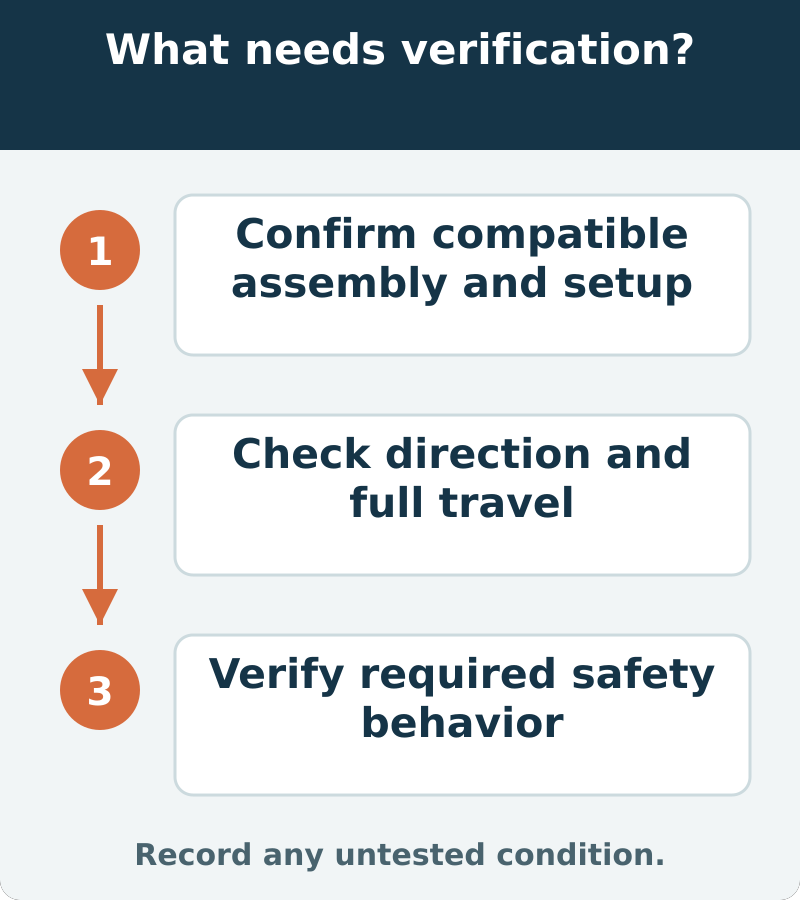
Test direction, travel and safety behavior
At handover, ask the workshop to confirm operation from the applicable controls, complete normal travel and the specified automatic or protection checks. Those checks must follow the exact service procedure. Do not use a hand, arm or household object as an improvised anti-pinch test.
Also confirm that the glass is supported and aligned correctly and that the door is reassembled without interfering with its movement. Keep the final component list: it is valuable if another repair is needed later. An economical used-part repair is a good result when it leaves a known, working combination—not merely a window that happens to move upward today.










Comments 0
Questions, fixes, and real-world diagnostic notes from readers.
Be the first to share a diagnostic result or ask a follow-up question.