
2007 Ford Escape Overheated Only Near 80 MPH: The Head Gasket Leaked Under Load

Overheats Only Fast? Test For Combustion Gas
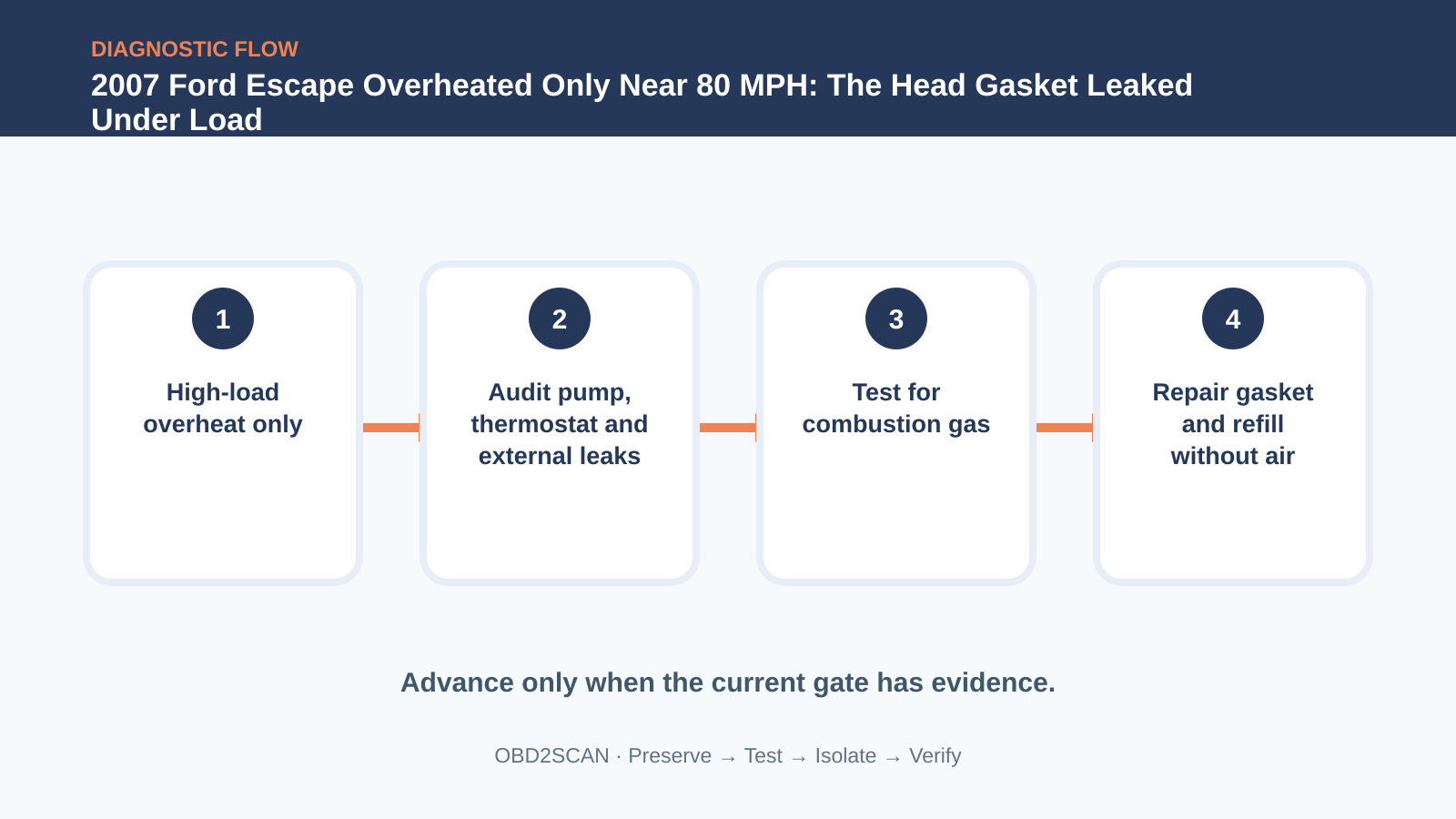
The Escape behaved normally around town and overheated only near 80 mph. A water pump and thermostat had already been installed. The useful translation was not “a speed problem,” but “a fault that appears when combustion load and heat rejection stay high long enough.”
A cold cooling system may need a controlled sealing check and an air-minimizing refill after repair. With the correct adapter, pressure and external air supply, the AUTOOL SC301 can support those two tasks. SC301 can help check cooling-system sealing and vacuum-fill a compatible system after it is cool and the correct adapter and pressure are confirmed. It cannot detect combustion gas, authorize opening a hot system or prove a head gasket from a short pressure hold.
External-system checks did not explain the narrow high-load overheat. A combustion-gas test at the cooling system was positive, supporting a head-gasket leak that appeared under load. After gasket repair and correct refill, the same operating condition no longer drove temperature upward.
Quick answer: A positive combustion-gas test explained the high-load overheat after pump and thermostat work; head-gasket repair passed the same highway condition.
In this guide
- Do not reproduce a high-speed overheat casually
- Translate 80 mph into engine load
- Audit the pump and thermostat history
- Pressure-test external sealing on a cold engine
- Use a combustion-gas test for the missing question
- Confirm the head-gasket repair scope
- Vacuum-fill and remove trapped air
- Repeat the original load while logging temperature
Do not reproduce a high-speed overheat casually
Do not reproduce an 80-mph overheat on a public road for diagnosis. A rising temperature can quickly damage the engine, release scalding coolant or strand the driver. Record the exact speed, grade, ambient temperature, load, A/C state and time until the gauge moved. If testing requires load, use a qualified technician, a controlled route or suitable dynamometer with a stop plan. Never remove a pressure cap hot. The original condition is valuable, but preserving the engine and people matters more than making the gauge move again.
Translate 80 mph into engine load
Vehicle speed is only the visible condition. At sustained high speed the engine makes more heat, cylinder pressure rises, airflow changes and the cooling system must transfer energy continuously. Separate road-speed effects from engine load by asking what happens on a steep grade at lower speed, with a trailer, or during a controlled stationary load where permitted. A collapsing hose, blocked radiator, airflow problem, lean combustion and combustion leakage can respond differently. The translation turns a vague customer threshold into testable physical demands.
Audit the pump and thermostat history
Review the pump and thermostat work rather than assuming new means good or bad. Confirm part specifications, belt routing, impeller direction, thermostat orientation and that no air pocket was introduced. Inspect radiator fins, cap sealing surfaces, hoses and fan operation. A previous repair can be unrelated, incomplete or a response to the same hidden cause. Replacing those parts again without new evidence would add heat cycles and cost. The mature case moved on because the common parts had not changed the high-load pattern.
Pressure-test external sealing on a cold engine
With the engine completely cold, check system sealing at the pressure and duration specified for the Escape. Look for hose, radiator, heater-core, pump and gasket leaks while protecting electrical components. A pressure or vacuum hold can reveal an external path and help assess whether the system will refill without drawing air. It cannot simulate peak cylinder pressure or identify exhaust gas entering coolant. A clean external test therefore answers one question: the system is not visibly losing pressure through the paths this setup can expose.
| Test or condition | What it can show | What it cannot prove |
|---|---|---|
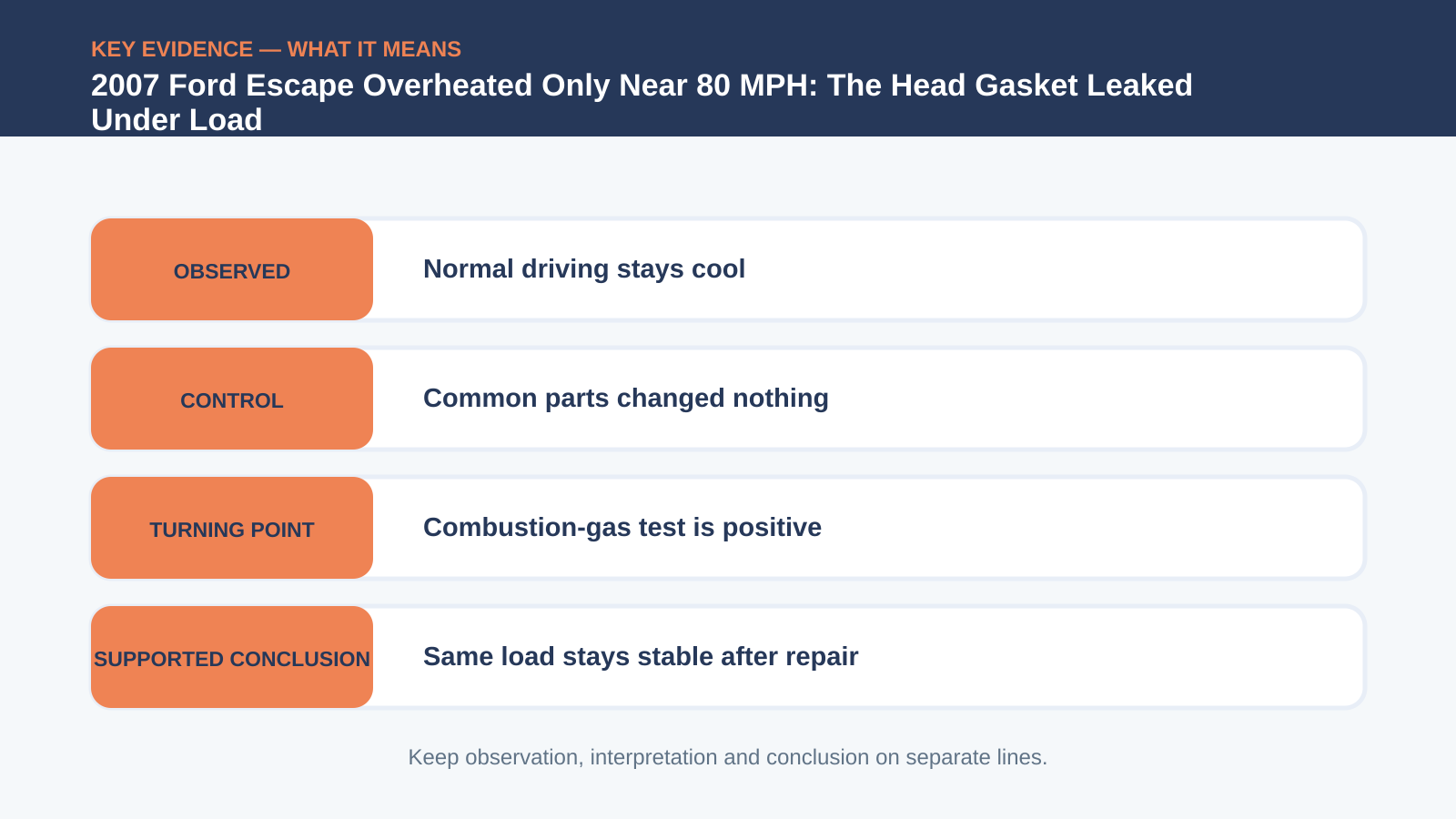
| Town driving stays normal | Fault needs a stronger trigger | Cooling system is healthy |
| Cold pressure test holds | No leak appears under that static condition | No combustion leak under load |
| Combustion-gas test is positive | Cylinder gas is entering the cooling system | Exact gasket location without further work |
| Same high-load route stays stable after repair | Original failure no longer reproduces | Future maintenance can be ignored |
Use a combustion-gas test for the missing question
A combustion-leak test asks the missing question by looking for exhaust gas above the coolant. Follow the kit instructions, keep liquid out of the tester and compare the result with a known baseline. Coolant contamination, test-fluid age and handling can affect interpretation, so repeat a marginal result and corroborate it with pressure behavior, misfire history, plug condition or cylinder testing. In this case the positive result fit the high-load complaint and the failed pump/thermostat attempts, supporting a head-gasket path rather than another external cooling part.
Confirm the head-gasket repair scope
Head-gasket service is not just installing a gasket. Inspect deck and head condition, check flatness and cracks to specification, identify the cylinder or path if possible, and address any cause of previous overheating. Use the required fasteners, torque sequence and surface preparation. Clean contaminated cooling and lubrication circuits as instructed. Because the engine may have been overheated repeatedly, document oil condition and compression before promising a narrow repair. The mature report states that gasket replacement corrected the condition; the shop still has to define the exact repair scope for the engine in front of it.
Vacuum-fill and remove trapped air
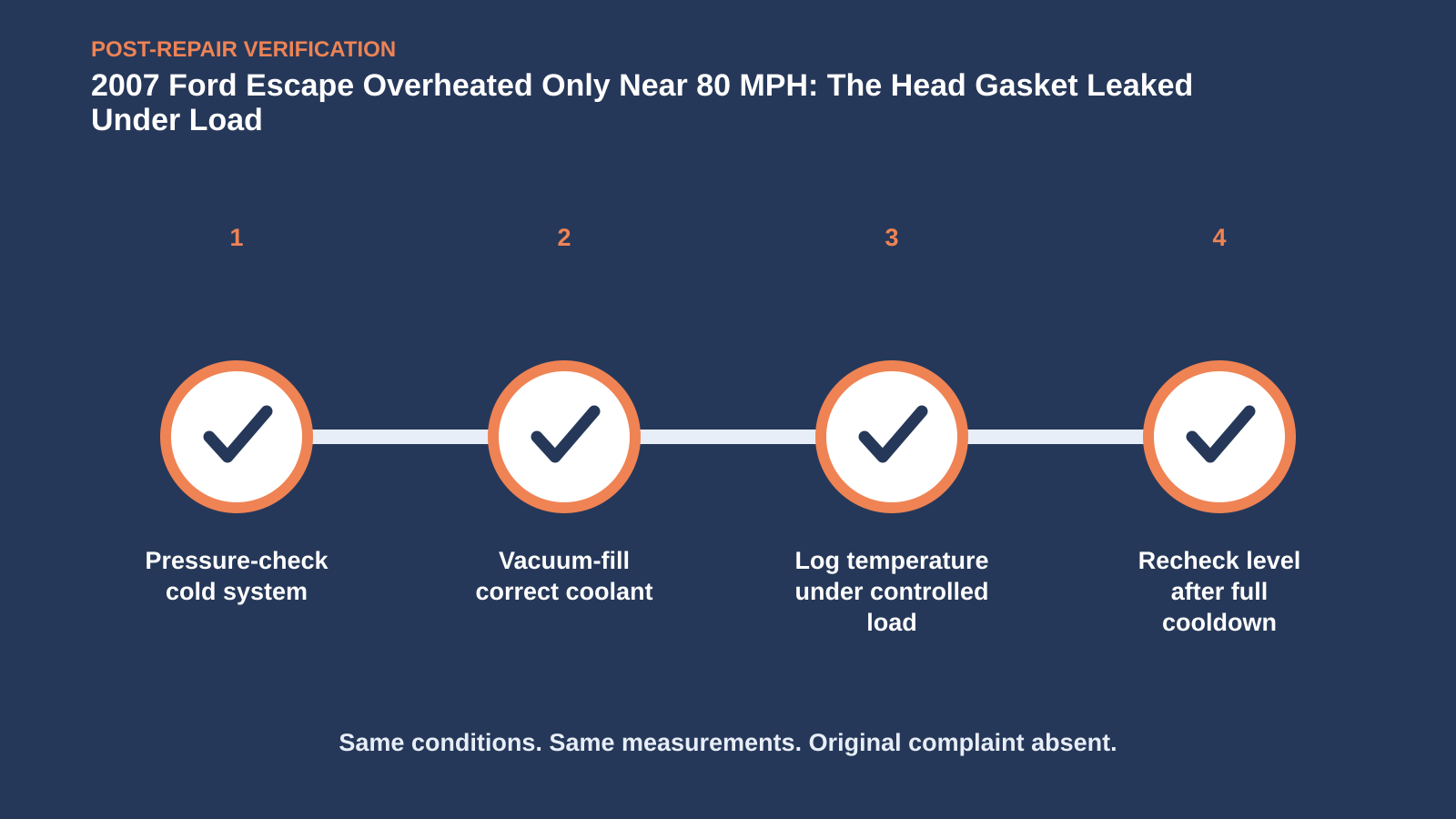
Refill with the specified coolant mixture after every opened connection is secure. A vacuum filler can reduce trapped air when compatible with the reservoir and procedure, but it is not a substitute for required bleed points or heater-valve steps. Use lower test settings on aged components as appropriate, confirm the cap and adapter seal, and collect displaced coolant. Warm the engine while watching actual temperature, cabin heat and hose behavior. Allow a full cooldown, then recheck level rather than opening the system under pressure.
Repeat the original load while logging temperature
Verification must challenge the old boundary without recreating unsafe conditions. Log coolant temperature under progressively increasing load, stop if it departs from normal and compare with the pre-repair timeline. Confirm fan command, stable cabin heat and no coolant expulsion. After the controlled high-load run, inspect for leaks, allow complete cooldown and verify level again. Repeating the same near-80-mph condition without overheating was the mature case’s functional close; the supporting pressure and gas evidence explain why that result is believable.
The number on the speedometer was only the trigger. Once it was translated into sustained combustion load, the head-gasket leak became a testable explanation rather than another cooling-system guess.





Comments 0
Questions, fixes, and real-world diagnostic notes from readers.
Be the first to share a diagnostic result or ask a follow-up question.