
2010 Ford F-150 A/C Stayed Hot: A Blower Circuit Code Blocked Compressor Command

A/C Hot, Compressor Command Off
The F-150 blew warm air, so low refrigerant was the obvious story. Static pressure was present, however, and scan data showed the more important fact: the compressor was not being requested at all. The HVAC controller was withholding permission because it saw a blower-control-circuit fault—even though the blower still moved air.
Once the circuit and safe test points are identified, a low-voltage circuit tester can help check polarity, continuity and supply on the blower-control path. The AUTOOL BT210 is one option for that limited role. BT210 can support polarity, continuity and voltage checks on an identified 9–30-volt blower-control circuit. Do not inject power into module outputs or signal wires; the tool cannot read HVAC codes, command the compressor or service refrigerant.
B10B9-14 identified an open or short concern in the blower-control circuit. Ford’s diagnostic order required other HVAC faults to be resolved before judging compressor performance, because the controller can use them as inhibit conditions. The mature case establishes why compressor command stayed off, but it does not document the exact wire, connector or controller repair—or a final vent-temperature test—so the result must remain open.
Quick answer: The F-150 had adequate static refrigerant pressure, but B10B9-14 blocked compressor command even though the blower still ran.

In this guide
- Hot air does not always mean low refrigerant
- Ask whether the compressor is being commanded
- Static pressure cleared only one enable condition
- B10B9-14 mattered even with a working blower
- Follow the blower control circuit as an interlock
- Repair evidence must come before refrigerant work
- The published case stops before the exact fix
- Define the cold-air verification still needed
Hot air does not always mean low refrigerant
Warm vent air can result from low charge, a compressor problem, a blend-door position, insufficient condenser airflow, sensor data or a controller deliberately withholding command. Begin with the customer’s conditions: ambient temperature, engine temperature, selected mode, blower setting and whether cooling ever returns. Inspect belt condition and obvious damage without placing hands near a running fan or pulley. Do not connect refrigerant equipment merely because the air is warm. First determine whether the system is trying to engage the compressor and what prerequisite it believes is missing.
Ask whether the compressor is being commanded
Use scan data capable of addressing the HVAC and powertrain modules. Compare A/C request from the control head, A/C permission or inhibit reason, compressor command, pressure-sensor data, evaporator temperature, ambient temperature and relevant blower information. In this case the command stayed at no. That distinguishes an uncommanded compressor from a clutch or variable-control device that receives a command but fails to respond. Follow model-specific architecture; some systems cycle a clutch while others modulate displacement, and neither should be force-powered as a shortcut.
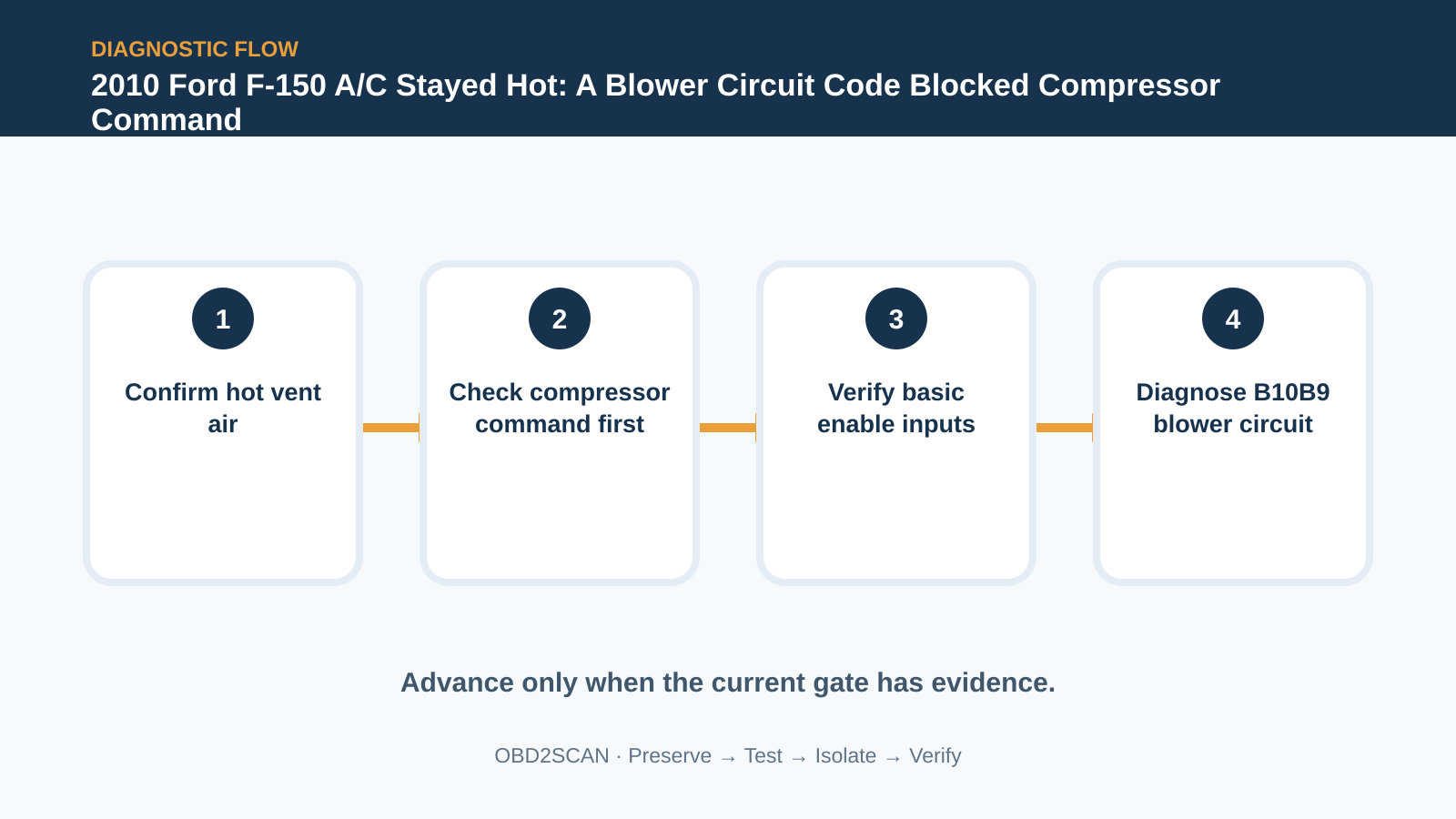
Static pressure cleared only one enable condition
Static refrigerant pressure was high enough to clear one basic low-pressure enable condition. It did not prove correct charge mass, remove air from the system, certify sensor accuracy or show operating high- and low-side behavior. Pressure depends strongly on temperature, and a system at rest tends toward equalization. Compare sensor data with a known pressure only under the approved procedure. If recovery becomes necessary later, use certified equipment and observe local refrigerant rules. Adding refrigerant before command logic is understood can overcharge a system that was never low.
B10B9-14 mattered even with a working blower
The HVAC module stored B10B9-14 for a blower-control circuit short or open. The blower happened to work, which made the code easy to dismiss. Yet a motor can run in a default or limited mode while its feedback, command or monitoring circuit remains implausible. Controllers often require confidence in airflow before allowing evaporator cooling, helping prevent icing or an unsafe operating state. Read the code’s exact Ford definition and status. A working output does not prove every feedback path that supervises it is healthy.
| Finding | What it clears | What remains |
|---|---|---|
| Cabin blower moves air | Motor has some operating path | Command/feedback circuit may still be faulty |
| Static pressure is sufficient | Obvious low-pressure lockout is less likely | Charge quantity and dynamic pressure remain unknown |
| Compressor command remains off | Clutch itself is not yet the first test | Identify the controller’s inhibit condition |
| B10B9-14 is present | Blower-control diagnosis has priority | Exact failed wire or component is not yet proven |
Follow the blower control circuit as an interlock
Use the wiring diagram to identify blower motor power, ground, controller or resistor connections, command line and any feedback path. Inspect connectors for heat distortion, terminal spread and water, then compare voltage and ground under load at relevant speed commands. Do not inject battery power into a control or feedback wire; a powered probe is safe only on a point the diagram and procedure identify as a load circuit. Wiggle tests should be observed in scan data and voltage, not used to manufacture a momentary change that nobody can explain.
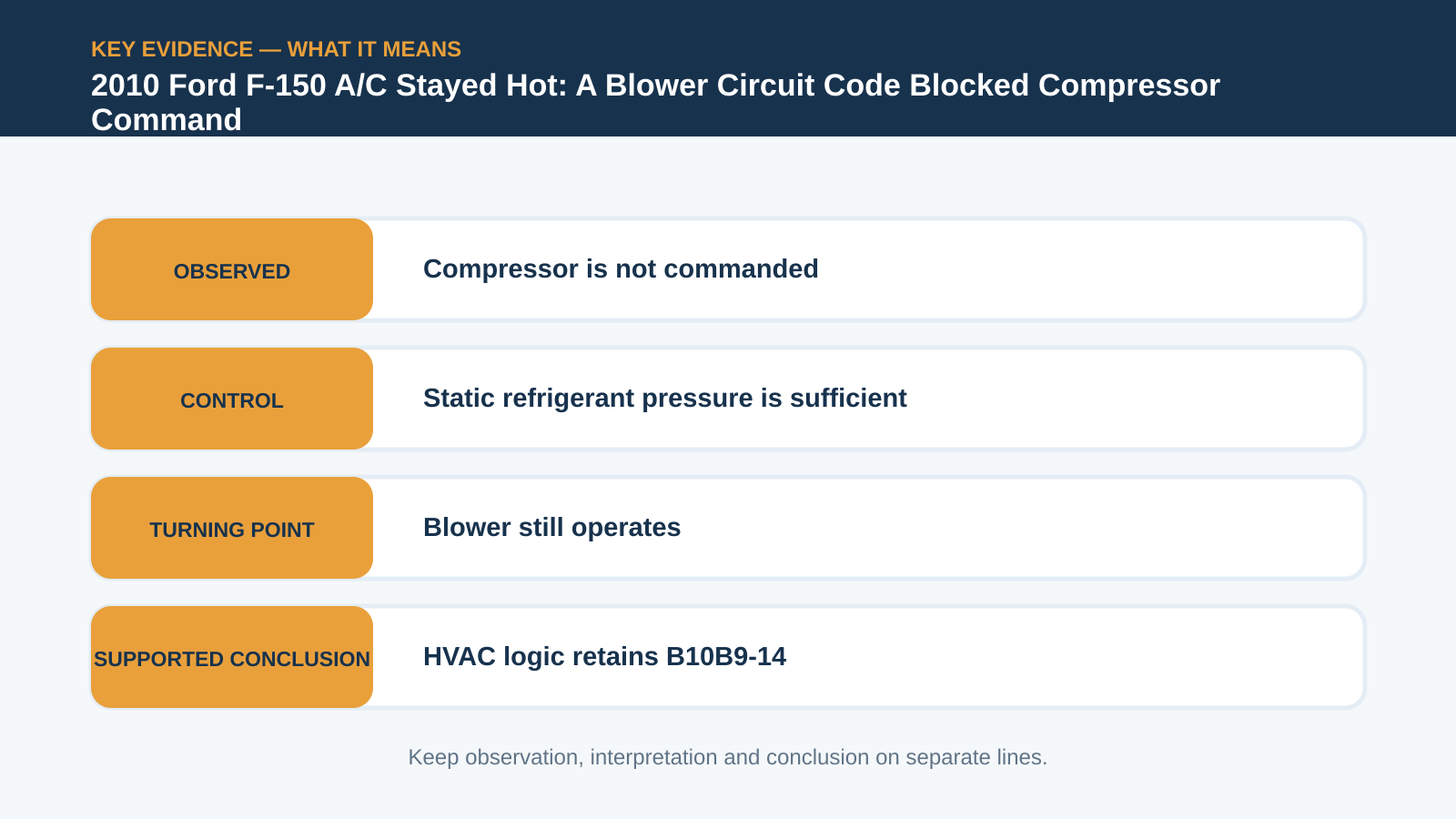
Repair evidence must come before refrigerant work
Ford service information directed the technician to diagnose other HVAC DTCs before continuing compressor tests. That order is part of the system design, not paperwork. Repair evidence should show the B10B9 condition changes when a specific circuit defect is corrected: for example, a restored loaded voltage, stable feedback signal or sound terminal repair. Clear the code only after saving the original state, then cycle every blower speed and confirm the code does not immediately return. Refrigerant work cannot fix a controller that still refuses to grant permission.
The published case stops before the exact fix
The mature article stops after identifying the blower-control fault as the compressor inhibitor. It does not say whether the final defect was a wire, terminal, blower controller, motor or HVAC module, and it does not publish a post-repair vent temperature. Those missing details matter. They prevent a reader from copying an unverified part choice and prevent this article from presenting a diagnostic direction as a completed repair. The safe next step is circuit testing against Ford specifications, followed by a fresh permission check after the proven fault is corrected.
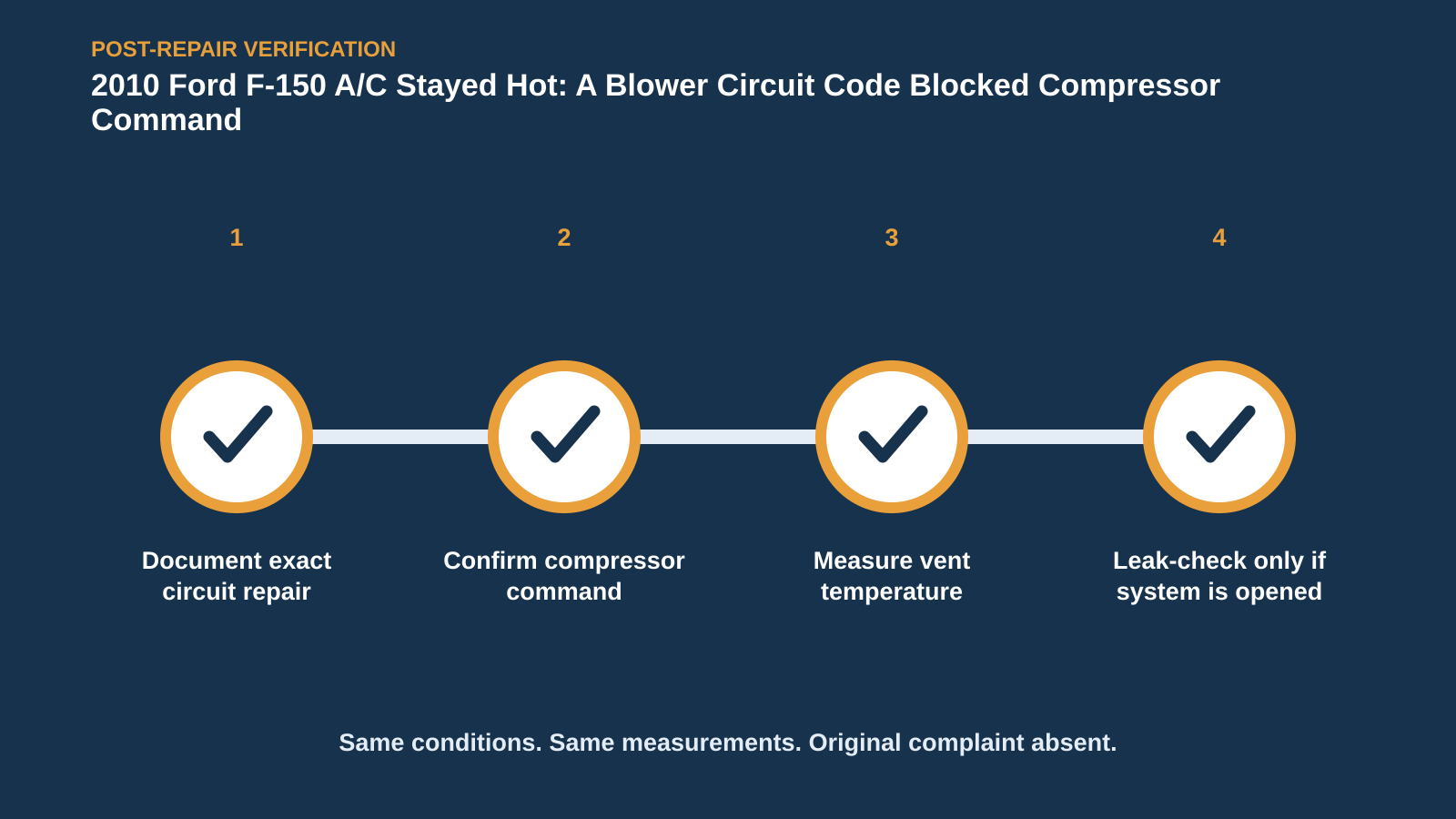
Define the cold-air verification still needed
Closure requires more than a cold-feeling vent. Confirm B10B9-14 remains absent as current and pending, all blower speeds follow command, the A/C request reaches the relevant module and compressor command changes to yes when enable conditions are met. Then measure center-vent temperature and operating pressures at a recorded ambient temperature, inspect condenser airflow and verify evaporator control without icing. Check for leaks only if pressure or recovered mass justifies it. Until those results exist, this is an explained inhibit with a concrete verification plan—not a documented finished repair.
The useful question was not “why won’t the compressor run?” but “why isn’t the controller asking it to run?” That shift protected the refrigerant circuit from unnecessary service and exposed the blower fault as a permission problem still awaiting a measured repair.










Comments 0
Questions, fixes, and real-world diagnostic notes from readers.
Be the first to share a diagnostic result or ask a follow-up question.